Guide
Customer Journey Map: Free Template and Worked Example
Use this customer journey map template to understand one customer experience, separate evidence from assumptions, and choose an improvement your team can test.
By the Space Office team · Published · Updated · 17 min read
A customer journey map shows how a particular customer moves toward a goal, including their actions, questions, touchpoints, and difficulties. Build one by choosing a single scenario, collecting customer evidence, arranging the experience into stages, and assigning an owner to the most useful next improvement. Download the free worksheet below and follow the renewal example. In Space Office, Sodium can organize approved customer research and Gold can examine the customer-success handoffs. Hydrogen coordinates and reviews the packet; a human verifies the evidence and decides what to change. A map supports a decision, but it cannot establish what customers think without research.

Key takeaways
- Choose one customer perspective and a clear beginning and end before drawing the map.
- Record customer actions and questions alongside touchpoints, evidence references, and gaps.
- Keep observed facts, customer reports, and team hypotheses visibly separate.
- Use a current-state map to understand today; label proposed future experiences as proposals.
- Finish with one owner, one next check, and an outcome you can measure without inventing a result.
The customer relationship management guide explains how to preserve the customer context in linked records, assign an owner, and test the handoff between sales and delivery.
Download the free customer journey map worksheet. Copy the plain-text template into a document, spreadsheet, or whiteboard, then use the worked renewal example below to fill it with your own evidence.
What belongs in a customer journey map?
Start with the person and the goal. A small-business owner deciding whether to renew a scheduling subscription has a different experience from an employee booking a room. Combining both perspectives can hide a problem: the employee may complete bookings easily while the owner cannot establish whether the subscription is worth keeping. Make two maps when the decisions, evidence, and needs are substantially different.
Nielsen Norman Group's introduction to journey mapping identifies an actor, a scenario, phases, customer actions and mindsets, and opportunities as core elements. Use those elements to organize understanding. The map's value comes from explaining a particular experience clearly enough to investigate it, rather than filling every available box with an attractive story.
Scroll horizontally to view all columns.
| View | Question it helps answer | What to keep in view |
|---|---|---|
| Customer journey map | What happens as this customer tries to achieve this goal? | The customer's actions, information needs, experience, and supporting evidence. |
| Conversion funnel | How many eligible people reach each defined conversion step? | Event definitions and counts; a drop between steps does not explain someone's reason. |
| Service blueprint | How does the organization produce and support that experience? | Customer-facing work, backstage operations, and dependencies between teams. |
The distinction between a journey map and a service blueprint is especially useful. Nielsen Norman Group's blueprinting guidance describes the former through the customer's perspective and the latter through the organization's delivery processes. If your draft contains mostly internal queue names and departmental tasks, keep that operational detail separately and restore the customer's goal to the main map.
Write a scope sentence before choosing software: this map follows an existing account owner from receiving a renewal reminder to deciding whether to continue. That sentence excludes acquisition campaigns and first-time setup. It also makes missing evidence easier to spot. If all your notes describe signup, you do not yet have the research needed for the renewal question.
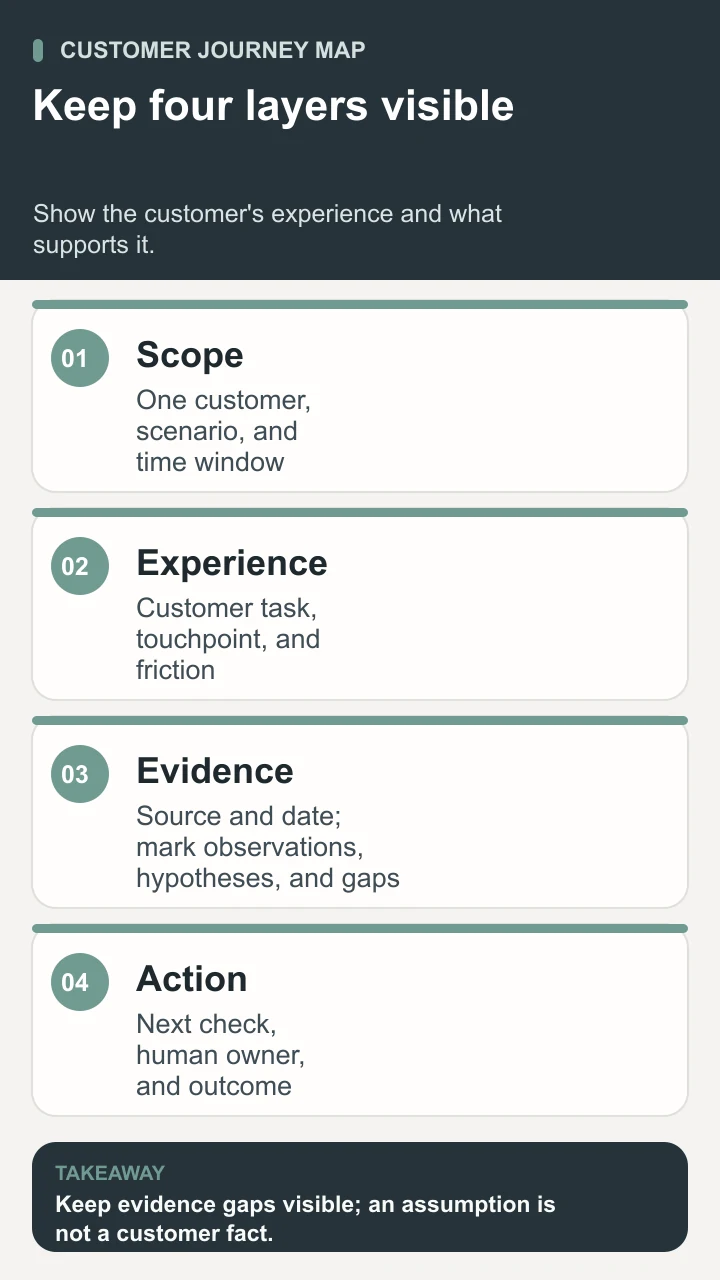
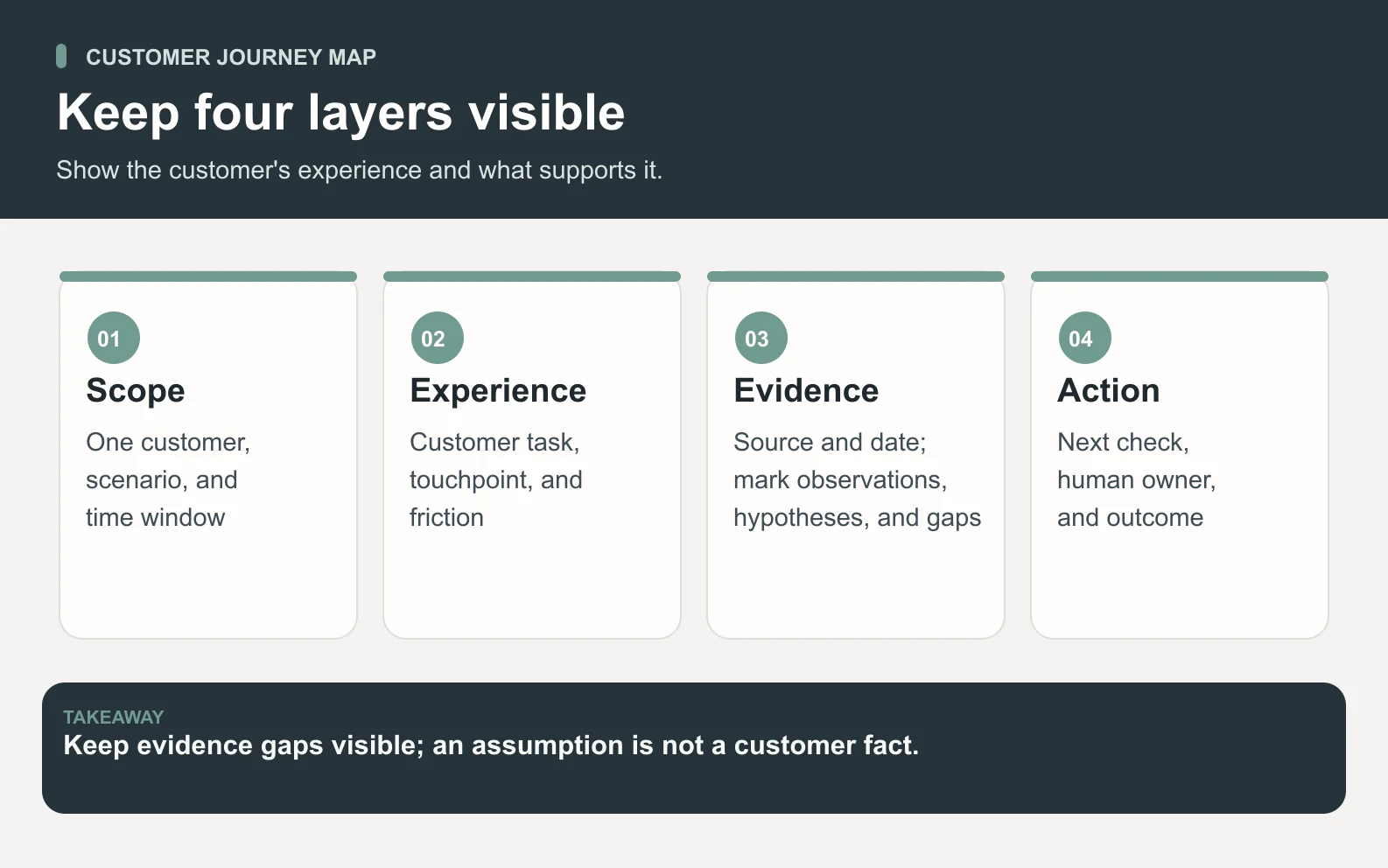
Copy the free customer journey map template
The downloadable worksheet opens without an account and includes a blank map, an evidence register, and an action record. Use the visible template below if you prefer to build your own layout. Space Office designed these working fields to keep each stage connected to its supporting evidence and a useful next decision.
Above the stage columns, record the customer group, goal, start and end events, product or service, map owner, research period, and last review date. Mark the version as current state or proposed future state. A customer group should describe the relevant situation, such as account owners approaching their first renewal, rather than an invented personality biography. Only include characteristics that change the experience you are investigating.
Scroll horizontally to view all columns.
| Field to repeat for each stage | What to enter |
|---|---|
| Stage and customer goal | Give the stage a short action-oriented name and describe what the customer is trying to accomplish there. |
| Action and touchpoint | Record the step taken and the place it happens, including conversations or offline work when relevant. |
| Question or expressed feeling | Use an attributed research reference; label your interpretation and leave the field unknown when needed. |
| Evidence reference | Link a note, event definition, support record, or observation, with its date and relevant customer context. |
| Evidence status and limits | Mark observed, customer-reported, or hypothesis. Explain missing coverage or a conflicting observation. |
| Friction or useful moment | Describe the specific difficulty or helpful interaction and what it prevents or enables. |
| Next check and owner | Name the question to investigate, the person responsible, and the evidence required before a change. |
| Outcome and review date | Define the customer outcome, how it will be checked, and when someone will review the finding. |
You can use stages as columns and fields as rows, or keep one record per stage in a spreadsheet. The underlying information is the same. Choose the arrangement your team can update. Avoid shrinking a large board into an unreadable screenshot for a meeting; share the evidence register and action record alongside the overview so people can inspect the reasoning.
An evidence reference can be as simple as E01, linked to an approved interview note. Keep personal details in the appropriate source system rather than copying every transcript into the map. The shared board usually needs the finding, its scope, and a way for an authorized reviewer to check it. A clean reference is more useful than a long quote whose origin nobody can recover.
Build the map from customer evidence
Collect what you already know, then investigate the gaps that affect the decision. Nielsen Norman Group's research guide recommends looking for existing evidence and using methods such as interviews, observation, and diary studies to understand the experience. Quantitative data can add context, but it cannot by itself explain a person's feelings or motivations. A page visit and a frustrated customer comment are different kinds of evidence.
- 1Define the decision. Write who will use the map and what they need to decide. For a renewal investigation, that might be whether an unresolved workflow problem deserves a product fix, clearer guidance, or another customer conversation.
- 2Create an evidence register. Give each approved source an ID, date, customer context, and limitation. Separate the source from your interpretation so a reviewer can disagree with the interpretation without losing the underlying observation.
- 3Reconstruct specific experiences. Ask a participant to describe a recent attempt: what started it, what they did next, what they needed, and where they stopped. Ask follow-up questions instead of supplying the reason you expect to hear.
- 4Group steps into meaningful stages. Use changes in the customer's task or question to organize the map. A return to an earlier step belongs in the record even when it makes the diagram less tidy.
- 5Review contradictions. If an interview describes a successful action while event data appears to show failure, check identities, dates, event definitions, and context. Record an unresolved discrepancy instead of selecting the more convenient story.
Salesforce's journey-mapping lesson includes touchpoints and context as explicit layers and suggests grouping activities as the customer's mindset or context changes. That helps explain why universal stage labels are only a starting point. Your renewal map may need a budget-approval stage because the customer must speak to a business partner, even though that conversation never appears in your website analytics.

Avoid a universal rule for how many interviews make a map valid. Coverage depends on the scenario and the variation within it. Record who you heard from and who is missing. If all participants renewed, your findings cannot explain why other accounts left. If all evidence concerns desktop use, leave the phone experience unverified. A small, clearly bounded map is easier to improve than an apparently comprehensive one built from guesses.
Worked example: a customer deciding whether to renew
Consider an imaginary workshop scheduling product. The actor is the owner of a small training business, and the scenario runs from a renewal reminder to a renewal decision. The following evidence IDs, events, and customer statements are invented solely to demonstrate the worksheet. They are not Space Office customer research or measured product results. In a real map, every ID would lead to an approved source collected for the stated period.
Scroll horizontally to view all columns.
| Stage | Illustrative evidence | Hypothesis to keep separate | Next check |
|---|---|---|---|
| Review recent use | E01: a fictional interview note says the owner checks completed workshops before deciding whether to continue. | A usage summary might help the owner assess value; the note does not prove which summary they need. | Ask the owner to show how they currently evaluate the subscription and what information is missing. |
| Check next-term needs | E02: an invented planning note records a need for two instructors to manage sessions together. | The current plan may seem unsuitable; neither actual feature availability nor the owner's understanding is established. | Verify the plan and inspect the real shared-management task before drafting a recommendation. |
| Resolve a booking problem | E03: a fictional support record describes uncertainty about rescheduling an existing class. | This difficulty might affect renewal, but the record does not establish that it causes cancellation. | Observe a permitted rescheduling task and ask how this issue affects the owner's decision. |
| Decide on renewal | E04: an invented account record shows a renewal decision is due; no outcome has been recorded. | A reminder alone might be insufficient. The account could also be waiting for budget approval. | Check the decision process and record the eventual outcome separately from the proposed explanation. |
One completed stage record: the fictional E03 support request
- Stage and goal: resolve a booking problem so the owner can move an existing class to a new time.
- Action and touchpoint: the owner asks how to reschedule through a support request.
- Question and feeling: how can I change this class? The customer's feeling is unknown; the example contains no emotional testimony.
- Evidence and status: fictional support note E03; customer-reported difficulty, with no direct task observation yet.
- Friction and limit: the rescheduling step is unclear to this owner; its effect on renewal remains a hypothesis.
- Next check and owner: the human customer-success owner arranges a permitted observation and asks how the difficulty affects the renewal decision.
- Outcome and review: check whether the user can reschedule and confirm the change without unintended effects. Set the review date when the observation is scheduled; no result is available yet.
The useful finding is a question: can this customer complete the work they need for the next term? The map does not justify a discount campaign or an automated renewal message. The apparent issue could be a missing feature, an existing feature that is difficult to find, an account-permission problem, or a misunderstanding. Each explanation implies different work, so verify it before assigning a solution.
Notice the restrained treatment of emotion. The example does not draw a red frustration curve merely because a support ticket exists. A support request can be routine, urgent, or reassuring depending on the circumstances. If the customer describes anxiety about an upcoming class, record the statement with context. If no one has asked, leave the feeling unknown and investigate it only if it matters to the decision.
A proposed future map might include an easier rescheduling path and a useful account review. Keep that proposal in a separate version. Qualtrics distinguishes understanding the current journey from designing an improved future experience. Moving a proposed step into the current map before it exists makes the document unsuitable for diagnosing today's problem.
Turn one friction point into an owned experiment
End the mapping session with a decision record. Nielsen Norman Group's practitioner research highlights the importance of including opportunities, ownership, and metrics. For the fictional scheduling example, write the next action narrowly: the customer-success owner will arrange a permitted observation of the rescheduling task, and the product owner will review the finding. Do not call the problem solved because the board has an assigned card.
If observation supports a specific problem, describe the proposed change and its acceptance check. For example, suppose the difficulty is finding an existing rescheduling control. A candidate improvement is clearer navigation, with a check that the intended user can move a class to a new time and confirm the change. This remains a hypothesis about a possible improvement, not a result from a test that has already happened.
- Define the customer outcome: successful completion of the relevant task, with the required confirmation and no unintended change to another class.
- Define the observation method: which user situation, account permissions, device, and task will be used, and what counts as completion or failure.
- Record the starting evidence: the current flow and its known problem, without inventing a baseline rate when no suitable measurement exists.
- Name the owner and review date: someone must inspect the result, decide whether more evidence is needed, and update the map.
- Check wider effects: a clearer control should not accidentally enable an unauthorized edit or make another routine task harder.
Keep business outcomes separate from task evidence. An observed improvement in rescheduling does not prove that renewal will increase. Renewal depends on other considerations, including budget and ongoing need. If you later compare renewal outcomes, preserve the cohort definition, time window, and other changes made during that period. Describe an association as an association unless your study supports a stronger conclusion.
If the map includes recommendation-survey feedback, use the net promoter score guide to preserve the question, response groups, denominator, and limits before connecting the comments to a journey problem.
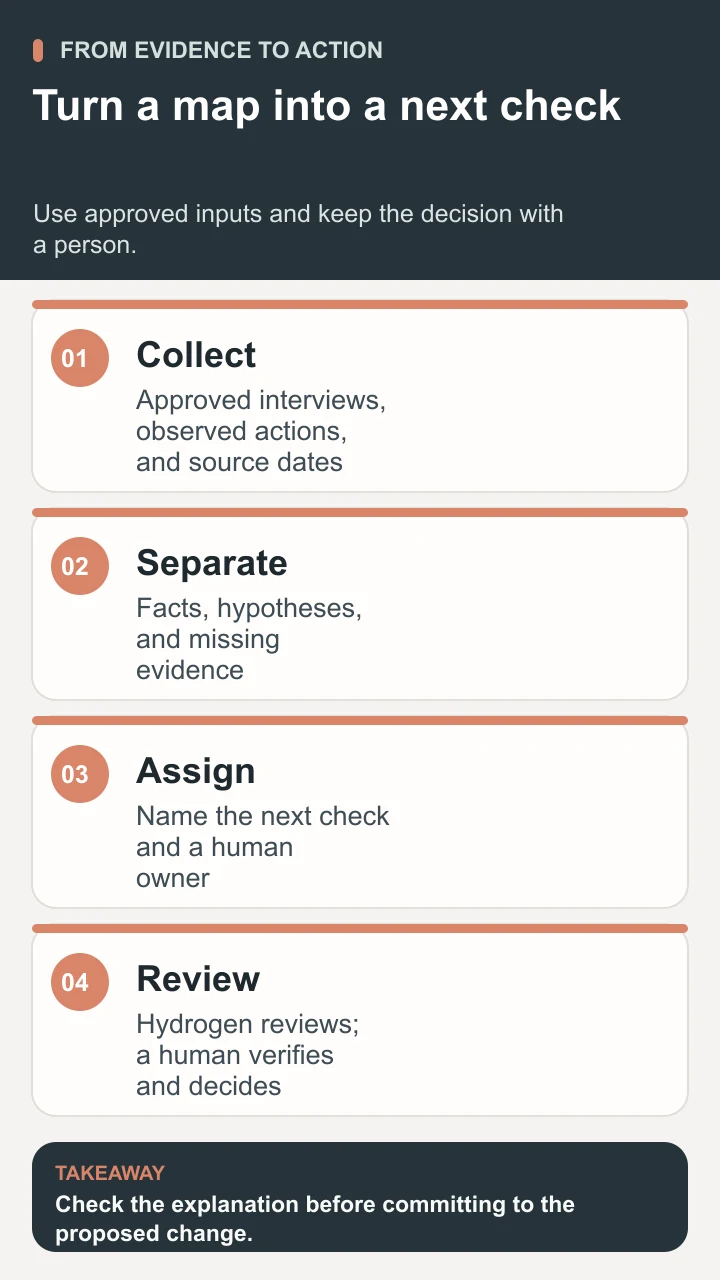
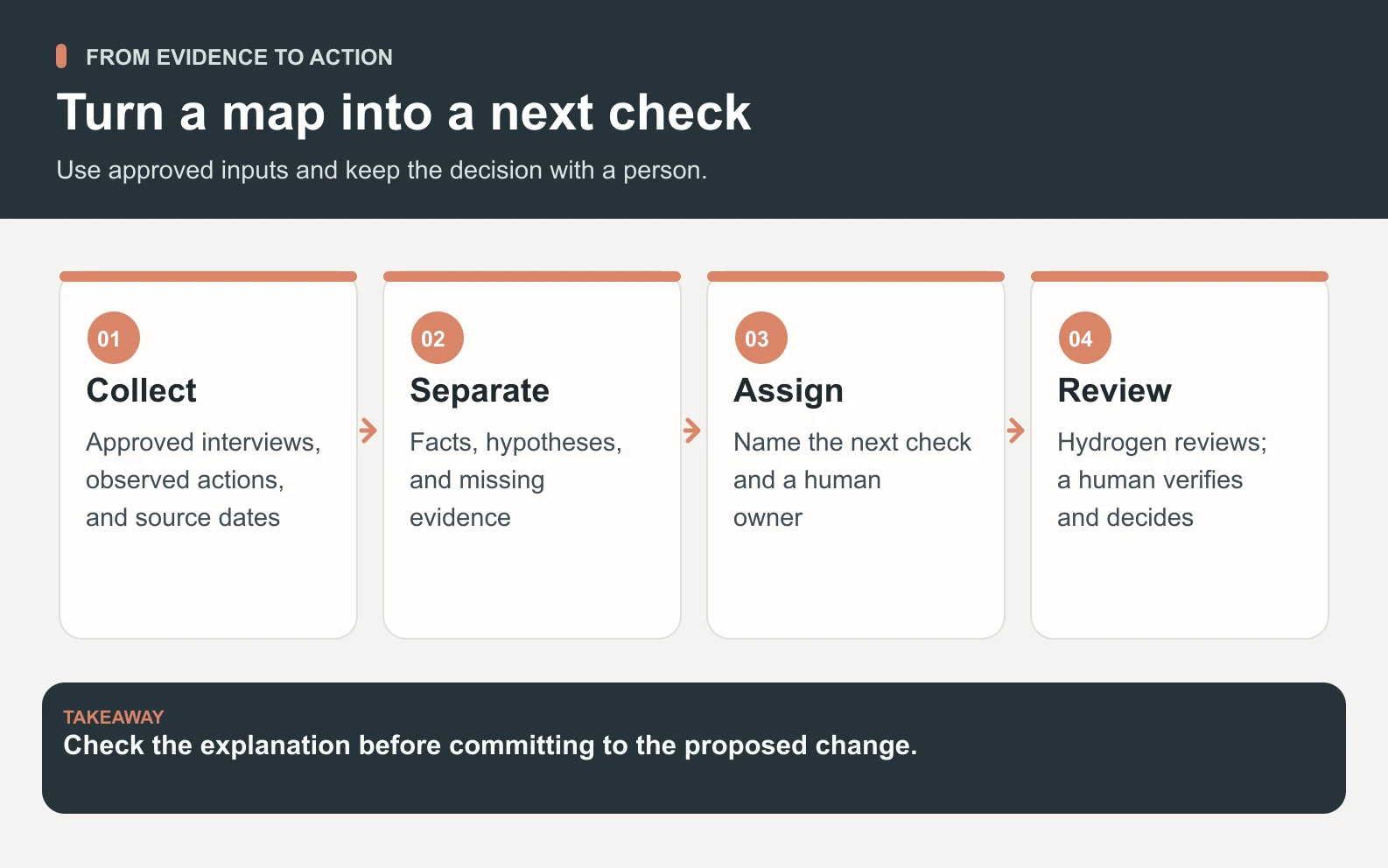
Use Sodium and Gold to prepare a reviewed map
The Space Office specialist roster provides a practical division of work. Sodium, the Market Research & Intelligence Specialist, can organize approved customer research and identify unanswered questions. Gold, the Customer Success & Retention Specialist, can examine the onboarding, ongoing-use, or renewal handoffs relevant to the scenario. Hydrogen coordinates the assignment and reviews the combined output. The customer-experience owner checks the evidence and decides whether to commission further research or make a change.
For the renewal example, provide the scenario, approved interview notes, relevant support excerpts, product facts, metric definitions, and the human owner. Specify what each source can be used for and what access is available. A file supplied for analysis does not authorize contacting the customer or editing their account. If an important source is unavailable, the packet should name the gap and its effect on the recommendation.
- 1Sodium prepares an evidence register, groups observations by journey stage, and flags interpretations that need a customer conversation or further observation.
- 2Gold checks the customer-success context, including the relevant account stage, unresolved handoff, and who can answer the next operational question.
- 3Hydrogen reviews whether each recommendation follows from the supplied evidence, resolves inconsistent terminology, and returns remaining questions with the draft map.
- 4The human owner inspects the sources, approves the final interpretation, and authorizes any research, account action, or customer-facing change separately.

A useful handoff contains the map, evidence register, unresolved questions, and one action record. It does not need a long presentation. Use the briefing guide to specify acceptance criteria, and the AI work review checklist to examine unsupported statements. For an actual new-client kickoff process, the separate client onboarding workflow covers intake and delivery handoffs in more detail.
Avoid the mistakes that make journey maps misleading
The first mistake is blending different customers into an average person. A buyer, administrator, and daily user may interact with the same product while trying to achieve different goals. Separate their perspectives when the distinction changes a decision. You can connect the maps at a shared handoff later, such as the administrator requesting purchasing approval. Preserve who is acting at each point.
The second mistake is treating the cleanest path as the whole experience. Record delays, alternative routes, return visits, and abandoned attempts when your evidence contains them. A customer who pauses to ask a colleague has not necessarily failed. Conversely, a successful payment does not establish that the customer can use the product. Choose success criteria that fit the stated goal instead of whichever event is easiest to count.
The third mistake is turning speculation into customer language. AI can suggest questions, group notes, and draft a summary; it cannot supply missing interviews. Do not label generated sentences as customer quotes or assign emotional scores to people you have not studied. If a suggested explanation is worth investigating, add it to the hypothesis field and name the evidence that could support or contradict it.
The fourth mistake is keeping a polished map after the underlying experience changes. Revisit affected stages when you change pricing, permissions, a product workflow, or a customer handoff. Keep the old version for context and record what changed in the new one. A review date means someone examined the evidence; simply changing the date on an untouched document does not make the map current.
Make your customer journey map useful this week
Choose one customer journey map that can answer a real question for your team. Download the worksheet, define the customer and scenario, and add only the evidence you can verify. Leave unknowns visible. Then select one next check with an owner and a review date. A map is ready to use when another person can follow its sources, understand its limits, and see what decision comes next.
If organizing that evidence is the bottleneck, see how Space Office coordinates reviewed work or describe the task for assisted setup. Sodium and Gold can help prepare the packet from approved inputs. Your team supplies the customer context and makes the final decision. Start by understanding one experience well enough to improve it, then expand the map when another question requires it.
Sources and review notes
Reviewed against the linked primary sources on the checked dates. Search features and citations are selected by their respective platforms; no placement is guaranteed.
- Nielsen Norman Group: Journey Mapping 101 — checked
- Nielsen Norman Group: How to Conduct Research for Customer Journey Mapping — checked
- Salesforce Trailhead: Start Your Journey Map — checked
- Qualtrics: Customer Journey Mapping for Better Experiences — checked
- Nielsen Norman Group: Journey Mapping in Real Life — checked
- Nielsen Norman Group: Service Blueprinting FAQ — checked
Frequently asked questions
What is a customer journey map?
Customer journey map is the term for a structured view of one customer's experience as they work toward a goal. It connects stages, actions, questions, touchpoints, and difficulties to supporting evidence and opportunities for improvement. A useful map identifies whose experience it represents, where it begins and ends, and which findings still need verification.
What are the stages of a customer journey map?
Choose stages that fit your scenario instead of assuming every journey uses one fixed sequence. A renewal map could follow reviewing recent use, checking future needs, resolving a problem, and making a decision. An acquisition or support map would need different stages. Confirm the sequence with customer evidence and record loops or alternative paths when they occur.
Can I create a customer journey map in Excel or Google Sheets?
Yes. Copy the worksheet fields into a spreadsheet, use one column per stage or one row per stage record, and keep a separate evidence register. The plain-text download does not require a particular application. Keep source references and action owners visible, and choose a layout that remains readable when teammates open it on smaller screens.
What if I have no customer research yet?
Create an explicitly labeled hypothesis map to organize the questions you need to investigate. Record what your team assumes and why, then identify suitable participants and evidence sources. Do not present imagined experiences as findings. A hypothesis map can help plan research, but its unverified claims should not be treated as an established account of customer behavior.
Can AI make the map for me?
AI can help organize approved notes, propose a structure, and draft questions or summaries. A person still needs to check whether each finding follows from the evidence. In Space Office, Sodium supports research and Gold contributes customer-success context, with Hydrogen coordinating and reviewing. That workflow does not automatically provide account access, customer interviews, or permission to change a live experience.
Does a journey map prove what will improve retention?
No. A map can reveal a question or a plausible source of friction, but it does not establish the effect of a proposed change. Verify the problem, define a suitable test or observation, and measure the relevant outcome. Report missing evidence and other changes that could affect results. A completed diagram is a planning artifact, not a retention benchmark.