Guide
AI Team Cost vs Agency Retainer: Full Breakdown
By the Space Office team · Published · Updated · 10 min read
An AI team is usually cheaper than an agency retainer, but it is not the same purchase. Agency retainers buy human judgment, meetings, accountability, and specialist hours. A managed AI team like Space Office buys coordinated execution: a choice of 24 live specialists, Hydrogen review, and a $60/month base subscription that includes two specialists. Extra roles, dedicated compute, and AI usage are separate. The right choice depends on whether your bottleneck is strategy or throughput. Dedicated AWS compute starts at about $30/month, and AI usage is paid separately through your own provider key with zero markup.

The short answer: cheaper is not the full question
An AI team usually costs far less than an agency retainer, but the useful question is what work remains on your plate. Agencies sell human strategy, account management, creative direction, channel judgment, and accountability. A managed AI team sells coordinated execution capacity. If you compare only the invoice, you will miss the management work each option includes or leaves behind.
Space Office is a managed AI workforce: Hydrogen coordinates work as the AI project manager, the base subscription includes Hydrogen plus two chosen specialists, and additional specialists cost $25/month each. That makes it strongest for reviewable deliverables: drafts, plans, SEO briefs, landing-page copy, design direction, research, ad concepts, workflow documentation, and campaign assets. It is not a promise that software replaces every senior human judgment call an agency can own.
What an agency retainer actually pays for

An agency retainer pays for people, process, and responsibility. Even when an agency uses AI heavily, the client is usually paying for strategists, account managers, specialists, meetings, reporting, QA, and the confidence that someone senior can defend the recommendation. That is expensive because people are expensive.
Digital Agency Network’s 2026 AI agency pricing guide, checked again on October 5, 2026, puts useful markers on the market: AI SEO services average $3,200/month with retainers ranging from $2,000 to $20,000+, AI automation builds typically cost $2,500 to $15,000+, and ongoing monitoring retainers range from $500 to $5,000+. Those are not universal quotes, but they show the order of magnitude for agency-led AI work.
What a managed AI team actually pays for
A managed AI team pays for access to coordinated specialists and a review layer, not for a human account team. Space Office charges $60/month or $600/year. Added specialists cost $25/month each. You bring your own AI key, so model usage is paid directly to the provider with zero markup. Dedicated AWS compute starts at about $30/month, and AI usage is paid separately through your own provider key with zero markup.
The product unit is intentionally different. Instead of a $5,000 retainer covering meetings, strategy decks, and specialist hours, Space Office gives a lean team a way to hand execution to Hydrogen and the specialist roster. Hydrogen coordinates tasks and reviews output; the customer still owns final approvals, strategic calls, brand judgment, and risk decisions. That makes the model strongest after the company can explain its audience, offer, and constraints in plain language, because clear inputs turn into cleaner reviewed outputs.
An agency retainer buys a managed relationship. A managed AI team buys managed execution. Similar words, very different cost structure.
Cost comparison by what you are buying
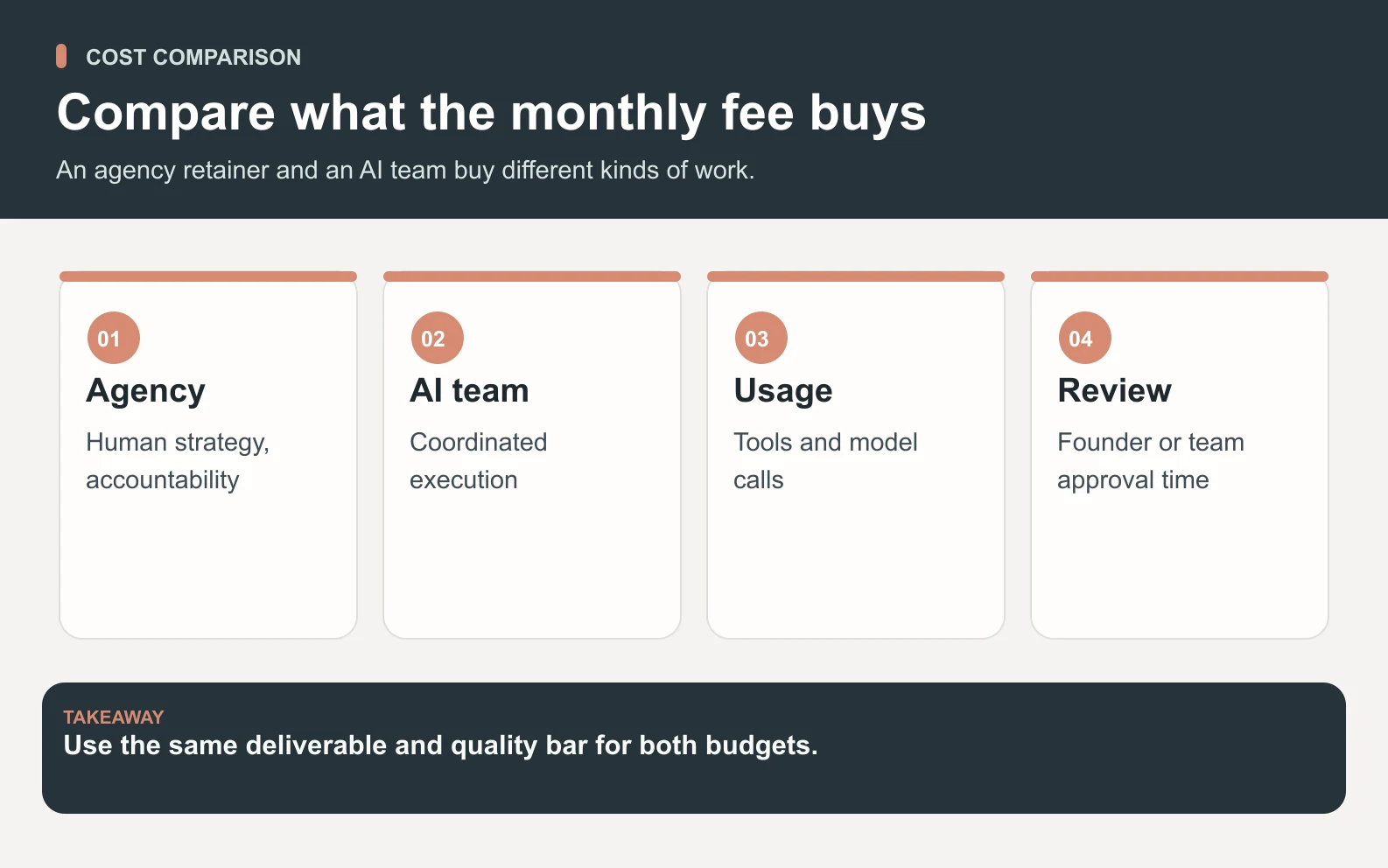
Swipe to explore the diagram
The fairest table is not a naked sticker-price grid. A $60 base subscription and a $5,000 agency retainer are not the same unit, so the comparison has to include scope, setup, review, and accountability.
Scroll horizontally to view all columns.
| Cost dimension | Agency retainer | Managed AI team |
|---|---|---|
| Typical monthly fee | Often $2,000–$20,000+ for AI SEO retainers per Digital Agency Network | Space Office is $60/month or $600/year |
| Setup | Discovery, onboarding, channel access, kickoff meetings | Brief Hydrogen, connect approved tools, choose specialists |
| Included labor | Human strategy, account management, specialists, reporting | Hydrogen plus two included specialists; add others at $25/month |
| Usage costs | May include platform fees, media, tools, or pass-throughs | Bring your own AI key; provider cost with zero markup |
| Review burden | Agency reviews internally; client approves milestones | Hydrogen reviews outputs; client approves final business calls |
| Best value | Complex strategy, paid media, accountability, stakeholder management | High-volume execution and reviewable deliverables |
A worked example: one launch month

Imagine a small SaaS company needs a launch month: four blog posts, a pricing-page refresh, eight social posts, two ad concept sets, a competitor comparison, and a simple reporting summary. With an agency, a modest AI-enabled retainer might land at $3,200/month if it is closer to an AI SEO/content engagement, using Digital Agency Network’s cited average as a reference point. Bigger scope can climb well beyond that.
With Space Office, the base is $60/month. Add four extra specialists for a heavier month: 4 × $25 = $100. Platform total: $160/month. Add an illustrative $40 of AI provider usage paid through your own key. Add estimated compute of $30. Total: $230 for the month, before ad spend. Compared with $3,200, the difference is $3,000 that month. Compared with $10,000, the difference is $9,800. The catch is important: you still make final strategy and approval calls. Dedicated AWS compute starts at about $30/month, and AI usage is paid separately through your own provider key with zero markup.
Scroll horizontally to view all columns.
| Line item | Agency retainer route | Space Office route |
|---|---|---|
| Base execution fee | $3,200/month example from AI SEO average | $60/month base |
| Extra specialists | Included if inside scope; extra if out of scope | 4 × $25 = $100 |
| AI usage / tools | May be bundled or passed through | Illustrative $40 provider usage at cost |
| Ad spend | Separate | Separate |
| Dedicated compute | Check agreement | Estimated $30 |
| Total before ads | $3,200+ | $230 illustrative |
| Savings vs $3,200 | — | $2,970 for that month |
The hidden cost is founder review time
The hidden cost in both models is review time. Agencies reduce it with account management and senior judgment. AI teams reduce it with Hydrogen’s coordination and QA, but the founder still has to approve the business meaning of the work. If a launch message changes positioning, pricing, legal risk, or customer promises, software should not be the final signer.
A practical budget should include 2–4 hours a week of founder review for a busy launch month. That figure is approximate / illustrative and varies with scope, risk, and how clearly the company has documented its positioning. The better your briefs and brand rules, the less time review takes.
When the agency retainer is worth it
The agency retainer is worth it when you are buying judgment you do not have. If you are spending serious paid-media budget, repositioning the company, managing a multi-stakeholder launch, or entering a market where mistakes are expensive, a human team can be the right call. The meetings, senior pushback, and accountability are part of the value, not overhead.
- You need a senior human to own strategy and defend tradeoffs.
- Your paid-media budget is large enough that optimization judgment pays for itself.
- Your board, partners, or internal stakeholders need a human account lead.
- Your campaign includes legal, compliance, or brand-risk decisions that require professional review.
When the AI team is the better value
The AI team is the better value when the bottleneck is throughput. Many lean teams already know the audience, the offer, and the rough strategy. What they lack is the time to turn those decisions into research, copy, design direction, SEO updates, reporting summaries, and follow-up. In that case, buying a full agency relationship can be too much machine for the job.
Hydrogen’s role is what keeps Space Office from becoming a pile of disconnected tools. It breaks down the brief, assigns specialists, and reviews every output before delivery. Hydrogen checks outputs against the brief and returns issues to the specialist for revision. You still review and approve the final work.
The decision rule: judgment first, execution second
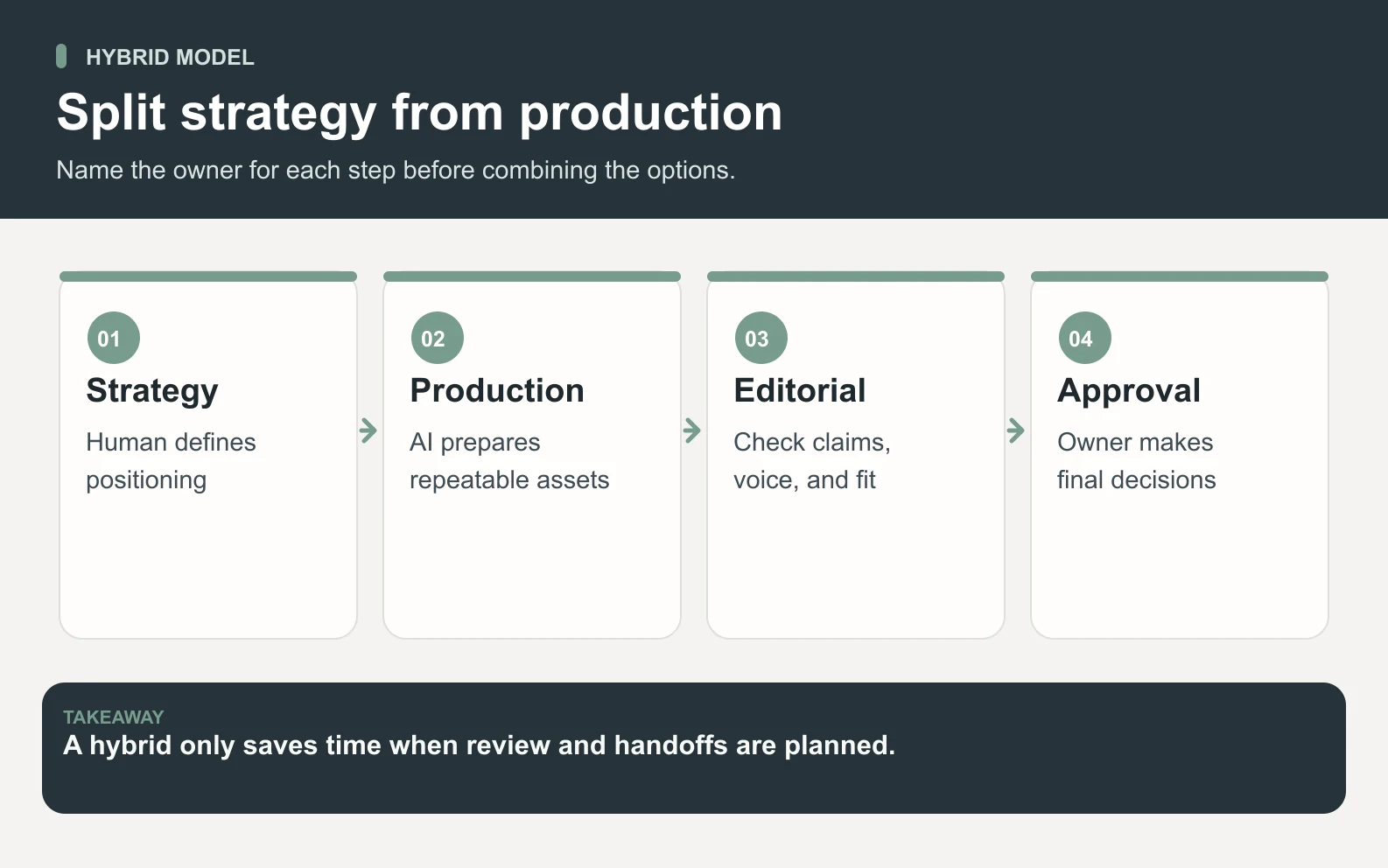
Swipe to explore the diagram
Use a simple rule: buy the scarce thing. If judgment is scarce, pay for human judgment. If execution is scarce, buy execution capacity. If both are scarce, use both: an agency or senior advisor for direction, and Space Office for the drafts, assets, checklists, research, and iteration that keep the plan moving.
- 1Write the outcome you need in one sentence.
- 2Mark every part that requires senior judgment, legal review, or budget ownership.
- 3Mark every part that is repeatable, draftable, or easy to inspect.
- 4Give the judgment-heavy work to humans and the repeatable execution work to the AI team.
- 5Review the first month before expanding scope.
How to keep the comparison honest
Keep the comparison honest by separating fees, media, tools, AI usage, and review time. Do not pretend the cheapest line item is automatically the best choice. Do not pretend the largest retainer is automatically strategic. The right answer is the setup that gets the work shipped with enough judgment around it.
Also label salary and hiring-cost figures approximate / illustrative whenever you use them. Costs vary by market, seniority, channel, and complexity. This post uses external retainer benchmarks where sourced and uses Space Office pricing where fixed. Any custom quote should be checked against the actual scope.
A practical monthly budget for a lean team
A lean team can start with three lines: $60/month for Space Office, a small provider-usage budget paid through its own AI key, and any channel spend such as ads or sponsorships. If the month needs more depth, add specialists at $25/month each. That keeps the execution line readable before the company commits to a retainer. Dedicated AWS compute starts at about $30/month, and AI usage is paid separately through your own provider key with zero markup.
Scroll horizontally to view all columns.
| Budget line | Low-control tool stack | Managed AI team | Agency retainer |
|---|---|---|---|
| Execution fee | $20–$200 tools, approximate / illustrative | $60–$210 typical Space Office setup | $2,000–$20,000+ depending on scope |
| Coordination | Founder | Hydrogen | Account manager / strategist |
| Review | Founder | Hydrogen plus founder final approval | Agency internal review plus client approval |
| Media spend | Separate | Separate | Separate |
| Best stage | Experimenting alone | Lean team needs output | Complex strategy or high-stakes growth |
See current monthly and annual subscription options, plus compute and AI usage, on the pricing page.
View pricingThe practical takeaway
AI team cost vs agency retainer is not a fight between cheap and expensive. It is a choice between execution capacity and human strategic ownership. Space Office makes sense when the work is specific, repeatable, and reviewable. An agency makes sense when the company needs senior humans to own strategy, channel risk, or stakeholder accountability. Buy the missing capability, not the fanciest invoice.
Sources and review notes
Published by Space Office on September 8, 2026 and updated October 5, 2026 as an owned-page refresh after the keyword map had no open rows. Agency pricing benchmarks ($3,200/month average for AI SEO, $2,000–$20,000+ retainer range, $2,500–$15,000+ automation builds, and $500–$5,000+ monitoring retainers) were rechecked October 5, 2026 from Digital Agency Network's AI agency pricing guide. Space Office pricing matches docs/PRODUCT-FACTS.md and src/lib/pricing.ts. Worked budgets are illustrative planning figures, not quotes.
Frequently asked questions
How much does an AI team cost compared with an agency retainer?
Space Office costs $60/month or $600/year, with added specialists at $25/month and AI usage paid at provider cost. Agency retainers vary widely: Digital Agency Network’s 2026 guide cites AI SEO retainers from $2,000 to $20,000+, AI SEO services averaging $3,200/month, AI automation builds from $2,500 to $15,000+, and monitoring retainers from $500 to $5,000+. Dedicated AWS compute starts at about $30/month, and AI usage is paid separately through your own provider key with zero markup.
Is a managed AI team always cheaper than an agency?
On subscription cost, usually yes. Space Office is priced like software at $60/month, while agency retainers often run in the thousands. But cheaper is not always better. Agencies can provide senior human strategy, account management, paid-media judgment, and stakeholder accountability that a managed AI team does not fully replace. Dedicated AWS compute starts at about $30/month, and AI usage is paid separately through your own provider key with zero markup.
What does Space Office include for $60/month?
Space Office includes Hydrogen plus two chosen specialists in the $60/month base subscription. Hydrogen coordinates work as the AI project manager and reviews outputs before delivery. Customers bring their own AI key with zero markup, can add specialists for $25/month each, and can choose $600/year for the annual plan. Dedicated AWS compute starts at about $30/month, and AI usage is paid separately through your own provider key with zero markup.
When should I choose an agency instead of an AI team?
Choose an agency when the bottleneck is strategy, not execution: major paid-media spend, repositioning, board-visible campaigns, compliance-sensitive work, or stakeholder management. A good agency brings senior humans who can own recommendations and tradeoffs. A managed AI team is better for high-volume, reviewable deliverables.
When should I choose Space Office instead of an agency retainer?
Choose Space Office when your team already knows the direction but lacks execution capacity. It is useful for research, SEO briefs, content drafts, landing-page copy, design direction, reporting summaries, workflows, and other deliverables that a founder can review without hiring a full agency relationship.
Do I still need to review work from an AI team?
Yes. Hydrogen checks outputs against the brief and returns issues to the specialist for revision. You still review and approve the final work. But you still approve final business calls, customer promises, legal risk, and strategic decisions. The AI team reduces review load; it does not remove responsibility.
Are agency retainer prices in this article exact quotes?
No. The agency figures are sourced benchmarks from Digital Agency Network’s 2026 AI agency pricing guide and should be treated as market ranges, not exact quotes. Actual retainers depend on scope, seniority, geography, paid-media responsibility, reporting depth, and how much strategy the agency owns.