Guide
How Much Does an AI Team Cost? Budget Math Before You Buy
By the Space Office team · Published · Updated · 9 min read
This guide explains the budget math behind an AI team—subscription, specialists, compute, and model usage—so you can plan before you buy. A Space Office setup starts at $60/month for Hydrogen plus two specialists, with a four-specialist subscription at $110/month before compute and provider usage. For live offers and the full calculator, visit /pricing.

The short answer: subscription is only one line
1. Start with the fixed subscription
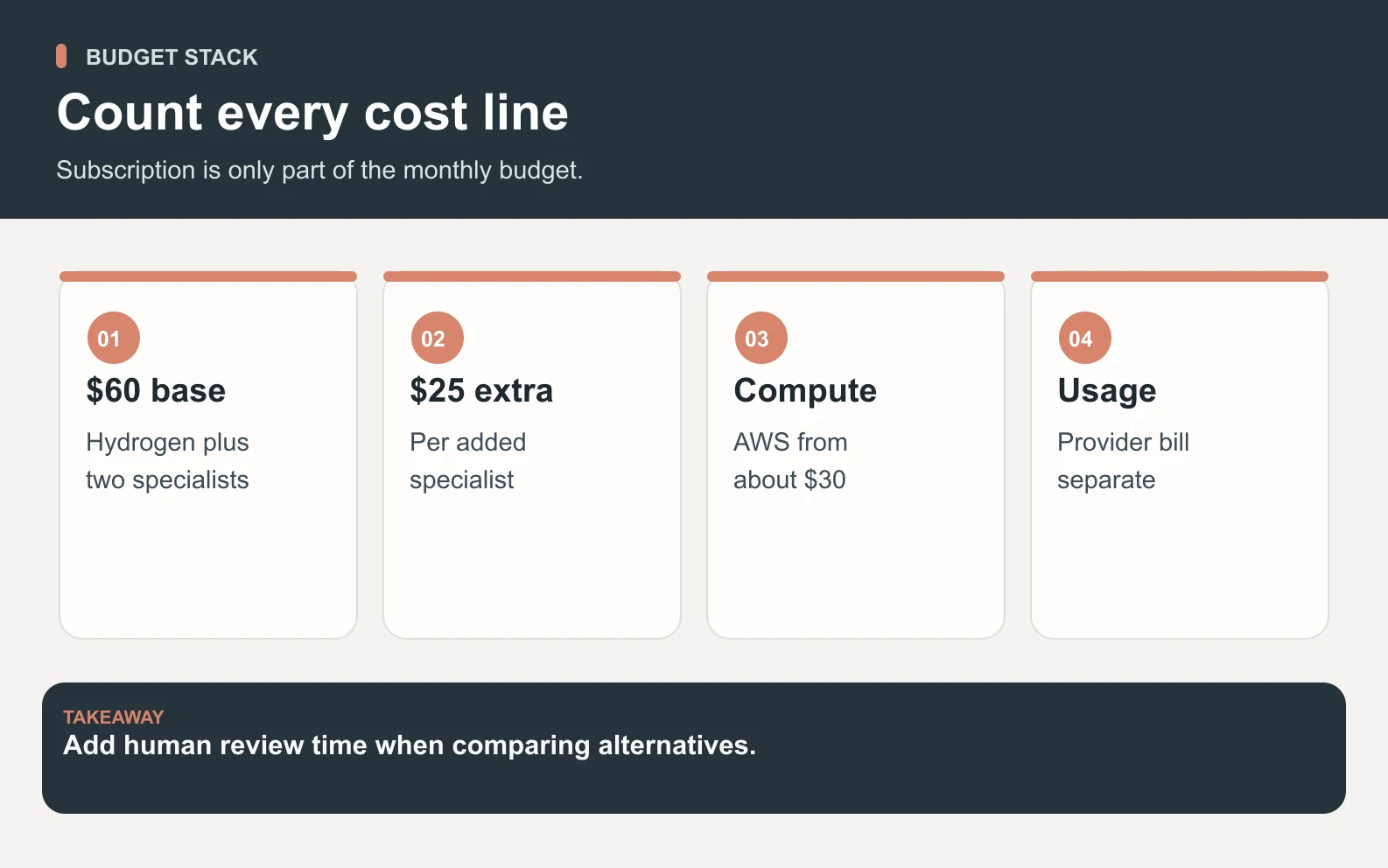
The honest answer to "how much does an AI team cost" is a formula, not one sticker price. Use this page to understand the lines; use Space Office pricing for the live calculator and current offer. Space Office starts at $60/month for Hydrogen, the AI project manager, plus two selected specialists. Each added specialist is $25/month. Dedicated compute and AI-provider usage are separate, so a complete budget should show all three lines before the team starts doing serious work.
For the live offer, specialist picker, and billing options, use the pricing page—this post is the math behind it.
Open live pricing2. Add the operating lines separately
That separation is deliberate. The subscription buys coordination, specialist access, and Hydrogen's review path. Compute pays for the customer's dedicated AWS workspace. Model usage goes to the AI provider the customer connects, with zero markup from Space Office. Combining those lines into one vague bundle would make the number easier to market and harder to audit.
Space Office pricing at a glance
Scroll horizontally to view all columns.
| Cost line | Published price | What it includes |
|---|---|---|
| Base subscription | $60/month or $600/year | Hydrogen plus two selected specialists |
| Each added specialist | $25/month or $250/year | One additional live specialist role |
| Light compute | About $30/month | Dedicated AWS t3.medium workspace estimate |
| Standard compute | About $60/month | Dedicated AWS t3.large workspace estimate |
| Performance compute | About $140/month | Dedicated AWS m5.xlarge workspace estimate |
| AI model usage | Provider bill | Anthropic, OpenAI, or Google usage through your key |

The formula: base plus specialists plus operating costs
1. Calculate the subscription first
Use this formula for a quick monthly subscription estimate: $60 + max(0, specialists − 2) × $25. Hydrogen does not consume one of the two included specialist slots. A two-specialist team costs $60/month. A three-specialist team costs $85/month. Four specialists cost $110/month. Six specialists cost $160/month.
Swipe to explore the diagram
2. Add compute, model usage, and approval time
Then add operating costs. Light compute starts around $30/month, Standard around $60/month, and Performance around $140/month. AI usage depends on the actual work and appears on the provider bill, not as a Space Office markup. Human review time is also real: Hydrogen reviews outputs, but the customer should still approve final customer-facing or public work.
Worked example: a four-specialist founder team
1. Choose the four roles
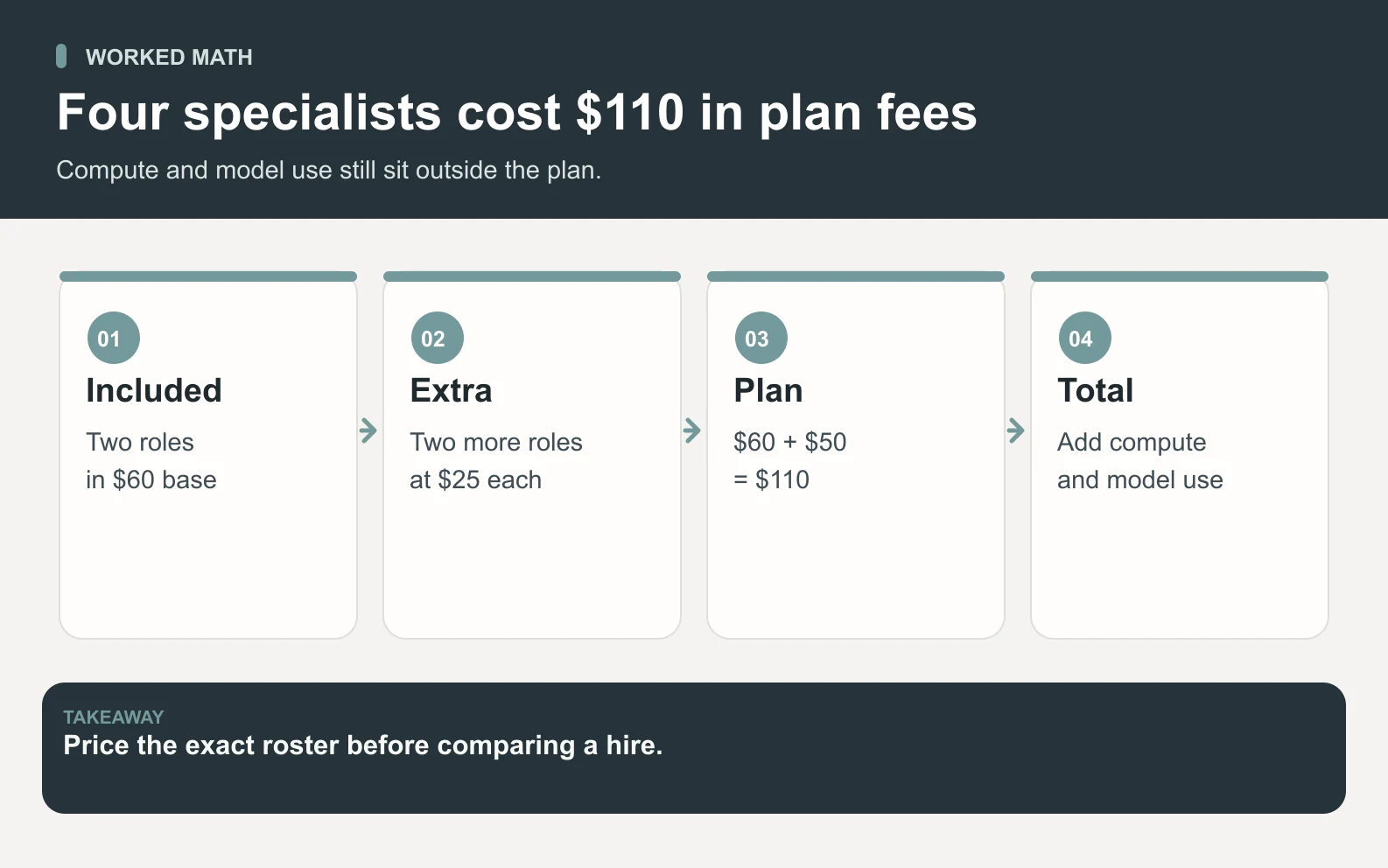
Suppose a founder chooses Nitrogen for content, Neon for SEO, Sodium for market research, and Cobalt for organic distribution. Two specialists are included in the base. The other two are add-ons. The subscription math is $60 + 2 × $25 = $110/month. With Light compute, the visible operating line is $110 + $30 = $140/month before model usage.
Swipe to explore the diagram
2. Compare monthly and annual billing
Annual billing changes only the subscription line. The same four-specialist subscription is $600 base + 2 × $250 = $1,100/year. Paid monthly, it would be $110 × 12 = $1,320/year. The annual subscription saves $220, while compute and model usage remain separate and are not included in that saving.
Scroll horizontally to view all columns.
| Line item | Monthly billing | Annual subscription billing |
|---|---|---|
| Base: Hydrogen + 2 specialists | $60/month | $600/year |
| 2 added specialists | $50/month | $500/year |
| Subscription subtotal | $110/month | $1,100/year |
| Light compute estimate | ~$30/month | ~$360/year |
| AI-provider usage | Provider bill | Provider bill |
| Visible total before model usage | ~$140/month | ~$1,460/year |
Worked example: a lean two-specialist support team
A SaaS founder might start with Gold for customer success and Nitrogen for help-center copy. That uses the two included specialist slots. The subscription is $60/month. Add Light compute at about $30/month, and the visible operating line is about $90/month before model usage. That is the lowest realistic paid operating budget because compute and provider usage still exist outside the subscription.
This setup does not mean every support job is automated. Hydrogen can coordinate and review drafts, but a human should approve customer-facing macros, policy-sensitive answers, refunds, account changes, and any message that could affect a customer's plan or data. The lower price comes from focused scope, not from removing ownership.
What changes when you add more specialists
Scroll horizontally to view all columns.
| Selected specialists | Monthly subscription | Example use case |
|---|---|---|
| 2 | $60 | Content + SEO, or support + copy |
| 3 | $85 | Add research, outreach, or design |
| 4 | $110 | Small go-to-market pod |
| 6 | $160 | Broader marketing, support, and revenue coverage |
| 24 | $610 | Complete current live specialist roster |
The live roster has 24 hireable specialists plus Hydrogen, and 15 further roles are in development. Future roles should not be budgeted as live services until they ship. If your workflow only needs two roles, stay at two. If the work crosses functions, add the specialist that removes a real bottleneck instead of buying the whole roster because it sounds comprehensive.
Compute is separate because every workspace runs on its own machine
Every paid Space Office workspace runs on dedicated AWS compute. The public pricing page lists Light at about $30/month, Standard at about $60/month, and Performance at about $140/month. These are passed-through AWS estimates, not a Space Office margin. A smaller instance may work through briefs more slowly, but the review expectation does not change.
Do not treat the $60 subscription as the entire operating cost. The realistic budget is subscription plus compute plus provider usage.
AI-provider usage is metered and paid directly
Space Office paid plans use the customer's own supported provider key for Anthropic, OpenAI, or Google. That means model usage, including generation and review, is paid to the provider under the customer's account. Space Office does not mark it up. It also means actual usage depends on the size, frequency, and complexity of the work.
For budget planning, separate fixed subscription costs from variable model usage. A few reviewed briefs a week is not the same workload as continuous content production, large research jobs, and heavy multi-specialist reviews. The provider bill is the source of truth for that variable line.
Monthly versus annual billing
Monthly billing is more flexible. Annual subscription billing gives two months free on the subscription lines: the base is $600/year instead of $720 paid monthly, and each added specialist is $250/year instead of $300. Compute and provider usage are separate, and annual plans have a 30-day prorated refund window before the term runs to its end.
If you are still proving fit, monthly billing is the safer pilot. If the team already has steady weekly work and the selected specialists are clear, annual billing can reduce the subscription line without hiding the ongoing compute and usage costs.
How to decide if the cost is worth it
1. Test the budget against recurring work
- 1List the recurring work you would actually delegate each month.
- 2Choose the smallest specialist roster that covers those jobs without pretending future roles are live.
- 3Calculate subscription with the $60 + add-on formula.
- 4Add the compute tier that matches workload volume, starting with Light when unsure.
- 5Estimate provider usage from a pilot and review the provider bill after real tasks run.
- 6Compare the accepted output, review time, and owner confidence against doing the same work manually or with point tools.

When an AI team is not the right spend
1. Skip it when the work is rare or ownerless
An AI team is not worth it when the work is rare, deeply regulated without a review owner, or better handled by one existing tool. It is also not a replacement for a person who owns strategy, customer relationships, legal judgment, or final accountability. The economics work best when a small team has recurring cross-functional work but not enough volume or budget to hire every function. To compare a specific hire against the team you'd build, try the employee cost calculator.
2. Buy only the smallest reviewed team that clears the bottleneck
The clean decision rule is simple: buy the smallest reviewed team that clears a real bottleneck. If two specialists and Hydrogen solve the problem, do not buy more. If the work spans SEO, content, research, and distribution every week, the four-specialist math gives you a transparent starting budget.
Use the pricing calculator to choose specialists, compute, and billing period before you commit to an AI-team budget.
Calculate your Space Office priceSources and review notes
This cost guide is published by Space Office and uses Space Office's own public pricing plus the current repository pricing source as of September 24, 2026. Worked examples are illustrative budgets, not customer results or guaranteed total costs. Model usage varies by workload and is billed by the selected AI provider.
- Space Office pricing — checked
Frequently asked questions
How much does a Space Office AI team cost per month?
Space Office starts at $60/month for Hydrogen plus two selected specialists. Additional specialists are $25/month each. Dedicated compute starts around $30/month, and AI-provider usage is paid separately through your own provider key with zero markup.
What is included in the $60/month base subscription?
The $60/month base includes Hydrogen, the AI project manager, plus two selected specialists. Hydrogen coordinates and reviews specialist output before delivery. Compute, AI-provider usage, and any specialists beyond the included two are separate costs.
How much does a four-specialist AI team cost?
A four-specialist Space Office setup costs $110/month for subscription: $60 base plus two added specialists at $25 each. Add compute from about $30/month and provider usage billed through your own key. The visible line before model usage is about $140/month with Light compute.
Does annual billing reduce the cost?
Yes, annual billing gives two months free on subscription lines. The base is $600/year instead of $720 paid monthly, and each added specialist is $250/year instead of $300. Compute and model usage remain separate and are not discounted by annual subscription billing.
Does Space Office mark up AI model usage?
No. Paid plans use your own supported Anthropic, OpenAI, or Google key. You pay that provider directly for model usage, including review-related usage, with zero Space Office markup. Actual usage depends on workload size and frequency.
Is an AI team cheaper than hiring?
It can be cheaper for recurring cross-functional work, but it is not a direct replacement for a person who owns judgment, relationships, or accountability. Compare the accepted work, review time, provider usage, and the human approval burden rather than treating subscription price as the whole decision.
Can I start with only two specialists?
Yes. The base subscription includes two selected specialists, and that is the right starting point when the workflow is focused. Add specialists only when a real bottleneck appears, such as research, SEO, support, outreach, design, or distribution work that one role cannot cover.