Guide
AI Team for Property Managers: Leasing, Ops & Review
By the Space Office team · Published · Updated · 8 min read
Property managers should use an AI team for the work around their system of record: leasing follow-up, listing copy, maintenance summaries, owner updates, reporting narratives, and local visibility. Keep rent, accounting, compliance, and approvals in trusted property-management software and human-controlled processes.

Property management already depends on purpose-built systems. Buildium's pricing page lists property-management plans with accounting, maintenance, leasing, reporting, resident portal, screening, eSignature, and AI-related communication features. AppFolio's public pricing page describes customizable property-management plans and value-added services. Those systems should remain the source of record for leases, payments, residents, owners, vendors, and compliance evidence.
An AI team fits a different layer. It helps a lean property manager produce the writing, research, follow-up, summaries, and operating documentation that surround the system of record. Space Office is useful when the work needs multiple specialists coordinated by Hydrogen, not when a regulated action needs to bypass software controls or human approval.
What an AI team can safely own
1. Leasing and listing support
Nitrogen can draft listing descriptions, neighborhood summaries, email templates, move-in instructions, and FAQ answers from facts you provide. Sodium can research comparable positioning or local context, and Neon can help make property pages clearer for search. A human must still verify availability, rent, fees, policies, fair-housing compliance, and final publication.
2. Resident and owner communication drafts
Gold can draft resident updates, owner summaries, renewal reminders, and support macros. The value is consistency: clear tone, fewer missing details, and repeatable responses. The boundary is equally important: humans approve legal notices, payment issues, lease interpretations, maintenance commitments, and anything that changes a resident's rights or obligations.
3. Operations documentation
Hydrogen can coordinate SOP work across specialists: Sodium gathers inputs, Nitrogen structures the procedure, Gold checks customer-facing clarity, and Carbon can review acceptance criteria when QA is needed. That is a better fit than asking one generic assistant to write a policy from memory.
Use property-management software as the source of record
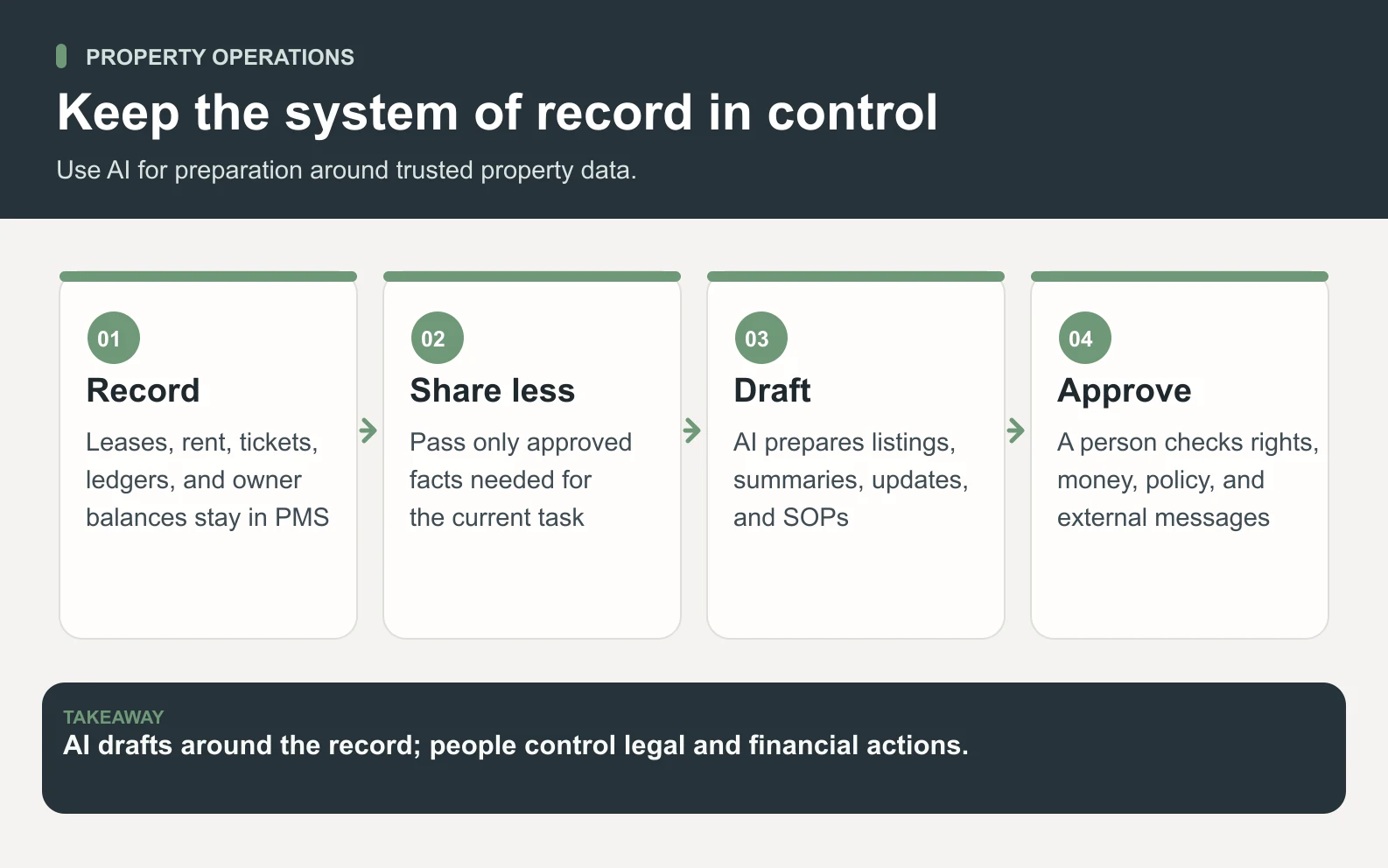
Swipe to explore the diagram
The AI team should not become a shadow database. Keep rent rolls, leases, owner balances, inspection records, maintenance tickets, applicant records, and resident ledgers in the property-management platform your team trusts. Export or summarize only the minimum information required for a task, and remove private information when a generic answer will do.
Boundary rule
If the task changes money, occupancy, lease status, legal notice, vendor authorization, or resident rights, keep a human and the property-management system in control.
AI team roles for property managers
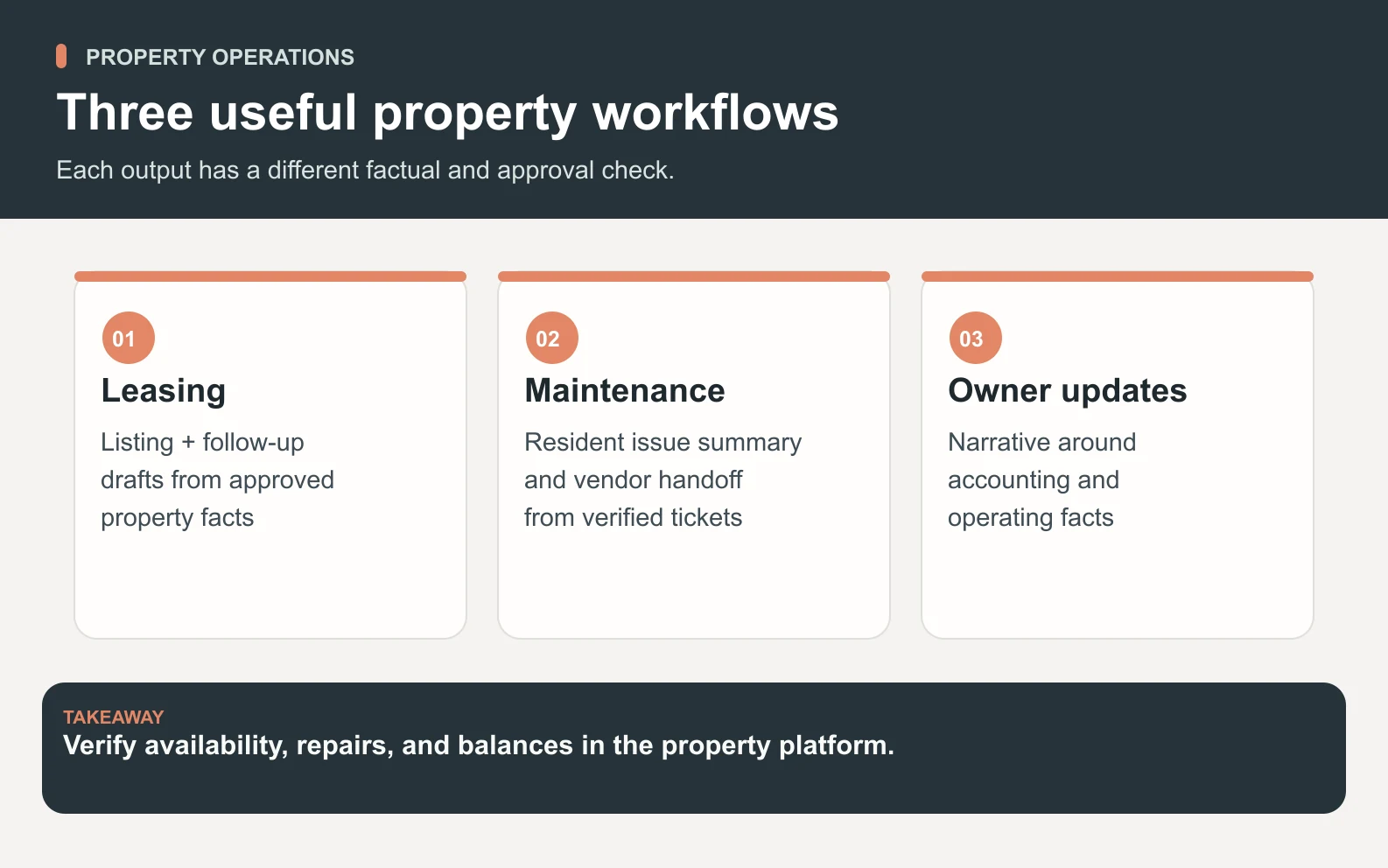
Swipe to explore the diagram
Scroll horizontally to view all columns.
| Need | Specialist | Example output | Human check |
|---|---|---|---|
| Market and neighborhood context | Sodium | Comparable positioning brief | Verify sources and property facts |
| Listing and email copy | Nitrogen | Listing copy, nurture sequence, owner update | Approve compliance and exact terms |
| Resident support | Gold | Response macros and onboarding notes | Approve policy-sensitive replies |
| Local discovery | Neon | SEO page brief and internal-link plan | Confirm service area and claims |
| Follow-up sequences | Copper | Lead nurture and vendor follow-up drafts | Approve recipients and timing |
A worked example: 80-unit boutique portfolio
Imagine a property manager with 80 units, 6 vacancies, 18 maintenance messages in a week, and 4 owners asking for narrative updates. The existing property-management software remains the source for rent, tickets, resident data, and owner balances. The AI team handles the surrounding work: listing copy for the 6 vacancies, maintenance triage summaries, 4 owner update drafts, and a weekly leasing follow-up sequence.
A practical Space Office setup could include Nitrogen and Gold in the $60 base plan, then add Sodium for market context and Neon for local discovery. The subscription math is $60 + (2 extra specialists × $25) = $110/month before compute, AI-provider usage, and human review time. With light compute, the operating model becomes $110 + $30 = $140/month before provider usage. That example is illustrative; it is not a claim about savings or property performance.
Scroll horizontally to view all columns.
| Line item | Cost | Purpose |
|---|---|---|
| Base plan | $60 | Hydrogen plus Nitrogen and Gold |
| Sodium add-on | $25 | Market and neighborhood research |
| Neon add-on | $25 | Local SEO and page clarity |
| Light compute estimate | $30 | Dedicated AWS workspace compute, if selected |
| AI-provider usage | Provider bill | Paid directly with zero Space Office markup |
| Human approval | Internal time | Final resident, owner, vendor, and legal review |
Leasing workflow you can delegate

- 1Export approved property facts: address area, amenities, rent, deposits, pet policy, showing process, and availability.
- 2Ask Sodium to summarize neighborhood context from allowed public sources and your own notes.
- 3Ask Nitrogen to draft listing copy, email follow-up, and a short FAQ from those facts.
- 4Ask Neon to check whether the page answers common local search questions without inventing claims.
- 5Have a human verify fair-housing language, fees, availability, and final publication before the listing goes live.
Maintenance workflow you can delegate

AI should not approve repairs or diagnose hazards from incomplete messages. It can, however, organize messy inbound information. Gold can turn resident messages into a structured summary, list missing details, draft a polite request for photos or access windows, and prepare a vendor-ready handoff for human approval.
- Summarize issue, unit, urgency, photos received, access notes, and missing information.
- Draft resident acknowledgment without promising a repair time you have not approved.
- Prepare a vendor brief from verified ticket data rather than resident speculation.
- Flag safety, water, heat, electrical, or access issues for immediate human review.
Owner reporting workflow you can delegate
Owners often want a narrative, not only a ledger. An AI team can draft the story around facts from the system of record: occupancy changes, leasing activity, maintenance themes, upcoming decisions, and suggested next steps. Keep the numbers in your accounting platform, then use the AI team to make the explanation clearer.
Risks and controls
Pros
- Faster drafting for listings, updates, FAQs, and SOPs
- Better consistency across resident, owner, and vendor communication
- Clearer delegation because Hydrogen routes work to named specialists
Cons
- Bad source data can create confident but wrong drafts
- Legal, financial, and resident-rights actions still need human approval
- Private resident data must be minimized and handled under your policies
The control set should be written before the first recurring workflow. Define which source fields are allowed, which facts must be verified in the property-management platform, which words are never approved automatically, and which situations escalate immediately. Examples include fair-housing-sensitive phrasing, payment disputes, habitability concerns, access issues, insurance claims, eviction-related language, and owner instructions that conflict with policy.
Give the AI team a checklist instead of a vague request to be careful. A useful checklist might require the draft to name the source document, mark assumptions, avoid legal conclusions, include a human approval note, and show the exact next action requested from the resident, owner, or vendor. That format makes review faster because the manager is checking a structured handoff, not rereading a polished but ungrounded message.
How to start in one week
Start with a low-risk workflow, not your hardest compliance case. A good first week is one vacant-unit listing, one owner update, and one maintenance-message summary format. Measure whether the drafts reduce editing time and whether the human reviewer finds fewer missing details. If that passes, expand to renewal communication or local SEO pages.
For the first week, keep the acceptance test simple: the listing must use only approved facts, the owner update must match the ledger and maintenance notes, and the maintenance summary must separate resident statements from verified information. If the reviewer needs to rewrite more than a third of each draft, narrow the brief before adding more workflows. A smaller reliable workflow beats a broad assistant that creates hidden review debt.
If your property-management system already holds the records, use Space Office for the reviewed work around those records.
Choose your AI specialistsSources and review notes
This guide uses public product and pricing pages plus Space Office's current pricing source. It is not legal, accounting, fair-housing, or property-management compliance advice, and no private benchmark or customer outcome study was performed.
- Buildium pricing — checked
- AppFolio property management pricing — checked
- Space Office pricing — checked
Frequently asked questions
Can an AI team replace property-management software?
No. Keep leases, payments, residents, owners, maintenance tickets, and accounting records in your property-management software. Use an AI team for drafts, summaries, research, SOPs, and reviewed communication around that system.
How much does Space Office cost for a property manager?
Space Office starts at $60/month for Hydrogen plus two specialists. Each additional specialist is $25/month. Dedicated compute and AI-provider usage are separate, and human review time should remain part of the operating plan.
Which specialists should a property manager start with?
A practical starter mix is Nitrogen for listing and email copy, Gold for resident and owner communication, then Sodium for market research or Neon for local SEO as needed. Hydrogen coordinates and reviews the work.
Can AI handle maintenance requests?
AI can summarize messages, ask for missing details, draft acknowledgments, and prepare vendor handoffs. It should not approve repairs, diagnose hazards, or make promises without human and system-of-record review.
Is this safe for resident data?
Only if the team minimizes private data, follows its policies, and keeps sensitive actions under human control. Do not paste unnecessary resident, payment, legal, or identity information into any AI workflow.
Can an AI team improve local SEO for property managers?
It can help produce clearer property pages, service-area content, FAQs, and internal links. Rankings are not guaranteed, and every claim about availability, pricing, amenities, and policies must be verified before publication.