Guide
AI vs Hiring Your First Employee: Cost Guide
By the Space Office team · Published · Updated · 10 min read
Hire your first employee when the work has become a real role. Use AI first when the work is still a shifting bundle of tasks across marketing, sales, ops, research, design, or support. The cost gap can be large, but the safer decision is based on ownership, not only price.

The short answer: decide whether you need a role or task capacity
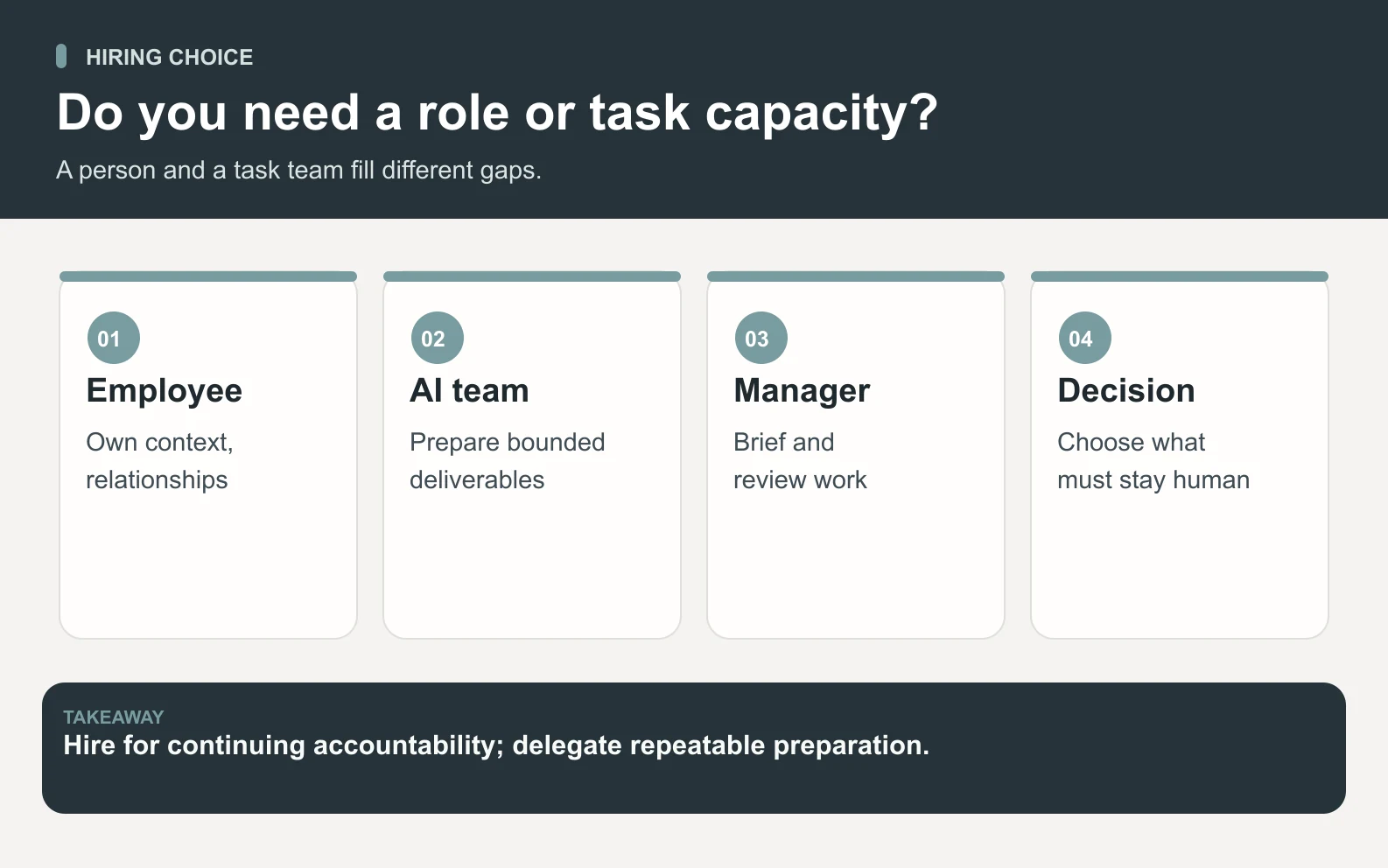
A first employee is not just a more expensive tool. A good hire owns outcomes, notices problems you did not ask about, builds relationships, and carries context over time. A managed AI workforce is different: it helps you get defined work done across several functions without committing to a permanent role before you know what the role should be.
Swipe to explore the diagram
That makes the AI vs hiring decision simpler. If the work needs one accountable owner, hire. If the work is a pile of cross-functional tasks, use AI first and learn what role is actually missing.
Scroll horizontally to view all columns.
| Question | First employee | Managed AI workforce |
|---|---|---|
| Best shape | A durable role | A bundle of defined tasks |
| Continuity | Strong: one person carries context | Depends on briefs and workflow memory |
| Relationships | Strong fit | Weak fit unless a human owns the relationship |
| Cross-functional breadth | Limited by one person's skills | Strong when several specialists are needed |
| Commitment | Payroll, management, onboarding, and legal obligations | Subscription plus compute and model usage |
| Final approval | Manager or founder | Hydrogen reviews; human still approves final work |
What a first employee costs beyond salary
Salary is only the visible line item. In the US, the IRS lists the employer Social Security rate at 6.2% and the employer Medicare rate at 1.45%, for 7.65% in employer FICA taxes before unemployment taxes or benefits. On a $60,000 salary, that required FICA line alone is $60,000 × 7.65% = $4,590.

Then come benefits, recruiting time, onboarding, software seats, equipment, management time, and the risk of a mismatch. Those vary widely, so the honest way to budget is to make assumptions explicit instead of quoting one universal multiplier. To put your own numbers side by side, use the employee cost calculator.
Scroll horizontally to view all columns.
| Line item | Illustrative arithmetic | First-year cost |
|---|---|---|
| Base salary | $60,000 | $60,000 |
| Employer Social Security + Medicare | $60,000 × 7.65% | $4,590 |
| Benefits allowance | Illustrative $900/month × 12 | $10,800 |
| Recruiting and interview time | Illustrative one-time budget | $3,500 |
| Laptop and software setup | Illustrative one-time budget | $3,000 |
| First-year cash planning number | Salary + listed costs | $81,890 |
What a managed AI workforce costs
Space Office starts at $60/month or $600/year for Hydrogen plus two chosen specialists. Additional specialists cost $25/month or $250/year each. Dedicated AWS compute starts at an estimated $30/month, and model usage is paid to your AI provider through your own key with zero Space Office markup.
That pricing does not mean AI replaces a person in every situation. It means the commitment is shaped differently. You can start with two specialists, add roles only when the work justifies them, and keep provider usage visible. Hydrogen reviews specialist output against the brief, but a human still approves final work.
Worked example: marketing work before a marketing hire
1. Price the human role honestly
Suppose the founder thinks they need a first marketing hire at $60,000. Using the illustrative table above, the first-year planning number is $81,890 before counting the founder’s management time or the cost of a bad hire. That can be a great investment if the business truly needs one person to own marketing every week.

2. Price the AI-team version for the same task bundle
Now suppose the actual work is a mixed bundle: keyword research, three articles, landing-page copy, social posts, and a campaign review. A Space Office setup might start with Neon and Nitrogen in the base subscription at $60/month. Adding Cobalt for social makes it $60 + $25 = $85/month. Adding Aluminum for design makes it $60 + 2 × $25 = $110/month, before compute and model usage.
3. Compare ownership, not only totals
The annualized subscription for that four-specialist setup is $110 × 12 = $1,320 before compute and provider usage. That is far below the illustrative first-year hire number, but it is not the same purchase. The hire owns marketing; the AI workforce completes reviewed task bundles while the founder keeps strategy and final approval.
When hiring first is the right call
- The work is continuous enough to fill a real role every week.
- Someone must own an outcome, not just complete tasks.
- The work depends on customer, partner, investor, or employee relationships.
- Judgment must happen in real time with incomplete context.
- The person will create institutional knowledge that compounds over time.
When AI first is the better move
- The work is spiky: busy one week, quiet the next.
- The tasks span several crafts that one junior generalist would not cover well.
- You are still learning whether the missing role is marketing, ops, sales, support, or product.
- You need reviewed drafts, research, QA, or implementation support before you can justify payroll.
- You want to keep fixed commitments low while preserving output speed.
The risk on both sides
The risk of hiring too early is locking into the wrong role. A founder may hire a generalist because the task list is long, then discover the real bottleneck is technical SEO, sales operations, or design. A person can grow, but they cannot be every specialist at once.
The risk of using AI too long is avoiding the role that the company genuinely needs. If the same outcome needs ownership every week, if customers need a consistent human relationship, or if decisions require business judgment that cannot be reduced to a brief, postponing a hire can slow the company down.
Practical rule
Use AI to clarify the role. Hire when the same outcome keeps needing one accountable human owner.
A five-question decision checklist
- 1Can you write one job title that owns most of the work? If yes, hiring becomes more plausible.
- 2Does the work require a relationship with customers, partners, or employees? If yes, hire sooner.
- 3Would the task list require three or more unrelated crafts? If yes, try a managed AI workforce first.
- 4Can you carry the loaded employee cost through a slow quarter? If no, avoid payroll until the role is clearer.
- 5After four weeks of AI support, is the same role still obviously missing? If yes, write the job description from the evidence.
Swipe to explore the diagram
How to pilot AI before making the hire
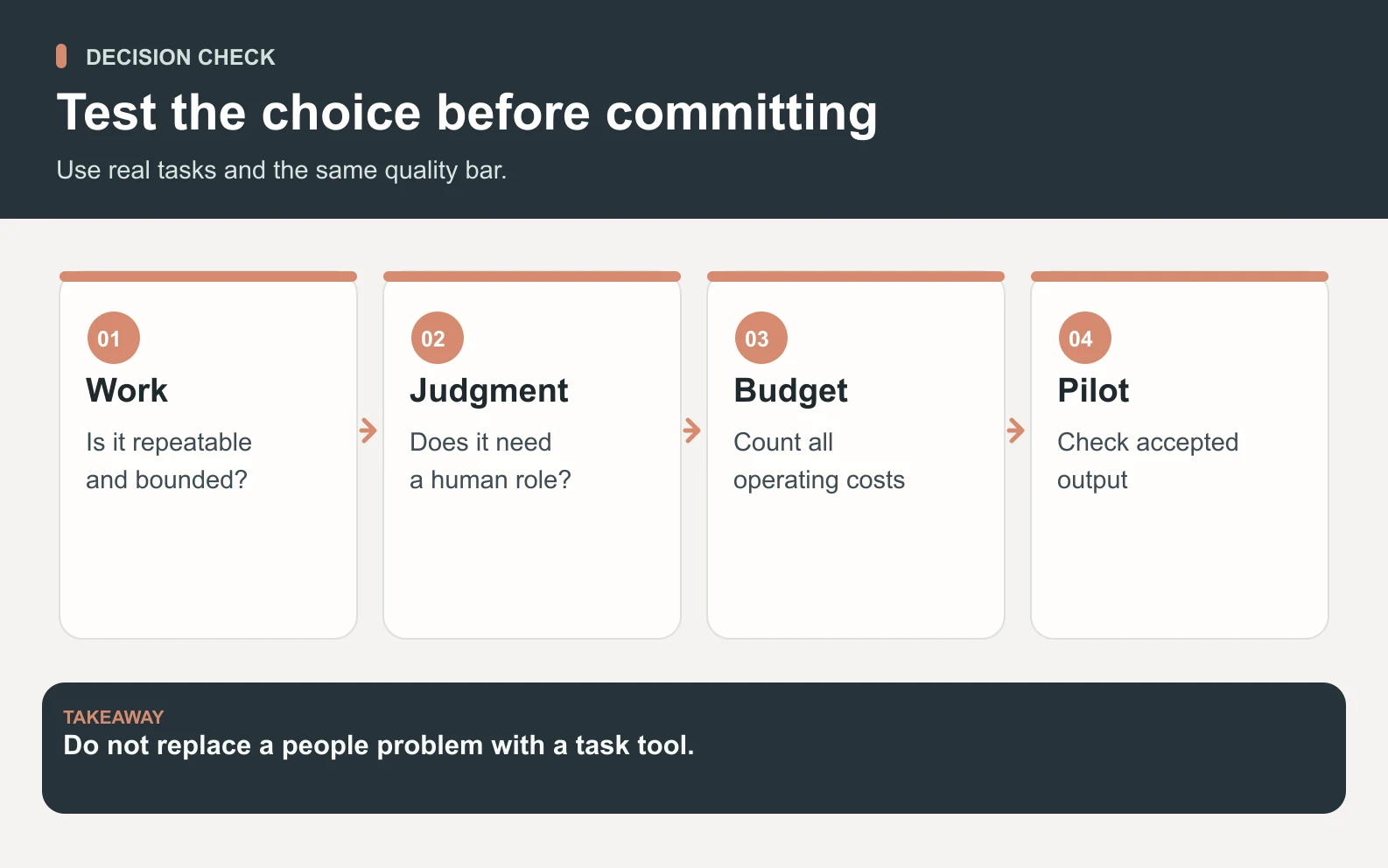
Run a four-week pilot with a narrow brief. Pick the two or three specialists closest to the work, define acceptance criteria, and track what still required founder judgment. If the same human-owned decision appears every week, the pilot has not failed; it has identified the right hire.
For Space Office, start with pricing to model the roster, review the agents to choose roles, and use how it works to understand how Hydrogen coordinates the brief. Keep the decision grounded in real work, not fear of payroll or excitement about AI.
Compare the roster and pricing before turning a task bundle into your first job description.
Plan your AI-team budgetSources and review notes
This guide uses IRS employer FICA rates for the payroll-tax example and labels benefits, recruiting, equipment, and ramp as illustrative assumptions. It is not legal, tax, HR, or compensation advice. Verify local payroll obligations and benefits costs before hiring.
Frequently asked questions
Is AI cheaper than hiring your first employee?
For task bundles, often yes. A managed AI workforce can start at $60/month plus compute and provider usage, while even a modest employee salary carries payroll taxes, benefits, equipment, recruiting, and management time. But a cheaper task system is not a substitute for a role that needs ownership.
How much does a first employee cost beyond salary?
It depends on location and benefits. In the US, employer Social Security and Medicare alone add 7.65% under IRS rates. Benefits, recruiting time, software, equipment, onboarding, and management time can add much more, so build a loaded-cost budget before hiring.
How much does Space Office cost for a small AI team?
Space Office starts at $60/month or $600/year for Hydrogen plus two chosen specialists. Additional specialists cost $25/month or $250/year each. Dedicated compute starts around $30/month, and model usage is paid directly to your provider with zero Space Office markup.
When should I hire instead of using AI?
Hire when the work is a durable role with one accountable owner, real-time judgment, relationships, or institutional knowledge that compounds. AI is better for defined task bundles; a person is better when the company needs ownership.
Can an AI workforce replace a first employee completely?
Not completely. It can replace many task outputs across several crafts, but it does not own the company outcome, build relationships, or make final business judgments. Hydrogen reviews work, and a human still approves what ships.
What is the safest way to decide?
Run a four-week AI pilot against a real task bundle. Track what was completed, what needed founder judgment, and whether the same missing role appears every week. If it does, hire for that role with better evidence.