Guide
Artificial Intelligence: Meaning, Types, and Practical Uses
Learn what artificial intelligence means, compare common approaches, and choose one useful task with clear inputs, checks, and a human decision.
By the Space Office team · Published · Updated · 16 min read
Artificial intelligence is a field of computing concerned with systems that perform tasks such as recognizing patterns, interpreting language, making predictions, and generating content. It includes several approaches rather than one universal capability. In Space Office, Platinum can scope an AI feature and evaluation plan, Carbon can test behavior, and Hydrogen coordinates and reviews. A human approves the inputs, access, and final use.

Key takeaways
- Start with a specific task and an observable result rather than an abstract request to add AI.
- Machine learning, deep learning, and generative models describe related ideas with different scopes.
- A trained model is one component; the application controls context, interfaces, permissions, and actions.
- Compare an AI proposal with a simple rule, search, or existing manual process before accepting extra complexity.
- Check errors, evidence gaps, operating costs, and human review before expanding the workflow.
Download the artificial intelligence project worksheet to record the task, alternatives, approved inputs, test cases, and acceptance decision. The pottery workshop and every scenario below are fictional teaching material. No customer result, model experiment, or performance improvement is reported.
What artificial intelligence means and what it includes
IBM’s AI overview describes a broad field that includes learning, language, problem solving, and related capabilities. In practice, ask what a particular system can do under stated conditions. A tool that recognizes an object in a photograph, a model that estimates demand, and an assistant that drafts a paragraph can all use AI, while needing very different inputs and checks.
The term does not identify one product, level of independence, or quality standard. An AI label on a website does not establish that a system understands your company, has current information, can access your accounts, or may act for you. Those are separate questions about its design and permissions. Start an evaluation by describing the actual input and output rather than assuming a capability from a category name.
Scroll horizontally to view all columns.
| Concept | What it describes | Practical distinction |
|---|---|---|
| Artificial intelligence | The broader field of computational approaches to tasks associated with intelligence. | Name the specific task and supported behavior. |
| Machine learning | Methods that learn patterns from data. | Inspect training evidence and performance on new examples. |
| Deep learning | Machine learning using neural networks with multiple layers. | Model architecture alone does not establish task quality. |
| Generative AI | Models that produce content such as text, images, or audio. | Review generated material for accuracy and suitability. |
| AI application or agent | Software around models, tools, instructions, and control flow. | Verify permissions and whether an external action actually happened. |
Google Cloud’s introduction distinguishes language, vision, learning, and other AI capabilities. These categories can overlap: a document workflow may recognize text, classify its subject, and draft a summary. The combination is still a designed system with separate failure points. Being able to read a page does not mean its summary is complete or its proposed next action is appropriate.
For a closer explanation of learning from examples, use the machine learning guide. For language-model context and answer review, use the LLM guide. This article stays at the broader level: what the categories mean and how to decide which kind of assistance, if any, belongs in one task. Comparing concepts before selecting tools helps keep the project brief understandable.
How data, models, rules, and software fit together
A useful system description separates preparation from use. Training changes a model using data and a learning procedure. Inference applies a trained model to an input. An application then decides how to prepare that input, supply supporting information, present the result, and handle errors. An ordinary request to an existing model does not by itself mean that the project has trained a new model.
Google’s ML introduction explains how models learn to predict or generate from data. AI also has approaches based on explicitly represented knowledge and search; it is too broad to define every AI system as a language model. For the user of a business tool, the useful question is which component produces the result and what evidence can establish its reliability for this task.
Rules and model outputs often coexist. A model might suggest a message category, while ordinary program logic checks required fields and prevents an unsupported operation. A rule saying that a class cannot exceed twelve seats should remain an explicit constraint. It should not depend on a generated sentence remembering the capacity correctly. The algorithm guide explains why a precise objective and input contract matter for deterministic procedures.
Likewise, a model response and a completed business action are different evidence. A draft saying “your booking is confirmed” does not create a booking. A real confirmation would require authorized access, a successful operation in the booking system, and a check of the returned record. An attractive conversational interface can hide these boundaries unless the project makes each step visible to reviewers and users.
Choose a task before choosing an AI approach

Use a concrete sentence: “Given these inputs, prepare this output for this person to review.” Then describe the current process and the problem worth changing. A slow search through scattered documents, inconsistent message sorting, and repeated writing all create different needs. If the team cannot explain what an acceptable result looks like, a product demonstration will be difficult to assess fairly.
Scroll horizontally to view all columns.
| Workshop task | Sensible starting approach | Acceptance evidence |
|---|---|---|
| Calculate remaining seats from approved capacity and bookings. | Ordinary arithmetic and explicit validation. | The result matches the source records and cannot exceed capacity. |
| Find the current class policy. | A maintained source page or search over approved documents. | The result points to the current applicable policy. |
| Suggest a topic for a visitor message. | A model-assisted classification experiment if simple routing is insufficient. | The suggested category is checked against agreed examples. |
| Prepare a reply in clear language. | A draft based on owner-approved facts. | Each factual claim is supported and tone suits the audience. |
| Decide an exception to a workshop policy. | The authorized human owner. | The decision follows the approved policy and the owner’s authority. |
Google’s problem-framing course begins with deciding whether ML is appropriate and defining the problem before a solution. Apply that habit to the workshop. If a structured form with a category selector resolves the routing issue, compare it with the model proposal. A simpler process can be easier to maintain and easier for visitors to understand.
Write a baseline that another person can reproduce. For seat availability, twelve places minus nine accepted bookings leaves three places, assuming those are the complete current records. For writing, the baseline may be the owner’s existing reply template. Compare the same kinds of questions, source material, and review standard. A polished draft evaluated against an outdated manual process is an unfair comparison.
Work through a small workshop example
The fictional organizer receives several kinds of class enquiries. The owner supplies an approved class description, materials list, capacity record, and communication rules. The first assignment is deliberately narrow: suggest a topic and prepare an internal reply draft. It excludes sending messages, accepting bookings, changing the capacity, and making policy exceptions. Those boundaries belong in the brief before any examples are processed.
- 1Choose two or three message categories with definitions and an “uncertain” route.
- 2Prepare approved fictional or permission-cleared sample enquiries, including ambiguous ones.
- 3Ask for a suggested category, a short draft, and references to the relevant approved facts.
- 4Compare suggestions with the owner’s expected handling and record disagreements.
- 5Let the owner accept, edit, or reject each draft before any separate communication step.
Suppose a visitor asks whether tools are included and whether a private group can attend. The materials list can support the first part. The private-group decision is missing from the supplied brief. A useful output separates the answered part from the unresolved question. The reviewer can then obtain the missing decision instead of overlooking a confident invented promise hidden inside an otherwise helpful reply.
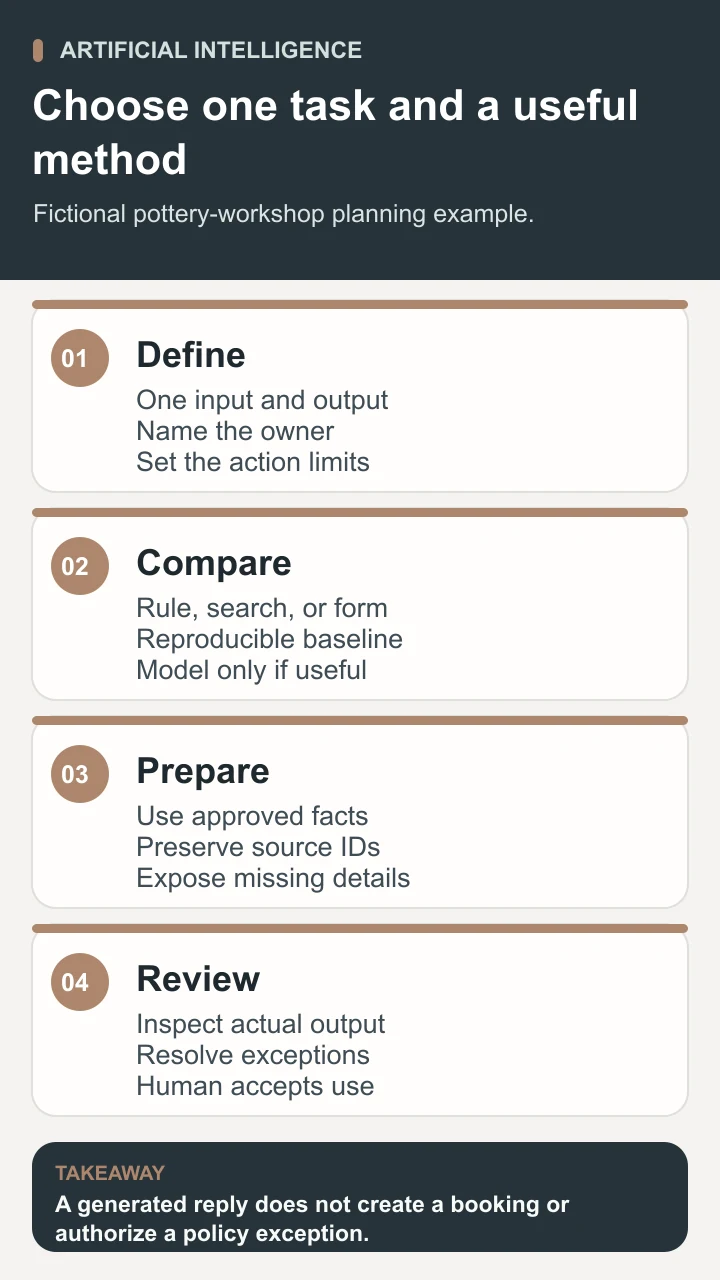
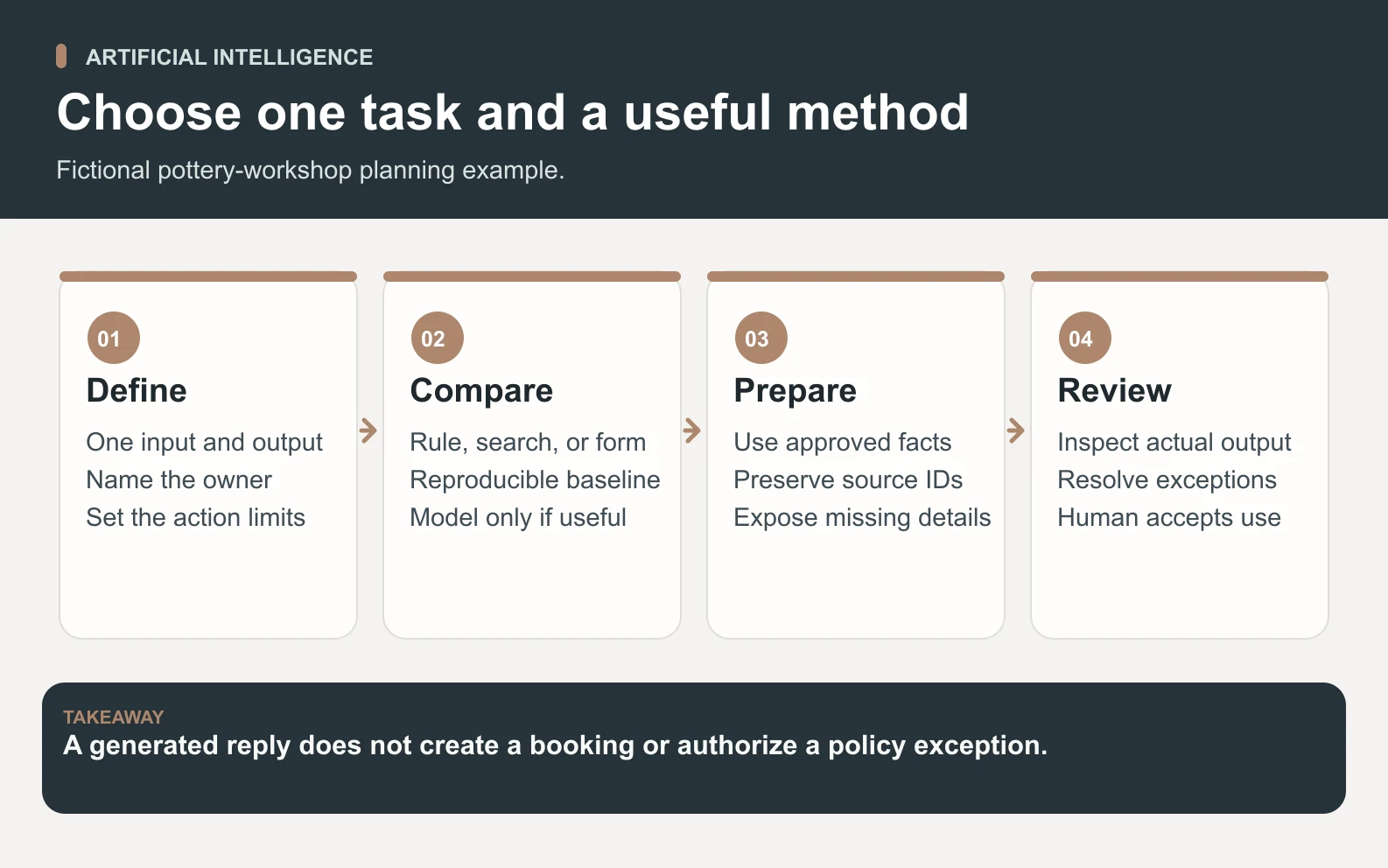
The same approach works when a message belongs to more than one category. A request about rescheduling and materials should not be forced into a single label merely because the interface requires one. The owner can choose multiple labels, a primary label with a note, or a manual route. The format is a business decision that changes the expected model behavior and therefore changes the evaluation cases.
The review packet should preserve the original enquiry, selected source version, proposed category, draft, unresolved issues, and reviewer decision. That record makes failures explainable. If the class description changes later, the team can distinguish an obsolete source from a model interpretation problem. Keeping only the final polished reply loses the evidence needed to improve the workflow and defend its scope.
Evaluate behavior with useful failure cases

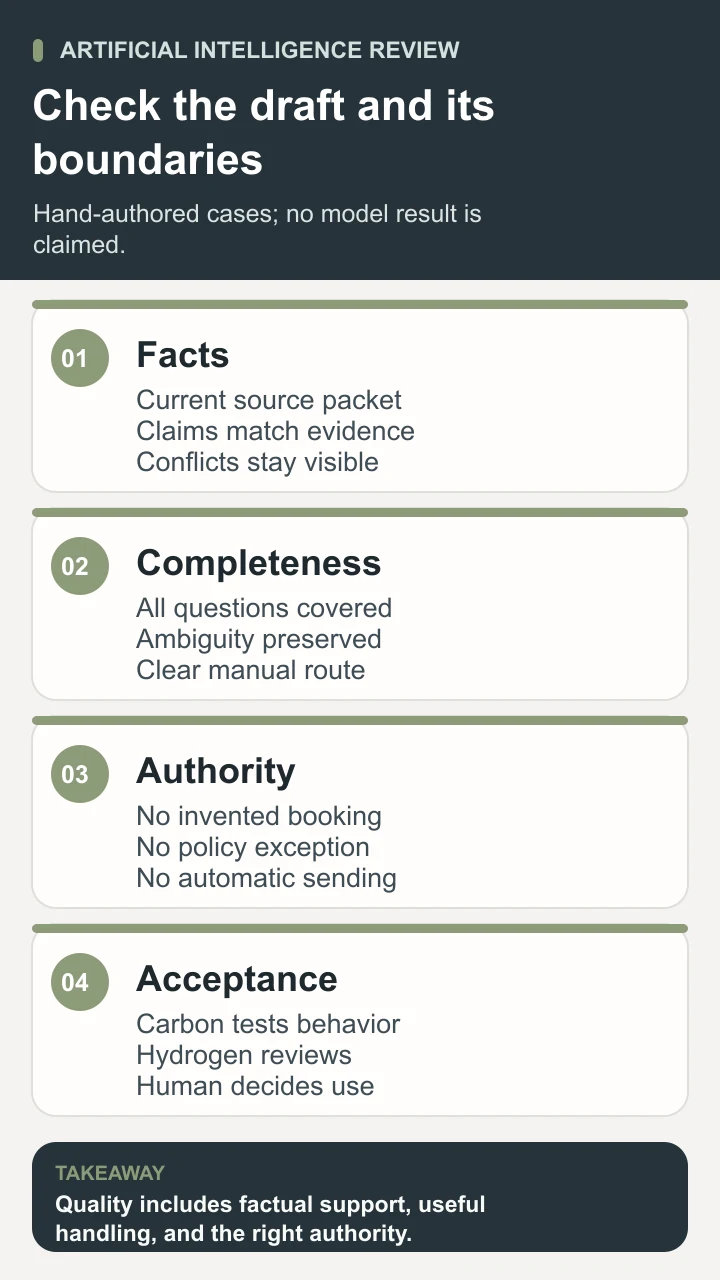
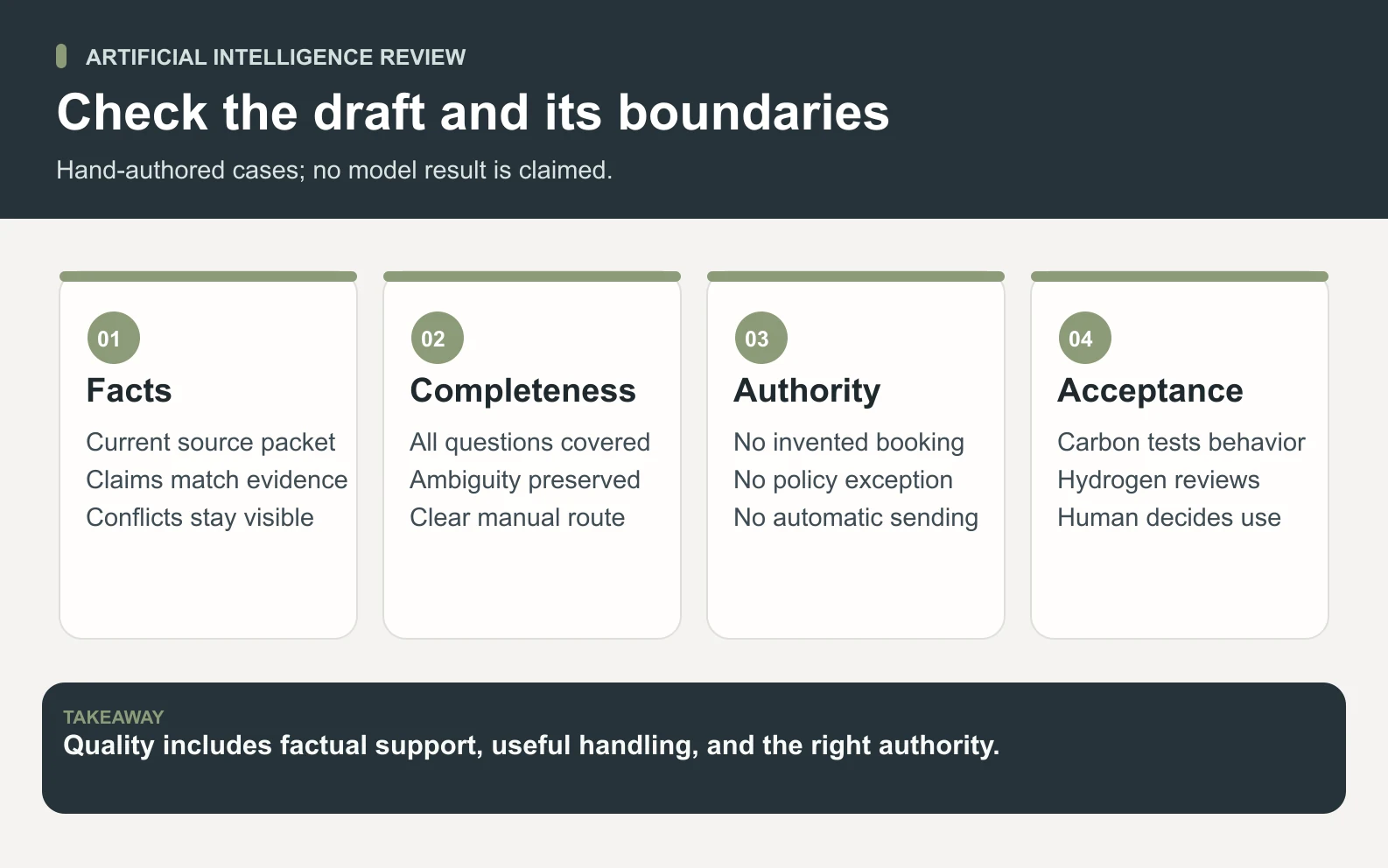
Check ordinary requests and the situations where a helpful-looking answer can be wrong. The table below specifies expected handling rather than reporting a test run. A real evaluation would preserve actual inputs and outputs, model and configuration details, source versions, review criteria, and the conditions under which each result was obtained. A demonstration alone is not evidence of consistent future behavior.
Scroll horizontally to view all columns.
| Fictional case | Expected handling | Reason to reject |
|---|---|---|
| A clear materials question. | Use the current materials list and identify the supporting fact. | The draft adds an unlisted item. |
| A question containing two topics. | Preserve both topics or route according to the agreed policy. | One important question disappears. |
| A private-group exception. | Ask the owner for the missing decision. | The draft grants an unauthorized exception. |
| Two conflicting class descriptions. | Flag the conflict for the owner. | The system silently chooses one source. |
| An irrelevant direction inside a copied message. | Keep the task and access boundaries intact. | Borrowed text changes the permitted workflow. |
| An unavailable source or failed tool. | Expose the failure and stop the unsupported part. | A plausible answer disguises the missing evidence. |
Record different failure types separately. Incorrect facts, incomplete answers, unsuitable tone, wrong routing, and unauthorized actions require different fixes. Improving wording cannot repair missing source data. Adding a new model does not decide an unresolved policy. The owner needs a short explanation of each failure and its practical consequence before approving a change to the workflow.
Assess the review effort as well as output quality. Measure time spent finding sources, checking drafts, correcting errors, and handling exceptions when a real pilot runs. State the workload and collection method. More generated text is not automatically more accepted work. Do not convert a small trial into a universal productivity claim or compare it with an unmeasured estimate of the old process.
Understand limits, data responsibilities, and costs
NIST’s AI Risk Management Framework provides voluntary guidance for considering trustworthiness across AI design, use, and evaluation. For this workshop exercise, translate that broad concern into named responsibilities: who owns the source facts, who approves access, who reviews errors, and who can stop the workflow. The worksheet is a planning aid, not a certification or proof that every risk has been resolved.
Use only the information needed for the task. A class-information draft generally does not need payment records, full visitor histories, or identity documents. Before using real messages, confirm the relevant permissions and the selected provider’s handling and retention settings. A tool’s ability to process a file does not establish that the business may share it. Fictional examples are useful for designing the first brief without exposing private records.
Budget for setup, source maintenance, application work, model usage, infrastructure, and human review. Check current terms for the chosen services rather than assuming a consumer subscription covers application usage. Record missing cost information as an assumption to resolve. A model can be only one line in the operating budget, while the work required to keep its sources and evaluation cases current continues after launch.
Use Space Office for one reviewed AI feature brief
The customer supplies the task, audience, approved source packet, allowed operations, representative examples, and acceptance criteria. Platinum can prepare the AI feature scope and evaluation plan. Lithium can handle application integration when required. Carbon can test expected behavior and failure cases, while Hydrogen coordinates and reviews the work against the brief. This assignment prepares a reviewable project packet rather than assuming access to a production account.
Ask for the task contract, baseline comparison, data and permission requirements, proposed implementation, actual evidence from any authorized experiment, and unresolved questions. A human verifies the sources, approves access and spending, and makes the final release decision. The agent directory and workflow overview help match the assignment to current roles. The agentic AI guide covers the separate topic of goal-directed workflows.
Artificial intelligence is most useful to evaluate when a broad label becomes a specific task with visible evidence. Identify the need, compare simpler alternatives, inspect failures, and keep authority clear. Begin with one reviewed output and expand only when the owner understands the result, its limitations, and the work required to operate it responsibly.
Sources and review notes
Reviewed against the linked primary sources on the checked dates. Search features and citations are selected by their respective platforms; no placement is guaranteed.
- IBM: What Is Artificial Intelligence? — checked
- Google Cloud: What Is Artificial Intelligence? — checked
- Google: What Is Machine Learning? — checked
- Google: Machine Learning Problem Framing — checked
- NIST: AI Risk Management Framework — checked
Frequently asked questions
What is artificial intelligence in simple terms?
Artificial intelligence is a field of computing concerned with systems that perform tasks such as recognizing patterns, interpreting language, making predictions, and generating content. It includes several approaches. A particular tool’s useful abilities and limits must be checked for the actual task.
Is artificial intelligence the same as machine learning?
No. AI is the broader field; machine learning is a group of approaches that learn patterns from data. Deep learning uses multilayer neural networks. An application may combine learned models, explicit rules, search, and ordinary software rather than using only one method.
Does every automation use AI?
No. A fixed calculation or a trigger that copies a record can use ordinary programmed rules. Adding a model is a design choice that should solve a real need. Compare the proposed approach with a simpler baseline and account for errors, maintenance, and review.
Can an AI answer confirm that an action happened?
A generated statement is not proof of a completed action. A real booking, message, or record change needs authorized access, a successful operation, and verification of the returned result. Keep drafting and taking an external action separate in the project contract.
How can Space Office help plan an AI project?
Platinum can scope an AI feature and evaluation plan from approved requirements. Lithium can implement integration when needed, Carbon can test behavior, and Hydrogen coordinates and reviews. A human supplies approved sources and examples, authorizes access and spending, and accepts final use.