Guide
Machine Learning: Meaning, Types, and a Worked Example
Understand machine learning by tracing a prediction task from approved examples to an honest evaluation and a human acceptance decision.
By the Space Office team · Published · Updated · 16 min read
Machine learning is a group of methods that train models to learn patterns from data and use those patterns to predict or generate outputs for new inputs. The aim is useful behavior beyond the training examples. In Space Office, Platinum can scope an AI feature and evaluation plan, Carbon can test behavior, and Hydrogen coordinates and reviews. A human approves the data, evaluation criteria, access, and final use.

Key takeaways
- Define the prediction, the time it is made, and the evidence available at that time.
- Features are inputs; labels are the outcomes used to teach or evaluate a supervised model.
- Keep training, validation, and final test roles separate, and watch for duplicates and future information.
- Choose metrics around the task: accuracy alone can hide important mistakes or class imbalance.
- A small fictional scorecard explains arithmetic; it cannot establish production reliability or business value.
Download the machine learning evaluation worksheet and fictional prediction scorecard. The tool library, records, predictions, and counts in this article are invented teaching material. No model was trained or used to generate these predictions, and the results are not a customer benchmark.
What machine learning does and how its types differ
Google’s introduction describes ML as training a model to predict or generate from data. Instead of writing a separate rule for every example, a learning procedure adjusts a model using a training objective. The result can capture useful patterns, but it can also learn accidental relationships. Performance must therefore be evaluated on examples that serve the intended use.
Scroll horizontally to view all columns.
| Approach | Learning signal | Example question |
|---|---|---|
| Supervised learning | Examples paired with known outcomes or labels. | Given information available now, which category or numeric outcome should be predicted? |
| Unsupervised learning | Structure found without supplied target labels. | Which records appear similar under a chosen representation? |
| Reinforcement learning | Feedback or rewards from actions in an environment. | Which behavior improves the defined reward over interactions? |
| Generative models | Learned patterns used to produce content. | What text, image, or other output fits the supplied input? |
Classification predicts a category, such as late or on-time return. Regression predicts a number, such as a duration. Clustering can reveal groups, but those groups do not arrive with a guaranteed business meaning. The owner still needs to interpret whether a grouping helps the task. A complex method is not automatically more appropriate than a simple model or an explicit rule.
Machine learning sits within the broader field of artificial intelligence. An LLM is a particular language-model example; this guide focuses on learning and evaluation concepts rather than prompting a chat interface. Ordinary software still prepares records, checks inputs, stores results, and controls any action around a model. Learning a pattern is not the same as receiving permission to use it.
Define features, labels, and the prediction moment
The fictional community tool library wants staff to review loans that might return late before deciding whether a reminder would help. The proposed prediction is made when a loan is issued. The label is whether the item is returned after its agreed due time. This is a planning example about a review queue, not a system that messages members or changes borrowing privileges.
A feature must be available at that prediction moment. Tool category and agreed loan length can be recorded at issue time. The actual return timestamp is only known afterward and therefore cannot be used as an input for this prediction. If a dataset accidentally includes it, the model may appear excellent while solving a task that is impossible when a new loan is issued.
Scroll horizontally to view all columns.
| Record element | Role in the exercise | Check before using it |
|---|---|---|
| Tool category | Possible input feature. | Use a consistent category vocabulary available at issue time. |
| Agreed loan length | Possible input feature. | Define units and verify the approved due time. |
| Actual late-return status | Target label. | Determine it consistently after the loan outcome is known. |
| Actual return timestamp | Information used to establish the label. | Exclude it from prediction-time inputs. |
| Member or loan-group identifier | Possible evaluation grouping aid. | Keep necessary access restricted; do not assume it belongs in model features. |
Write an operational label definition. Does a return exactly at the due time count as on time? How are approved extensions handled? What happens if a record has no recorded return because the item remains out? Resolve these cases before labeling. A missing outcome should not quietly become an on-time result. Otherwise the training target describes database quirks rather than the event the coordinator wants to predict.
Check the purpose and permissions of the records before preparing a real dataset. Initial design can use fictional samples. Later analysis should include only the information needed for the approved task and should document who may access it. Predictive convenience does not establish permission to reuse private histories, and a prediction about a loan should not be presented as a judgment about a member’s character.
Separate training, validation, and final testing
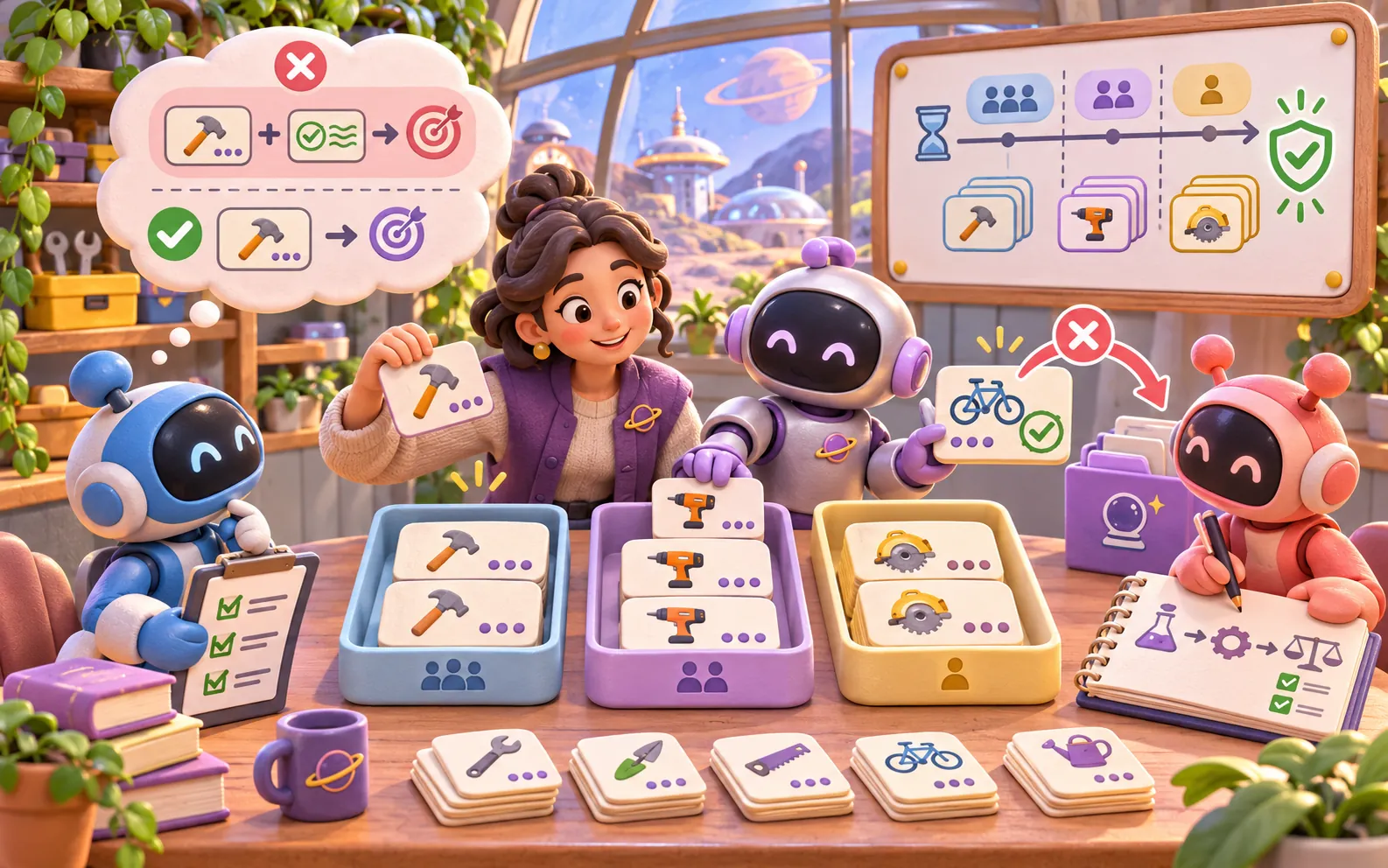
Google’s dataset guidance distinguishes training, validation, and test roles. Training fits the model. Validation helps compare development choices. A held-out test set provides a final check after those choices are fixed. A universal split percentage does not guarantee a good evaluation; the important question is whether the separation represents the intended use and preserves enough useful evidence.
For the library, loans from the same related series may be highly similar. Randomly splitting near-duplicate records can make the final check easier than predicting genuinely new circumstances. A future-facing task may also need a time-based evaluation. Decide which deployment situation matters, then document the split and any grouping constraints. The data science forecast example shows how to advance a cutoff for a one-week planning decision. Keeping related cases separate and respecting chronology can create tradeoffs that require an explicit evaluation design.
scikit-learn’s leakage guidance explains why information unavailable at prediction time can produce overly optimistic results. Fit learned preparation steps only on the training data, then apply the fitted transformation consistently to other sets. Looking at the final test outcomes to select features or settings uses that set for development, even if no one explicitly adds its rows to the training collection.
- 1Freeze the question, label definition, prediction time, and data eligibility rules.
- 2Identify duplicates, related groups, and time boundaries before assigning evaluation roles.
- 3Fit the model and learned preparation on training data only.
- 4Compare candidate choices using the designated validation procedure.
- 5Fix the chosen procedure, run the final check, and preserve the full record of outcomes.
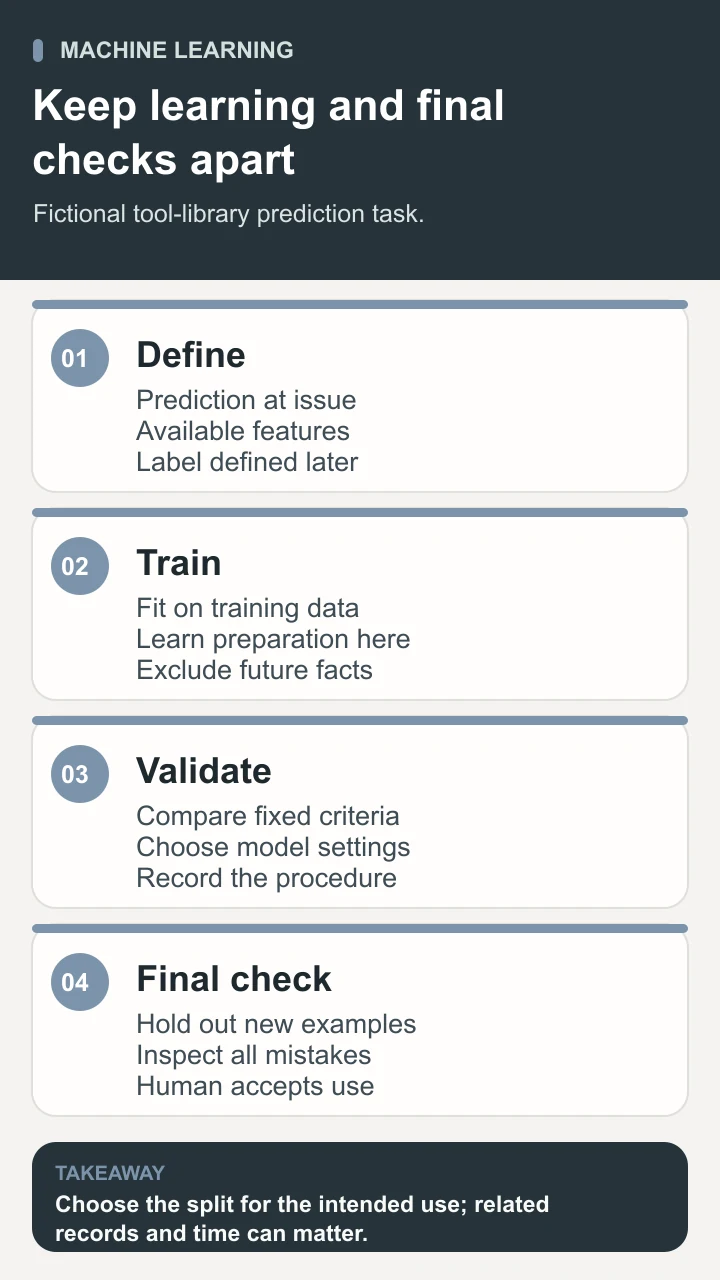
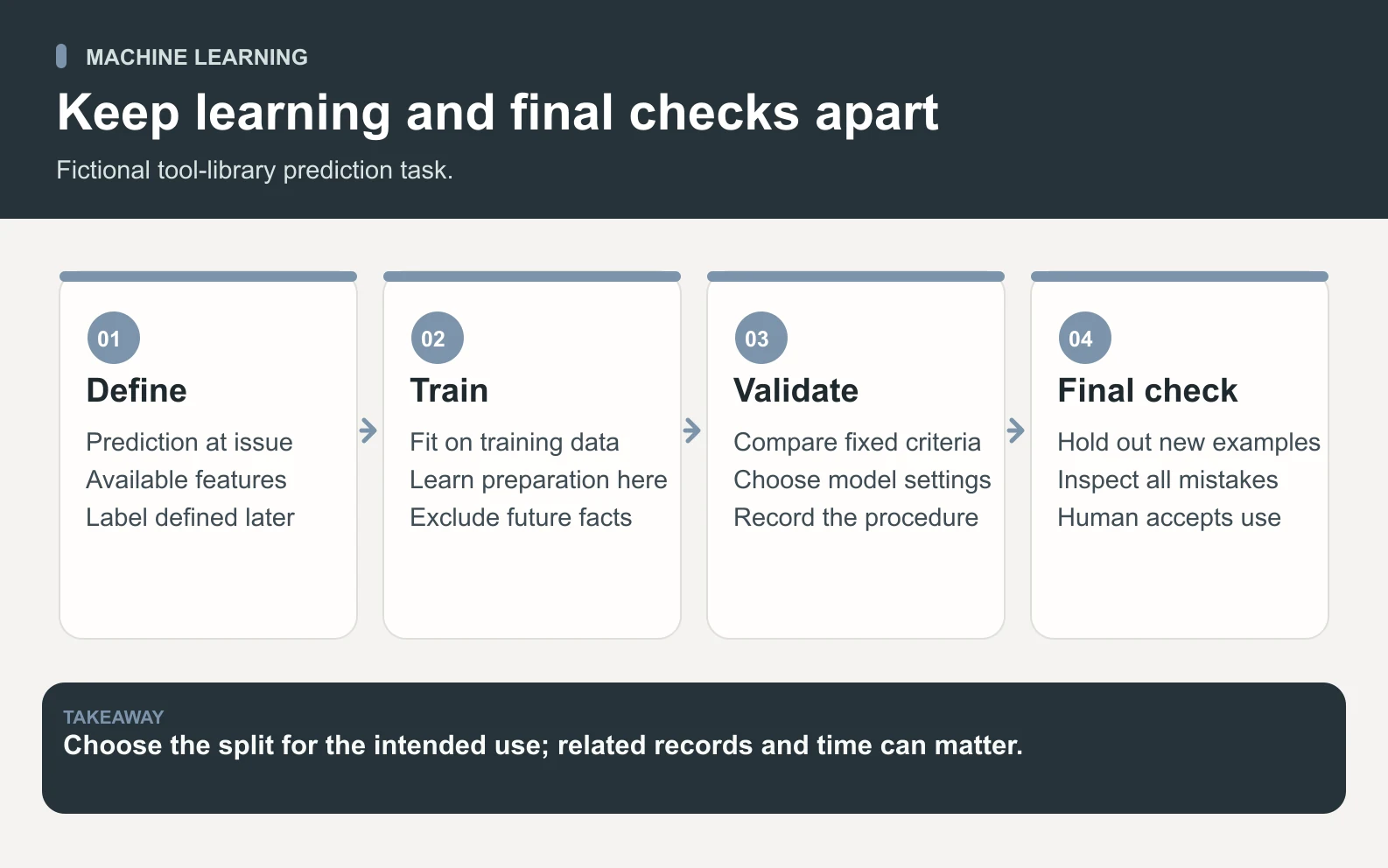
Repeatable records matter. Save the data snapshot identifier, split assignment, labeling rules, preparation steps, model and software versions, settings, and evaluation procedure. If any random process affects an experiment, record how it is controlled. Reproducibility helps explain a score; it does not by itself make the dataset representative or the chosen model useful to staff.
Read a worked classification scorecard
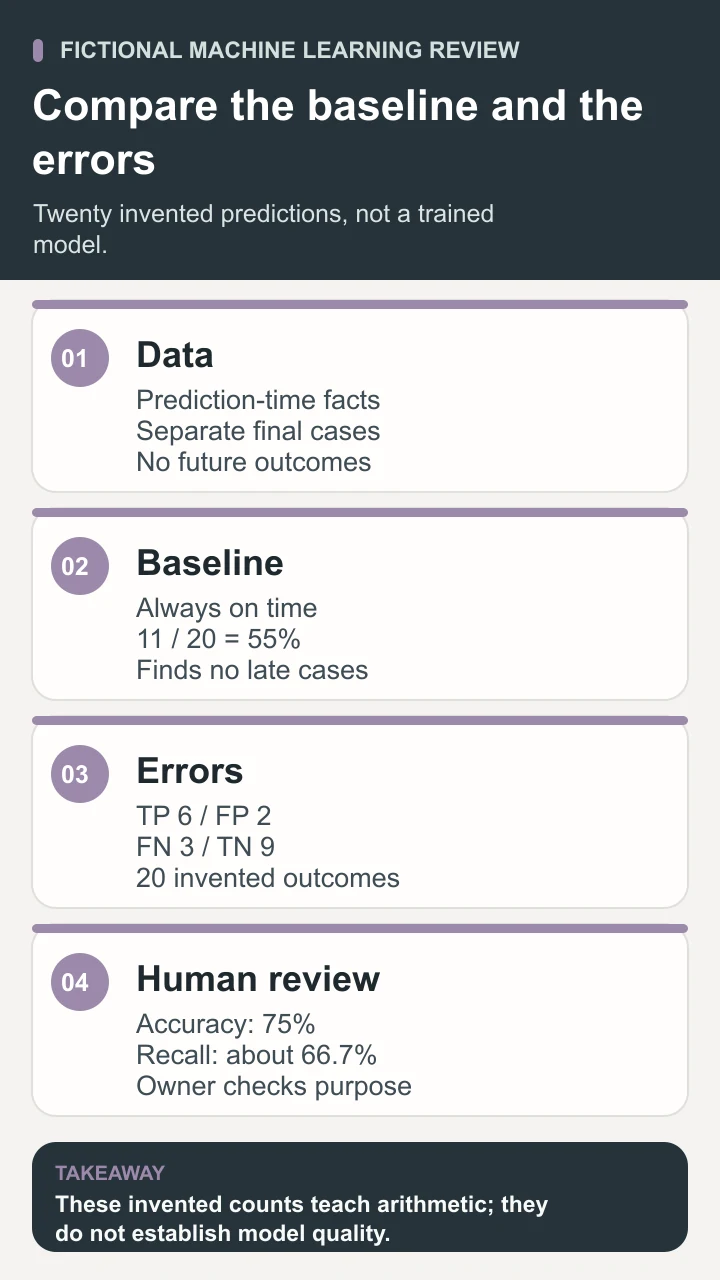
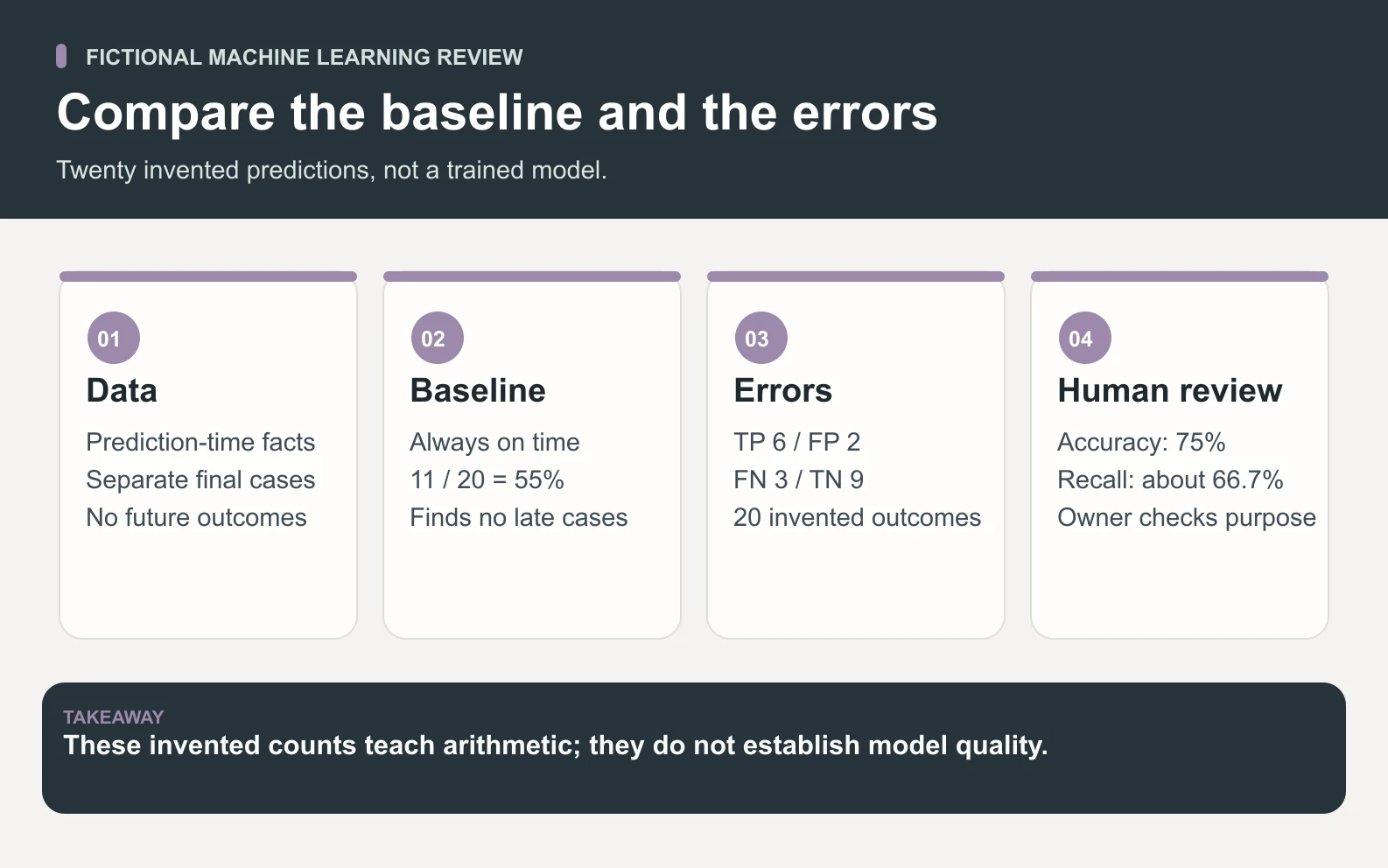
The downloadable scorecard contains twenty hand-authored predictions and twenty fictional outcomes. “Positive” means predicted late, not a desirable event. Six late loans are correctly flagged, two on-time loans are incorrectly flagged, three late loans are missed, and nine on-time loans are correctly left unflagged. These counts describe invented cases solely to make the following arithmetic inspectable.
Scroll horizontally to view all columns.
| Prediction | Actual late | Actual on time | Predicted total |
|---|---|---|---|
| Late | 6 true positives | 2 false positives | 8 |
| On time | 3 false negatives | 9 true negatives | 12 |
| Actual total | 9 | 11 | 20 |
Google’s classification metrics guide defines accuracy, precision, and recall from these outcomes. Accuracy is the fraction of all predictions that are correct. Precision asks how many flagged cases are actually positive. Recall asks how many actual positives were found. The right emphasis depends on what each kind of mistake costs in the specific workflow.
Scroll horizontally to view all columns.
| Measure | Calculation from the fictional cases | Meaning here |
|---|---|---|
| Accuracy | (6 + 9) / 20 = 75% | Fifteen of the twenty assigned categories match the fictional outcomes. |
| Precision | 6 / (6 + 2) = 75% | Six of the eight flagged loans are actually late. |
| Recall | 6 / (6 + 3) ≈ 66.7% | Six of the nine actually late loans are flagged. |
| Always-on-time baseline accuracy | 11 / 20 = 55% | A fixed on-time guess matches eleven outcomes but misses every late loan. |
The baseline is deliberately simple. It exposes whether an impressive-looking total can be achieved without learning anything useful. In a different invented collection with five late returns and ninety-five on-time returns, always predicting on time would achieve 95% accuracy while finding none of the late cases. Its late-class recall would be zero, and its precision would be undefined because it never predicts positive.
Inspect the individual mistakes before celebrating a metric. A false positive may create an unnecessary staff review. A false negative may omit a useful review opportunity. Neither count tells us whether a reminder would change the return outcome. That would require a separately designed intervention study. A prediction score cannot establish a causal benefit from an action that was not evaluated.
Look beyond one score when evaluating a model

A classifier may produce scores that a threshold converts into categories. Changing that threshold changes which records are flagged and can change precision and recall. Choose the operating rule using the development procedure and practical staff capacity, then evaluate the fixed choice. A score that looks like a probability is not automatically a well-calibrated estimate; do not interpret an arbitrary confidence display as verified certainty.
Compare performance across relevant conditions when there are enough examples to support a useful comparison. The natural language processing guide shows how to evaluate a booking label while measuring the number of messages sent to review. For the library, a tool category introduced recently or a changed loan policy may be underrepresented in old records. Report counts alongside subgroup metrics so a tiny sample does not look as authoritative as a large one. Where evidence is sparse, preserve the uncertainty and use an appropriate manual route.
Google’s overfitting explanation describes a model that fits training examples but performs poorly on new ones. A gap between development performance and held-out performance should prompt investigation. More complex models can capture accidental details. Check label quality, data separation, and the evaluation design before treating extra complexity as the solution.
Distinguish an implementation error from a modeling limitation. A date conversion bug, wrong category mapping, or changed unit can damage predictions even when the underlying model is unchanged. Inspect the complete path from source record to displayed result. Keep a small collection of known input-contract cases alongside statistical evaluation. The software procedure guide is useful for separating deterministic checks from predictive claims.
The twenty fictional cases cannot estimate performance across a real lending population. They contain no training data, recorded model, or sampling procedure. Their purpose is to teach how outcomes become metrics. A real decision needs relevant data, suitable sample sizes, uncertainty analysis, and an agreed acceptance standard. Keep that distinction in any presentation that reuses the table or worksheet.
Plan operation, monitoring, and the human decision
Google’s production guidance highlights infrastructure, monitoring, and release procedures around ML pipelines. For the library, the operational plan also needs a named owner for broken inputs, changed policies, unavailable predictions, and rollback. A model file alone cannot keep the workflow useful when the source system or business process changes.
Monitor the quality and availability of incoming records, the distribution of predictions, delayed actual outcomes, and the work required to review exceptions. Different signals answer different questions. A rising flag count might reflect a changed loan mix rather than a worse model. A lower count of recorded late returns might reflect missing outcome records. Investigate these possibilities before reporting an improvement or scheduling retraining.
Keep the prediction and any communication separate. This exercise prepares an internal staff review queue; it does not send reminders, impose fees, or restrict access. The human owner approves the appropriate follow-up after checking the record. When a model or its input service fails, define whether the system stops, uses a simpler baseline, or routes the case to manual handling. Make that behavior visible to the people doing the work.
Use Space Office for an evaluation-ready feature brief
The customer provides the business question, prediction time, approved data description, permitted access, baseline, error consequences, and acceptance criteria. Platinum can scope the AI feature and evaluation approach. Carbon can check behavior, data-boundary cases, and reproducibility of the review packet. Lithium can implement application integration when required, and Hydrogen coordinates and reviews. Do not assume that this assignment includes training a production model on private records.
Ask for a data contract, proposed split rationale, test cases, metric definitions, actual evidence from any authorized experiment, and unresolved operating requirements. A human validates label meaning and permissions, approves costs, and decides whether to release the feature. Use the current specialist roster and workflow overview to define the work. The AI development team guide helps scope the surrounding implementation and review roles.
Machine learning is useful when learned patterns answer a well-defined question on new inputs and the evidence supports the intended use. Define the prediction moment, protect the evaluation boundary, inspect errors against a simple baseline, and plan the operating responsibilities. Keep the model’s output connected to an accountable human decision rather than treating one score as permission to act.
Sources and review notes
Reviewed against the linked primary sources on the checked dates. Search features and citations are selected by their respective platforms; no placement is guaranteed.
- Google: What Is Machine Learning? — checked
- Google: Dividing Datasets — checked
- Google: Accuracy, Recall, and Precision — checked
- scikit-learn: Common Pitfalls and Data Leakage — checked
- Google: Overfitting — checked
- Google: Productionization — checked
Frequently asked questions
What is machine learning in simple words?
Machine learning is a group of methods that train models to learn patterns from data and use those patterns to predict or generate outputs for new inputs. Useful evaluation checks whether behavior extends beyond the examples used to build and choose the model.
What is the difference between a feature and a label?
A feature is an input available when a prediction is made. A label is the target outcome used to teach or evaluate a supervised model. In the fictional loan example, agreed loan length can be a feature, while actual late-return status is the label learned afterward.
Why separate training, validation, and test data?
They serve different roles: fitting the model, comparing development choices, and checking the fixed choice on held-out examples. Duplicates, related records, future information, and learned preparation can leak information across those boundaries. Design separation around the actual intended use.
Is 95% accuracy always good?
No. In the invented example with ninety-five on-time returns and five late returns, always predicting on time gets 95% accuracy but misses every late case. Inspect class counts, precision, recall, error consequences, and a suitable baseline before judging usefulness.
Can Space Office help evaluate a machine learning feature?
Platinum can prepare feature scope and an evaluation plan, Carbon can check behavior and the review evidence, and Lithium can implement integration when needed. Hydrogen coordinates and reviews. The customer supplies approved requirements and data permissions, while a human approves access, spending, and release.