Guide
Customer Service: Skills, Examples, and a Small-Team Workflow
Build customer service around checked facts, a clear next owner, and an outcome the customer can understand.
By the Space Office team · Published · Updated · 18 min read
Customer service is the assistance a business provides before, during, and after a purchase. It combines useful answers, problem resolution, and follow-through. Good service makes the next step clear and gives it an owner. This guide follows a fictional bicycle repair request. In Space Office, Gold can prepare post-sale context and follow-up drafts, Carbon can check the response cases, and Hydrogen reviews the work before a human owner approves the message.

Key takeaways
- Start with the customer’s actual question and the approved source that can answer it.
- Give every open request a next owner, action, and update commitment.
- Keep acknowledgment, useful response, and resolution separate in the record.
- Read response speed beside open work, reopened cases, and feedback denominators.
- Test a small workflow before expanding templates or automation.
What customer service covers
Customer service helps someone understand an offer, use what they bought, and resolve a problem. It can happen at a counter, by phone, through email, or in a digital conversation. The channel changes how the exchange works, but the business still needs a useful answer and an accountable next step. Salesforce’s customer service overview describes this assistance across the customer relationship.
For a small bicycle repair shop, service begins when a rider asks what a booking includes. It continues when staff explain a quote, check progress, arrange collection, or investigate a question after the visit. The mechanic owns the technical work. The person handling the request owns communicating verified information and making sure the right colleague receives any unresolved issue. A friendly reply is valuable when it helps the rider understand what happens next.
Customer support often focuses on helping someone use a product or fix a particular problem. Customer success looks more broadly at whether a customer reaches their intended outcome over time. Teams can combine these responsibilities, but naming the task helps avoid an ownership gap. The shop should know who answers a collection question today even if it has no separate support department. Our customer relationship management guide explains how records preserve the context around those exchanges.
Service quality is visible in small operational details: whether a stated opening time is current, whether the same quote appears in the job record and the reply, and whether a promised update actually arrives. Start by identifying the questions people already ask. A short list of recurring requests gives the team a more useful starting point than a long collection of generic scripts.
Skills that make a response useful
Scroll horizontally to view all columns.
| Skill | What it looks like | What to check |
|---|---|---|
| Listening | Restate the rider’s actual question before proposing an action. | Did the reply address the request, including its timing? |
| Clear explanation | Separate a confirmed fact from something the mechanic must check. | Can the rider tell what is known and what is pending? |
| Empathy | Acknowledge the inconvenience in ordinary language. | Does the tone fit the situation without making an unsupported promise? |
| Judgment | Recognize when a quote, exception, or technical question needs its owner. | Was the request routed with enough context? |
| Follow-through | Record the next update and confirm the completed step. | Did the owner do what the customer was told? |
A useful acknowledgment is specific. “I understand you expected to collect the bicycle today. I am checking the job record with the mechanic and will update you by our agreed time” tells the rider what staff are doing. Only include a time the team can support. “We always resolve this immediately” creates an obligation that the person replying may be unable to fulfill. Staff should have a clear way to ask for help when they cannot make the promised update.
Use a short question when the request is ambiguous. A rider who writes “Is it done?” might mean a repair, a quote, or a payment confirmation. Ask for the approved job reference through the appropriate channel rather than guessing which record belongs to them. Keep the request proportionate: staff rarely need a long personal history to locate a booking. A public comment can invite the rider to a private contact route when account-specific details are needed.
Write for the person receiving the answer. Explain a status label such as “waiting for approval” in terms of the decision needed and how to provide it. Avoid internal shorthand that makes a routine exchange harder to understand. Read the response aloud during training and ask a colleague to identify the next step. If two reviewers interpret it differently, simplify the wording before using it as an example.

Build a simple request-handling workflow
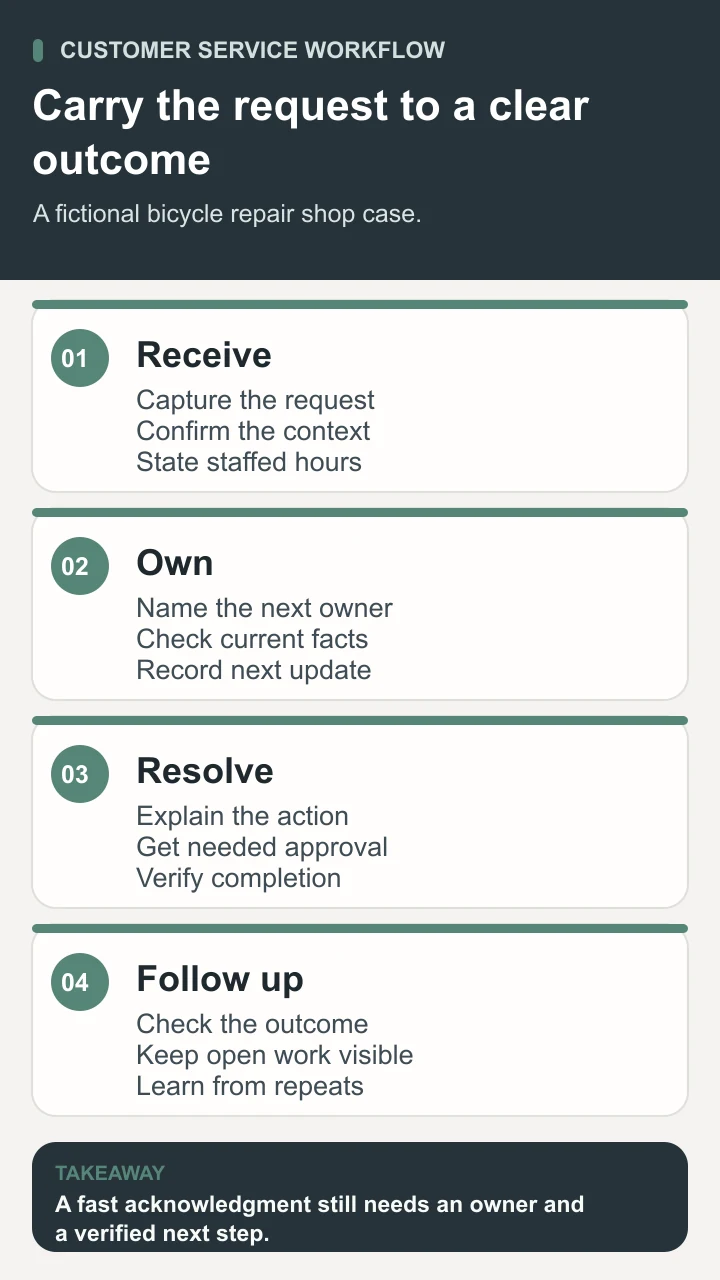
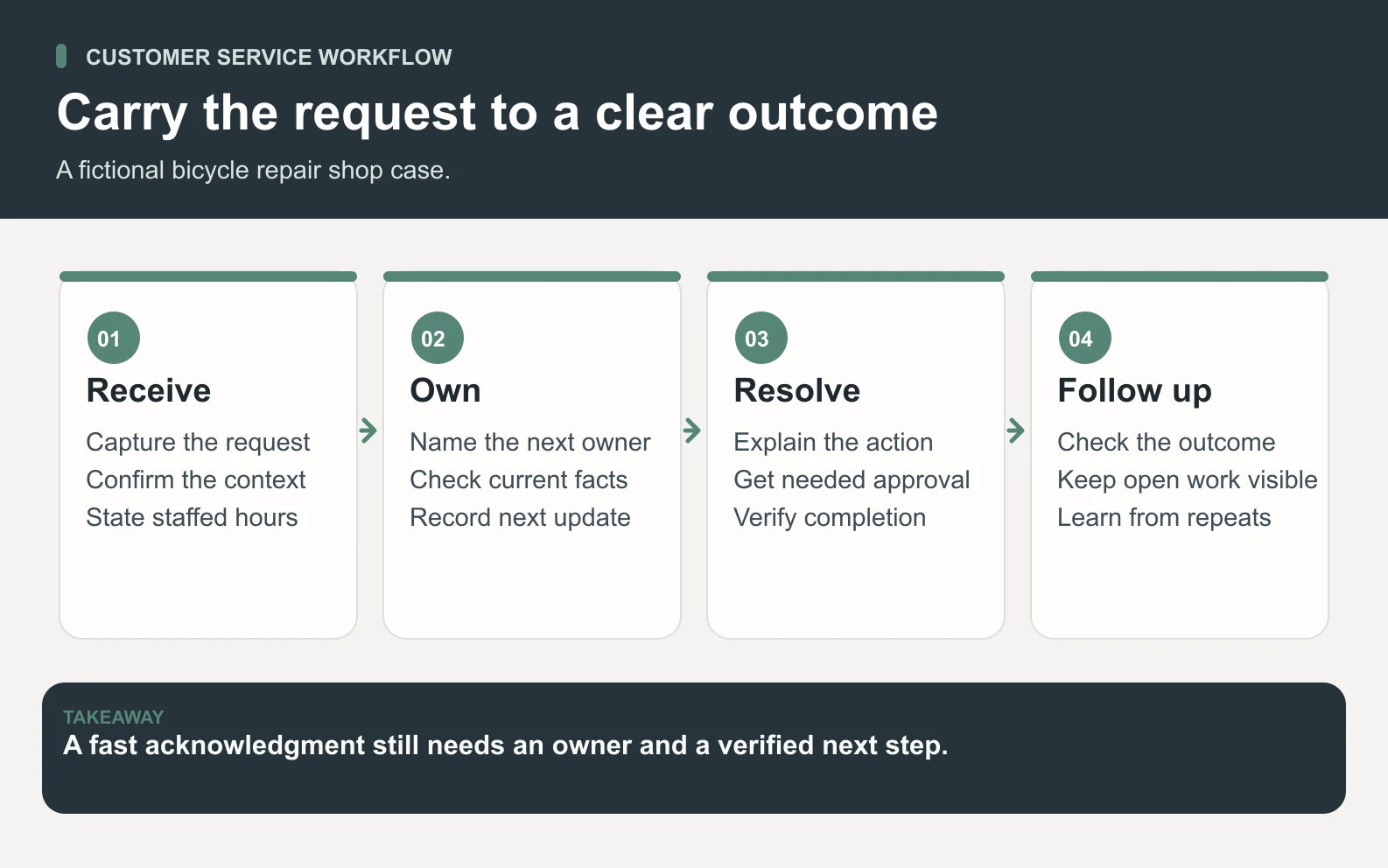
- 1Receive the request in a channel the team actually monitors. Record the question, the received time, and the minimum approved identifier needed to find its context.
- 2Confirm the task and check the relevant source. Use the current job record, published information, or approved policy, and mark anything that needs a colleague’s confirmation.
- 3Assign one next owner. Give that person the question, the facts already checked, the action required, and the next update expected by the customer.
- 4Prepare the response or action. Get the required approval for an exception or commitment, then communicate what has actually happened and what remains open.
- 5Verify the outcome. Check that the promised step occurred, record unresolved work, and follow up when the customer’s original question still needs an answer.
These steps can live in a shared queue before the team buys a sophisticated service platform. Each open request needs a status, an owner, and a next action. Define what the statuses mean. “Waiting for mechanic” should identify which fact is missing. “Waiting for customer” should identify the question already sent. A record that simply says “pending” gives the next person little help when the original staff member is away.
Choose staffed hours and update commitments from actual capacity. An email sent on Sunday night can receive an acknowledgment that explains when the team returns, while the first useful response follows during the published service period. Keep automated receipt messages distinct from a reply that addresses the question. This prevents a fast automated message from disguising a request that nobody has reviewed.
Specify what a handoff preserves. The second person should receive the rider’s question, the job reference, the relevant prior response, and the unresolved decision. The rider should know whether to wait for an update or take an action themselves. Transferring the message without an owner can leave both colleagues expecting the other to respond. Review a few handoffs from the customer’s side to see where this uncertainty appears.
Worked example: a delayed repair request
The following case is fictional. At 9:10 on a staffed Tuesday, a rider asks whether a bicycle can be collected at 17:00. The job record shows a part has arrived but contains no completion confirmation. The owner can confirm receipt of the question and check with the mechanic. The arrival of a part alone does not establish that the repair is complete. The reply should preserve that distinction.
Scroll horizontally to view all columns.
| Stage | Observed fact or agreed action | Customer-facing meaning |
|---|---|---|
| 9:10, intake | Rider asks about collection at 17:00. | The requested outcome is a collection decision. |
| 9:25, useful reply | Staff confirm they are checking completion and will update by 11:00. | The rider knows who is checking and when to expect the next answer. |
| 10:40, internal check | Mechanic confirms additional work needs the rider’s approval. | Staff have a decision to explain, rather than a completed repair to promise. |
| 10:50, next response | Owner sends the approved explanation and asks for the required decision. | The request stays open while the rider decides. |
| Later, verification | Staff record the rider’s decision and confirm the actual collection arrangement. | The final update reflects what the team can deliver. |
The first useful response takes 15 elapsed minutes in this example. The later response explains a decision but does not mean the customer’s task is finished. If the rider replies the next day, preserve that waiting period in the case history. Decide whether your service reports use elapsed time or staffed business time, then apply the same definition to comparable cases. Different clocks answer different operating questions.
A suitable draft might say: “The mechanic has reviewed the job and needs your approval for the additional work described in the quote. Please use the reply route below to confirm your decision. We will confirm the collection arrangement after that step.” The owner must insert the actual approved quote and contact details. The draft cannot create a new price, make a technical diagnosis, or say the bicycle is ready without evidence.
Review the case after it ends. If the rider had to ask because no progress update was sent, the improvement may be an earlier internal reminder. If staff could not find the quote, the improvement may be a clearer record link. The most useful change addresses the source of repeated uncertainty. Training everyone to send a warmer first sentence would leave those operational causes in place.
Measure speed, resolution, and open work together
Define the reporting population before calculating a result. A report of requests created this week differs from a report of requests solved this week, because some solved cases began earlier. Zendesk’s Support dashboard documentation distinguishes ticket, efficiency, backlog, and satisfaction reporting. Use your tool’s definitions and inspect whether its time filters refer to creation, activity, or resolution.
For a separate fictional weekly cohort, suppose the shop receives 40 distinct requests. By Friday’s cutoff, 30 meet the team’s solved definition and 10 remain open. Five of those open requests are waiting for a customer decision, while five require a staff action. The cohort’s solved share at that cutoff is 30 divided by 40, or 75%. It describes those 40 requests at that time; it is not a general promise about service reliability.
Now inspect the 30 solved requests. If three later reopen within the stated review window, record that fact beside the original solved count. A closure label can precede a lasting outcome. Look at why each reopened: an unclear instruction, an incomplete action, a new question, or an unrelated issue. Use consistent classification rather than treating every new message as proof that the original resolution failed.
For satisfaction feedback, keep both the rating rule and response count visible. Suppose 12 people respond to the same survey and nine meet its defined positive threshold. The positive share is 9 divided by 12, or 75%, among respondents. It does not describe the 28 people who did not respond. Zendesk’s CSAT guidance explains how configured scales map to positive and negative ratings. Record the actual scale used in your own survey.
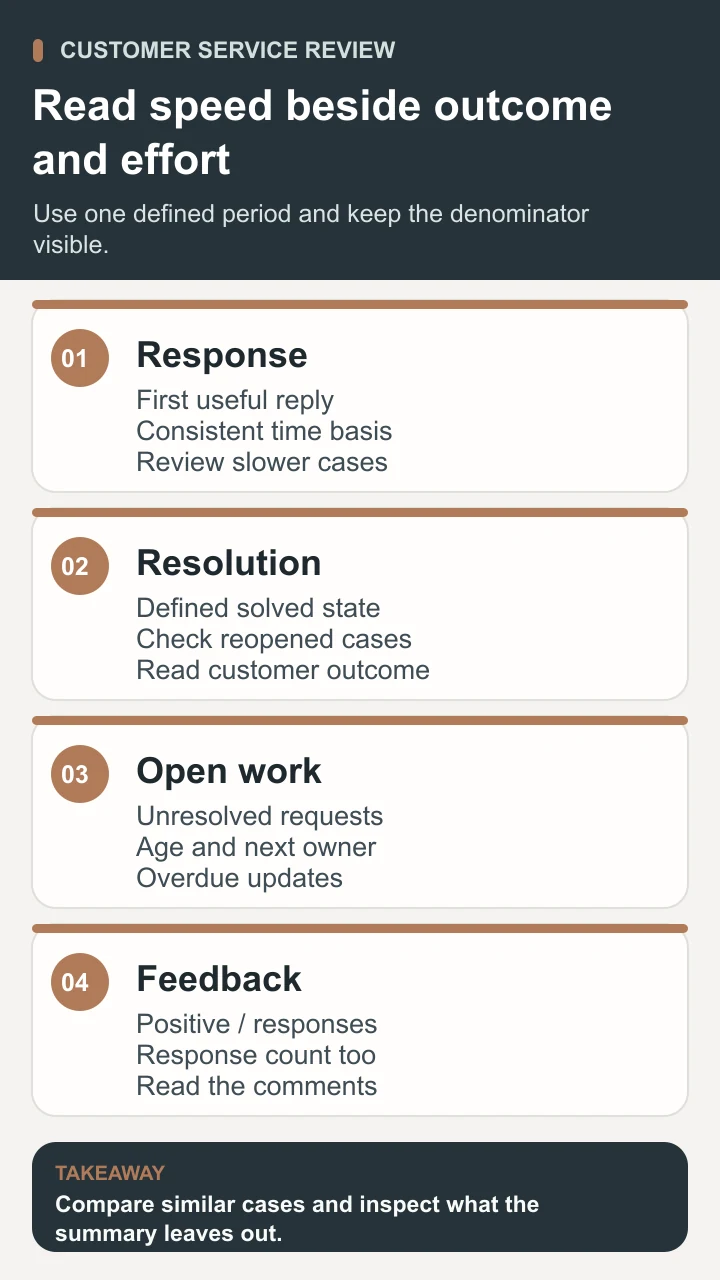
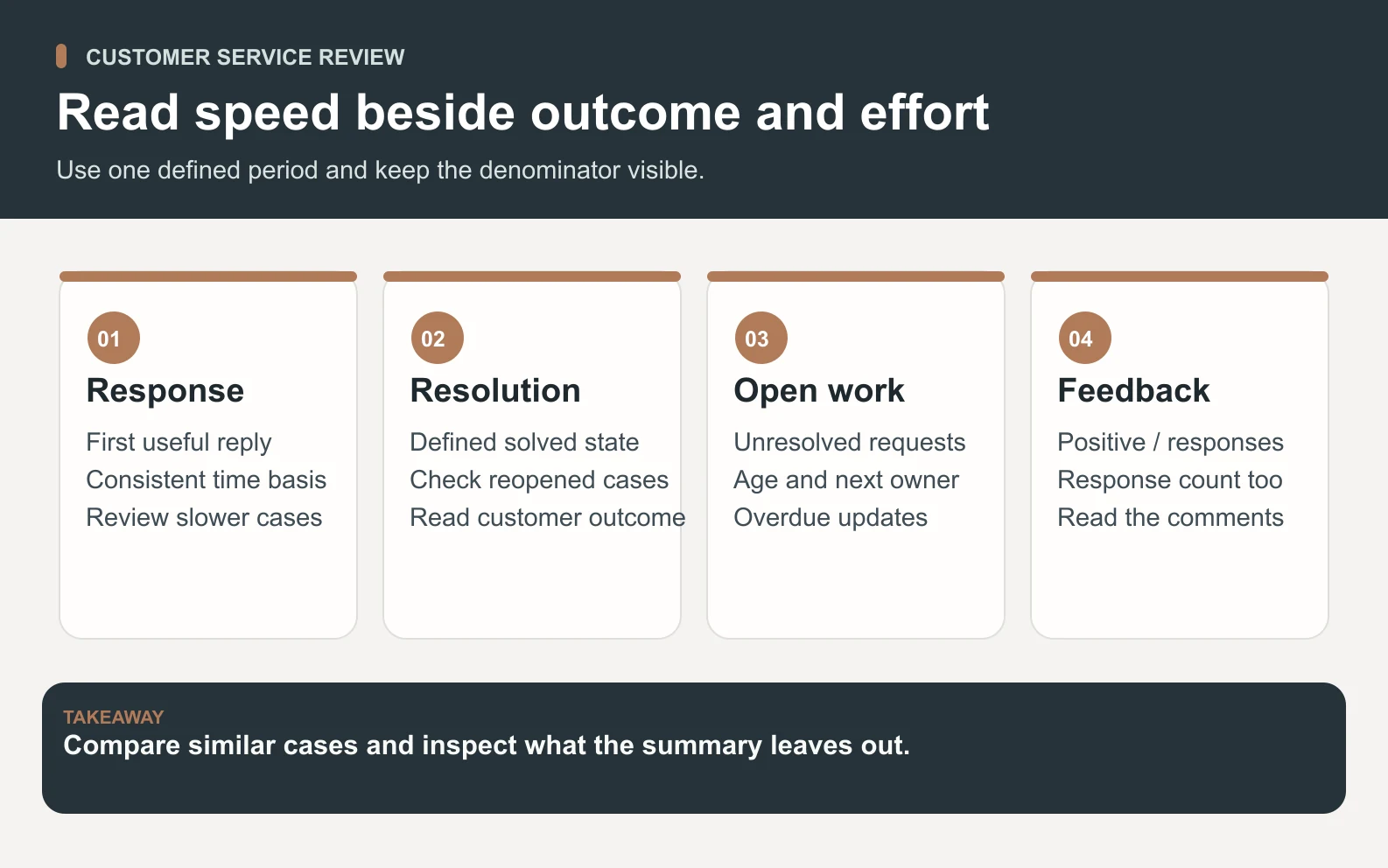
Use a median and a slower-case review when response times vary widely. A short reply to a simple opening-hours question and a complex quote investigation require different work. Segment those cases before interpreting a change in the overall figure. A weekly average can move because the request mix changed. Read several slower cases and determine whether time was spent waiting for a missing source, an approval, or available staff.
Improve the process before adding automation
Choose one recurring failure to improve first. For the shop, that might be unanswered collection questions after a colleague changes shifts. A small change could require an owner and update time before a case enters the handoff queue. Run the revised procedure with a few approved examples, ask another staff member to take over, and check whether they can finish the task from the record.
Templates can help with structure: acknowledge the question, state the checked fact, explain the next step, and name the update route. Keep the variable facts visible to the person editing the message. A template becomes risky when an old price or response-time promise survives unnoticed. Assign an owner to review the template when a policy changes, and test a difficult example before making it the default.
Automation can collect a request, suggest a category, retrieve a public answer, or prepare a draft. Each function needs an agreed scope and a way to handle exceptions. Our AI chatbot guide covers testing a conversational interface, while AI customer support agents covers delegated service work. This broader process remains useful when every response is written by a person.
Download the customer service review worksheet to record the workflow, rehearse the repair case, and recalculate the weekly measures. It separates a received message, a useful response, a required decision, and a verified outcome. Replace the fictional details with approved examples for your business and keep customer-specific data in the systems authorized for it.

Prepare a reviewed service workflow with Space Office
In the Space Office workflow, give Hydrogen the approved service policy, staffed hours, anonymized example requests, and named escalation owners. Gold, the Customer Success and Retention Specialist, can prepare post-sale issue summaries, follow-up drafts, and escalation context. Carbon, the Senior QA Engineer and Test Strategist, can check agreed cases for factual support and a clear next step. Hydrogen coordinates and reviews the work. The human owner approves policy, access, and the final customer message.
A bounded first assignment is a reviewed packet: a request map, five draft responses, a handoff checklist, and an exception log. Supply only the records and access required for that agreed task. Ask the reviewer to include an incomplete job record, a conflicting update, and a request that needs an owner’s decision. The live specialist roster describes the available roles. A completed draft still needs the business to verify the underlying facts and decide what to send.
Make the next customer service step clear
Customer service works when the customer can understand the answer, the team owns the next action, and the recorded outcome matches what happened. Start with one recurring request, make its sources and handoff visible, and check it from the customer’s perspective. Measure response speed alongside resolution, open work, and feedback. Then improve the specific step that creates uncertainty instead of adding more messages around it.
Sources and review notes
Reviewed against the linked primary sources on the checked dates. Search features and citations are selected by their respective platforms; no placement is guaranteed.
- Salesforce introduction to customer service — checked
- Zendesk Support activity and performance metrics — checked
- Zendesk CSAT rating interpretation — checked
Frequently asked questions
What is customer service?
Customer service is the assistance a business provides before, during, and after someone buys or uses its products or services. It includes answering questions, explaining next steps, and resolving problems. A useful process connects the customer’s request to checked information, a responsible owner, and a clear outcome.
What is an example of good customer service?
When a rider asks about a repair, staff check the job record, explain what is confirmed, and name the next update if a mechanic must verify a detail. They follow through on that update and confirm the collection arrangement when it is actually agreed. The quality comes from clarity and follow-through.
Which customer service skills should a small team practice?
Practice listening, clear explanation, empathy, judgment, and follow-through using real approved examples. Review whether the response answers the actual question, separates known facts from missing information, and leaves the customer able to identify their next step.
How should a team measure customer service?
Use defined response and resolution times, open-request age, reopened cases, and feedback with visible response counts. Keep the case population, reporting cutoff, time basis, and rating scale consistent. Read individual cases to understand what a summary number leaves out.
Can AI handle customer service automatically?
An application can assist with specific tasks when the approved sources, permissions, integrations, and exception route support them. Test those tasks and keep an accountable owner. Draft preparation does not establish that a repair is complete, a policy exception is approved, or a message has been sent.