Guide
Generative Engine Optimization: A Practical Guide to Becoming a Useful Source
Use generative engine optimization to build a verifiable source page, with Space Office specialists helping research, draft, review, and measure the work.
By the Space Office team · Published · Updated · 15 min read
Generative engine optimization (GEO) is the practice of making a website's information easier for generative search systems to find, understand, and use in an answer. Start with accessible pages and clear claims backed by evidence. In Space Office, Neon can audit the page and search data, Nitrogen can draft the content, and Hydrogen can review the handoff before a person approves publication. Measure observed queries and referrals; no format or workflow guarantees an AI citation.

Key takeaways
- Keep important claims in visible, crawlable page content with clear titles, headings, and internal links.
- Give an answer enough evidence to be useful: definitions, methods, dates, examples, and source links where they matter.
- Separate verified search and referral data from AI citation observations; each platform reports a different slice of activity.
- Improve one page for one reader need, record the change, and compare matching periods rather than claiming a ranking guarantee.
- Use Neon for the search audit, Nitrogen for the sourced draft, Hydrogen for coordination, and a human owner for final approval.
What is generative engine optimization?
The term GEO comes from research on generative search systems. In practice, it describes work that makes a source easier to discover and more useful when an answer is assembled. The research introduced the term and tested approaches in its own setting; it does not establish a universal ranking formula for today's products. Use GEO as a planning lens, then follow each search platform's published requirements.
Traditional search can send a reader to a page of results. Generative interfaces may also synthesize an answer and cite selected pages. The same reader can move between both. Google says its AI features use ordinary Search fundamentals and require a page to be indexed and eligible for a snippet to appear as a supporting link. There is no separate AI-specific optimization requirement or assured inclusion.
Imagine a founder searching for a way to brief an AI team on an SEO page. A generic landing page that says the team is powerful gives an answer system little to verify. A useful source page instead names the input, the relevant specialists, the review boundary, and the result a customer can reasonably expect. The same detail helps a human judge the service. That is the practical GEO question for a Space Office page: if a reader landed here without seeing any search result, could they check the explanation and decide what to do next? A citation is a possible downstream outcome, not the editorial brief.
How Space Office helps prepare a GEO source page
A practical Space Office brief is one URL, one audience question, and approved evidence. The page owner can supply a page-filtered Search Console export or approved account access. Neon, the SEO and discovery specialist, can inspect access, query intent, source gaps, and internal links. Nitrogen can turn that brief into clear page copy. Hydrogen coordinates the handoff and reviews specialist output; a person checks the claims and decides whether to publish. Account access and a specialist name do not imply an automatic connection, a live deployment, or a citation outcome.
Start the brief with the current canonical URL, the intended reader, the one question the page should answer, and any approved product facts or customer examples. Add a dated export of relevant page queries if the owner has one. Ask Neon to return an audit rather than an unexplained score: which parts of the page are accessible, which claims need support, which related pages already cover the topic, and which internal links would help a reader. Nitrogen can then draft the answer, headings, and evidence notes against that audit. Hydrogen can identify missing inputs or conflicts for the owner. This sequence gives the reviewer concrete artifacts to accept, revise, or reject.
For example, a draft might say that Space Office publishes an SEO article automatically. If the approved brief establishes only research and drafting support, the reviewer should remove that claim and describe the human publication step. The same check applies to prices, integrations, customer outcomes, and agent availability: cite the current product page or approved internal source, or leave the assertion out. Product relevance does not excuse loose evidence. A useful GEO page can explain what the team helps prepare while being precise about what remains the customer's decision.
Scroll horizontally to view all columns.
| Space Office role | Bounded contribution | Human check |
|---|---|---|
| Neon | Audit the chosen page, search intent, access, and source gaps. | Confirm the supplied data and target URL. |
| Nitrogen | Draft the direct answer and supporting explanation. | Verify claims, citations, and brand voice. |
| Hydrogen | Coordinate the brief and review the specialist output. | Approve the final page and publication decision. |

How generative engine optimization builds on SEO
Scroll horizontally to view all columns.
| Work | Why it matters | What to verify |
|---|---|---|
| Technical access | A system must be able to fetch the relevant content. | The canonical page loads, is indexable where needed, and is linked internally. |
| Answer quality | A concise claim helps a reader understand the subject. | The claim is visible, accurate, and supported by detail on the same page. |
| Source quality | Specific evidence makes a page worth checking. | Examples, methods, dates, and primary references are attributable. |
| Measurement | Search and referral reports reveal different outcomes. | Dates, filters, sample size, and limitations are recorded. |
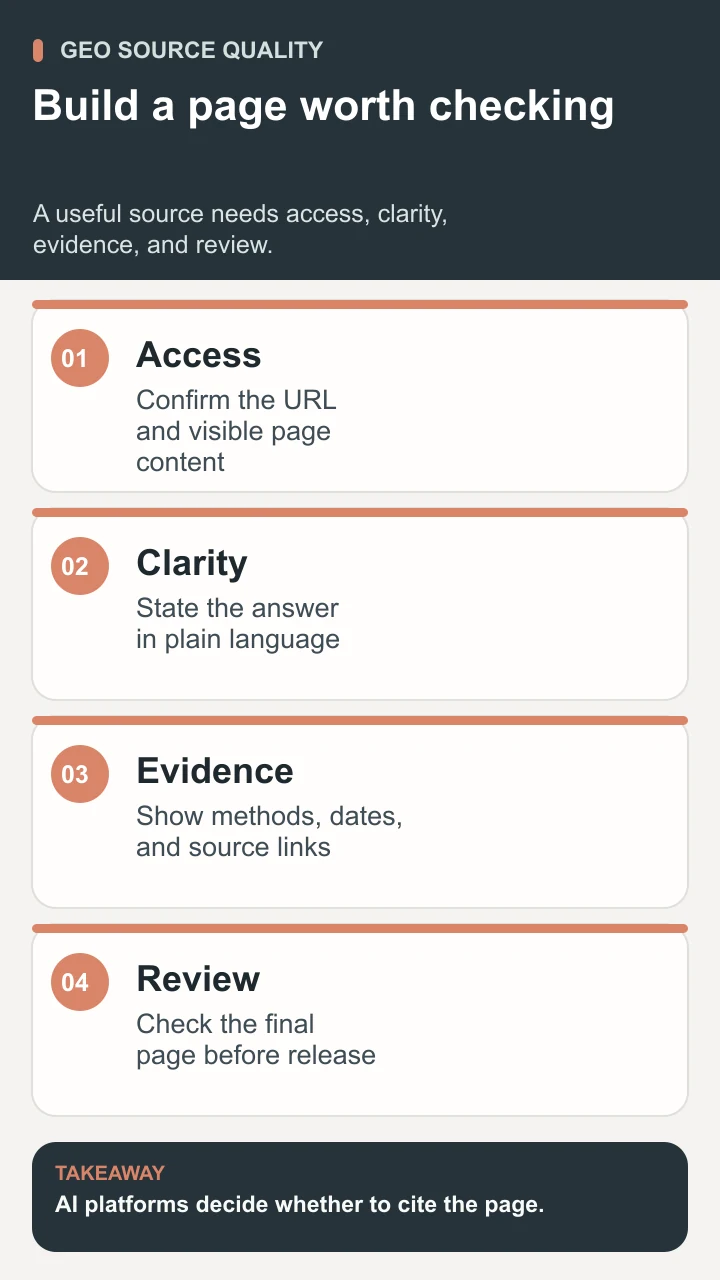
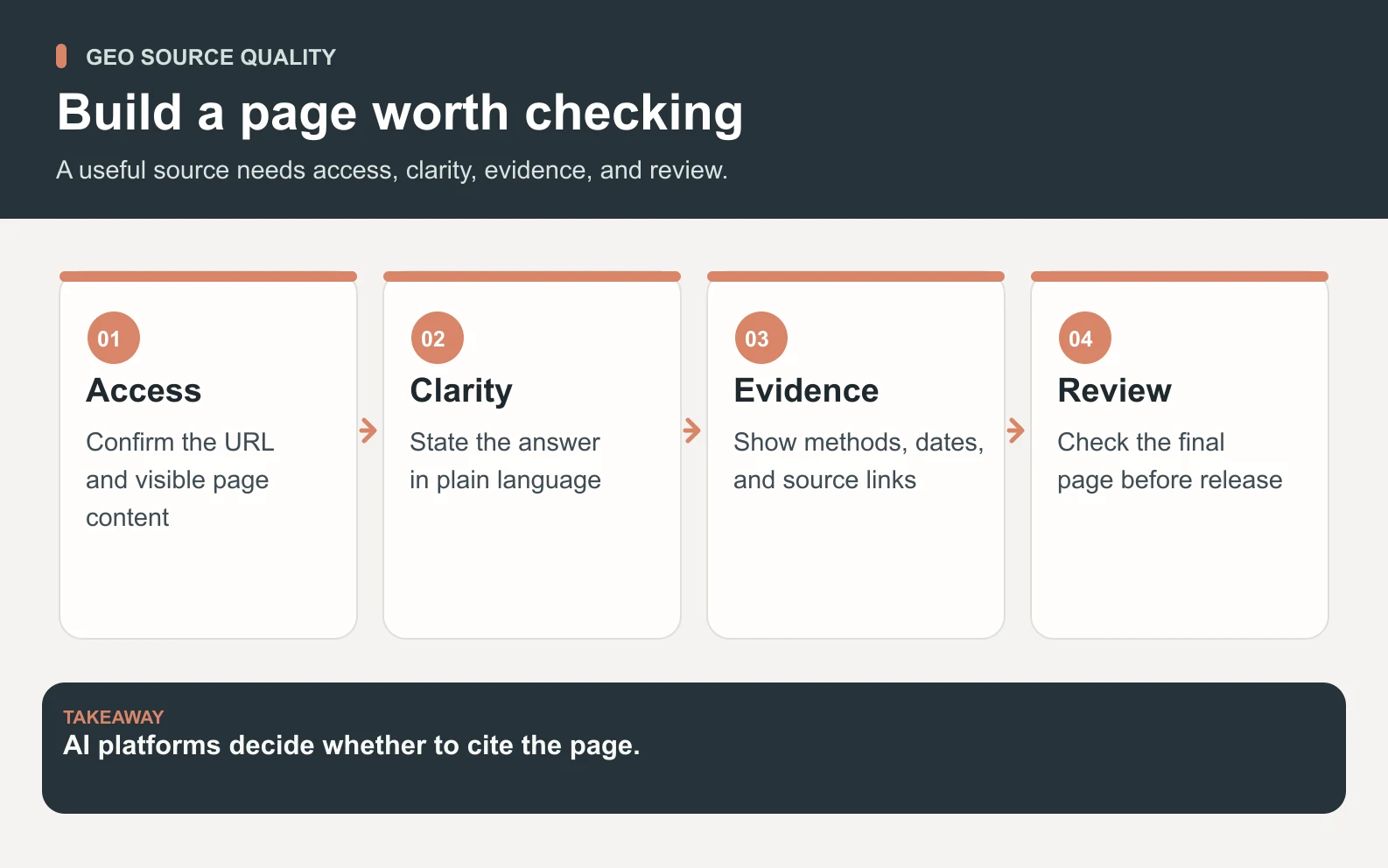
Search visibility is the foundation. A page blocked from crawling or absent from the index is a poor candidate for Google's AI search links. Keep the canonical URL stable; make important text available without requiring a click or sign-in; use descriptive internal anchors; and make images explain their subject in nearby copy and alt text. Google's AI feature guidance also says structured data should match visible page content.
Run the access check on the actual URL, not on a draft screenshot. Confirm that the page returns its article text, names itself with one self-canonical URL, and is linked from a relevant index or neighboring page. Then compare the visible answer with the structured data: the schema should describe the same author, date, questions, and images a reader sees. If a beautiful diagram contains the only explanation of a process, add equivalent text beside it. The text gives readers using assistive technology a usable account and gives crawlers a clearer source than tiny labels embedded in pixels.
A five-step GEO workflow for one page
- 1Choose one real question. Use Search Console queries for the page, customer language, or a repeated support question. Record the current URL and the exact question before editing.
- 2Check access. Confirm the canonical page returns useful content, can be crawled, is indexed where the platform requires it, and has internal links from relevant pages.
- 3Write an answer readers can test. Put a direct response near the top. Define the terms, give the process or comparison, and show the evidence behind any consequential claim.
- 4Add source context. Credit primary documentation and original data, name the date or method of your own observations, and remove statistics you cannot verify.
- 5Measure after release. Save the edit date, baseline queries and pages, then compare equivalent windows. Note other site or search-result changes before drawing a conclusion.
For a recurring workflow, Space Office can help turn this five-step checklist into a brief, draft, and review cycle. Start with one page and a human owner who can verify the underlying data and approve changes. The current specialist roster and pricing show which roles are available and what is separate from the subscription.
Keep a small change log for the page. Record the original answer, the revised answer, the evidence added, the internal links changed, and the date the owner approved the revision. If the page covers a product feature, name the source of truth and who will update the page when that feature changes. This prevents a common problem: an AI-friendly paragraph looks convincing long after its facts have expired. A staged draft can be reviewed against the current product page before anything goes live. After publication, a dated check of the live canonical and its linked images confirms that readers see what was approved.
What makes an answer page citable?
A strong source stands on its own. It tells a reader what a claim means, how it was reached, and where to check it. For example, a pricing comparison should show the billing term and what is included; an experiment should explain its sample and date; a how-to guide should name its inputs and expected result. Google's people-first guidance asks whether content provides original information, substantial explanation, and clear sourcing.
A quoteable sentence is helpful only when the surrounding page supports it. Repeating definitions without evidence adds little. Use a table when readers need to compare options, a numbered sequence when order matters, and a concise answer when the query asks for a definition. Our answer engine optimization guide focuses on this question-to-answer structure; the AI agents for SEO guide shows how to select a page change from actual Search Console data.
Consider three possible claims on a service guide. A definition can be supported by explaining the term and linking the platform documentation that defines its rules. A workflow claim needs visible steps and a realistic example, including who approves the output. A result claim such as 'this method doubled traffic' needs an attributable measurement window, baseline, and context; without those, it should not be published as a fact. This is a useful editorial test even when no answer engine ever cites the article. Google's helpful-content questions ask whether the reader leaves with enough information to achieve their goal, which is a stronger standard than inserting a keyword into every heading.
How to measure GEO without inventing AI traffic
Start with Google Search Console page-filtered queries and compare clicks, impressions, CTR, and average position using the same country, device, search type, and date length. Those figures describe search performance, not a count of AI answer citations. Google documents Search Console reporting for AI features, but its aggregate reporting cannot identify every answer that may have mentioned you.
Next, review analytics referrals from known AI services and direct visits to the page. Referral labels are incomplete: a visit can arrive without a usable referrer, and a bot request is not a human visit. If you can observe an actual answer citation, save its query, platform, date, and page URL as an observation, not a stable ranking. OpenAI's crawler documentation distinguishes OAI-SearchBot, used for ChatGPT search discovery, from GPTBot, associated with model training; crawler totals should not be reported as visitors.
Use a page-level baseline before the edit and a comparable period afterward. For a low-traffic page, a change from zero to one referral is worth recording but too small to establish a reliable trend. Look at whether the page is appearing for more relevant queries, whether clicks and impressions move together, and whether a visitor continues to a useful next page. Keep a separate observation log for answer citations because the same prompt may show different sources by time, country, or account. If you change the title, body, navigation, and technical indexing at once, record all four changes; do not assign the entire movement to the new GEO paragraph.
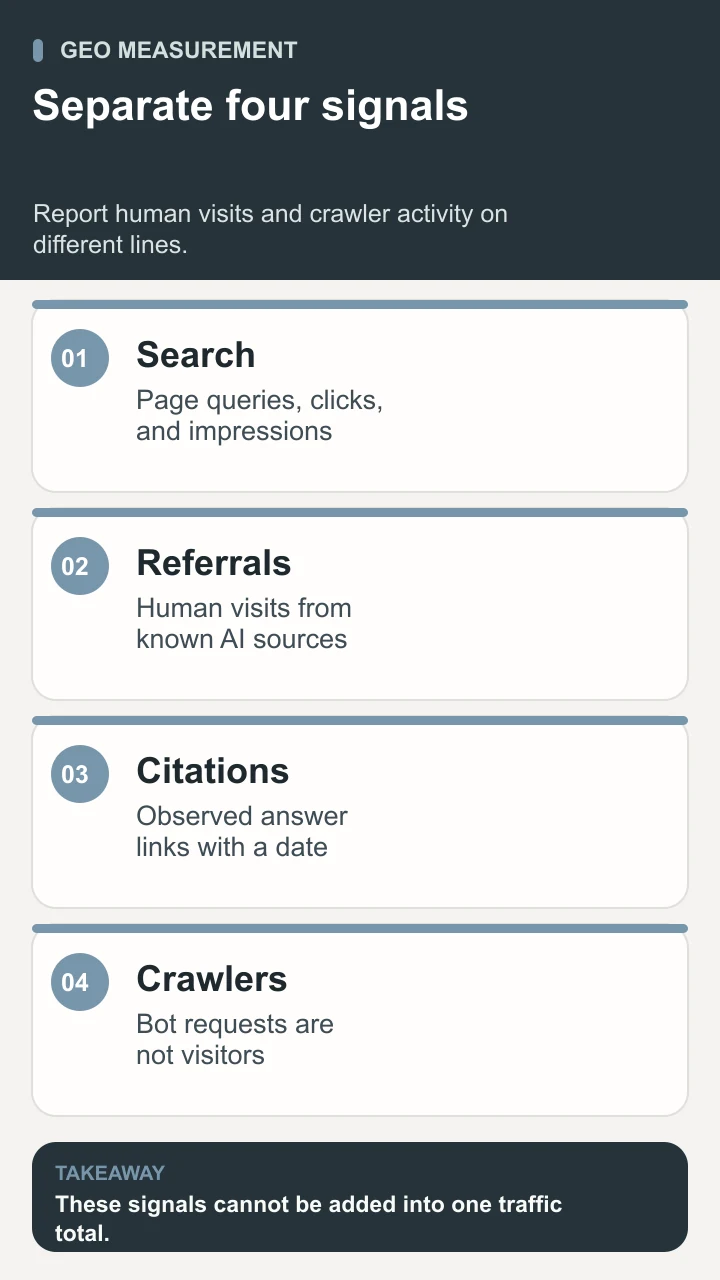
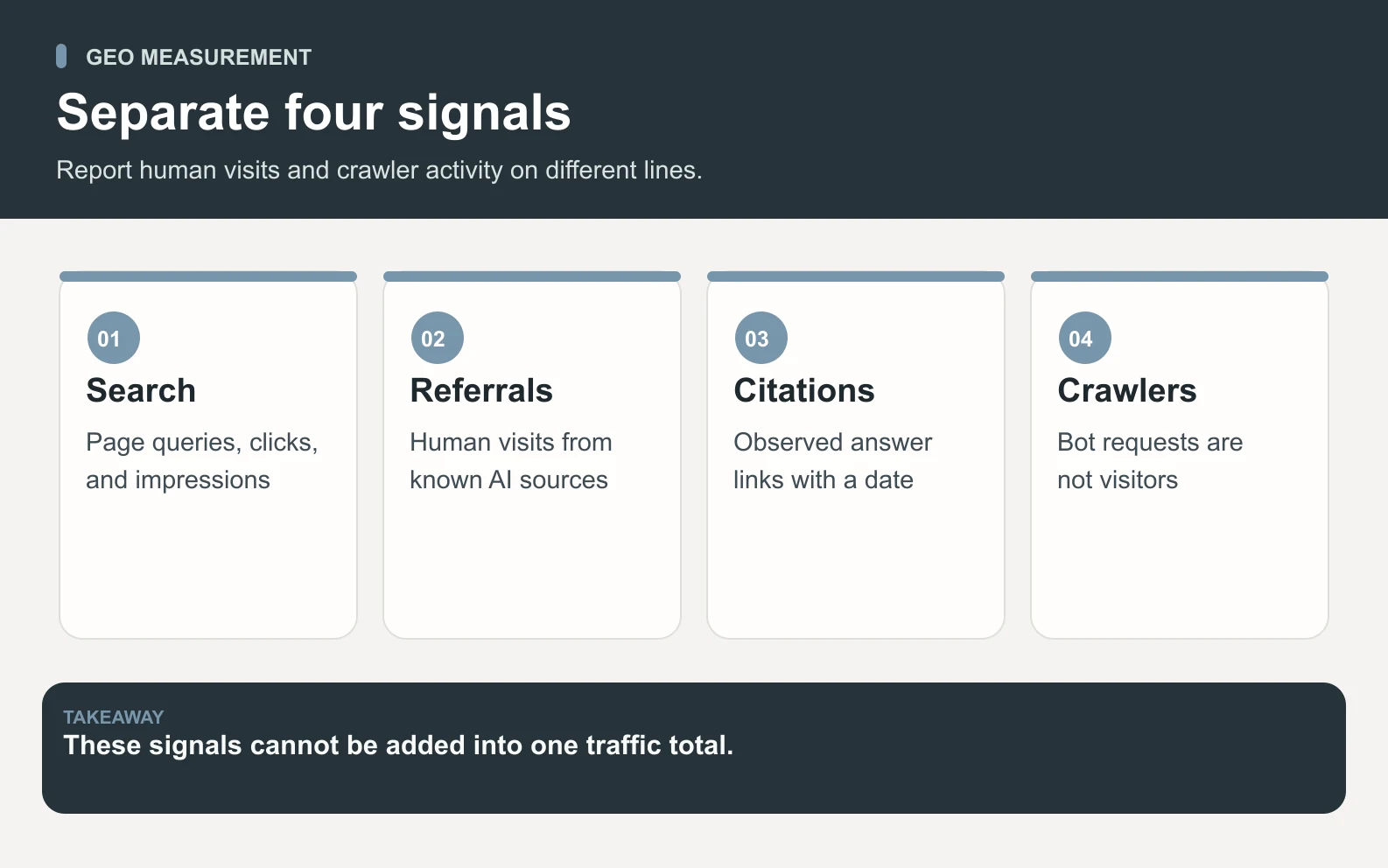
A simple monthly review can have four rows: Search Console performance for the canonical page; recognizable human referrals from AI services; manually observed answer links with their query and date; and crawler requests. Each row uses its own denominator and caveat. Search Console impressions are not visitors. Referral visits do not count all people who may have seen an AI answer. A crawler request is not a reading session. This separation lets the Space Office team and the page owner discuss actual movement without manufacturing a single 'AI traffic' number from incompatible signals.

Scroll horizontally to view all columns.
| Signal | What it tells you | What it cannot prove |
|---|---|---|
| Search Console query and page data | Search exposure and visits under the chosen filters. | A specific AI answer cited the page. |
| AI-service referral in analytics | A visit arrived with a recognizable referrer. | Every AI-assisted visit was counted. |
| Observed answer citation | A particular answer linked to the page at that time. | The citation will repeat for all users or queries. |
| AI crawler request | A bot fetched or requested a resource. | A human read the page or clicked through. |
GEO mistakes that waste effort
- Treating a special file or schema property as a required AI ranking switch. Google says no additional technical requirement exists for its AI features.
- Publishing a polished summary with no original example, method, or verifiable source.
- Calling crawler requests visits, or treating a single observed citation as a persistent ranking.
- Making multiple page changes at once and then assigning all movement to one headline or paragraph.
Another failure is choosing a broad keyword and then making several pages compete for it. Give this guide the primary question about making a page useful as a generative source. Keep a separate answer engine optimization guide for the structure of a direct on-page answer, and keep a service page for current product capabilities. Link between them when the reader's next question changes. This preserves one clear canonical destination for each intent and makes updates easier: the product roster is maintained on the agents page, while this guide explains the method and its limits.
Conclusion: use generative engine optimization to make better source pages
Generative engine optimization starts with an accessible page and ends with an honest measurement plan. Answer the reader's question, show evidence the reader can inspect, and log what actually changes. Space Office can help through a bounded Neon, Nitrogen, and Hydrogen workflow; the page owner supplies approved inputs and makes the final publication decision. See how the team works before assigning the first page.
Sources and review notes
Reviewed against the linked primary sources on the checked dates. Search features and citations are selected by their respective platforms; no placement is guaranteed.
Frequently asked questions
What is generative engine optimization?
Generative engine optimization is the practice of making a website's information accessible, clear, and sufficiently supported to be useful as a source for generative search answers. It extends ordinary SEO and does not guarantee a citation.
Does Google require special GEO markup?
No. Google's published AI feature guidance says its usual Search fundamentals apply and no additional technical requirement is needed. Structured data, when used, should match visible content.
How is GEO different from answer engine optimization?
GEO considers whether a page can be discovered and used as a trustworthy source across generative answers. Answer engine optimization focuses on giving a clear, supported response to a specific question on that page. They overlap and both depend on useful content.
Can AI crawler visits be counted as traffic?
No. Crawler requests show bot activity. Human traffic should be counted in visitor analytics, with referral and attribution limitations stated separately.
Can Space Office guarantee that a GEO page will be cited?
No. Space Office can assist with an evidence-led audit, draft, and review workflow. Search and answer platforms decide what to surface or cite, and a human owner approves any final page change.