Guide
Answer Engine Optimization: How to Write Pages That Answer Real Questions
Use answer engine optimization to turn a real reader question into a clear page, with Space Office helping research, draft, and review the answer.
By the Space Office team · Published · Updated · 15 min read
Answer engine optimization (AEO) is the practice of organizing a page so it gives a clear, accurate answer to a question people actually ask. Identify the question from search or customer evidence, answer it near the top, then support it with context and sources. In Space Office, Neon can find the page opportunity, Nitrogen can draft the answer, and Hydrogen can review the handoff before a person approves publication. No format or FAQ markup guarantees answer placement.

Key takeaways
- Choose a question the page can answer well; use page-filtered search queries or customer language to check demand.
- State the answer early, then show the reasoning, constraints, and examples a reader needs to act on it.
- Use headings, lists, tables, and visible FAQs when they clarify the content; markup does not create an answer by itself.
- Track page-query performance and useful visits, and keep answer-placement observations separate from traffic data.
- Use Space Office specialists for a bounded research and writing task while a human owner verifies and publishes the final page.
What is answer engine optimization?
AEO is a working name for designing content around an answerable question. It is not an official Google ranking program or a replacement for search fundamentals. The first goal is simple: a reader should find the answer quickly and know why to trust it. The second is to make that visible content easy for search systems to interpret. Google says its AI search features use the same underlying Search requirements, with no extra technical requirements.
For a definition question, give the definition in one or two sentences, then explain scope and examples. For a comparison, state the decision criteria before the table. For a how-to question, state the prerequisite and outcome before the steps. An opening sentence alone is insufficient if the rest of the page does not substantiate it.
Suppose a visitor asks whether an AI team can help prepare a page for search. A vague 'yes, AI can help' leaves the reader to guess which work is included and who checks it. A useful answer names the research input, the draft or audit the team can produce, the approval boundary, and the page where current product details live. AEO treats that concrete question as the editorial unit. It does not mean placing a short paragraph above an unrelated article; the sections below must answer the conditions and follow-up questions raised by the first sentence.
How Space Office helps answer a real question
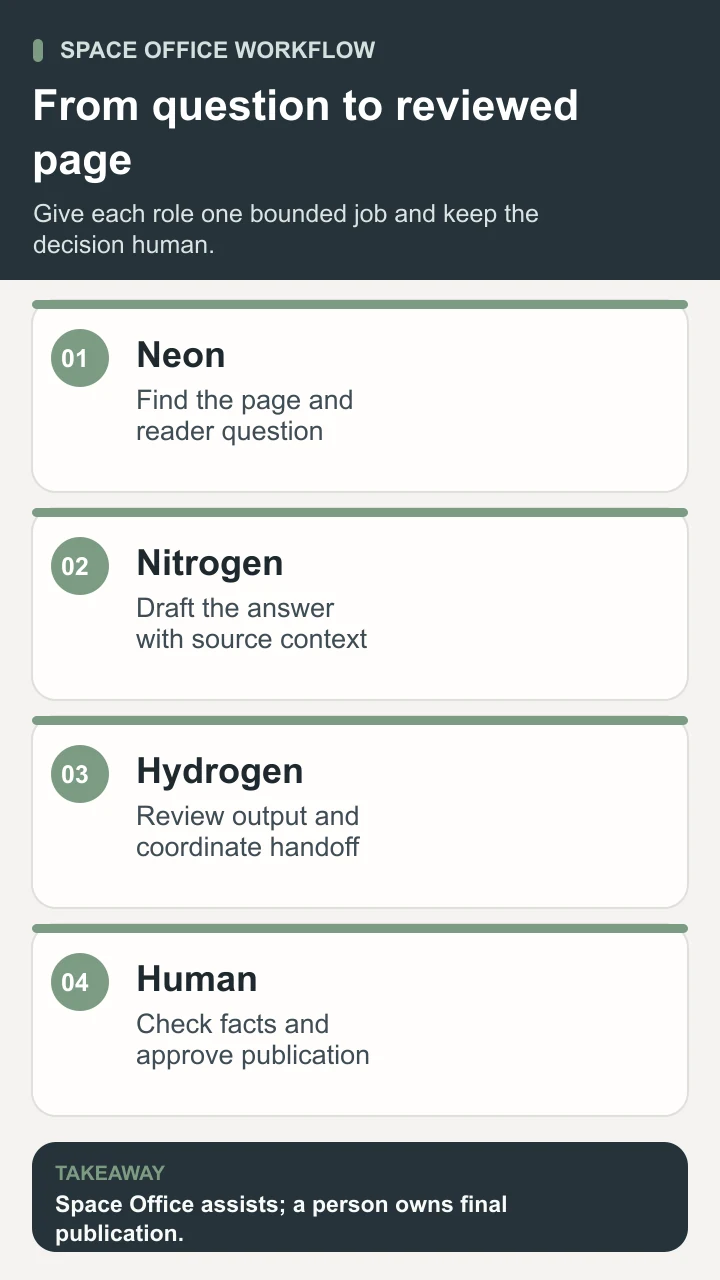
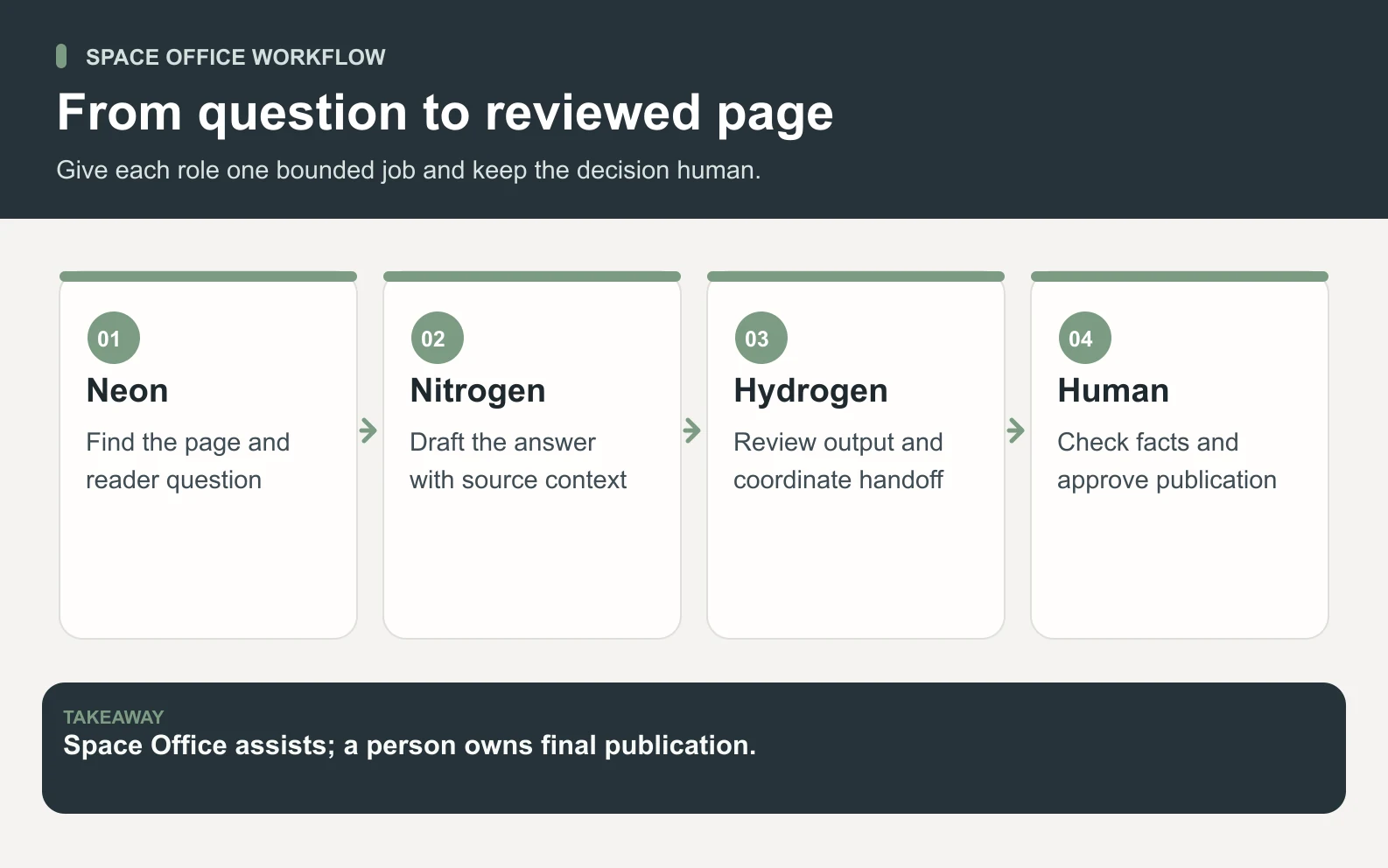
Give Space Office one reader question, the page that should answer it, and approved source material. Neon, the SEO and discovery specialist, can inspect page-filtered search queries and related pages. Nitrogen can draft the concise answer and supporting copy. Hydrogen coordinates the work and reviews specialist output. The page owner still checks facts, permissions, and the publication decision; no role name implies automatic Search Console access or direct publishing rights.
The handoff should be narrow enough to review. Give Neon a page URL, a question, the intended reader, and only search data you have approved. The audit should identify the existing page's promise, relevant queries, and nearby URLs that might already cover the answer. Give Nitrogen the approved product facts and a source list. The draft should contain a short answer followed by conditions, a worked example, and a clear next step. Hydrogen can compare the draft with the brief and point out missing evidence. The page owner decides whether the answer is true for the current product and whether any edit may be published.
For Space Office, this matters most where product detail changes. A draft about the team should not infer that every specialist has automatic access to a customer's Search Console or can publish directly to a site. If the source only supports research and drafting, say that. Link to the live specialist roster for available roles and the how-it-works page for the current process. The answer remains useful even if the reader never becomes a customer, because it shows what information and review a sound page requires.

Find a question the page should answer
Begin with first-party language: support tickets, sales questions, site search, and the actual queries shown for an existing page in Search Console. A sitewide Queries export does not by itself tell you which URL received each query; apply a page filter when judging which page should answer it. Group questions that share an intent, then choose one primary question for the page. A pricing page, for example, should state current prices; a guide can explain how to compare pricing models and point readers to the pricing page for current figures.
Write the question exactly as a customer might ask it, then identify the page that can fulfill the promise. A question about the meaning of answer engine optimization belongs in a durable guide like this one. A question about Space Office's current subscription belongs on the pricing page, because that page can be updated as plans change. A question about who does the work belongs on the agents page. Related follow-ups can sit beneath the primary answer, but they should not turn a single URL into a loose collection of unrelated keywords. If two live pages already answer the same primary question, decide which one owns it before writing another.
Check whether the question has enough specificity to guide an answer. 'AI SEO' could mean a tool, a service, a method, or a definition; a page trying to serve all four will be hard to evaluate. 'How do I review an AI-drafted SEO page before publishing?' points to a clear task and a review checklist. Search volume may justify choosing the broader primary phrase for a guide, but the article still needs a concrete reader problem. Use query data as evidence of language, not as permission to claim a searcher wanted a product pitch.
Scroll horizontally to view all columns.
| Question | Suitable page | Answer shape |
|---|---|---|
| What does the term mean? | A dedicated explanation or relevant guide section | Definition, boundaries, example |
| How do I do it? | A process guide | Inputs, ordered steps, check |
| Which option fits? | A comparison page | Criteria, evidence table, trade-offs |
| What does this service cost? | The current pricing page | Current price, inclusions, exclusions |
A five-step answer engine optimization workflow
- 1Write the exact reader question and choose its canonical page. Check related live pages so two URLs do not make competing primary promises.
- 2Draft a direct answer in plain language near the top. Include the condition or limitation that would change the recommendation.
- 3Add the material a reader would need to check or use it: a definition, ordered steps, a comparison table, examples, and primary sources where appropriate.
- 4Use descriptive headings and links to adjacent guides. Add FAQs only for distinct follow-up questions answered visibly on the page.
- 5Publish with a dated baseline, then compare matching page and query windows. Review the actual page and search result before attributing any change to the edit.
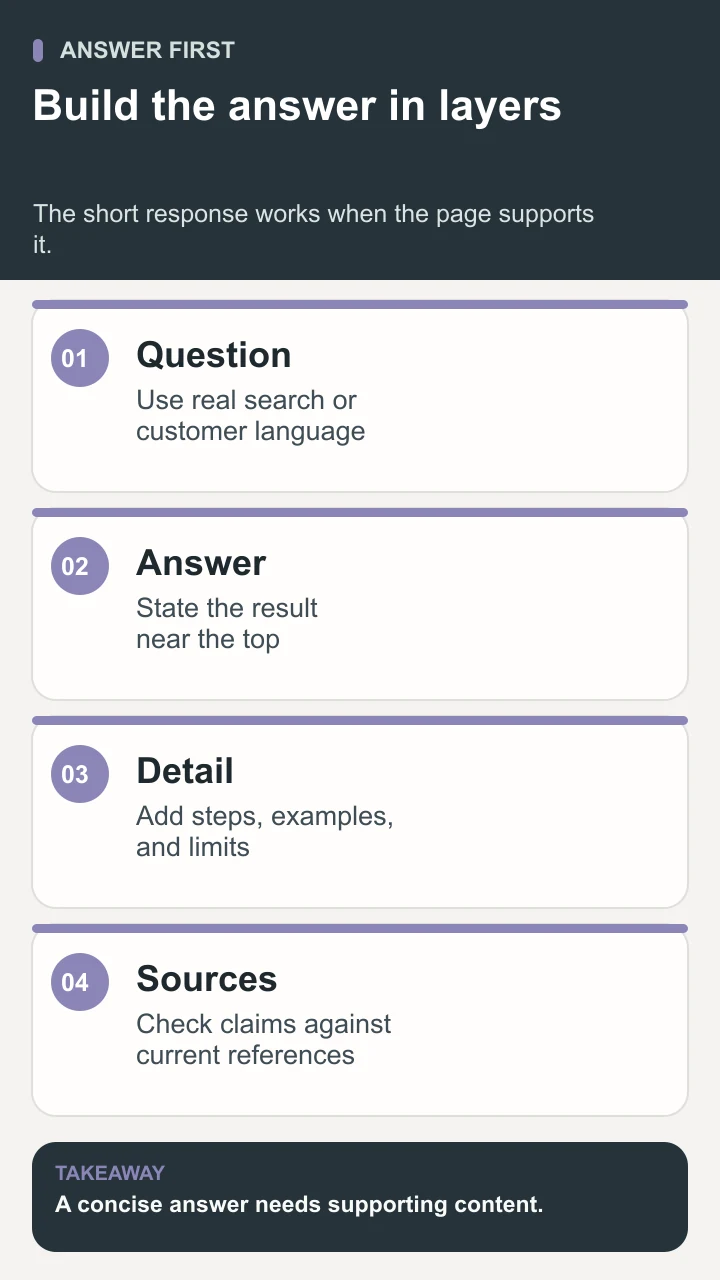
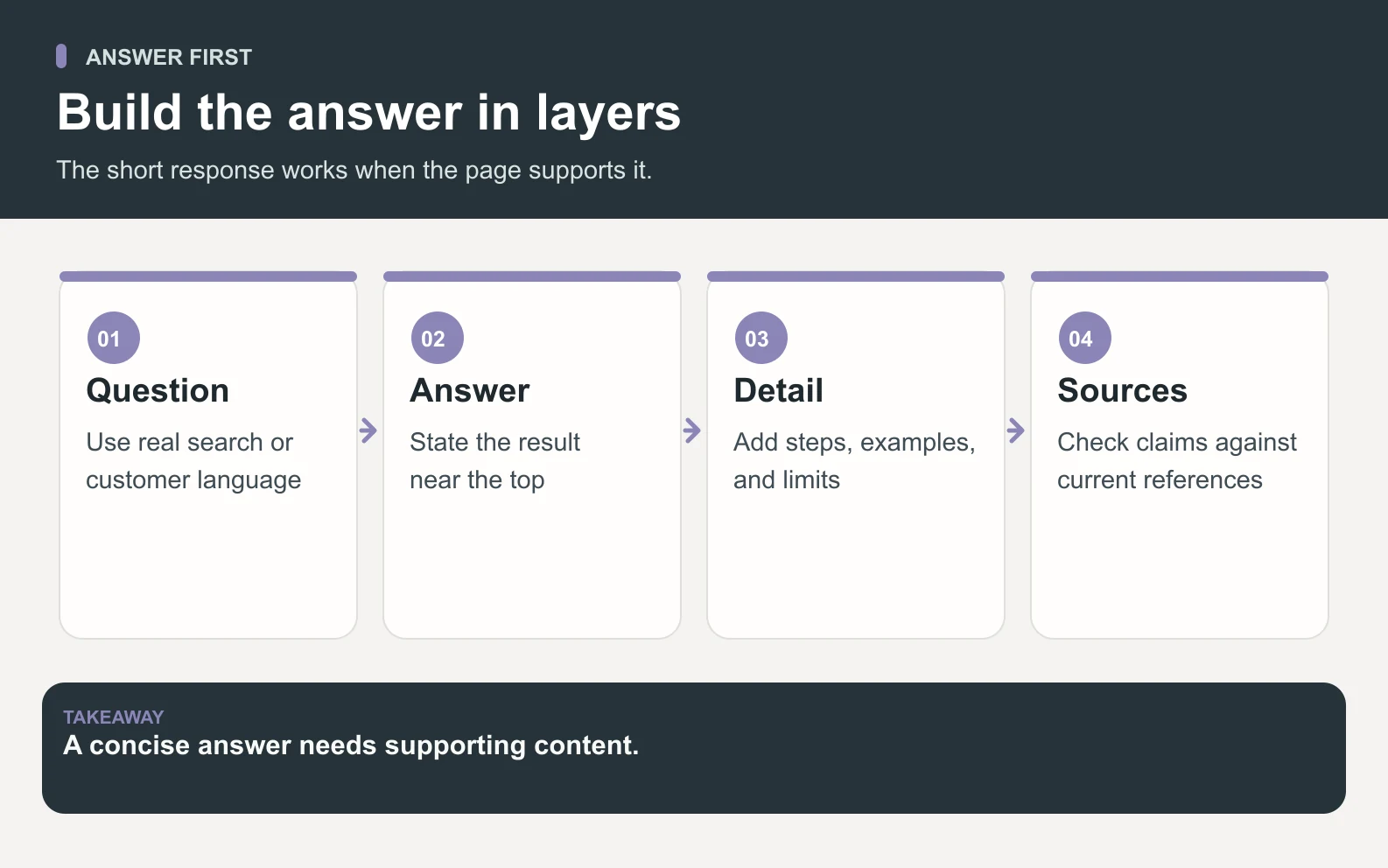
In the draft, make the first paragraph answer the actual question without requiring the reader to inspect a diagram. Follow it with the prerequisites: what information is needed, which cases the answer applies to, and which cases need another page or a human decision. For a process, show the steps in the order they happen and name the output of each step. For a comparison, put the decision criteria in table headers rather than burying them in prose. These choices help a reader scan, but they also make it easier for an editor to catch an answer that is too broad, unsupported, or on the wrong URL.
Before release, compare every factual sentence with its source. The source link should sit near the claim it supports, not only in a list at the bottom. Check that the title, H1, description, opening answer, and canonical URL all describe the same question. Keep dates honest: the publication date records the first release, and the updated date changes when the article materially changes. The FAQ should answer real follow-ups already visible in the page, while its schema reflects those exact answers. Finally, open the public page on a phone; a wide graphic that needs horizontal panning may hide half the method from a reader.
Worked example: answer a Space Office buyer question
Suppose a founder asks, “Can Space Office help us prepare an SEO page?” The direct answer is: yes, Neon can research the page opportunity, Nitrogen can draft the content, and Hydrogen can coordinate and review the output; a human owner verifies facts and approves publication. The next paragraph should name the required input, such as an existing URL, audience question, and approved Search Console export, then link the current specialist roster and how the team works. It should not imply automatic account access, live publishing, or a guaranteed ranking. The AI agents for SEO guide walks through a bounded content-edit workflow.
That short answer has four facts a reviewer can check. First, the work starts with a specific page and audience question, rather than an instruction to optimize the whole site. Second, the named specialists have bounded research, drafting, and coordination roles. Third, approved material defines what the draft may assert; if the owner has not supplied a customer example, the page should not invent one. Fourth, a person reviews and publishes the final copy. The supporting section can then show a sample brief and a list of checks: target URL, current question, source documents, conflicting pages, draft answer, citation check, and decision owner. That is useful teaching content, not simply a longer version of the opening sentence.
A concise answer still needs proof
Write the short response for orientation, not as a substitute for the details below it. If the answer depends on a current price, policy, or product feature, link the primary source and show when it was checked.

Do headings and FAQ schema guarantee answer placement?
No. Google explains that it usually builds ordinary search snippets from page content and may use the meta description when it better describes the page. For featured snippets, Google selects the result; publishers cannot mark a paragraph for guaranteed inclusion. A good heading and visible answer make a page clearer, but they are not an application form for a search feature.
FAQ blocks can help readers navigate follow-up questions. Their structured data should describe the same visible questions and answers. Google narrowed FAQ rich results to well-known, authoritative government and health sites, so a commercial blog should not expect an FAQ rich result simply because it emits FAQ schema. Keep a FAQ when it serves the reader, not for a promised search treatment.
There are limits beyond markup. A page cannot answer a question accurately if the product facts are missing, if the reader needs a personalized assessment, or if the source changes faster than the page is maintained. In those cases, give the reader the stable method and point to the current primary page or a human contact path. Do not use an invented quote, synthetic review, or fabricated performance figure to make an answer seem authoritative. Google's people-first content guidance asks whether a reader gets substantial value; adding repeated FAQ variants to reach a word count would fail that test.
How to measure an AEO page
Record the page, primary question, edit date, and the query groups you expect to serve. In Search Console, filter to that page and compare equal complete periods under the same country, device, and search type. Look at clicks, impressions, CTR, and average position together; a new query mix can move CTR even when the page improves. In analytics, watch engaged visits and relevant next actions when those data are available. Label small samples and avoid claiming an edit caused a change unless you have stronger evidence.
If you manually observe the page in a featured snippet or AI answer, log the platform, query, country, device, and date. That observation is useful but can vary across users and time. Google's people-first guidance remains the best editorial check: would the page satisfy a reader who came directly to it? For broader AI-source discoverability and citation measurement, read our generative engine optimization guide.
Review the question-to-page match alongside the metrics. If impressions rise because the page begins appearing for unrelated searches, the extra exposure is not proof that the answer improved. If clicks rise but visitors leave before reaching the relevant section, inspect the opening promise and the page experience. If the sample is tiny, write down the count and wait for a more meaningful window rather than turning one visit into a growth story. A monthly review can compare the page's primary question, the actual queries it received, the answer currently visible, and any newly approved facts that require an update.
Keep the measurement boundary clear. Search Console reports search appearances and clicks under its filters; analytics reports visits under a different attribution system; a manual AI-answer screenshot records one observation. None is an exact count of every time an answer engine reused the page. The task for Space Office specialists is to help assemble and explain these signals for a human owner, not to declare a guaranteed answer placement. The owner can then revise the answer or internal links for a documented reason and record the date, which makes the next comparison more informative.
Conclusion: use answer engine optimization to serve the question
Answer engine optimization works best when the page serves a real question, states a useful response early, and supports it with enough detail to be trusted. Space Office can help with the Neon, Nitrogen, and Hydrogen handoff while the owner checks sources and approves the final page. See the specialists and current plan details if you want to assign that bounded workflow.
Sources and review notes
Reviewed against the linked primary sources on the checked dates. Search features and citations are selected by their respective platforms; no placement is guaranteed.
- Google Search Central: Control your snippets in search results — checked
- Google Search Central: Featured snippets and your website — checked
- Google Search Central: AI features and your website — checked
- Google Search Central: Changes to HowTo and FAQ rich results — checked
- Google Search Central: Creating helpful, reliable, people-first content — checked
Frequently asked questions
What is answer engine optimization?
Answer engine optimization is the practice of structuring a page around a real reader question, giving a direct response, and supporting it with the context and evidence needed to be useful. It does not guarantee a search snippet or AI citation.
How is AEO different from SEO?
AEO is a content-planning focus within broader search work: it emphasizes matching a specific question with a clear supported answer. SEO also covers technical access, site structure, links, and many other factors.
Will FAQ schema make my page appear in Google answers?
No. FAQ schema cannot guarantee a snippet or AI answer. Google has limited FAQ rich results primarily to authoritative government and health sites; use FAQs because the visible answers help readers.
How many questions should one page target?
Give the page one primary intent and answer closely related follow-ups where they help the same reader. Create a separate page only when a question needs a distinct, substantial answer and would otherwise blur the existing page's purpose.
Can Space Office guarantee an AEO placement?
No. Space Office can help prepare and review a question-focused page, but Google and other answer systems choose what they display. The customer approves the final page and remains responsible for publication.