Comparison
Motion Alternative: Calendar AI or Managed AI Team?
By the Space Office team · Published · Updated · 8 min read
Motion is an AI productivity platform for tasks, calendars, meetings, projects, docs, and workflows. Space Office is a managed team of 24 AI specialists coordinated by Hydrogen, an AI project manager that reviews every output before delivery. If you need smarter planning, evaluate Motion. If the plan needs reviewed execution by specialists, compare Space Office.

A useful Motion alternative comparison should not flatten every AI work tool into the same category. Motion's public site positions the product around AI tasks, projects, calendar, meetings, docs, notes, reports, and workflows. Its pricing page checked on September 24, 2026 lists Pro AI at $19 per seat per month and Business AI at $29 per seat per month when paid annually, with credit allowances and team features described at https://www.usemotion.com/pricing.
Space Office solves a different layer. Hydrogen receives the brief, assigns real specialists such as Sodium for research, Nitrogen for copy, Neon for SEO, Copper for outreach, Gold for customer success, Boron for design, and Carbon for QA, then reviews the output before delivery. That makes Space Office an alternative when planning is not the only problem.
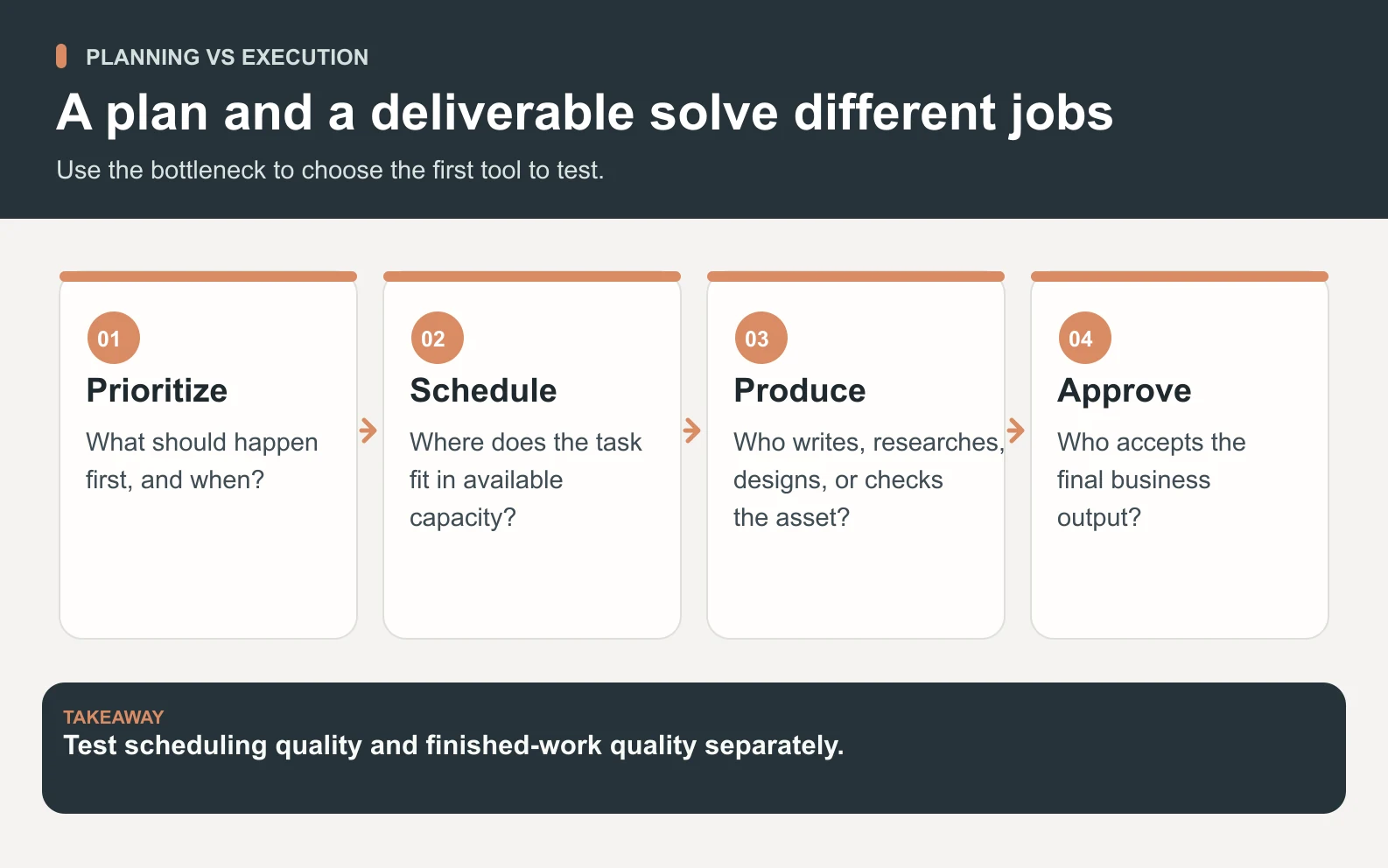
Start with the actual bottleneck
Swipe to explore the diagram
Motion should be on the shortlist when your team misses deadlines because tasks, calendars, docs, and project plans are scattered. Space Office should be on the shortlist when the calendar is already full because nobody has time to turn plans into assets, campaigns, research, support replies, QA notes, or sales follow-up.
Decision shortcut
If the work mainly needs a better schedule, evaluate Motion first. If the work needs a specialist to complete and review it, evaluate Space Office first.
Motion is strongest when planning is the product

Motion's homepage describes an AI-powered work superapp with AI projects, tasks, calendar, meetings, docs, notes, reports, workflows, and related features at https://www.usemotion.com/. Its AI Calendar page says the calendar recalculates schedules when plans change, schedules tasks by deadlines and priorities, and spots capacity issues at https://www.usemotion.com/features/ai-calendar. Those are planning and coordination promises, not claims that a specialist will independently finish your SEO brief or sales sequence.
1. Choose Motion for personal productivity
A founder, operator, or agency lead who needs a daily plan, meeting notes, capacity view, and smarter project list may get more immediate value from Motion than from a managed AI workforce. The core value is knowing what to do next and whether the schedule can hold it.
2. Choose Motion for team capacity visibility
Motion's Business AI tier lists team capacity planning, dashboards and reports, timeline and Gantt charts, time tracking, permissions, central billing, and priority support. If the team already has people to do the work, better visibility may be the missing layer.
Space Office is stronger when planning creates work

Space Office is useful after the plan has named the work. A product-launch task may need Sodium to research competitors, Oxygen to shape the GTM angle, Nitrogen to write launch copy, Neon to optimize the page for search and answer engines, Boron to shape creative direction, and Carbon to test the final deliverable. Hydrogen keeps that handoff coordinated instead of asking the founder to manage separate AI chats.
3. Choose Space Office for reviewed deliverables
Reviewed deliverables are different from organized tasks. A reviewed landing-page brief, outreach sequence, onboarding checklist, SEO refresh, support macro, or QA report needs role-specific judgment and a review gate. Hydrogen reviews outputs before delivery; the human still approves final external use.
4. Choose Space Office when one task spans functions
A single client request can cross research, sales, support, content, operations, and analytics. That is where a managed specialist model has an advantage over a planning surface. The user does not need a longer task list; they need the task completed to a standard they can check.
Motion vs Space Office at a glance
Scroll horizontally to view all columns.
| Decision point | Motion | Space Office |
|---|---|---|
| Core job | AI planning, calendar, projects, docs, meetings | Managed specialist execution |
| Best when | You need tasks scheduled and project visibility | You need reviewed business outputs |
| Primary unit | Per-seat productivity platform | Managed AI team subscription |
| Review model | User reviews and acts on the plan | Hydrogen reviews specialist output before delivery |
| Public pricing | $19 or $29 per seat per month when paid annually | $60/month or $600/year, plus $25/month per added specialist |
| Good neighboring tools to compare | Taskade, Bardeen, Lindy | Fyxer alternative, Lindy alternative, AI team cost |
Pricing math: seats versus specialist capacity
Motion's pricing page checked this run lists Pro AI at $19/seat/month and Business AI at $29/seat/month when paid annually. Space Office pricing is $60/month or $600/year. Additional specialists cost $25/month each. Customers bring their own AI provider key, and Space Office adds zero markup to provider usage. The annual base plan is $600/year; AI-provider usage and added specialists are modeled separately.
Worked example: a four-person team on Motion Business AI paid annually is 4 seats × $29 = $116/month before any plan limits or add-ons. A Space Office setup with Hydrogen, two included specialists, and three added specialists is $60 + (3 × $25) = $135/month before AI-provider usage and human approval time. Motion is cheaper in this example if the team mainly needs planning. Space Office is aimed at specialist output across five roles.
Scroll horizontally to view all columns.
| Line item | Motion example | Space Office example |
|---|---|---|
| Base subscription | 4 × $29 = $116/month | $60/month |
| Specialist capacity | Handled by your team | 3 added specialists × $25 = $75/month |
| AI usage | Included credits depend on plan | Paid through your own provider key, zero markup |
| Human review | Internal team reviews plan and work | Human approves after Hydrogen review |
| Best interpretation | Productivity stack for four users | $135/month specialist team setup |
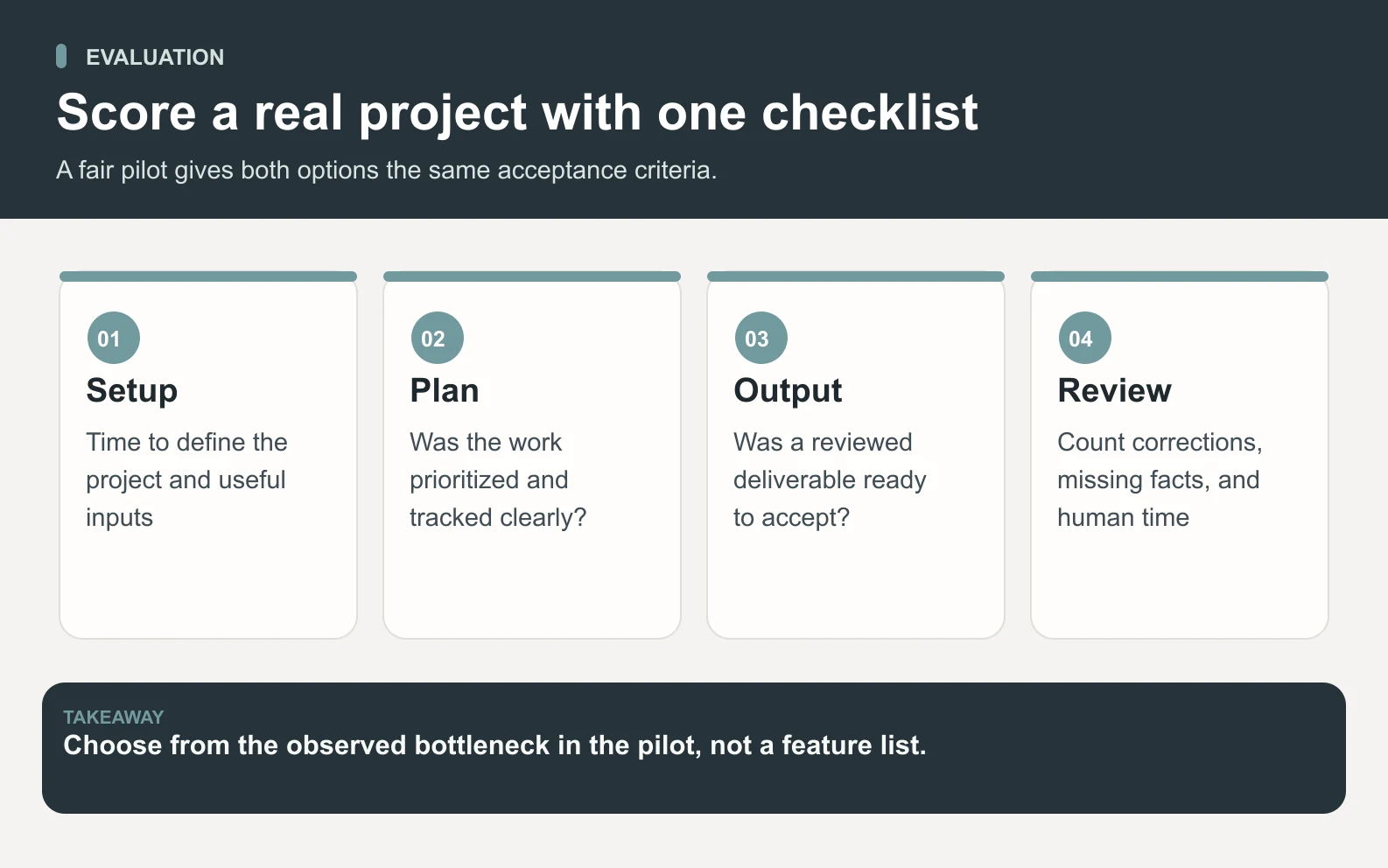
A practical pilot for a Motion alternative
Swipe to explore the diagram
- 1Pick one real project, not a toy task.
- 2Write the same acceptance checklist for both tools.
- 3In Motion, measure how well the project is planned, scheduled, and tracked.
- 4In Space Office, measure whether Hydrogen returns a reviewed deliverable you can accept.
- 5Record setup time, corrections, missing information, and final human review time.
When Motion is the better choice
- Your team already has the people to do the work.
- The biggest pain is scheduling, prioritization, calendar conflict, or project visibility.
- Every user needs their own productivity workspace.
- You want an AI calendar and task planner more than role-specific business outputs.
When Space Office is the better alternative
- The task requires research, content, SEO, outreach, customer success, design, QA, or analytics.
- You want Hydrogen to coordinate specialists instead of managing multiple AI chats.
- You need finished drafts, reports, or assets rather than only a plan.
- You prefer a managed team model with BYO AI key usage at zero markup.
Internal links for the next decision
If Motion feels too planning-focused, compare the broader specialist model on the Space Office agents page at /agents. If cost is the deciding factor, use /pricing and the AI team cost guide. If your buyer is comparing productivity tools, the Lindy, Taskade, Bardeen, and Fyxer alternative pages help narrow the category without duplicating this Motion comparison.
If your project plan is clear but the work is still not getting done, compare Motion with the Space Office specialist roster.
Meet the AI specialistsBottom line
Motion is a credible choice when you need AI planning, calendars, projects, meetings, docs, and team capacity visibility. Space Office is the better Motion alternative when planned work must become reviewed deliverables across multiple functions. Decide whether the bottleneck is organization or execution, then pilot the tool that attacks that layer.
Sources and review notes
This comparison is published by Space Office, one of the products discussed. It uses Motion's public pages checked on September 24, 2026 and Space Office's current public offer. We did not run a comparative benchmark or private product test.
- Motion pricing — checked
- Motion homepage — checked
- Motion AI Calendar — checked
Frequently asked questions
What is the best Motion alternative for startups?
The best Motion alternative depends on the bottleneck. If the startup needs AI scheduling, tasks, docs, and project visibility, Motion may be the right fit. If the startup needs reviewed execution from specialists across research, content, SEO, outreach, and customer success, Space Office is the broader alternative.
How is Space Office different from Motion?
Motion is an AI productivity platform for planning work. Space Office is a managed team of AI specialists coordinated by Hydrogen, an AI project manager that reviews every output before delivery. Motion organizes the work; Space Office helps complete reviewed deliverables.
How much does Motion cost compared with Space Office?
Motion's pricing page checked on September 24, 2026 lists Pro AI at $19/seat/month and Business AI at $29/seat/month when paid annually. Space Office costs $60/month or $600/year, with added specialists at $25/month each and BYO AI usage at zero markup.
When should I choose Motion instead of Space Office?
Choose Motion when your main problem is task planning, calendar scheduling, project visibility, meeting notes, docs, and team capacity. It is a productivity workspace. Space Office is a better fit when the work needs specialist output and review.
Does Space Office replace project management software?
Not always. Many teams still need a project system of record. Space Office is useful when the project tasks require research, writing, design, support, outreach, QA, or analysis that a managed AI team can prepare and Hydrogen can review before human approval.
What does annual Space Office pricing mean?
Annual Space Office pricing means the base subscription is $600/year instead of paying $60 month to month. Added specialists are $25/month each, and AI-provider usage is paid through your own key with zero markup.