Comparison
Accio Alternative: Desktop Agent vs Managed AI Team
By the Space Office team · Published · Updated · 10 min read
Accio and Space Office solve the same founder pain from different angles. Accio Work is a desktop AI business team for turning ideas into business tasks. Space Office is a managed AI workforce where Hydrogen coordinates named specialists and reviews the finished work before it reaches you.

Accio Work and Space Office are both trying to reduce the gap between a founder's idea and the work required to make it real. Accio's public pages describe an AI business team that goes beyond chat to execute business tasks with skills and connectors. Space Office describes a managed AI workforce: Hydrogen coordinates live specialists, checks their output, and hands back reviewed work.
Quick verdict: choose a desktop business agent or a managed specialist team
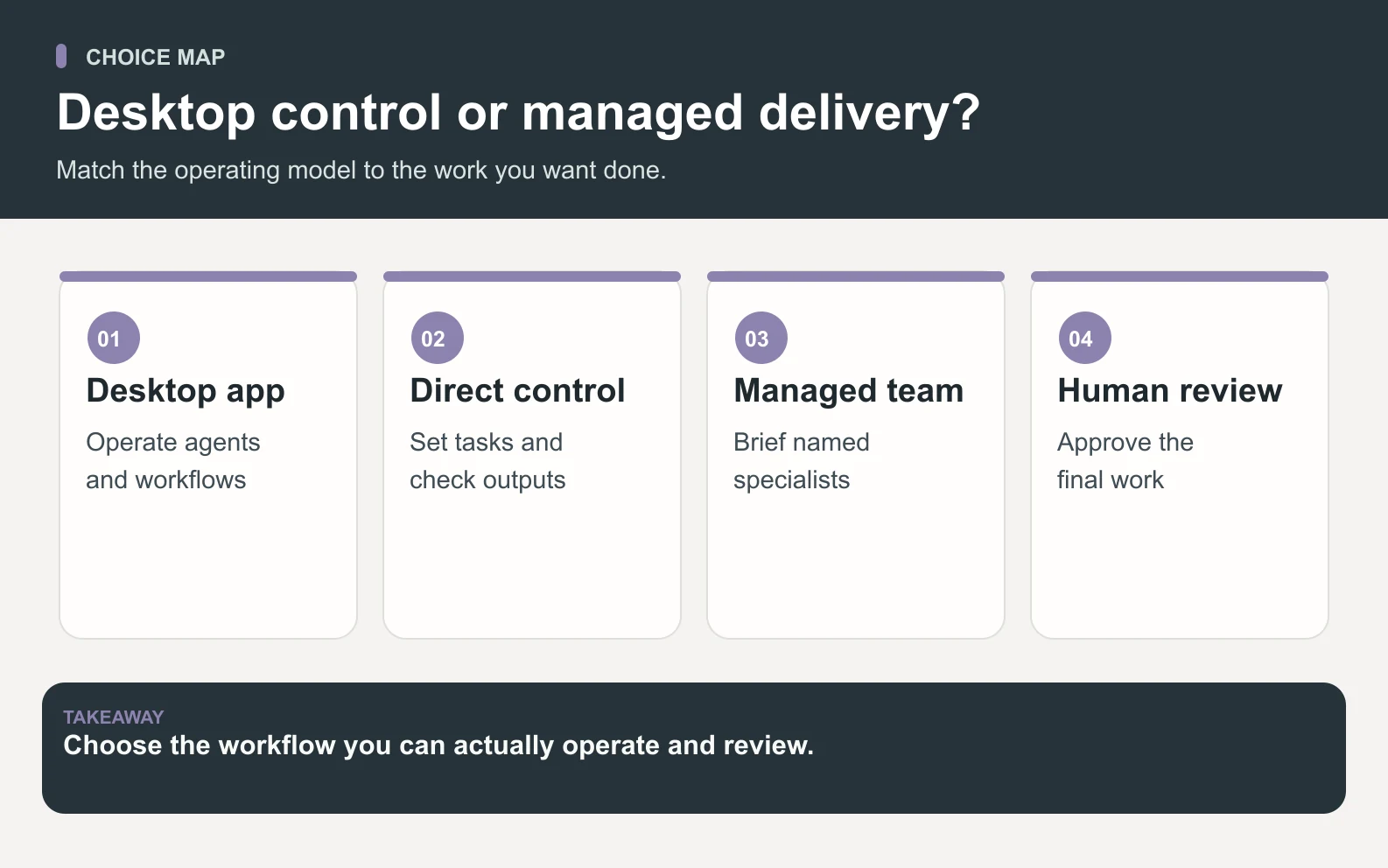
Swipe to explore the diagram
Choose Accio if you specifically want a desktop AI business environment with browser automation, scheduled automations, and workflows around business operations. Choose Space Office if you want a managed team structure where the coordination and review layer is part of the product. The key decision is whether you want to operate an AI business app or brief a managed AI workforce.
Scroll horizontally to view all columns.
| Decision point | Accio Work | Space Office |
|---|---|---|
| Core model | AI business team that turns ideas into business tasks | Managed AI workforce with Hydrogen coordinating live specialists |
| App environment | Native desktop app; Accio's public FAQ text says macOS and Windows are supported | Dedicated workspace with agents, tasks, and specialist delegation |
| Automation model | Browser automation, scheduled automations, skills, connectors, and multi-agent teams per public page text | Hydrogen plans, delegates, reviews, and escalates work across named specialist roles |
| Published Space Office subscription | Accio's checked public page did not expose a simple comparable seat price in the extracted public text | $60/month for Hydrogen plus two selected specialists; $25/month per added specialist |
| Best fit | Founders who want a desktop AI business app, especially for business operations and sourcing-style workflows | Founders who want reviewed work across marketing, code, design, research, sales, and operations |
| Quality-control model | User controls and reviews the agent output | Hydrogen reviews specialist output before the customer handoff; a human approves final work |
What Accio does better

Accio is better when the buyer wants a desktop agent experience rather than a managed service layer. Its public pages describe macOS and Windows support, browser control through Chrome DevTools Protocol, scheduled agents, multi-agent teams with a team lead, and business workflows such as design, trend analysis, sourcing, store operations, SEO, and marketing.
That matters for operators who want the AI system close to the machine, browser, and business workflows they already run. Accio's positioning is also more connected to commerce and Alibaba-style sourcing language than Space Office's general startup-workforce positioning.
What Space Office does better
Space Office is better when the founder wants less direct agent operation and more managed delivery. Hydrogen is the AI project manager in every workspace. It reads the brief, chooses the right specialist roles, delegates tasks, reviews output, and sends weak drafts back before delivery. The public roster shows live specialists across engineering, design, marketing, revenue, brand, and intelligence.
The practical difference
Accio is closer to an AI business app you operate. Space Office is closer to a managed AI team you brief.
Pricing and budget clarity
Space Office's public product facts are explicit: $60/month includes Hydrogen and two chosen specialists, extra specialists cost $25/month each, dedicated AWS compute starts around $30/month, and model usage is paid directly through the customer's own provider key with zero markup. Accio's checked public pricing page identified the product as an AI business agent partnered with Alibaba, but the extracted public page text did not provide a simple comparable seat price to quote here.
Scroll horizontally to view all columns.
| Team shape | Subscription arithmetic | Before model usage |
|---|---|---|
| Base Space Office workspace | $60 subscription + about $30 dedicated compute | About $90/month before provider usage |
| Three-specialist workspace | $60 + 1 × $25 + about $30 compute | About $115/month before provider usage |
| Five-specialist workspace | $60 + 3 × $25 + about $30 compute | About $165/month before provider usage |
Worked example: an ecommerce launch workflow

Suppose a founder needs product-page copy, SEO checks, simple landing-page implementation, and launch QA. In Space Office, pick Neon for SEO and Nitrogen for copy as the two included specialists under the $60 base subscription. Add Chromium for frontend and Carbon for QA: 2 extra specialists × $25 = $50. Subscription becomes $60 + $50 = $110/month. Add estimated dedicated compute starting around $30/month, and the visible platform-plus-compute budget is about $140/month before AI-provider usage. This is an illustrative budget, not a guarantee that every launch needs exactly those roles.
Where Accio's Alibaba context matters
Accio's public pricing-page metadata describes an AI business agent partnered with Alibaba and mentions design, trend analysis, sourcing, store operation, SEO, and marketing. If sourcing, ecommerce operations, or Alibaba-connected workflows are central to the job, Accio may be a better natural starting point than a general managed AI workforce.
Where Space Office's roster matters
Space Office is stronger when the job spans departments and needs named accountability. The Space Office agents page shows the actual specialists available today. That matters because a founder can brief Hydrogen once and have the work split across SEO, content, frontend, QA, operations, or sales without inventing a new desktop-agent workflow for each function.
Review and risk: direct control vs managed QA
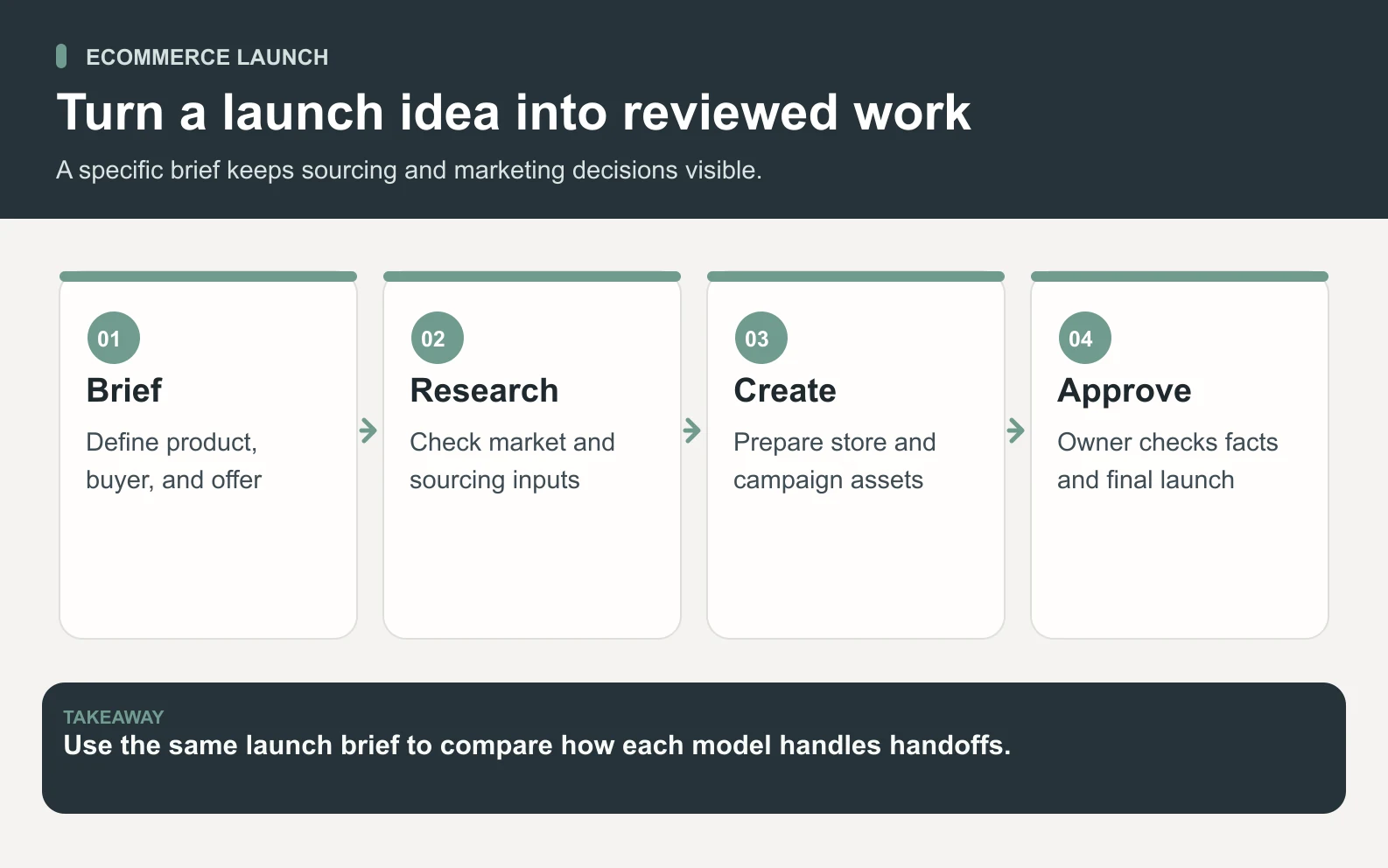
Swipe to explore the diagram
Direct control is useful when you want to inspect every browser step or agent action. Managed QA is useful when you want a reviewer between specialist drafts and the final customer handoff. Accio gives more of the app-control feeling. Space Office makes the project-management layer visible through Hydrogen. Neither removes the need for final human approval, especially for legal, financial, security, or customer-facing claims.
When Accio is the right answer
- You want a native desktop AI business app on macOS or Windows.
- You care about browser automation, scheduled agents, skills, connectors, and team-style agent groups inside one app environment.
- Your use case leans toward sourcing, ecommerce operations, trend analysis, store operations, or Alibaba-adjacent workflows.
When Space Office is the right answer
- You want to brief one AI project manager instead of operating a desktop agent environment yourself.
- You need several named specialists across marketing, design, engineering, revenue, operations, or research.
- You want reviewed deliverables and a clear handoff rather than a transcript of agent actions to interpret.
- You want transparent subscription arithmetic before choosing how many specialists to add.
Internal links for the next decision
If the managed-team model is the reason you are comparing Accio alternatives, review the Space Office specialist roster. If you need the operating model first, read how Space Office works. If the budget is the blocker, compare the formula on Space Office pricing or read the broader AI agent pricing comparison.
Want a managed AI team instead of another desktop agent environment?
See how Space Office worksSources and review notes
This comparison uses Accio's public homepage and pricing page checked on 2026-09-21, plus Space Office's public product facts checked on 2026-10-05. Accio's public pages were used for positioning and capability claims; this is not a hands-on benchmark of output quality, speed, or reliability.
- Accio Work homepage — checked
- Accio pricing page — checked
- Space Office product facts — checked
Frequently asked questions
What is the best Accio alternative for startups?
Space Office is a strong Accio alternative if you want a managed AI workforce rather than a desktop AI business app. Accio is stronger for app-based agent control and commerce-oriented workflows. Space Office is stronger when Hydrogen should coordinate specialists and review deliverables.
How is Space Office different from Accio Work?
Accio Work is positioned as an AI business team and desktop app that executes business tasks with skills and connectors. Space Office is positioned as a managed AI workforce: Hydrogen routes work to named specialists, checks drafts, and returns reviewed output.
How much does Space Office cost compared with Accio?
Space Office starts at $60/month for Hydrogen plus two specialists. Additional specialists cost $25/month each, dedicated compute starts around $30/month, and model usage is paid through your own provider key. Accio's checked public page did not expose a simple comparable seat price in extracted text.
Is Accio better for ecommerce or sourcing workflows?
Accio may be better when sourcing, ecommerce operations, trend analysis, store operation, or Alibaba-adjacent workflows are central. Its public pricing-page metadata emphasizes those business tasks. Space Office is broader: it fits cross-functional startup work across marketing, engineering, sales, design, and operations.
Does Space Office have a desktop app like Accio?
Space Office should not be evaluated as a local-first desktop-agent replacement. It is a managed AI workforce with a workspace, Hydrogen as the coordinator, named specialists, and reviewed handoffs. Choose it for managed delivery rather than desktop-agent control.
Does Space Office replace Accio?
Not always. Keep Accio if you need its desktop app model or Alibaba-oriented business workflows. Consider Space Office if you want one brief routed to specialist agents and reviewed by Hydrogen before final delivery.