Guide
AI Agents for Lead Generation: A Reviewed Prospecting Workflow
A practical way to use AI agents for lead generation: define fit, collect evidence, prepare a small prospect packet, and review it before contact.
By the Space Office team · Published · Updated · 18 min read
AI agents for lead generation can prepare a focused list of accounts, check public buying signals, draft account briefs, and suggest outreach angles. Start with an approved ideal customer profile and a small batch. Require a source and checked date for every factual signal, then let a person decide which accounts qualify and whether to contact them. In Space Office, Iron can prepare prospect research, Copper can draft a separate outreach option, and Hydrogen coordinates and reviews the handoff; the customer makes the final decision. No account access or outbound sending is automatic.

Key takeaways
- Define who is in scope, who is excluded, and what evidence would make an account timely before asking for leads.
- Treat a buying signal as an observed fact plus a labeled hypothesis, not proof that a company intends to buy.
- Start with a short, sourced prospect packet; accept or reject each row before drafting a message.
- Separate research, outreach drafting, account access, and sending permissions into explicit stages.
- Judge the pilot by accepted accounts, source quality, corrections, and review time rather than list size alone.
For the broader process around channels, enquiry capture, qualification, and follow-up, start with the lead generation guide. It includes a reconciled four-week example; the workflow below focuses specifically on preparing a sourced account packet with agents.
What should AI agents for lead generation actually deliver?
The useful deliverable is a decision-ready prospect packet, not an enormous spreadsheet. Each row should identify an account, explain why it appears to fit your ideal customer profile, show the evidence for any timely signal, identify gaps, and propose a next action for a person to approve. A company hiring for a role, launching a product, or opening a location may be relevant to a particular offer. The public announcement is evidence; the claim that the company needs your product is an inference. Keeping those two statements apart is the first quality control.
The term “agent” is useful when the work involves several steps: searching approved sources, comparing an account to criteria, checking a claim, and packaging the result for review. Anthropic's engineering guide distinguishes a fixed workflow from an agent that chooses steps and uses tools, and recommends starting with the simplest design that works. A one-off export and a filter may solve a narrow lead-list task. Use a multi-step agent only when the evidence gathering and judgment are worth the added complexity.
In the current Space Office roster, Iron is the live lead generation and prospecting specialist. Copper is the live outreach specialist, and Hydrogen coordinates the work and reviews specialist output. A bounded starting setup uses Iron and Copper as the two selected specialists: Iron prepares the researched account packet; Copper drafts an optional message only after an account passes review. Hydrogen checks the handoff against the brief. The human owner decides whether the account is relevant, whether a message is accurate, and whether any contact should occur. The how-it-works page explains the coordination model; no connection to a CRM, email account, or third-party data vendor is implied by hiring a role.

Write the qualification brief before searching
Begin with the smallest plausible buyer segment. Describe the kind of organization, geography, size range if relevant, actual use case, decision maker, and the problem your offer solves. Then write exclusions with equal care. A consultant serving US software companies may exclude agencies, students, current customers, and vendors. An explicit exclusion prevents a plausible-looking list from turning into a pile of accounts that could never buy. If you do not know the segment yet, interview customers and review closed opportunities before delegating research.
Turn the brief into observable tests. “Fast-growing company” is vague; “announced a second operations office in the last 90 days” is checkable. “Needs automation” is a guess; “published a role description mentioning a manual handoff that our product addresses” is evidence worth investigating. Ask for the exact page URL, publication or access date, and a short quotation or paraphrase that the reviewer can verify. If a claim comes from a directory, ask whether the directory has a source and when it was updated. Never let an agent turn an undated list entry into a current buying signal.
- 1Name one buyer segment and one use case that your current offer genuinely serves.
- 2List firmographic boundaries and explicit exclusions, including current customers and restricted accounts.
- 3Define at most three observable signals, with a time window and acceptable source types for each.
- 4Specify the output fields: account, fit reason, source URL, checked date, uncertainty, owner decision, and proposed next step.
- 5Choose a batch of ten to twenty accounts for review before increasing volume.
Give Iron customer-approved inputs: the offer description, target segment, examples of good and bad accounts, exclusions, and public sources or permitted data access. The specialist should not assume that a named integration is connected or that a paid enrichment database is available. If you want private CRM context, grant only the access needed for the task and identify which fields may be used. If that access is unavailable, a public-source packet with a clear “CRM status unknown” flag is more honest than a fabricated clean record.
Build a sourced account packet in four passes
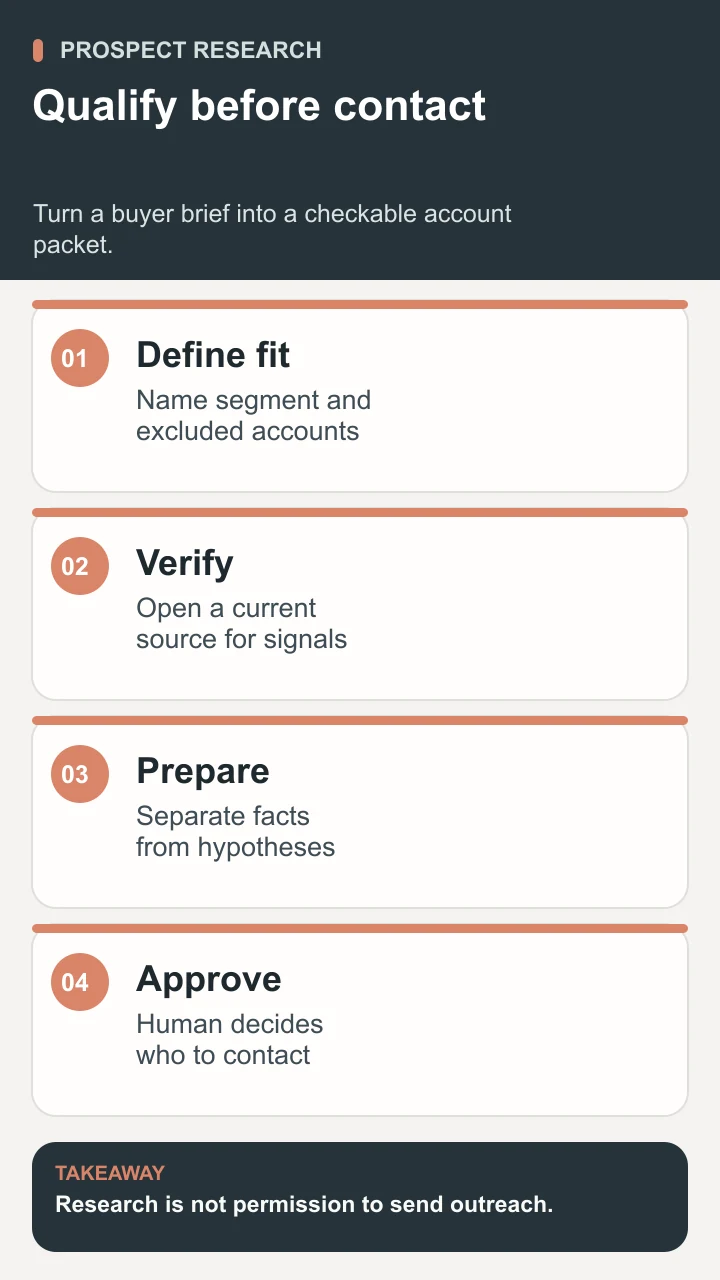
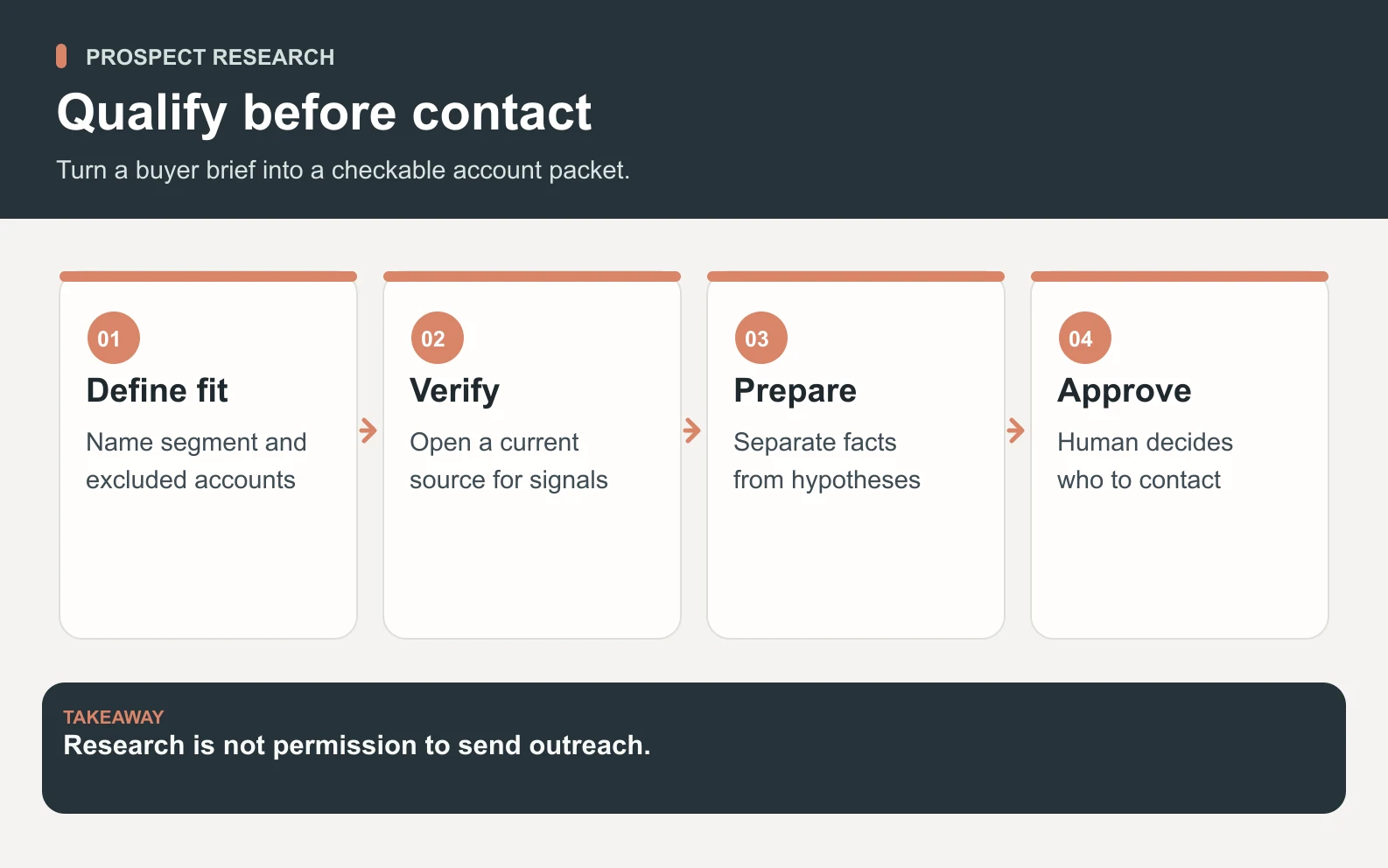
The first pass is discovery: find organizations matching the objective criteria without judging intent. Record why each candidate entered the pool. The second pass is verification: open the original company page, hiring post, press release, or other approved source and check that the claim is still there. The third pass is interpretation: explain how the observation might connect to the buyer's task, label alternative explanations, and list what is unknown. The fourth pass is deduplication and handoff: compare the candidate with the approved exclusions and existing-account list if access was supplied, then place it in a short packet for a person.
Those passes should be visible in the final artifact. For each account, include a link beside the evidence, not a citation dump at the end of the document. The reviewer should be able to open a source and answer three questions quickly: Does this account fit? Is the signal real and recent? Does the proposed offer follow from the signal, or is the connection merely hopeful? An agent may be good at describing a plausible connection, but plausibility is not confirmation. Mark the gap so a salesperson can test it in conversation.
Scroll horizontally to view all columns.
| Field | Acceptable entry | Reject or investigate |
|---|---|---|
| Account fit | US B2B service firm in the approved size band | Unknown industry or outside geography |
| Observed signal | Dated company job post describes manual intake routing | Undated directory labels the firm ‘growing’ |
| Source | Direct URL to the job post, checked today | No URL, or a generated summary only |
| Reason to contact | Ask whether intake handoffs are a current priority | State that the firm needs the vendor's product |
| Owner decision | Approve research; request one question-led draft | Do not contact until account status is checked |
This packet gives the reviewer a way to reject weak rows without discarding the whole batch. If six of fifteen candidates fail because the signal is old, change the source rule. If many pass the objective filter but have no credible timing, revisit the signal definition. If the account is attractive yet no appropriate contact path exists, leave it in research rather than inventing a person or email address. Treat “not enough information” as a useful outcome: it protects the team from turning uncertainty into false precision.
Separate prospect research from outreach
Before an account owner authorizes email, use the email deliverability guide to check the actual sending service, authentication, list provenance, suppression handling, and provider feedback. Phosphorus can prepare a send-path diagnosis for review; a researched account and a drafted message do not establish that the path is ready.
A qualified account is not permission to send a message. Research can produce a brief while outreach remains entirely manual. If the owner approves the account, Copper can prepare a separate draft that refers accurately to the public observation and asks a modest, relevant question. The person who owns the relationship checks the wording, the recipient, current account status, and applicable rules before sending anything. The draft should not claim that the prospect has a problem the source never established.
This boundary matters because different stages need different information and authority. Research can often use public company pages. Drafting may require product positioning, tone, and approved claims. Sending needs an authorized account, recipient details, suppression lists, and a decision about compliance and relationship risk. Putting all of that behind a single instruction such as “find leads and email them” conceals the most important checks. Record who can approve each stage, and keep drafts in a reviewable place until that person acts.
A first message should make it easy for the recipient to decide whether the reason for contact is relevant. Use the verified fact sparingly and avoid synthetic familiarity. For example, if a company publicly announced a new intake team, a draft might ask whether consistent handoffs are on the team's current agenda. It should not pretend an insider revealed an urgent failure. If the signal is merely a weak proxy, say less and ask a broad question. The human reviewer owns the judgment and the consequences of sending.

Run a two-week pilot and count accepted work
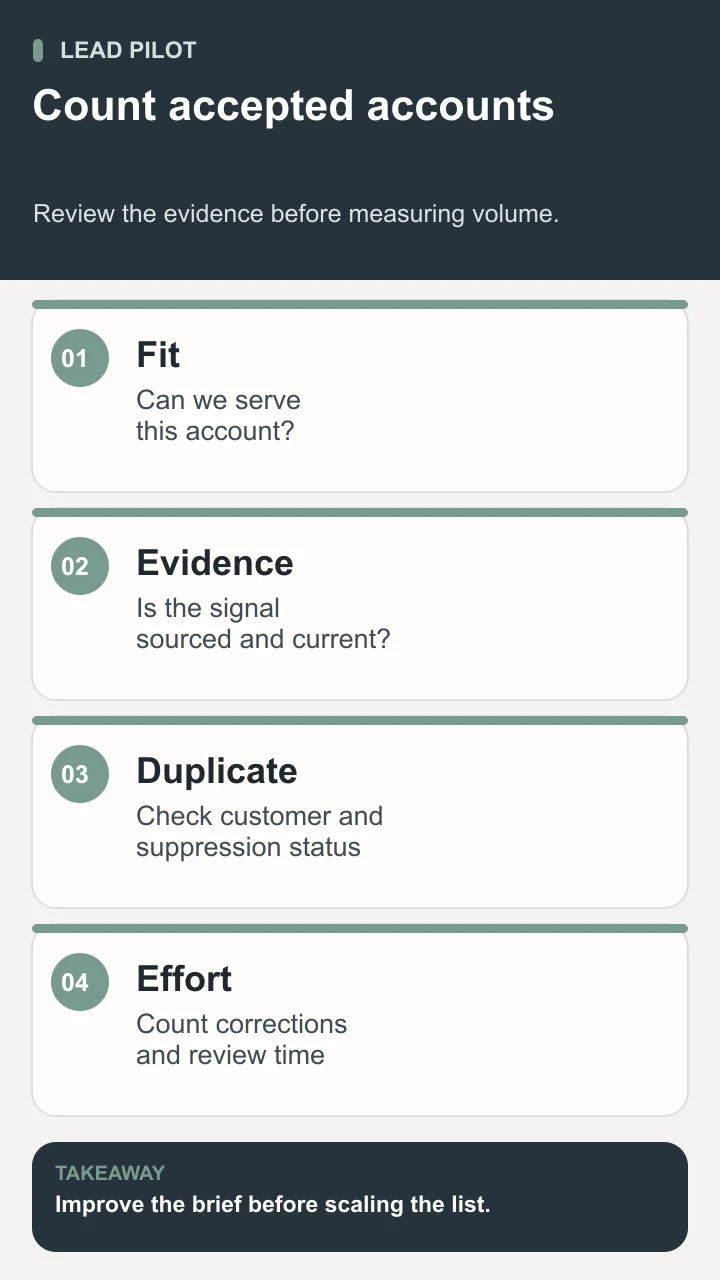
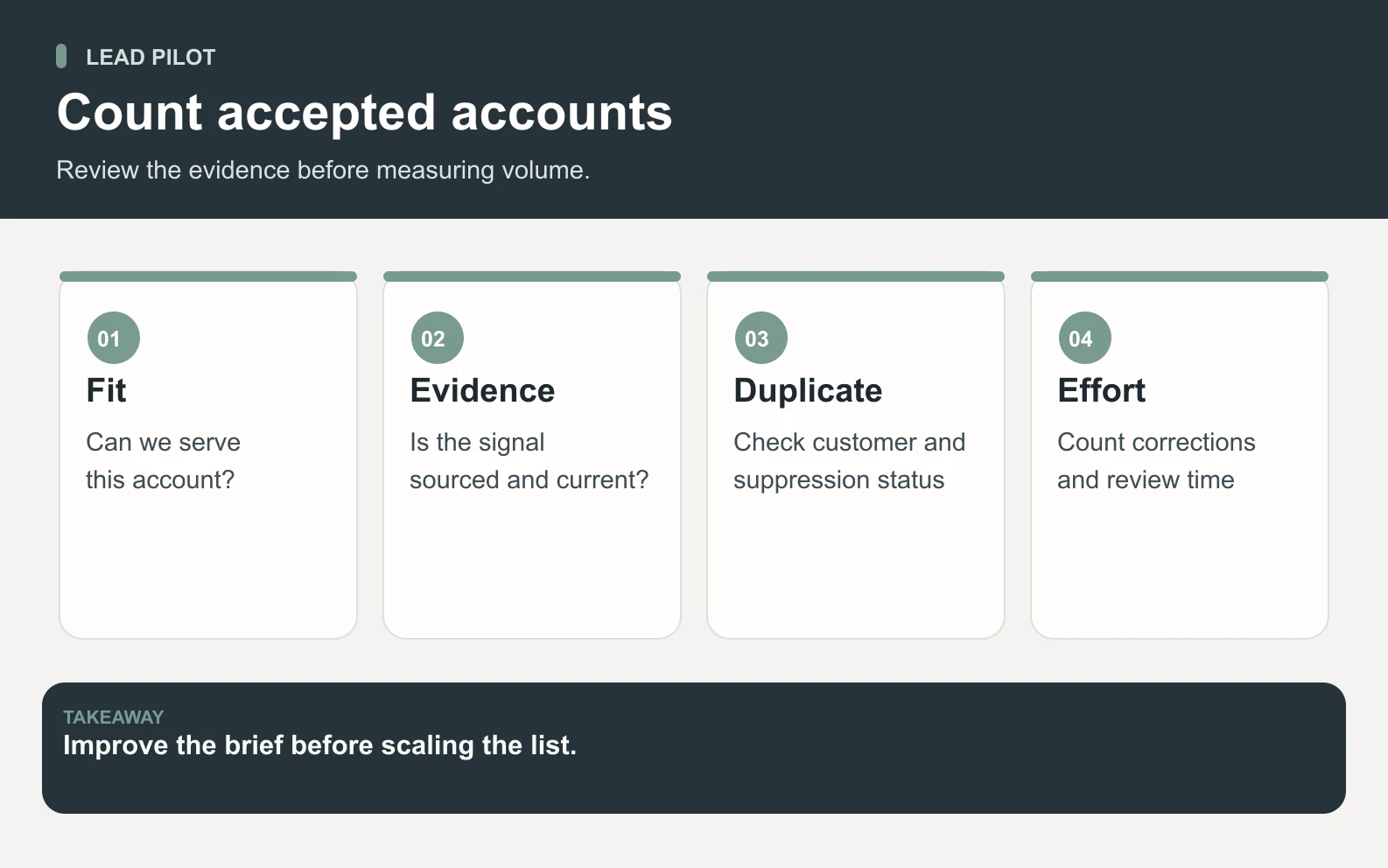
Use one segment, a short source list, and one reviewer for the first pilot. Have Iron prepare a small batch, then compare each row with the brief before allowing Copper to draft. Keep the old method or a simple manual sample as a baseline when feasible. You are testing whether the process improves useful research per unit of review effort, not whether an agent can produce the longest list. An attractive list with unverified facts can cost more in corrections and reputation than it saves in preparation.
Count candidates, accepted accounts, duplicate or excluded accounts, source failures, factual corrections, and minutes spent reviewing. For drafts, count how many were approved, rewritten, or discarded and why. Later funnel numbers such as replies and meetings can be observed, but a tiny two-week pilot cannot prove that AI caused a sales result. Offer quality, timing, market conditions, and the human conversation all matter. Use the early numbers to improve the research brief and approval path first.
Scroll horizontally to view all columns.
| Check | Question for the owner | Action when it fails |
|---|---|---|
| Fit | Would we serve this account today? | Tighten exclusions or buyer segment |
| Evidence | Can I open a current source for the claimed signal? | Replace the source or remove the claim |
| Duplication | Is this already a customer, opportunity, or suppressed account? | Check approved CRM data before contact |
| Message | Does the draft say only what we can support? | Rewrite or keep research-only |
| Review effort | Did the packet save owner time after corrections? | Reduce fields or simplify the workflow |
If you add tracking links to an approved campaign, use consistent source, medium, and campaign parameters. Google Analytics' campaign URL builder guidance explains how those parameters identify referred traffic. A tagged visit helps attribution; it does not tell you whether the underlying prospect research was correct. Keep source quality and owner acceptance as separate measures. Review the full cost too: Space Office pricing lists the subscription model, while dedicated compute and AI-provider usage are separate. Iron and Copper can occupy the two included specialist slots; the customer still supplies any approved source access and final review time.
Where the method can fail
Public signals are incomplete and can become stale quickly. A company may advertise a role that was filled, delay a launch, or change its priorities. A database can preserve an outdated title or merge two firms with similar names. An AI agent can also quote a real source accurately and still draw the wrong commercial conclusion. Require the human reviewer to open decisive links, check dates, and treat a suggested need as a hypothesis. If there is no checkable source, remove the signal rather than padding the packet with confidence language.
This workflow is especially weak when the buyer segment is not yet known. If the offer has never been validated, automating a list amplifies uncertainty instead of resolving it. Talk to customers, inspect won and lost deals, and choose a narrow test before sourcing more accounts. It is also weak when data permissions are unclear. Do not paste private CRM exports, personal contact data, or confidential customer notes into a tool without the access and processing decision your organization requires. Scope the approved inputs first.
Finally, do not confuse sales research with a fully automated outbound system. That system needs working account connections, suppression handling, deliverability controls, legal review where relevant, monitoring, and a stop mechanism. Nothing in an agent roster proves those pieces are configured for a customer. Use a human send decision until the actual workflow, permissions, and quality gates have been tested. The related AI sales team guide covers the broader funnel, while AI SDR versus human SDR explores where people remain central to discovery and relationships.
Conclusion: start with one checkable prospect packet
AI agents for lead generation are most useful when they reduce the work of finding and checking relevant accounts without hiding uncertainty. Define one segment, a few observable signals, and the evidence required for each row. Let Iron prepare the research, use Copper only for an approved draft, have Hydrogen review the handoff, and keep a person responsible for qualification and contact. After a small pilot, expand only if the accepted accounts and review effort justify it. If you want to discuss a bounded setup, the contact page is the next step; bring the buyer brief and one example of a good account.
Sources and review notes
Reviewed against the linked primary sources on the checked dates. Search features and citations are selected by their respective platforms; no placement is guaranteed.
- Anthropic: Building effective agents — checked
- Google Analytics: Campaign URL builder — checked
- Space Office: Live specialist roster — checked
- Space Office: How it works — checked
- Space Office: Pricing — checked
Frequently asked questions
What are AI agents for lead generation?
AI agents for lead generation are software-driven workers that can gather approved account information, compare it with a buyer brief, verify signals, and prepare a prospect packet for a person's decision. They can support research and drafting across steps. They do not establish buyer intent, grant access to a CRM, or authorize outreach by themselves.
Should an agent send prospecting emails automatically?
Start with research and drafts that a human reviews. Sending requires an authorized account, correct recipients, suppression checks, accurate claims, and a decision about applicable rules and relationship risk. A later automated send step should be separately scoped and tested; hiring a research specialist does not switch it on.
How do I tell a buying signal from a guess?
Write the source, observed fact, date, and possible relevance in separate fields. A company job post is an observation; an assertion that the company is ready to purchase your product is a hypothesis. A reviewer can verify the first and decide whether the second is worth testing in a conversation.
Which Space Office specialists would handle the workflow?
Iron is the live lead generation and prospecting specialist, Copper handles optional outreach drafts, and Hydrogen coordinates and reviews their output. The customer provides the approved buyer brief and any permitted access. A human owner accepts accounts and decides whether to send a message. The two specialists fit the base subscription; compute and AI-provider usage are separate.
What should I measure in the first pilot?
Count accepted accounts, source failures, duplicates, factual corrections, approved drafts, and human review time. Reply or meeting numbers can be tracked later, but a small pilot cannot isolate the effect of an agent from offer quality, timing, and human sales work. Improve the qualification brief before increasing batch size.