Guide
Lead Generation: A Practical Process With a Worked Example
Connect lead generation to a service you can fulfil, a clear response owner, and records that distinguish interest from a qualified opportunity.
By the Space Office team · Published · Updated · 18 min read
Lead generation is the work of attracting relevant interest and turning it into identifiable enquiries that a business can evaluate and follow up. Define a suitable customer need, choose an appropriate channel, offer a useful next step, capture the necessary information, and qualify the enquiry before advancing it. In Space Office, Iron can prepare fit criteria and research, Nitrogen drafts the capture and response copy, and Hydrogen coordinates and reviews their work. A human approves contact, qualification decisions, and customer commitments.

Key takeaways
- Define what the business can serve before trying to increase enquiry volume.
- Choose channels according to the buying situation and your ability to respond.
- Make the request, required information, and response expectation understandable.
- Separate raw submissions, distinct enquiries, suitable leads, meetings, and signed work.
- Judge a pilot using lead quality, follow-through, cost, capacity, and the limits of its evidence.
If the next task is investigating a new segment or partner route, the business development guide explains how to qualify that opportunity and test the important assumptions before expanding the commitment.
Once an enquiry becomes active work, the customer relationship management guide helps define linked customer records, evidence for stage changes, and a next action owned by the receiving colleague.
If your customers are organizations, the B2B marketing guide adds account fit, buying-group evidence, and an owned marketing-to-sales handoff.
To follow the process through to a first verified paid purchase, use the customer acquisition guide. Its worked pilot separates enquiry costs, acquisition costs, revenue, and first-order contribution before the owner decides what to repeat.
Download the free lead generation worksheet for fit criteria, a channel plan, enquiry fields, a response log, and the worked pilot below. This guide covers the general process. For a specific researched-account workflow using agents, see AI agents for lead generation.
What lead generation should produce
A lead is useful when the team can explain why the interest is relevant and what should happen next. A name in a purchased list, an anonymous visit, a download, a request for information, and an agreed sales conversation are different kinds of evidence. Calling all of them leads without recording the distinction makes the report look fuller while leaving the response team unsure what to do.
Salesforce's lead generation guide connects generating interest with evaluating and nurturing prospects. The operational definitions still need to fit your business. In the process below, an enquiry is a distinct request about the offer; a fit-reviewed lead meets the documented service criteria; and a needs-confirmed conversation has additional human-verified context. These labels are working definitions, not a universal industry standard.
Scroll horizontally to view all columns.
| Record | What it establishes | Possible next step |
|---|---|---|
| Website session | A recorded visit under the analytics system's definition | Inspect whether the page answered the intended question |
| Raw form submission | Someone or something submitted a form | Check validity, duplicates, and the actual request |
| Distinct valid enquiry | A real request recorded once under your matching rule | Check fit and assign an owner |
| Fit-reviewed lead | The request meets the stated service criteria | Clarify need, timing, and the appropriate conversation |
| Sales opportunity | The business has accepted a defined potential piece of work | Agree the next sales step and record its current status |
Lead generation does not finish simply because a form was completed. Someone must interpret the request, reply appropriately, and keep the record current. A business with unanswered enquiries may benefit more from fixing that handoff than from adding another traffic source. Put the response owner and available capacity in the plan alongside the acquisition activity.
Define fit before choosing lead generation channels
Begin with the work the business wants and can deliver. For a commercial window-cleaning service, useful criteria might include service area, building type, access requirements, the requested work, and timing. A nearby homeowner asking for a service the company does not offer can be a real person with a real need while still being outside this campaign's scope. Rejecting that fit does not require inventing a negative judgment about the person.
Use current operating facts to set the boundaries. Check the actual service area, staff availability, equipment limits, accepted work, and the person who can authorize a quote. Avoid a vague definition such as 'any business with money.' The target audience guide can help narrow the segment; the lead process should turn that choice into questions a reviewer can answer from evidence.
- 1Write the need the offer addresses and the kinds of request it does not cover.
- 2Name the service or product constraints that affect suitability.
- 3Separate required facts from helpful context that can be collected later.
- 4Define a fit decision, an uncertain decision, and a clear reason for declining or redirecting a request.
- 5Assign a human owner for exceptions and record the next action for each state.
Do not treat an unknown value as a positive qualification. If access arrangements or the buyer's authority matter, ask an appropriate question or mark them unconfirmed. Begin with a small set of explainable criteria before introducing a complex score. A number can prioritize records, but it cannot turn a guessed fact into a verified need or a commitment to buy.
Choose a route that matches the buying moment
Consider how a suitable person encounters the need. Someone searching for a commercial cleaning assessment is in a different situation from someone reading a maintenance checklist months before choosing a supplier. Match the material and next action to that situation. HubSpot's lead generation guide describes attracting interest and converting it into identifiable leads; the channel choice should support that path rather than maximize form fills in isolation.
Scroll horizontally to view all columns.
| Route | Useful role | What to prepare |
|---|---|---|
| Relevant search page | Answer an existing service question | Accurate scope, practical details, and an appropriate enquiry action |
| Paid search | Reach people searching for a defined offer | A controlled budget, suitable destination, and source-level review |
| Partner referral | Introduce a relevant request through an existing relationship | A clear fit description and a response owner |
| Educational material or event | Help someone understand a problem before a sales conversation | Useful content and an honest explanation of any follow-up |
| Researched outbound approach | Start a relevant business conversation from checkable evidence | Verified context, appropriate contact, and human approval before outreach |
A downloadable resource should be useful enough to stand on its own. Explain what the person receives and how their information will be used; do not disguise a sales appointment as an independent report. An event registration or resource request also does not automatically establish readiness for a quote. Keep the expressed interest and the commercial interpretation in separate fields.
Start with a route the business can support consistently. Search content takes maintenance; paid activity needs budget and destination checks; referrals need relationships and responsive handling. Use the digital marketing guide for wider channel planning and the content marketing guide when ongoing educational work is the main route. Adding every channel at once makes a small pilot harder to interpret and manage.
Create a useful capture and response path
Name a next step that the business can actually deliver: request a site assessment, ask a product question, view a demonstration, or receive a defined resource. Put the relevant scope and conditions beside the action. A form labeled 'Get an instant quote' creates the wrong expectation if a person must first inspect the building. 'Request a site assessment' describes that earlier step more accurately.
Collect enough information to route the request without making the form an entire discovery interview. In the cleaning example, a business contact, site location, broad building type, and a description of the need may support an initial review. Explain why a field is required. Leave detailed access, technical requirements, and commercial commitments for the appropriate human conversation when those facts cannot be established reliably in the form.
Write the confirmation and the internal handoff before sending traffic. Tell the person what was received and what the actual response process is. Assign a reviewer, record the arrival time, and provide a way to flag an urgent or unsuitable request. Test the form, notification, destination record, duplicate handling, and failure messages with a clearly labeled test enquiry before launching the real activity.
Keep contact preferences with the request. A person asking for one assessment has expressed a particular need; do not silently turn that into permission for unrelated messages. Share only the information needed for the task and have the responsible owner check the requirements that apply to the business and market. Improving capture should make the relationship clearer, not conceal what happens to the person's details.

Qualify and route each enquiry with a clear owner
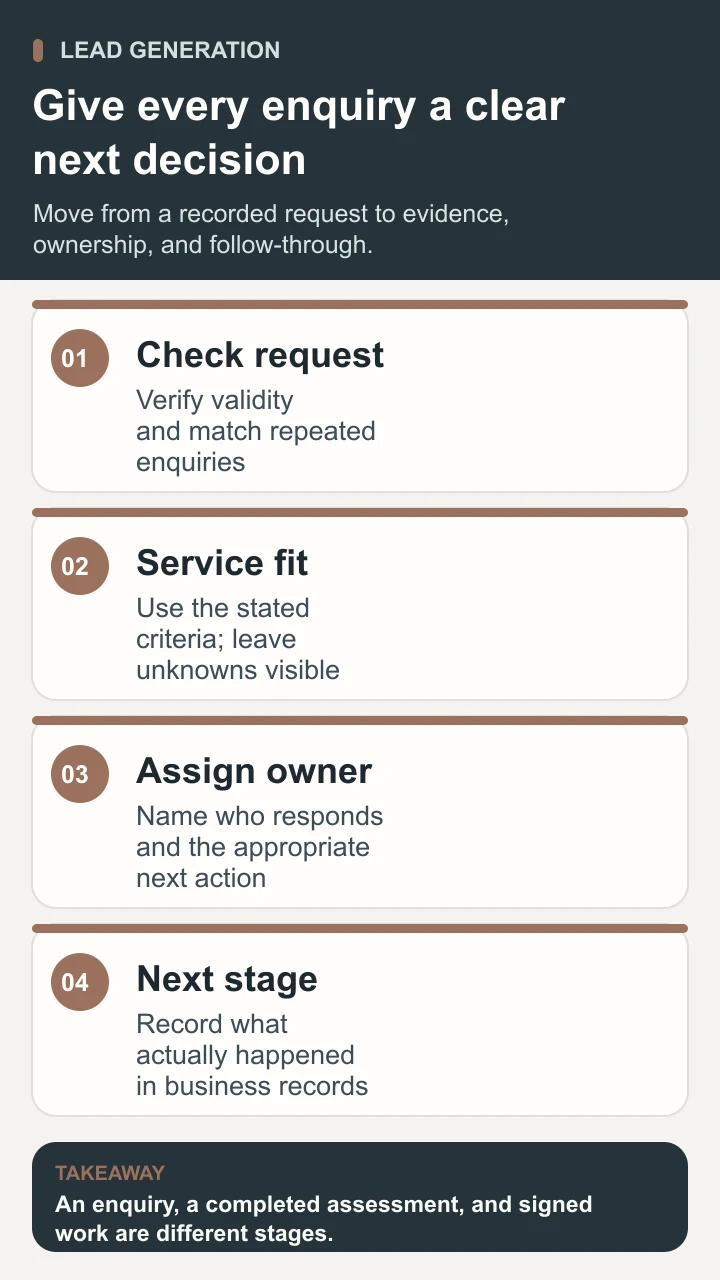
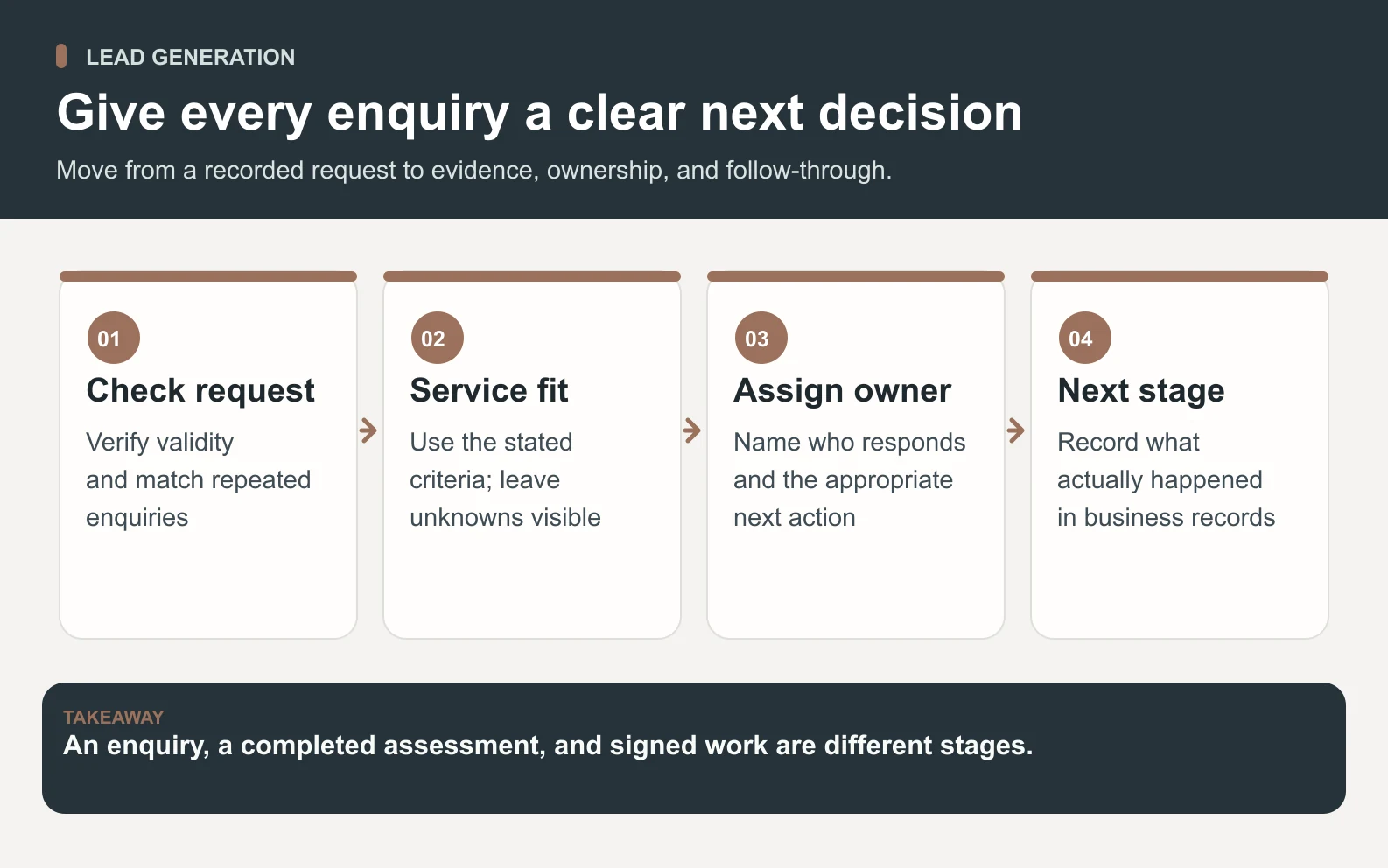
Review validity before interpreting demand. Remove obvious test records and invalid submissions from the reporting cohort while preserving a documented reason. Match repeated requests according to a stated rule. For a site-based service, two contacts discussing the same business, site, and current requirement may belong to one enquiry. A repeat request about a different site or a later requirement may need a new record rather than automatic removal.
Next apply the service criteria. Record the evidence, decision, owner, and any unanswered question. An uncertain request needs clarification, not a fabricated qualification. A request outside the service area may need a courteous explanation or an appropriate referral if the owner chooses one. A suitable request should move to a defined response queue with a next action instead of disappearing into a generic list of contacts.
Keep status and activity separate. 'Email sent' records something the team did; 'needs confirmed' records something learned about the opportunity. A scheduled assessment is different from one that happened. A proposal is different from signed work, and signed work is different from an invoice paid. This separation lets the owner see whether the actual bottleneck is fit, unanswered messages, attendance, proposal preparation, or the offer itself.
Worked example: reconcile a four-week lead pilot
This example is fictional. It illustrates record keeping and arithmetic, not a Space Office customer result or a forecast. A commercial window-cleaning service tests enquiries for office sites in two service districts. It uses an existing service page, a small paid-search campaign, and partner referrals. The response owner reviews each request against the same scope. A distinct enquiry means one business, site, and current requirement under the matching rule above.
Scroll horizontally to view all columns.
| Recorded source | Sessions | Raw submissions | Duplicates / invalid | Distinct valid enquiries |
|---|---|---|---|---|
| Organic service page | 220 | 14 | 2 / 1 | 11 |
| Paid search | 250 | 16 | 2 / 1 | 13 |
| Partner referral | 30 | 2 | 0 / 0 | 2 |
| Total | 500 | 32 | 4 / 2 | 26 |
The owner first reconciles the raw records: 32 submissions minus 4 duplicates and 2 invalid records equals 26 distinct valid enquiries. The example assigns each accepted enquiry one source using the first valid submission record and preserves later activity on that record. This is an attribution convention for the sheet. It does not show every prior encounter or prove that the assigned channel caused the enquiry.
Scroll horizontally to view all columns.
| Recorded source | Distinct valid | Outside scope | Fits the stated scope |
|---|---|---|---|
| Organic service page | 11 | 3 | 8 |
| Paid search | 13 | 3 | 10 |
| Partner referral | 2 | 0 | 2 |
| Total | 26 | 6 | 20 |
At the review date, the 20 scope-fitting enquiries have mutually exclusive current states: 8 have a human-confirmed need and timing, 7 are awaiting a reply, and 5 are not ready to proceed. Within the 8 confirmed cases, 5 site assessments have happened, 2 are scheduled, and 1 was cancelled. Of the 5 completed assessments, 3 have proposals and 2 need further scoping. Of the 3 proposals, 1 is signed and 2 remain open. These are nested stages, so adding them together would count the same enquiry several times.
The pilot records $500 in paid-search spending and $100 in page-asset production, or $600 in partial cash costs. Dividing $600 by 20 scope-fitting enquiries gives $30 per scope-fitting enquiry for this pilot. It is not customer acquisition cost, profit, or the cost of an additional sale caused by the campaign. Staff time, follow-up, delivery, overhead, and other costs are excluded, and a signed proposal does not establish collected revenue.
The useful next decision is specific: clarify service-area information to address the six unsuitable requests and assign the seven unanswered cases before increasing volume. Two partner enquiries are too little evidence to declare referrals the winning channel. Keep the same definitions for the next review, record the changes, and examine whether suitable requests receive the response they need.
Use Space Office to prepare a reviewed lead process
Scope the work around one offer and one enquiry cohort. Supply the service criteria, approved offer facts, permitted source records, current form, channel definitions, response process, and the owner who can resolve exceptions. Use only the customer information needed for the defined task. The business remains responsible for deciding what can be shared and for maintaining its source records.
- 1Iron prepares fit criteria and checks the supplied enquiry evidence, marking duplicates, uncertainties, and proposed priorities for review.
- 2Nitrogen drafts the capture explanation, confirmation, clarification questions, and response templates from the approved offer and scope.
- 3Hydrogen coordinates the handoff and reviews whether the definitions, copy, evidence, and proposed next actions agree.
- 4The human owner verifies the records, approves fit decisions and contact, assigns the response, and authorizes any customer commitment or external change.
Ask for an inspectable packet: criteria, reviewed records, draft messages, open questions, and a reconciliation summary. Compare the live roles with the coordination workflow before selecting specialists. Naming Iron or Nitrogen does not automatically connect a CRM, purchase data, send messages, or spend an advertising budget. Scope those actions and permissions separately when required.

Improve lead generation from quality and capacity
Create a compact review with defined counts: sessions, submissions, distinct valid enquiries, fit decisions, needs-confirmed conversations, completed next steps, and current proposal states. Keep the reporting window and cohort consistent. A large raw count with many duplicates can hide a capture problem; many suitable enquiries waiting for replies can expose an operating constraint rather than a lack of demand.
Use source labels as evidence about recorded acquisition, with their limits preserved. Google Analytics explains how campaign URL parameters populate campaign information. Choose consistent labels and retain them in the enquiry record where your implementation supports it. A tagged link does not identify every person, recover all missing attribution, or prove that a campaign created an incremental sale. Do not put personal or confidential details into campaign labels.
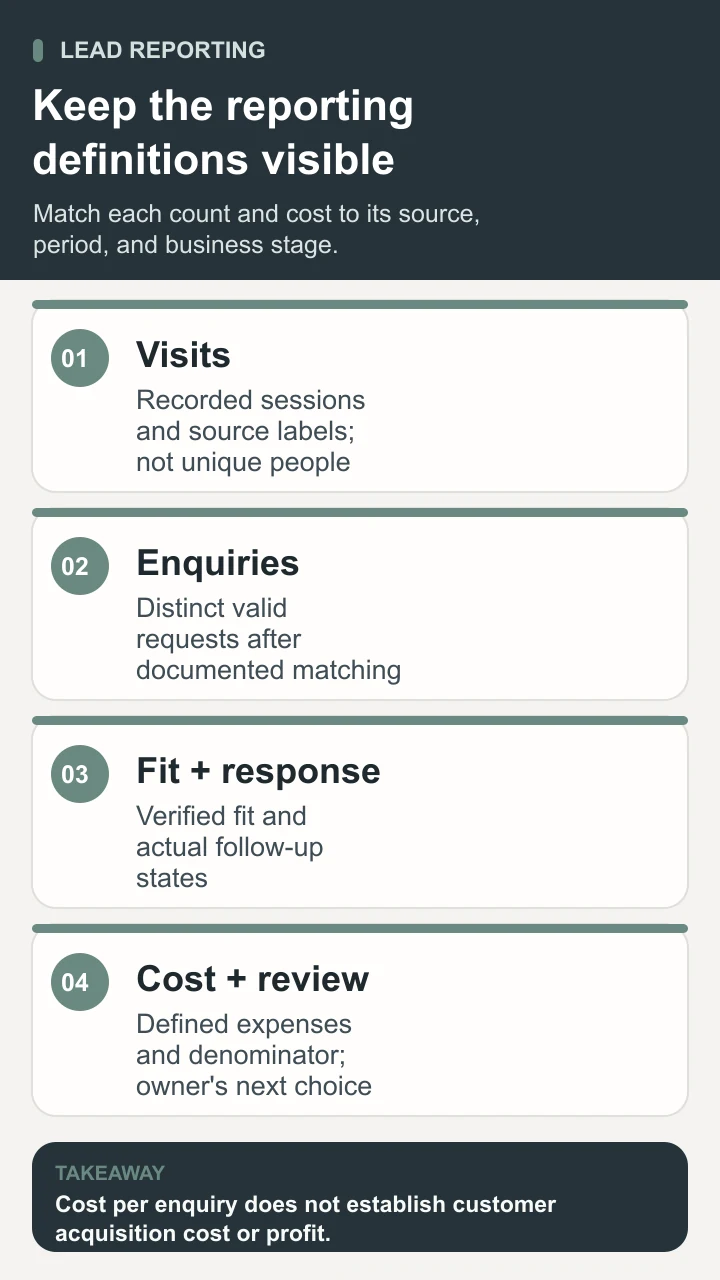
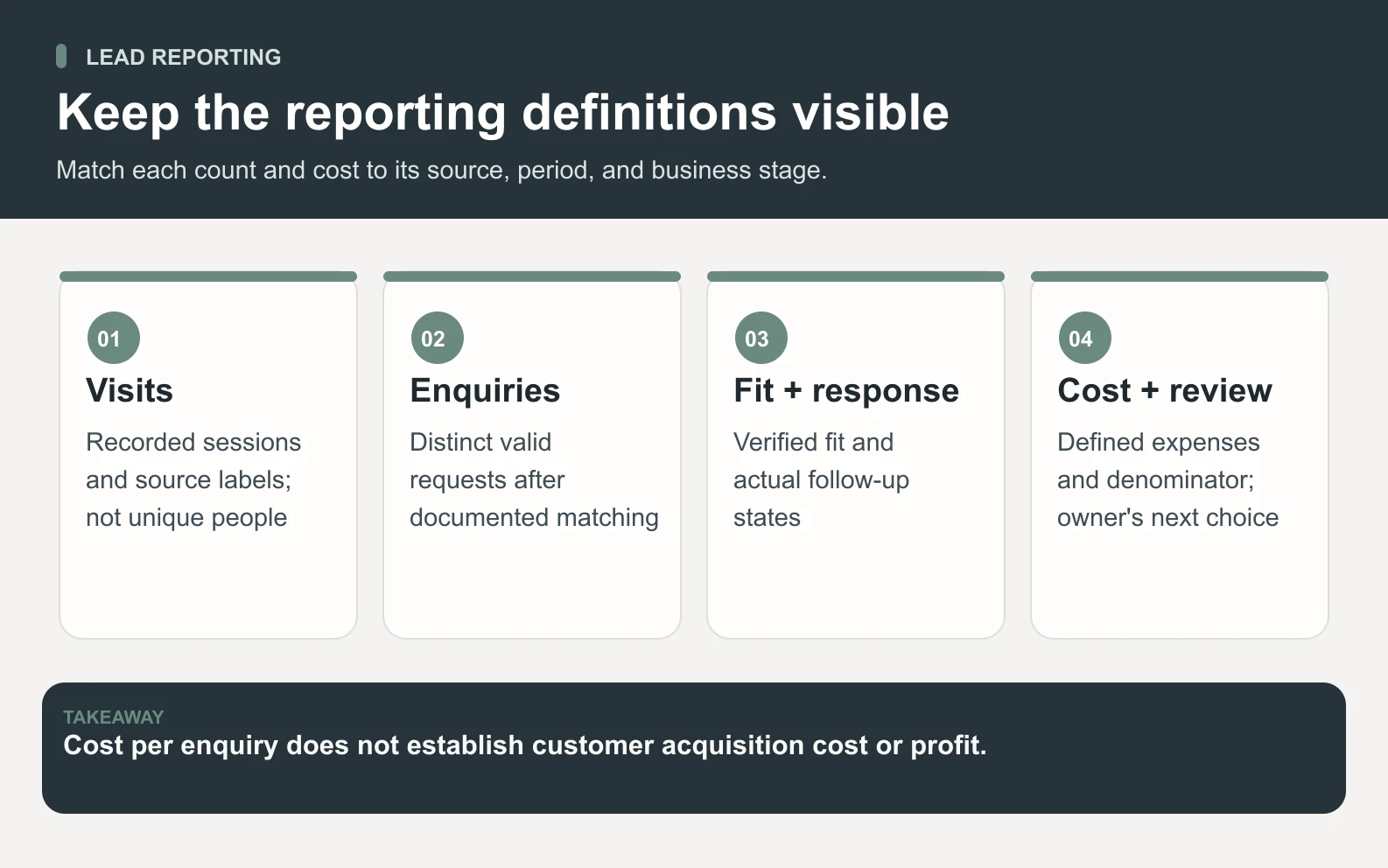
Choose the next change from a named failure. Improve scope copy when unsuitable requests repeat. Repair missing source records before comparing channels. Fix the response queue when suitable people are waiting. Revisit the offer or sales conversation when completed assessments repeatedly fail to progress for a documented reason. A small pilot should create a better next decision, not a universal benchmark from a few outcomes.
Useful lead generation connects relevant interest with honest capture, evidence-based qualification, and a response someone owns. Start with one serviceable need, maintain clear records, and expand only when quality and follow-through support the additional work. The objective is a process the business can understand and fulfil, not an impressive contact count with no reliable next step.
Sources and review notes
Reviewed against the linked primary sources on the checked dates. Search features and citations are selected by their respective platforms; no placement is guaranteed.
- Salesforce: Lead Generation Guide — checked
- HubSpot: Lead Generation Strategies — checked
- Google Analytics: Collect Campaign Data With Custom URLs — checked
Frequently asked questions
What is lead generation?
Lead generation is the work of attracting relevant interest and turning it into identifiable enquiries a business can evaluate and follow up. It can involve useful search pages, paid campaigns, referrals, educational material, events, or appropriately researched outreach. The process needs a clear offer, understandable capture, fit criteria, and a response owner. An enquiry is not automatically a customer or a sale.
What makes a lead qualified?
A lead is qualified against criteria the business has defined and checked. Those criteria might concern the requested work, service area, timing, access, or buying context. Record what is verified and what remains unknown. A fit-reviewed enquiry and a sales-ready opportunity can require different evidence, so keep those stages separate instead of assuming that one score or form submission proves readiness to buy.
Which lead generation channel should a small business use first?
Start with a channel that matches the customer's buying situation and the team's ability to maintain the material and respond. A useful service page may suit an existing search need; referrals may suit an established relationship; educational material may help before a buying conversation. Run a bounded pilot with clear source records and fit definitions before expanding. There is no universally best channel for every offer.
How should I measure the cost of leads?
Define the cost period, included expenses, and the lead stage before dividing. In this fictional pilot, $600 of partial cash costs divided by 20 scope-fitting enquiries equals $30 per scope-fitting enquiry. Other definitions and exclusions produce different measures. This is not customer acquisition cost or profit, and it does not prove the number of additional sales caused by the campaign.
Can Space Office help with lead generation?
Iron can prepare fit criteria and verify enquiry or account evidence, while Nitrogen drafts the capture and response copy. Hydrogen coordinates and reviews the work. Supply approved offer facts, permitted records, clear definitions, and a human owner for exceptions. A person approves contact, qualification decisions, access, spending, and customer commitments. The workflow does not guarantee leads, meetings, or sales.