Guide
AI Agents for Social Media: A Reviewable Publishing Workflow
A practical guide to AI agents for social media: turn one approved source into useful channel drafts, check them, publish deliberately, and learn.
By the Space Office team · Published · Updated · 18 min read
AI agents for social media can turn an approved product fact, customer question, or source article into channel-specific drafts, visual briefs, a calendar, and review notes. Give them the audience, claim boundaries, source material, and success measure; ask for variants that fit each channel rather than identical cross-posts. In Space Office, Nitrogen can prepare source copy, Cobalt can adapt it for organic distribution, and Hydrogen coordinates and reviews the work. A human checks facts, rights, tone, and timing, then makes the publication decision. No account access or posting is automatic.

Key takeaways
- Start with a source packet containing approved facts, audience context, rights, and a clear reason to post.
- Choose one or two channels and adapt the format, opening, proof, and call to action for each audience.
- Keep claims, creative assets, and publication permissions in separate review steps.
- Measure useful audience actions and owner review effort, not just post count or generic engagement.
- Use a short pilot to learn what readers respond to; no agent can promise reach or platform distribution.
For the decisions that come before delegation, start with the social media marketing guide: choose a channel, plan a four-week pilot, assign response ownership, and decide which results will change your next action. This article then explains the specialist handoff.
What can AI agents for social media usefully handle?
The valuable job is a repeatable editorial handoff. An agent can collect an approved source, extract the claim, draft several openings, adapt the idea to chosen channels, prepare a visual brief, and organize an approval packet. A person can then decide what is accurate, worth saying, and appropriate for the current moment. This is more useful than asking for “thirty posts about our brand,” because the source, reader, and review decision are visible. It also creates a way to learn which parts of the workflow actually save time.
Anthropic's guide to building effective agents advises starting with simple, composable workflows before adding agentic complexity. That principle fits social content. If one writer can turn a product note into a clear post, a template may be enough. If the work involves checking several sources, coordinating a writer and distributor, adapting material across formats, and returning revisions to the right owner, an agent workflow can help. The complexity is justified by the handoffs and checks, not by the number of drafts generated.
The Space Office specialist roster lists Nitrogen for content and copy and Cobalt for organic distribution across platforms. Hydrogen coordinates tasks and reviews specialist output. For a bounded social workflow, a customer can select Nitrogen and Cobalt as the two included specialists: Nitrogen prepares a faithful source draft and claim notes; Cobalt turns that material into channel-specific openings, formats, and a small calendar. Hydrogen checks the packet against the brief. The customer provides approved facts, brand voice, and rights to any media, then approves the final public assets. A role description does not grant account access or publish posts.

Create the source packet before the calendar
Pick one subject that matters to a real audience this week: a customer question, a product change that is already released, a useful lesson, or a published research finding. Write the fact in plain language, link the original source, and describe what cannot be claimed. If the source is internal, identify the owner who approved it for public use. A calendar built before that work often becomes a collection of plausible slogans. The source packet gives every draft a factual center and makes later review much faster.
Include the intended reader, the problem they recognize, the one insight to communicate, approved proof, desired next action, and known sensitivities. If a screenshot or quote is proposed, record its owner and permission status. If a case study lacks customer approval, use a general educational example instead. If the product feature has not shipped, label the draft as internal planning rather than an announcement. The packet should also state which claims require a person to check a current page or data source immediately before publication.
- 1Choose one idea and identify the source URL or approved internal document that supports it.
- 2Write the audience question and the single answer the post should give.
- 3List allowed facts, claims requiring review, and statements that must not appear.
- 4Name the channels, asset formats, owner, and final approval point.
- 5Set one learning question, such as whether the audience saves the checklist or visits the deeper guide.
For example, a small software company could provide a released feature page, three support questions, a product screenshot cleared for sharing, and a link to the full guide. Nitrogen can write a 100-word explanation that accurately answers the most common question. Cobalt can adapt the explanation into a LinkedIn post and a short caption for an image. If the screenshot contains private customer data or an unreleased control, the visual stops for human correction. The output is a review packet, not a standing instruction to post.
Adapt the idea to the channel, not merely the character limit
A channel-specific draft changes more than length. It changes what the reader sees first, how the proof appears, and what action makes sense in that context. A professional audience may value a brief worked example and a question it can discuss. A short visual format may need one clear step, an accurate caption, and an accessible description. The same approved fact can support both, but copying the same generic paragraph everywhere loses the reason people use each surface.
LinkedIn's Pages Playbook is a first-party resource for company-page publishing and audience engagement on that platform. Treat its platform guidance as context rather than a promise that one format will always perform. Algorithms and features change. Cobalt's useful contribution is to choose an appropriate native format, write a relevant opening, and flag claims about platform mechanics that lack a current source. A human should still decide whether the idea serves the audience and brand, rather than chasing a rule that happened to work elsewhere.
Scroll horizontally to view all columns.
| Surface | Opening | Body and proof | Next step |
|---|---|---|---|
| Professional feed | A common review mistake framed as a question | Three short checks with a link to the original guide | Invite a specific discussion or deeper read |
| Short visual post | One check visible in the first frame | Simple graphic and caption with source context | Save the checklist or open the full explanation |
| Community reply | Answer the member's actual question first | One relevant example, with any affiliation made clear | Continue the conversation if requested |
| Newsletter note | A reader problem in the subject or lead | A fuller explanation and one useful link | Reply with an edge case or visit the guide |
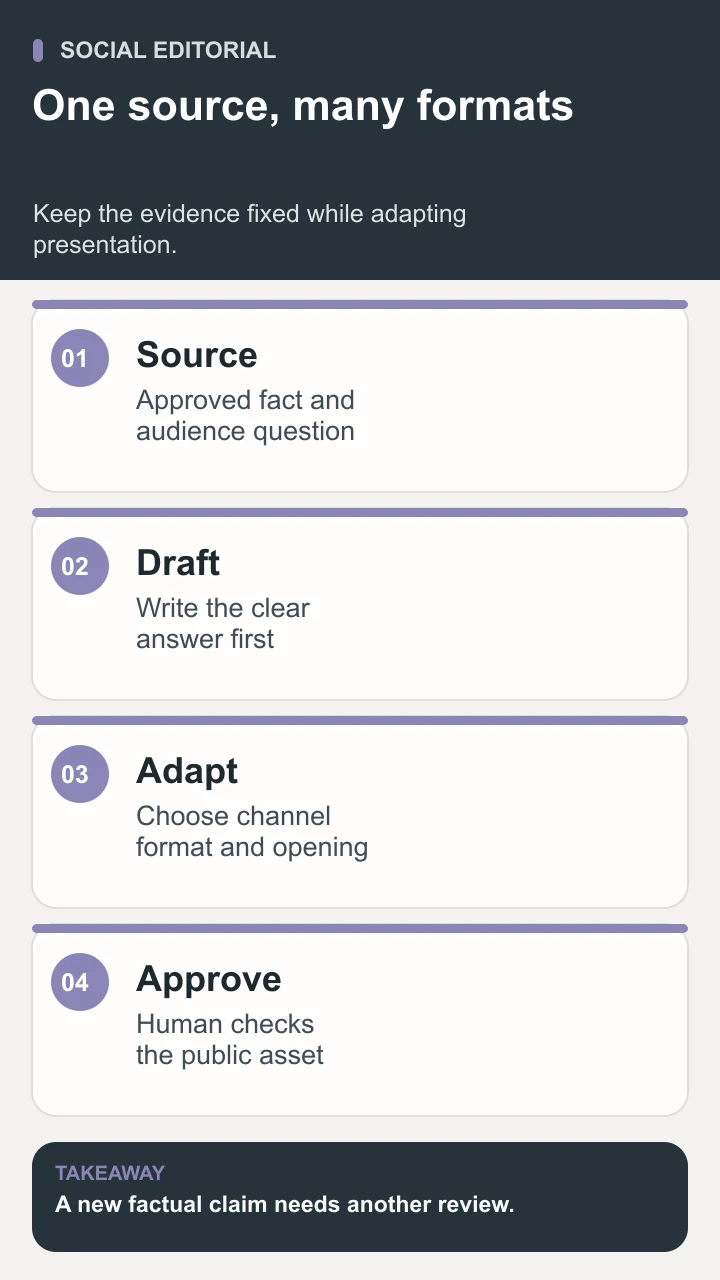
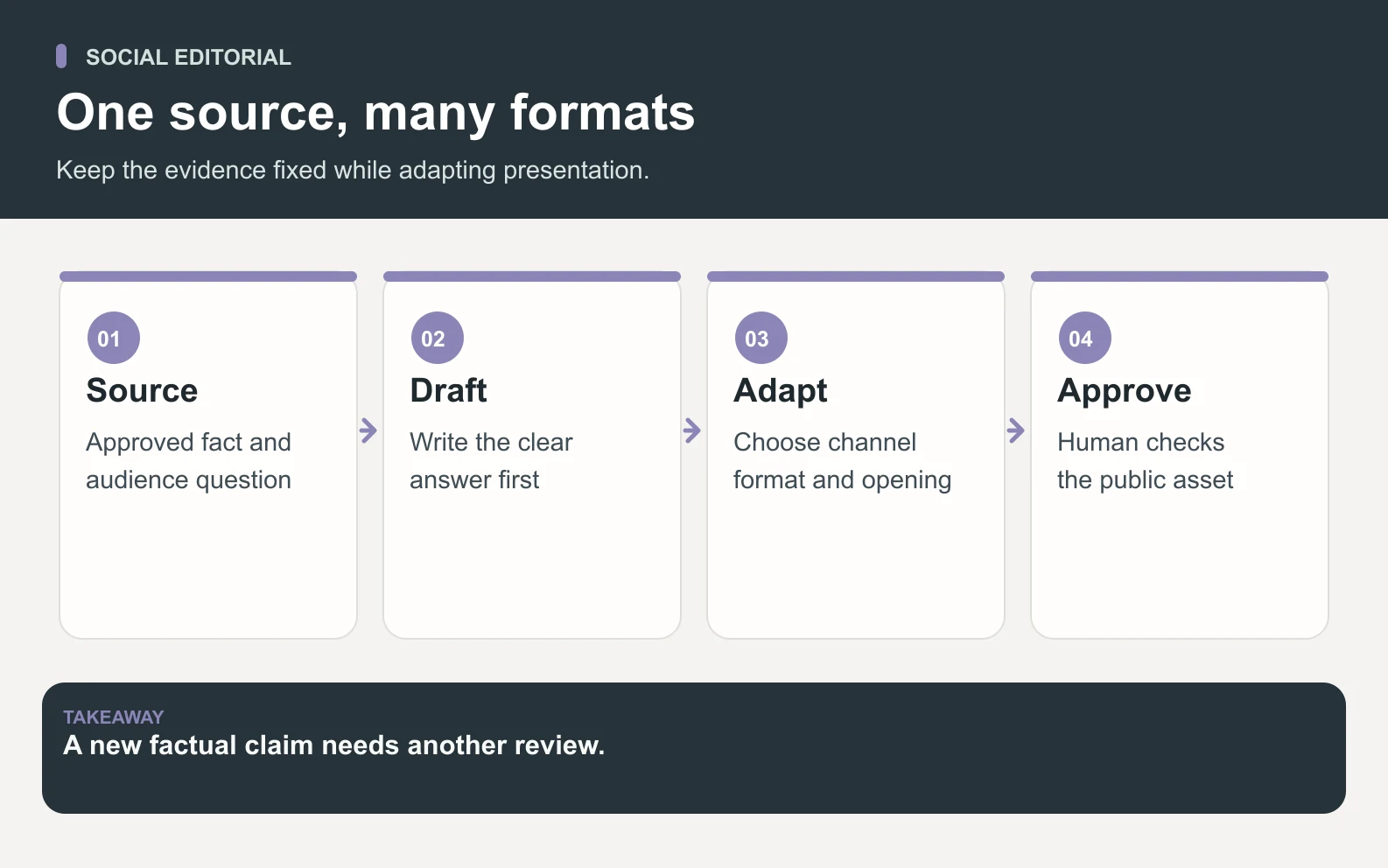
The table is a decision map, not a requirement to use four channels. Start with one or two where you already know the audience. Ask Cobalt for a reason each variant fits its channel, and ask Nitrogen to compare every factual statement against the source packet. If the adaptation needs a new fact, another approval is necessary. The fastest way to lose trust is to make a source narrower than the claim: a customer anecdote about one team does not establish a market-wide result, and a product screenshot does not establish an outcome.
Build a review gate a busy owner can actually use
Review should be a short decision sheet attached to each proposed post. Put the source link, date checked, intended audience, exact asset, and any unresolved claim beside the draft. The owner should not have to reconstruct why a sentence exists. Separate factual approval from taste: first confirm the product description, figures, quotations, rights, and destination link; then decide whether the wording sounds like the brand. If a factual issue remains, hold the post even if the copy is polished.
Give the reviewer a small set of outcomes: approve, revise, hold for evidence, or discard. Require a reason for the last three so the next brief improves. Common reasons include a source that no longer says what the draft claims, a visual that cannot be reused, a call to action that leads to the wrong page, or an opening that overstates the result. Hydrogen can check for completeness before the packet reaches the owner, but Hydrogen's review is not the human final decision. This distinction should remain visible in the calendar.
Publication is a separate permission. A social account may require access, scheduling software, platform permissions, and a clearly authorized person. None of those are established by the presence of a content specialist. For an initial pilot, a person can publish manually after approval and record the live URL. That keeps the decision clear while the team learns whether the preparation process is useful. If automatic scheduling is later considered, scope the account connection, allowed actions, approval step, and pause mechanism as their own workflow.

Run a small publishing pilot and learn from useful actions
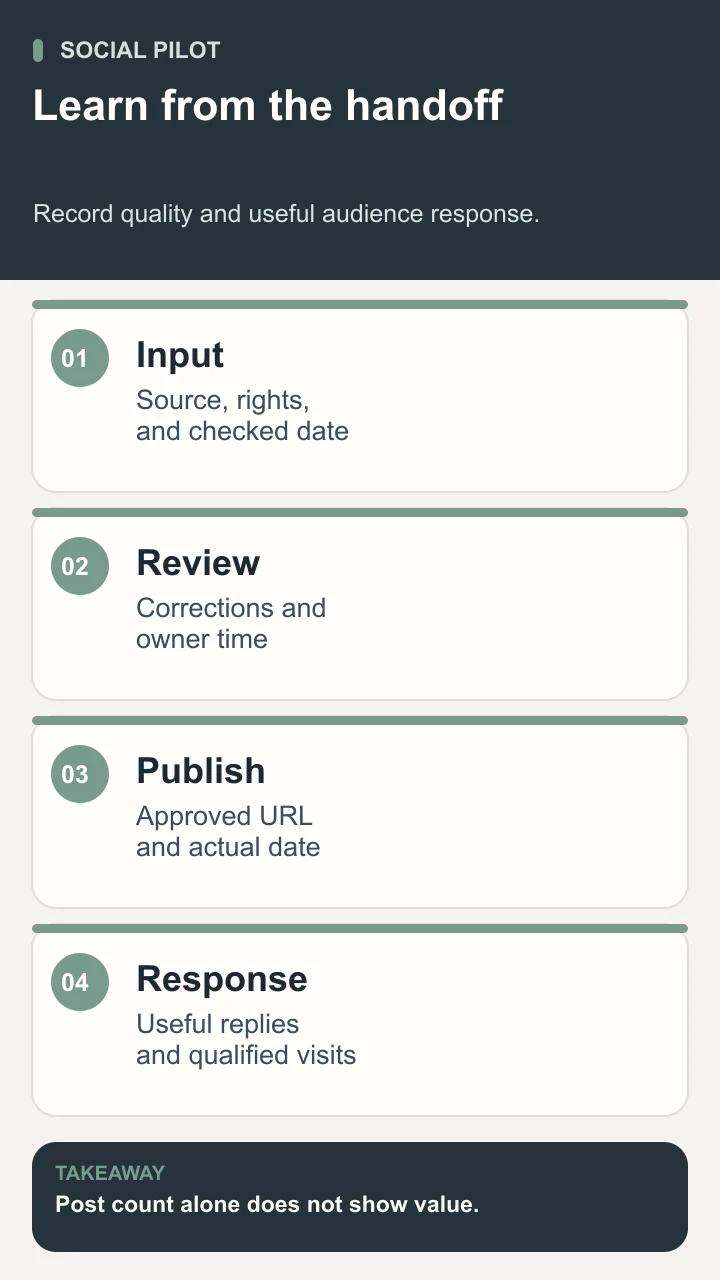
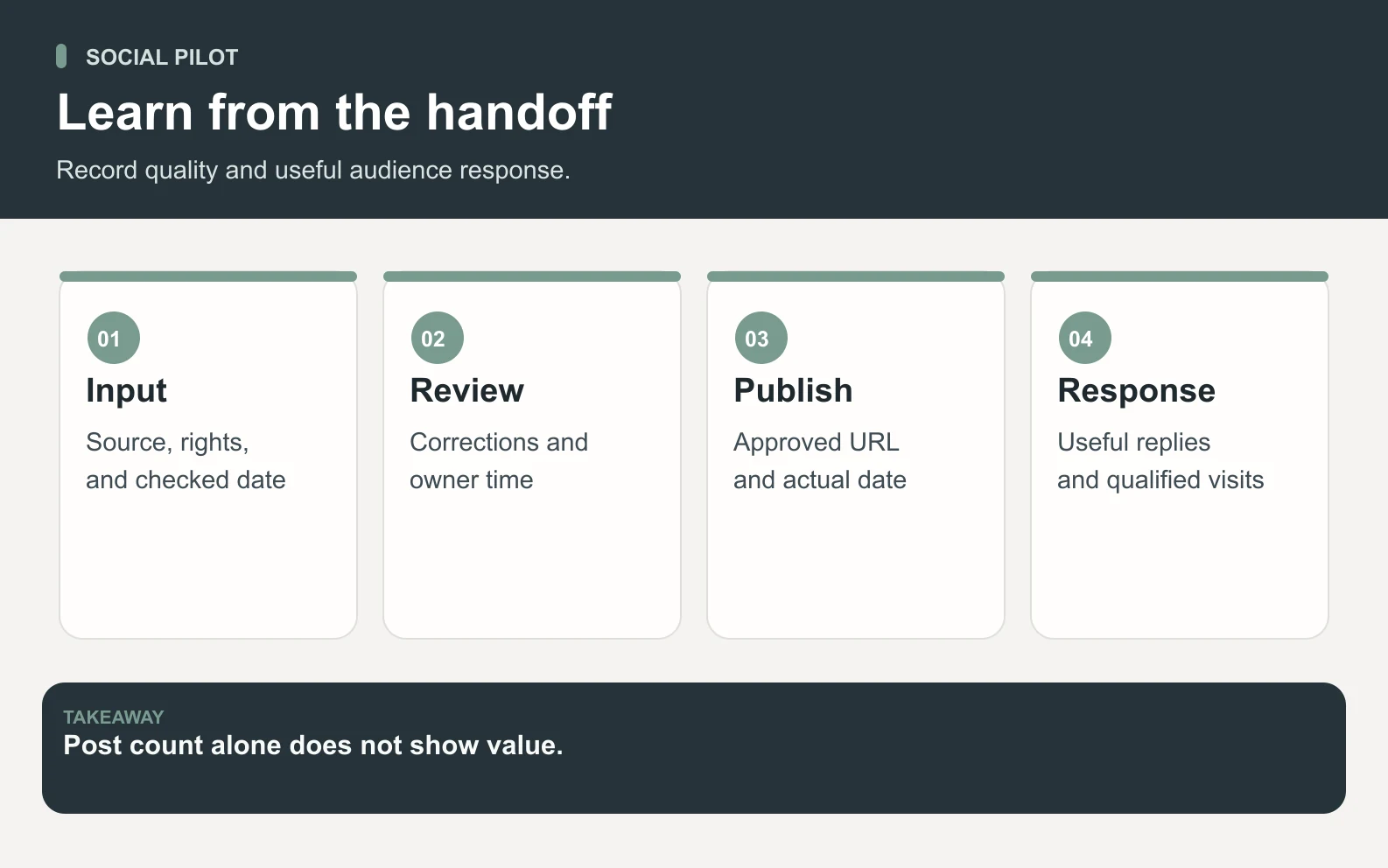
Start with one approved source and two or three drafts a week on one or two channels. The human owner decides which to publish. Keep a simple log with the original idea, channel, format, claim corrections, review time, published URL, and result. This lets you see whether a format helps the intended reader and whether the agent workflow saves preparation time after revisions. A larger calendar is not automatically a better program; the limiting factor may be a shortage of approved ideas or a slow review decision.
Choose a result that follows from the task. If the post answers a practical question, saves, substantive replies, or qualified visits to a deeper guide may be more informative than raw impressions. If it announces a release, look at relevant visits and questions from actual users. If it builds community, record whether conversations are useful and whether a person can answer follow-ups. These measures still have limits: platform counts can change, distribution varies, and a tiny pilot cannot isolate one post's effect on revenue.
When a post links to your site, Google Analytics' campaign URL guidance explains how consistent UTM parameters identify referring campaigns. Keep those links readable and test them before publication. Some social and video content may also be discoverable through Google Search; Google Search Central's guide describes what its Search Console reporting can show. Those tools answer different questions from in-platform engagement. Use them to learn where a reader came from, not as evidence that the agent caused a sale or that every platform view was measured.
Scroll horizontally to view all columns.
| Field | Record | What it teaches |
|---|---|---|
| Source | Approved page or fact, owner, checked date | Whether the calendar has reliable inputs |
| Draft | Channel, format, audience question | Whether the idea was truly adapted |
| Review | Decision, corrections, minutes | Where quality or handoff causes work |
| Publication | Human-approved URL and date | What actually went live |
| Response | Useful replies, saves, qualified visits | Which reader task resonated |
After two weeks, inspect the rejected drafts as carefully as the successful ones. If most corrections are product facts, improve the source packet. If the posts are accurate but sound interchangeable, sharpen the audience question and native format. If the owner takes too long to review, reduce the number of fields or move the evidence beside the sentence it supports. If a channel produces no useful response, reconsider whether the audience is there before increasing frequency. The next experiment should address one observed bottleneck.
Know the limits before adding automation
An agent does not know a brand's unwritten boundaries. It can repeat a stale price, describe a planned feature as live, or use a customer anecdote beyond the permission granted. It can produce a visual that looks plausible while misrepresenting the interface. It can also recommend a platform tactic based on outdated advice. Require current sources for factual claims, direct checks of product and pricing pages, rights review for media, and a human final read. When the source is thin, publish a smaller claim or skip the post.
A social workflow also cannot promise reach. Distribution depends on the audience, the platform, timing, topic, and factors outside the team's control. Do not put an unsupported algorithm rule in a brief simply because it is easy to repeat. Keep experimental hypotheses labeled as hypotheses. If a post underperforms, ask whether the subject mattered to the intended reader before changing every visual, hook, and schedule at once. A useful editorial system learns; it does not turn every low number into a new superstition.
Space Office's scope should stay just as clear. The pricing page sets the base subscription at $60 per month or $600 per year for Hydrogen and two chosen specialists; more specialists cost extra, while dedicated compute and bring-your-own AI-provider usage are separate. Nitrogen and Cobalt fit the two included specialist slots for this example. A customer supplies approved source material and any access it chooses to grant. Hydrogen coordinates and reviews the specialist handoff, and a human approves the final work. No automatic social login, scheduling, publication, guaranteed engagement, or citation follows from that plan.
This guide addresses social drafting and editorial review. The broader marketing-without-a-hire guide covers choosing an offer and running a weekly marketing system; the B2B SaaS marketing team guide maps several marketing roles. If you already have a reliable writing process and only need scheduled distribution, a simpler publishing tool may be enough. If source research, copy, channel adaptation, and review are the recurring bottleneck, a small coordinated specialist workflow is worth testing.
Conclusion: publish fewer, better supported posts first
AI agents for social media are useful when they turn approved ideas into channel-specific, reviewable work without hiding who decides what goes live. Start with a source packet, ask Nitrogen for clear copy and Cobalt for native adaptations, let Hydrogen review the packet, and have a person check claims, rights, tone, and timing. Run a short pilot and measure both review effort and useful reader response. Expand the calendar only when that loop produces work the owner is comfortable publishing. To discuss a bounded setup, bring one approved source and two example posts to the contact page.
Sources and review notes
Reviewed against the linked primary sources on the checked dates. Search features and citations are selected by their respective platforms; no placement is guaranteed.
- Anthropic: Building effective agents — checked
- LinkedIn: The LinkedIn Pages Playbook — checked
- Google Analytics: Campaign URL builder — checked
- Google Search Central: Analyze social and video content in Search Console — checked
- Space Office: Live specialist roster — checked
- Space Office: Pricing — checked
Frequently asked questions
What are AI agents for social media?
AI agents for social media are software-driven workers that can use an approved idea and evidence to prepare channel-specific copy, visual briefs, calendars, and review notes across several steps. They can support an editorial workflow, but they do not own a brand's judgment, obtain account permissions automatically, or guarantee distribution.
Can social media agents publish posts automatically?
Some workflows can be configured with account access and scheduling tools, but that is a separate permission and implementation decision. In the bounded workflow here, agents prepare drafts and a human approves and publishes them. Do not infer automatic publication from a specialist's ability to write a calendar.
Should the same draft go to every platform?
Usually the underlying fact can stay the same while the opening, format, proof, and next step change for each audience. Keep one source of truth and adapt only the presentation. If a platform version requires an extra factual claim or a new image, send it through review again.
Which Space Office roles help with a small social workflow?
Nitrogen handles content and copy, Cobalt handles organic distribution and channel adaptation, and Hydrogen coordinates and reviews the handoff. The two specialists fit the base subscription. The customer provides approved facts, voice, and media rights; a human owner approves publication. Compute and AI-provider usage remain separate.
What should a two-week pilot measure?
Record the source and channel for each draft, corrections, human review minutes, what actually went live, and useful audience actions such as substantive replies or qualified visits. Post count alone does not show whether the material helped readers or reduced the owner's work. Use rejected drafts to improve the brief.