Guide
Social Media Marketing: A Practical Four-Week Plan
Make social media marketing a repeatable way to teach, listen, and earn relevant visits, with one audience, a realistic schedule, and a clear review decision.
By the Space Office team · Published · Updated · 16 min read
Social media marketing is the use of social platforms to reach an audience, share useful content, build relationships, and support business goals. It includes organic publishing, community engagement, and paid campaigns. Start with one audience, one objective, and a channel you can maintain; publish relevant work, respond, and measure what people do next. In Space Office, Nitrogen can prepare source copy and Cobalt can adapt organic posts. Hydrogen coordinates and reviews their work, while a human approves publication.

Key takeaways
- Choose the audience and desired action before choosing platforms or formats.
- Separate organic publishing, paid distribution, and the daily work of account management.
- Use a four-week pilot to test a specific question with a manageable publishing and response schedule.
- Read impressions, clicks, useful conversations, and business outcomes together, using clear definitions.
- Keep approved sources, account permissions, and human publication decisions visible in the workflow.
For a campaign involving an independent creator, use the influencer marketing guide to check creator fit, agree deliverables and permissions, review the final content, and reconcile the campaign evidence.
Download the free social media marketing worksheet to build your own pilot. It includes a channel decision, four-week calendar, response rules, and measurement record. The consultancy below is fictional; its schedule and numbers illustrate the method and are not performance targets or customer results.
What social media marketing includes
A useful social presence helps a particular person understand or do something. A product team might explain a confusing setup step. A consultant might show how to diagnose a recurring business problem. A shop might answer questions about choosing and using an item. The business benefits when those interactions create relevant awareness, trust, visits, inquiries, or repeat purchases. The right outcome depends on the offer and the reader's situation.
Scroll horizontally to view all columns.
| Activity | What it involves | What to plan separately |
|---|---|---|
| Organic social | Publish posts, demonstrations, discussions, and replies without paying for that placement. | Production time, review, community care, and uncertain distribution. |
| Paid social | Pay a platform to distribute an advertisement or promote eligible content. | Budget, audience settings, creative, landing page, and measurement. |
| Social media management | Operate the account: scheduling, permissions, moderation, reporting, and coordination. | A responsible owner, response coverage, and escalation rules. |
These activities overlap. A helpful organic post can inform a future advertisement, and management supports both. But a popular unpaid post does not establish what paid acquisition will cost. An organized calendar does not establish whether the audience finds the message useful. Give each activity a purpose and budget so you can tell which part needs improvement.
LinkedIn's strategy guide connects objectives, audience, channels, responsibilities, and measurement. Its planning structure is useful here; the article was published in 2019, so we are not using its historical audience statistics or trend predictions. The plan below applies that general structure through an original small-business example.
Keep this channel plan connected to your wider marketing. Your website explains the offer and gives interested people a useful next step. Content marketing develops the deeper guides, examples, and resources you may share. Social work adapts selected ideas for a platform and handles the resulting conversation. A post should still teach something to a person who never leaves the feed.
When the account represents a founder, consultant, or individual specialist, first decide what that person can credibly be known for. The personal branding guide and worksheet connects a clear professional promise to approved examples of real work. Use that foundation to choose the lessons you share through your social plan.
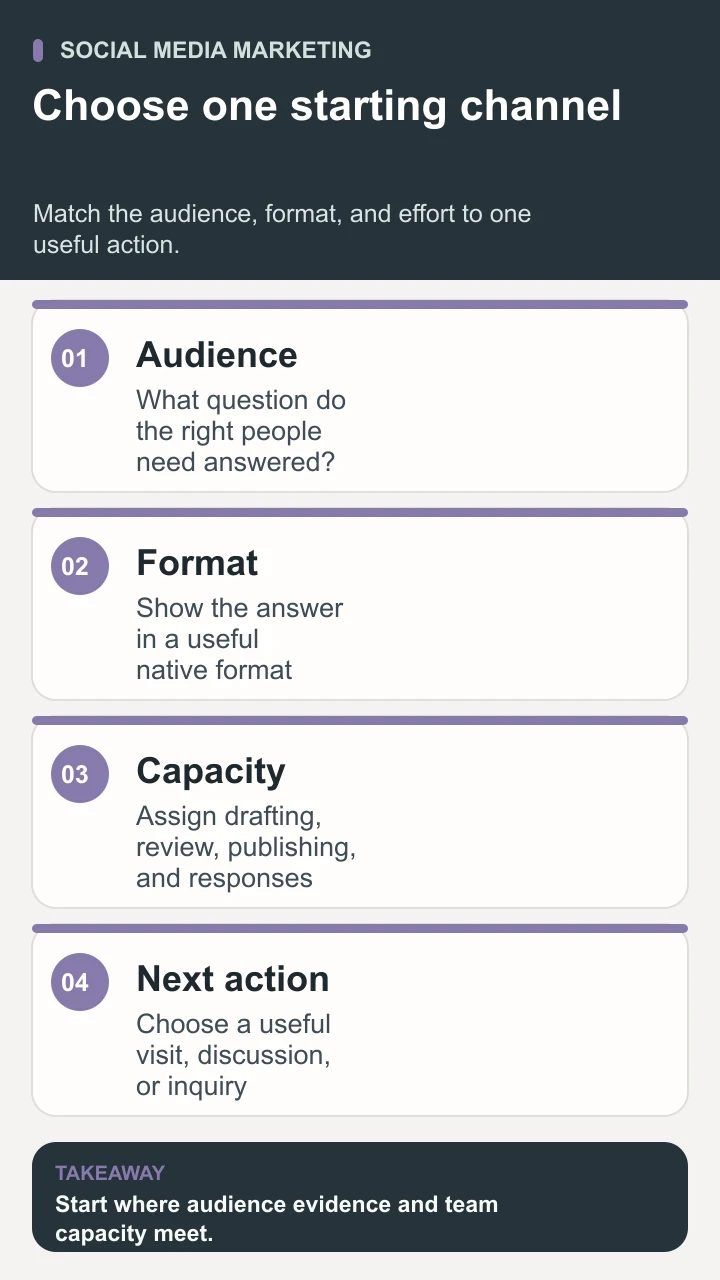
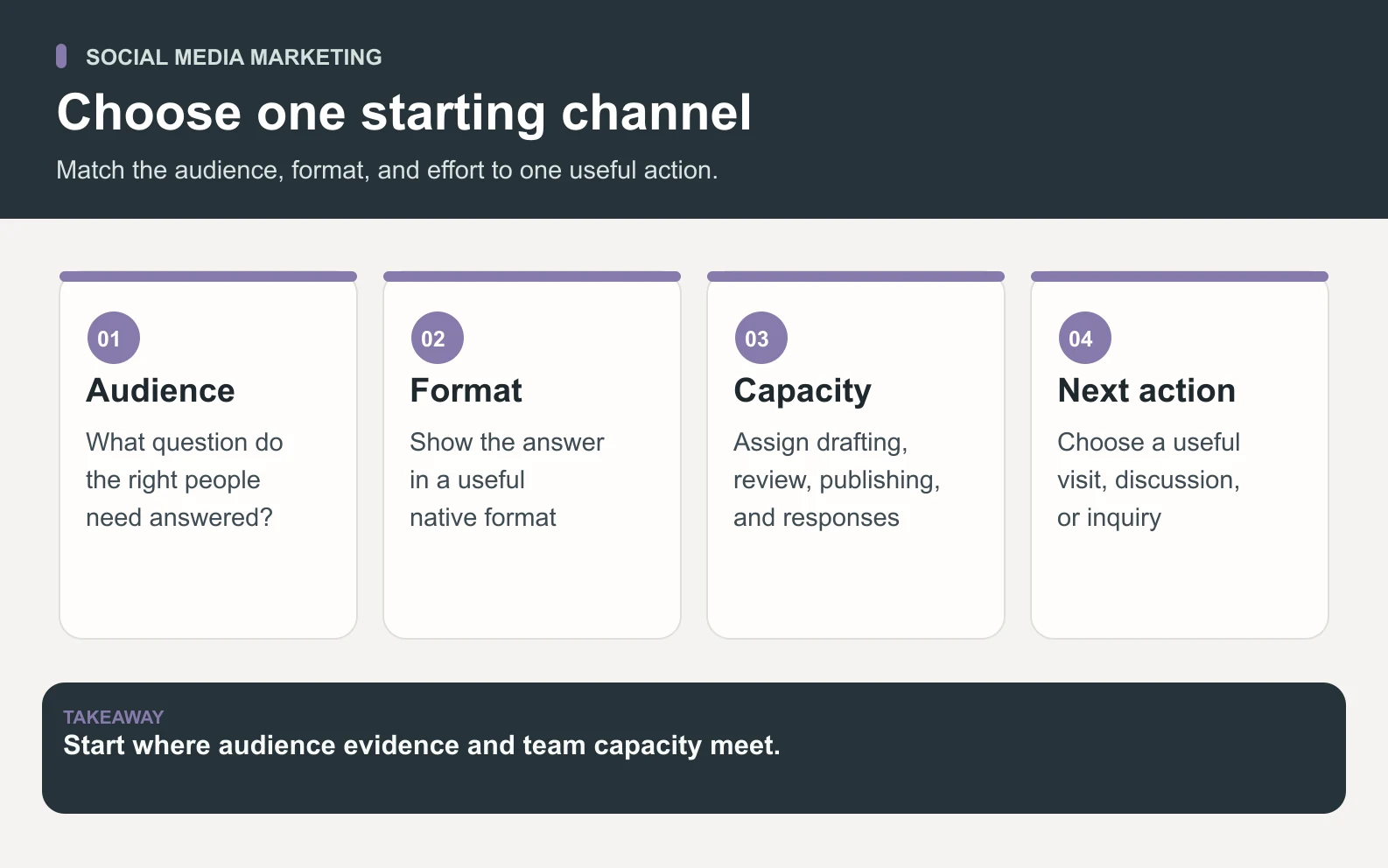
Choose one objective, audience, and starting channel
Write the objective as an observable action within a period: help relevant operations managers visit our handoff checklist during the next four weeks. That is more actionable than become famous online. Define a useful visit or inquiry before reporting results. For example, an inquiry may need to describe a handoff problem within the consultancy's scope. General compliments remain welcome, but they answer a different question.
Use customer conversations and existing audience evidence to identify whom you can help. Record their recurring question, the context in which they ask it, and what they need before acting. If those details are missing, begin with the target audience worksheet. Follower demographics alone may not tell you who has the problem, who buys, or whether the person can use your service.
Scroll horizontally to view all columns.
| Candidate approach | Evidence that would support a test | Practical constraint |
|---|---|---|
| LinkedIn company Page | Relevant professional conversations and customer questions you can answer publicly. | Someone must contribute useful examples and respond to discussion. |
| YouTube demonstrations | People need to see a process or product explained over time. | You need clear recordings, editing capacity, and a sustainable format. |
| A visual social channel | The audience already discusses the subject there and visual proof helps explain it. | You need appropriate media, rights, and a format the team can produce. |
| An existing community | Members ask relevant questions and the rules permit your contribution. | Participation must fit community expectations and moderator rules. |
This is a decision framework, not a universal platform ranking. Inspect actual conversations and your own capacity before selecting one. A visual channel is a weak choice if all your useful evidence is difficult to show. A discussion community is a weak choice if your only intended contribution is a link. Record why the selected channel fits and what observation would change your mind.
Before posting, make the account understandable. Use a recognizable identity, a plain description of the offer, and a working destination link. LinkedIn's Page guidance covers Page information, publishing formats, participation, and analytics. Use those controls to support your plan; do not treat the platform's promotional performance figures as a forecast for your account.
Build a four-week plan: a fictional consultancy example
Imagine a small operations consultancy that helps service teams document project handoffs. Its owner has an approved checklist, three recurring customer questions, and one anonymized process example cleared for public use. The team chooses one LinkedIn Page for this pilot because its existing conversations suggest that relevant managers use it. This assumption will be tested through responses and visits; it is not a claim about all consultancies.
The learning question is whether practical handoff examples lead appropriate readers to the checklist and useful discussions. The owner can approve two posts a week and review replies on working days. Eight planned posts are a capacity choice, not an algorithm rule. The team keeps paid promotion outside this pilot so the report can describe the organic work clearly. It records writing, review, and response time alongside audience actions.
Scroll horizontally to view all columns.
| Week | Two planned posts | Owner's task | Question to review |
|---|---|---|---|
| 1: Establish the problem | A missing-handoff example; a three-question diagnostic. | Verify facts, approve posts, test the checklist link, and record the starting measurements. | Do relevant readers recognize the problem? |
| 2: Demonstrate a method | A completed checklist field; a before-and-after handoff note. | Check permission for the example and answer questions about the method. | Which step needs a clearer explanation? |
| 3: Answer the audience | An answer to a real recurring question; an example of a useful exception. | Select questions without exposing private details and check service boundaries. | Do replies show a situation the consultancy can help with? |
| 4: Connect to a next step | A summary of common mistakes; an invitation to use the checklist. | Review the whole period, including effort and any qualified inquiries. | Should the team continue, revise, or pause this approach? |
For the first post, the opening could be: A handoff is incomplete when the next person knows the deadline but cannot find the decision owner. The body shows a fictional two-line handoff with an owner, next action, and unresolved issue. The closing asks which missing detail most often delays the reader's team. This teaches a usable distinction and invites experience relevant to the consultancy's work.

Each calendar entry needs the intended reader, source, format, draft owner, approver, publication slot, destination, and response owner. Include a status such as drafting, needs correction, approved, or published. A calendar date should never silently count as approval. If a source becomes inaccurate or the team cannot cover replies, move the item and record why.
At the weekly review, change one meaningful element where possible. If readers misunderstand the checklist, improve the example before adding another channel. If people ask useful questions but do not click, investigate whether the destination offers anything beyond the post. Keep the observations attached to individual posts so a later decision has a traceable reason.
Turn useful ideas into posts people can act on
Build a small collection of subjects from the work your business understands: recurring questions, common mistakes, practical demonstrations, and decisions customers struggle to make. For each idea, write the reader's question and one useful answer before choosing a format. An educational post can be brief if it gives a complete step; a longer post earns its length by explaining a decision or showing evidence.
- 1Open with a recognizable situation. Describe the problem in the audience's language and avoid a dramatic claim you cannot support.
- 2Show the useful part. Supply a concrete step, comparison, demonstration, or worked example instead of hiding every answer behind a link.
- 3Make evidence inspectable. Identify the source of a factual claim and label fictional examples. Obtain permission before sharing customer words or work.
- 4Choose a proportionate next action. Invite a relevant response, offer a useful resource, or explain the next buying step when the post supports it.
- 5Review the actual presentation. Check links, image descriptions, video captions, legibility on a phone, and whether the opening matches the content.
Adapting an idea means changing how someone encounters it. A handoff checklist might become a short demonstration, a diagram, or a discussion prompt. Preserve the underlying facts while changing the explanation. Avoid creating several nearly identical posts simply to fill the calendar. Repeat a subject when a new example, audience question, or useful angle gives the reader another reason to care.
For video, examine where viewers continue or leave. YouTube's Content tab guidance describes retention, traffic sources, and comparisons within the same format. Those reports can suggest where an explanation loses people. Treat a pattern as a reason to inspect the content; a single dip cannot tell you exactly why someone stopped watching.
Plan community responses as part of the work
Someone must own the conversation after publication. Reserve time to read replies, answer relevant questions, correct errors, and recognize useful contributions. Write a realistic coverage schedule and identify a backup. If the business is available only on working days, plan the posting schedule around that capacity rather than implying continuous support.
Scroll horizontally to view all columns.
| Response situation | Useful action | Who decides |
|---|---|---|
| A genuine question | Answer the public part clearly and link to a deeper explanation when it helps. | The assigned responder, using approved facts. |
| A correction or disagreement | Inspect the evidence, acknowledge a valid correction, and update the original where appropriate. | The content owner when the claim changes. |
| A customer-specific problem | Acknowledge the issue and move necessary details to an approved private support route. | The responsible service owner. |
| Spam, harassment, or prohibited material | Apply the published community rules and platform controls consistently. | The account's authorized moderator. |
In the consultancy example, a reader asks whether every handoff needs a meeting. The responder can explain that the checklist distinguishes missing decisions from routine information and ask which part causes friction. If the reader names a client or shares private project details, stop expanding those details publicly and point them toward the appropriate private route. A useful public answer should not depend on collecting confidential material in comments.
Record recurring questions in the next planning brief. Keep the question, the relevant context, and the resulting content idea without copying unnecessary personal details. Do not interpret every interaction as permission for a sales message. The conversation itself may reveal an unclear explanation, an unsuitable offer, or a useful topic that deserves a better answer.
Measure impressions, clicks, and useful outcomes together
Choose the metric that matches the objective, then keep supporting context nearby. Impressions describe counted displays under a platform's definition. Reach generally describes the audience counted as exposed, where the report provides it. Engagement may combine several actions. Link clicks, website sessions, inquiries, and sales describe different stages. Write down the exact report labels so your team does not accidentally compare unlike numbers.
For links to your own site, use consistent campaign labels. Google Analytics documents UTM parameters for identifying referring campaigns in acquisition reports. The consultancy could use source linkedin, medium social, campaign handoff_pilot, and a distinct content value for each post. Keep the spelling consistent, test the destination, and avoid putting personal information in the URL. Tracking still depends on the site's measurement setup.
Scroll horizontally to view all columns.
| Observed item | Illustrative value | Interpretation |
|---|---|---|
| Published posts | 8 | The agreed pilot workload was completed. |
| Reported post impressions | 4,000 | Counted displays, not necessarily 4,000 different people. |
| Reported outbound link clicks | 80 | 80 ÷ 4,000 × 100 = 2% calculated outbound click rate. |
| Recorded campaign website sessions | 60 | A separate website measure; it does not have to equal platform clicks. |
| Qualified inquiries recorded | 3 | Review each inquiry's source and fit before attributing business value. |
| Production and review effort | 10 hours | Include response time separately if it was not recorded here. |
The calculated 2% rate uses outbound clicks divided by the reported impressions; it may differ from the platform's own CTR metric if that report counts other clicks. Three inquiries among 60 recorded sessions would be 5% only if those inquiries were reliably matched to that session group. Without that matching, report the counts separately. Do not call three inquiries three sales or claim the posts caused every inquiry.
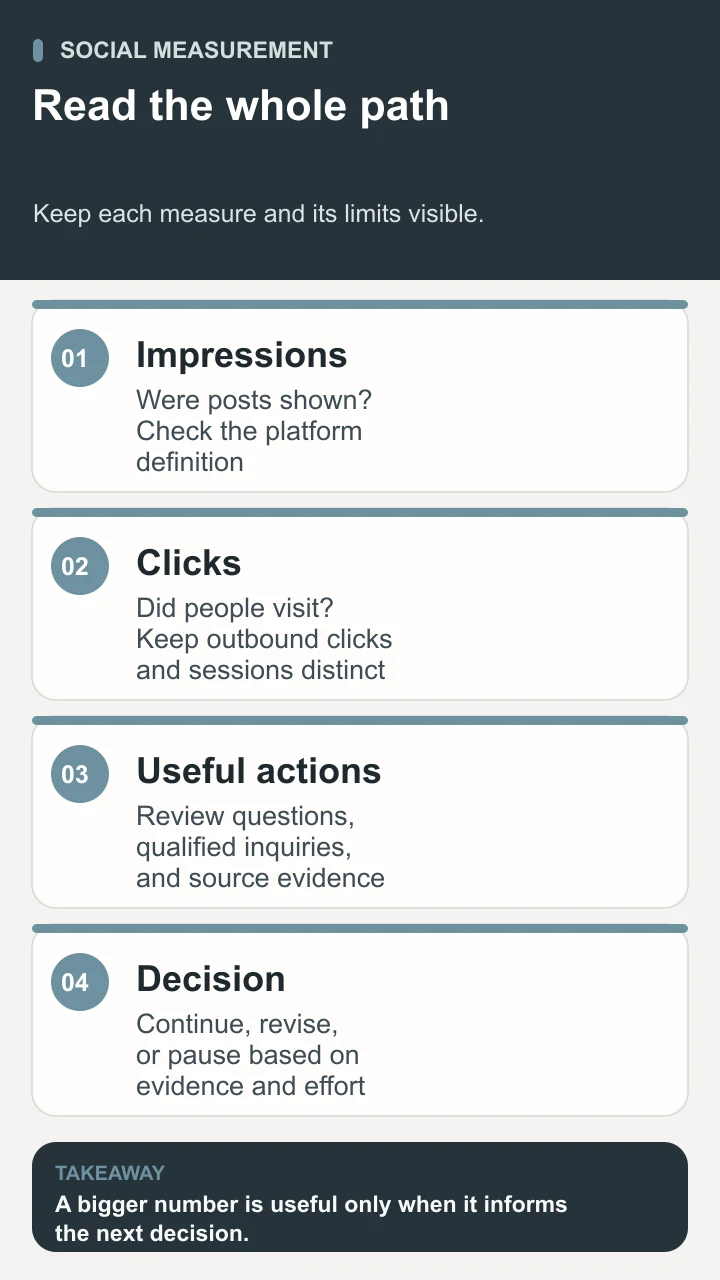
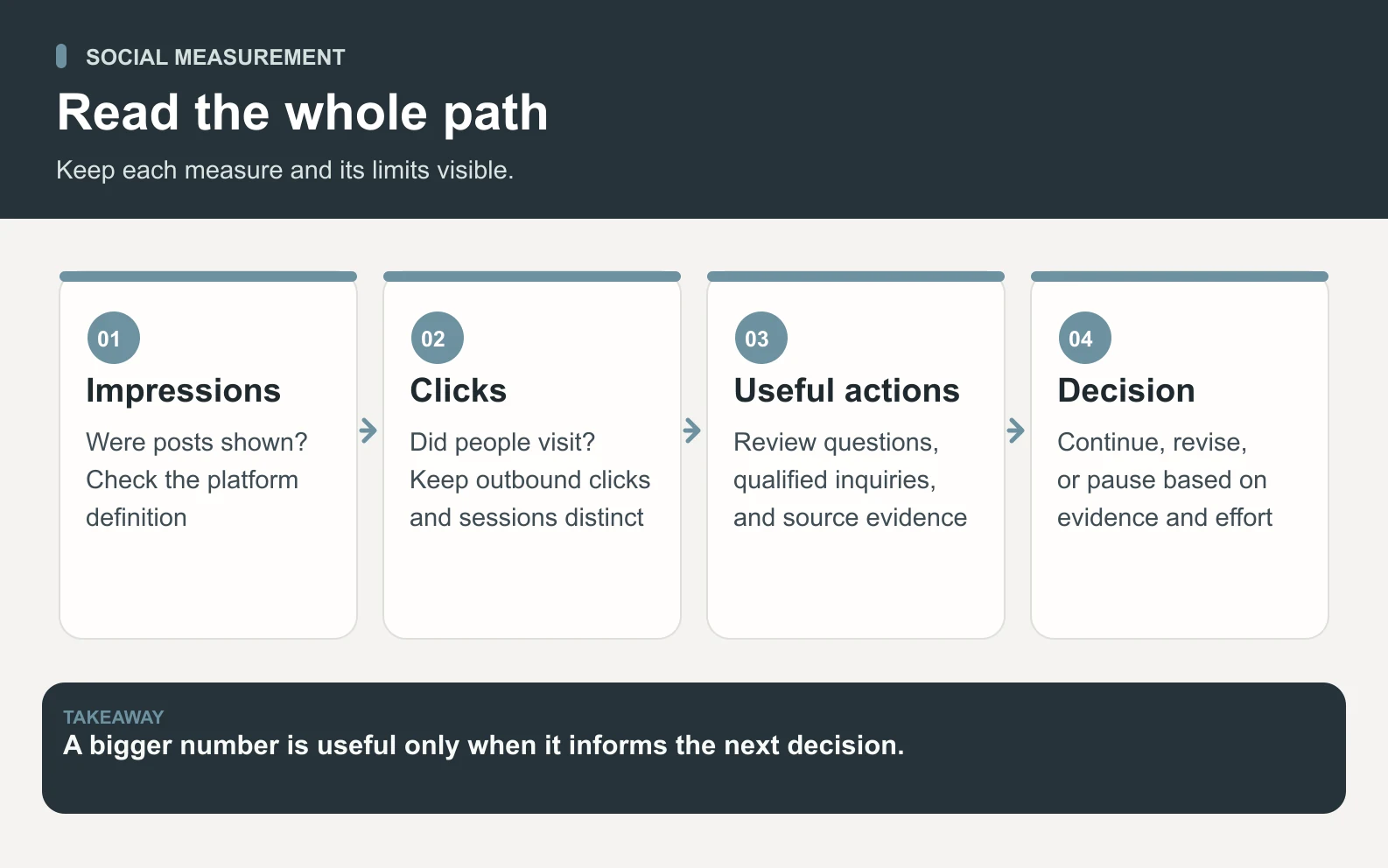
Compare similar formats, periods, and traffic sources before drawing conclusions. YouTube explains that CTR can fall as a video reaches a broader audience and that source context matters. A falling rate alone therefore cannot establish that the content worsened. Equally, a rising impression count cannot establish that the business reached more suitable buyers.
End the review with a decision and a reason. Continue when the work produces useful signals at sustainable effort. Revise when the audience responds but the explanation or destination fails them. Pause when the channel consumes capacity without evidence of a relevant audience. Four weeks can reveal workflow problems and promising questions; a small sample cannot establish durable demand or predict future distribution.
Use Space Office to prepare a reviewed publishing packet
The bounded Space Office workflow starts with the approved checklist, customer questions cleared for use, brand voice, audience, channel, schedule, and allowed claims. Add the destination link, measurement labels, and a named human approver. If an input is missing, the brief should identify the owner who can supply it. Drafting can proceed from approved material without assuming access to the social account.
- 1Nitrogen, the Content & Copy Specialist, prepares clear explanations and post drafts from the supplied facts, preserving sources and open questions.
- 2Cobalt, the Multi-Platform Content & Organic Distribution specialist, adapts openings and formats for the selected channel and organizes the calendar and proposed responses.
- 3Hydrogen coordinates the handoffs and reviews the packet against the objective, source boundaries, and requested deliverables, returning issues for revision.
- 4The human owner checks accuracy, permissions, tone, links, timing, and response coverage, then decides which final assets may be published.

A role assignment does not provide account authorization, publish a post, or approve an advertising budget. Any connected account access and public action need the customer's explicit authorization and appropriate setup. The live specialist roster and how Space Office works explain the roles and coordination. For the detailed delegation process, see AI agents for social media.
Make the next social media marketing decision specific
Start with a question your audience recognizes, a channel you can maintain, and a next action worth taking. Give the first four weeks enough structure to publish, respond, and learn. Record what you observed and what remains uncertain, then choose one concrete improvement. Social media marketing becomes easier to manage when the team can explain why each post exists and what would justify doing more of it.
Use the worksheet to capture that decision before opening another account or adding more posts. Useful work and clear measurement can improve your process; no schedule, AI workflow, or platform tactic can guarantee reach, Google rankings, clicks, or sales.
Sources and review notes
Reviewed against the linked primary sources on the checked dates. Search features and citations are selected by their respective platforms; no placement is guaranteed.
- LinkedIn: What Is Social Media Marketing? Strategy and Best Practices — checked
- LinkedIn: Pages Best Practices — checked
- YouTube Help: Decoding CTR and Impressions in Your Analytics — checked
- YouTube Help: Content Tab Analytics Tips — checked
- Google Analytics: Collect Campaign Data With Custom URLs — checked
Frequently asked questions
What is social media marketing?
Social media marketing is the use of social platforms to reach an audience, share content, build relationships, and support business objectives. It includes organic publishing, community participation, and paid distribution. A practical plan names the audience, useful message, channel, responsible owner, desired action, and way to evaluate results.
How often should a small business post?
Choose a frequency your team can sustain while producing useful work and answering responses. The two-post weekly schedule in this guide is an illustrative capacity decision, not a platform requirement. Begin with a manageable cadence, track production and review time, and change it when audience evidence or staffing supports the change.
What is the difference between social media marketing and management?
Marketing sets the audience, objective, message, distribution approach, and evaluation. Management operates the account through scheduling, permissions, moderation, reporting, and coordination. One person may do both, but naming the responsibilities prevents a complete calendar from being mistaken for an effective marketing plan.
Does a business need paid social advertising?
That depends on the objective, audience, offer, and available budget. An organic pilot can help you understand questions and test explanations. Paid distribution is a separate decision that needs a defined budget, suitable creative, a useful destination, and measurement. Organic engagement alone cannot predict advertising cost or profitable acquisition.
Can AI run a social account without human review?
AI can help prepare copy, channel adaptations, calendars, and response drafts from approved inputs. It still needs accurate source material and clear limits. In the Space Office workflow described here, Hydrogen coordinates and reviews the specialists' output, and a human approves final public work. Account access and publication are never implied by generating a draft.