Guide
Go to Market Strategy: Template and Worked Example
A practical go to market strategy connects a specific buyer, a credible offer, and a route to purchase that your business can afford to deliver.
By the Space Office team · Published · Updated · 16 min read
A go to market strategy defines how one offer will reach its first suitable customers and become a viable business proposition. It connects the buyer's problem, the alternative they use today, your offer, the route to purchase, delivery economics, and a testable launch decision. Start with one segment and compare a few routes before committing resources. In Space Office, Sodium can organize customer and competitor evidence, Oxygen can draft strategy options, and Hydrogen coordinates and reviews the work. A human chooses the route and approves access, spending, claims, and launch.

Key takeaways
- Start with one offer and one buying situation; a large market does not tell you who can buy first.
- Compare against the customer's current workaround as well as competing products.
- Choose a discovery channel and a sales motion together, with an owner for the next customer step.
- Include selling time, delivery costs, and capacity before deciding a route is affordable.
- Set pilot limits and decision gates before seeing results; small samples support learning, not confident forecasts.
To investigate one new segment or partner route before committing to a wider launch, use the business development guide for evidence mapping, qualification, and a bounded pilot decision.
Download the free go to market strategy template. Copy the plain-text worksheet into your editor and keep the evidence beside each choice. This guide focuses on selecting a workable route for one offer. Once that choice is approved, use a marketing plan to schedule the actions and assign their resources.
What a go to market strategy needs to decide
A team can publish attractive launch materials while leaving its commercial route unresolved. A prospect reads the page, wants a demonstration, and discovers that nobody owns follow-up. Or people buy, but the promised setup consumes more staff time than the price covers. Your strategy should expose those gaps while changing direction is still inexpensive.
Use it when introducing a product or service, entering a new segment, or changing how customers buy. Stripe's GTM guide includes customer definition, positioning, pricing, sales, distribution, and support within the same launch strategy. The original worksheet here turns those connections into six decisions with evidence and an accountable owner.
Scroll horizontally to view all columns.
| Decision | Write down | Evidence that could change it |
|---|---|---|
| First customer | One buying situation, user, payer, and trigger. | The problem exists, but this person cannot authorize a purchase. |
| Reason to switch | The current alternative and a specific improvement. | The workaround is good enough or switching is too disruptive. |
| Offer | Scope, price basis, proof, and exclusions. | Customers need a capability you cannot yet deliver. |
| Route | Discovery channel, buying steps, and delivery handoff. | Interested buyers cannot complete the next step. |
| Viability | Contribution, acquisition effort, and delivery capacity. | Selling or servicing each order consumes the available margin. |
| Pilot decision | A review date, limits, and continue/change/stop criteria. | Observed behavior contradicts the assumptions supporting the route. |
Keep the decision summary brief; attach interviews, calculations, and comparisons. Record a version and review date so a later update does not erase what you originally believed. A useful first draft contains visible unknowns. Calling every assumption validated makes the document easier to approve and harder to learn from.
1. Start with a buyer and a problem worth changing
Describe the moment when a customer might act. For a scheduling product, 'small businesses' leaves too much open. 'An owner managing three appointment calendars after adding a second location' suggests a trigger, a workflow, and someone who may control the budget. It also reveals exclusions: a solo operator with one calendar may have little reason to switch.
Separate the person using the offer from the person buying it. A team member may welcome a tool while the manager needs evidence about setup effort and the finance owner needs predictable billing. Ask who encounters the problem, who evaluates solutions, who approves the purchase, and who maintains the result. One person can fill several roles; write that down rather than assuming it.
The SBA's market research guidance distinguishes existing research from direct customer research and includes demand, alternatives, location, and pricing among useful questions. Combine broad context with evidence from the specific buying situation. Industry size can suggest opportunity; it cannot tell you whether this buyer will change a familiar process this month.
- 1Ask about the last real occurrence: what happened, what the person did, and what remained unresolved.
- 2Record the current workaround, the people involved, and the actual cost or time when the customer can substantiate it.
- 3Find the trigger for action and the approval path. Distinguish a recurring annoyance from a funded priority.
- 4Compare accounts from buyers, nonbuyers, and people who abandoned a previous attempt. Keep contradictory evidence.
Avoid questions that invite agreement, such as whether a convenient solution sounds useful. Ask what they have already tried and why they kept or rejected it. A request for a proposal, an introduction to the budget owner, and a polite compliment carry different information. Record each accurately without treating any single signal as proof of broad demand.
Use the target audience guide when your segment is still too broad. Then select a first group you can reach, understand, and serve. Give rejected groups a reason and a revisit condition. Excluding complex enterprise buyers for now can be sensible if your current delivery process cannot support their procurement and implementation needs.
2. Make the offer credible against the current alternative
List the customer's realistic choices: buy from a competitor, use an internal process, hire someone, combine existing tools, or do nothing. Compare how each handles the particular job. A competitor with fewer features may still win because the team already knows it, the invoice is approved, or switching would interrupt important work. Those are practical advantages your offer must address.
Write an offer someone could evaluate: 'For [buyer facing trigger], we deliver [bounded outcome or deliverable], through [method], for [price basis], with [credible proof].' State what the customer must provide and what remains their responsibility. If the promised benefit depends on clean records or a trained operator, include that condition before the sale.
Proof should match the claim. A sample report can demonstrate the format and depth of a deliverable. A product walkthrough can demonstrate a workflow. Neither establishes a savings percentage across customers. Label prototypes, fictional examples, and internal trials accurately. When you lack outcome evidence, make a narrower promise that a buyer can inspect instead of inventing a performance story.
Scroll horizontally to view all columns.
| Offer question | Useful check |
|---|---|
| What is included? | Name the deliverable, quantity, completion conditions, and handoff. |
| What must the buyer contribute? | List required inputs, access, review time, and a decision owner. |
| What is excluded? | Identify custom work, integrations, or support outside this version. |
| How is it priced? | Explain the unit being purchased and when extra scope changes the price. |
| Why change now? | Connect the trigger to a supported benefit and acknowledge switching effort. |
Test the offer as a complete package. A lower price may generate interest while attracting buyers who need disproportionate support. A paid setup can reduce uncertainty for some buyers and create a barrier for others. Record what changed between versions so you can distinguish an objection to price from a missing capability or an unclear result. The value proposition guide can help refine this promise.
3. Choose a route customers can actually complete
A channel describes how people discover you; a sales motion describes how they evaluate and buy. Search can lead to a self-service checkout or to an assisted consultation. A partner can introduce a buyer while your own team still handles the proposal. Choose the combination, then walk through every step from first contact to a useful delivered result.
Scroll horizontally to view all columns.
| Route | When to consider it | What must be ready |
|---|---|---|
| Self-service purchase | The scope is easy to understand and a buyer can start with little assistance. | Clear price, useful proof, reliable payment, onboarding, and accessible support. |
| Assisted sale | The customer needs a diagnosis, demonstration, or scope agreement before buying. | A qualification rule, conversation owner, proposal, and realistic follow-up capacity. |
| Partner introduction | A trusted provider already serves the same buying situation. | A reason for the partner to participate, agreed responsibilities, and a clear customer handoff. |
| Product-led evaluation | A user can experience meaningful value before a larger purchase decision. | A working evaluation experience, activation support, cost controls, and a defined upgrade path. |
These routes can overlap, but start with one primary path. Product-led evaluation requires a product capable of demonstrating value; adding a trial button does not create that experience. An assisted sale requires time for conversations and follow-up. Partner interest does not create distribution until someone agrees how introductions, ownership, and support will work.
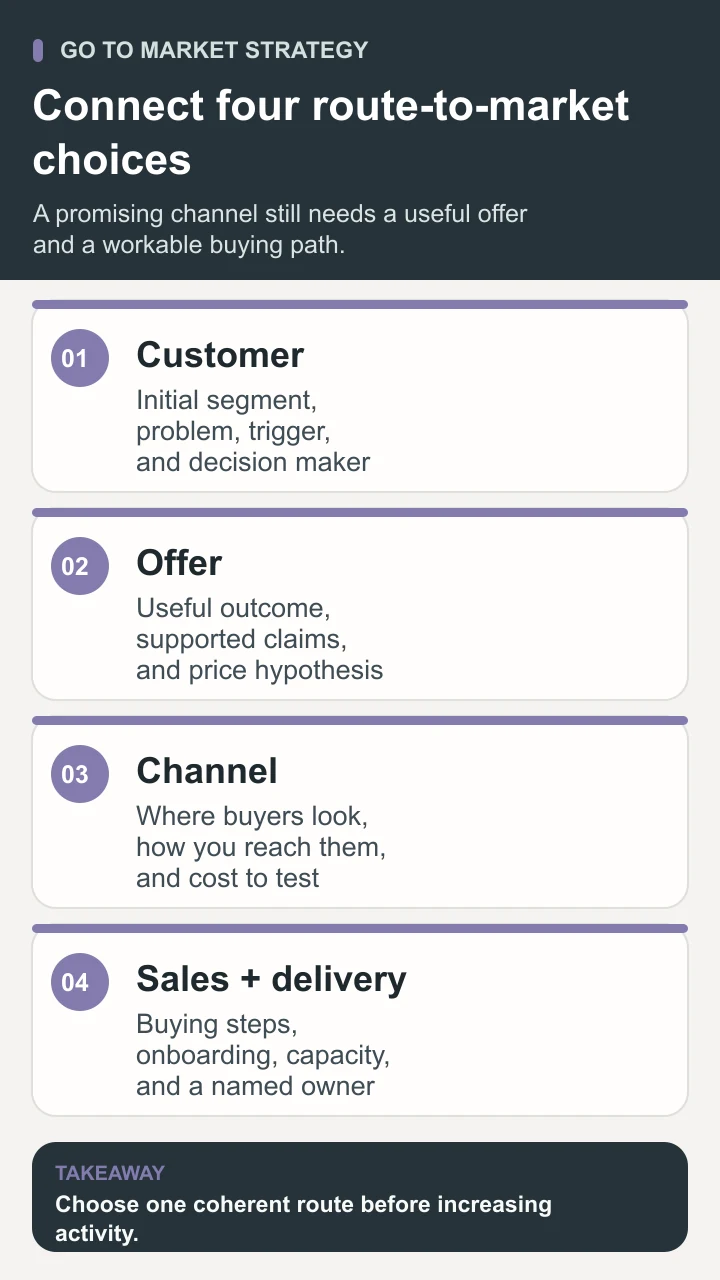
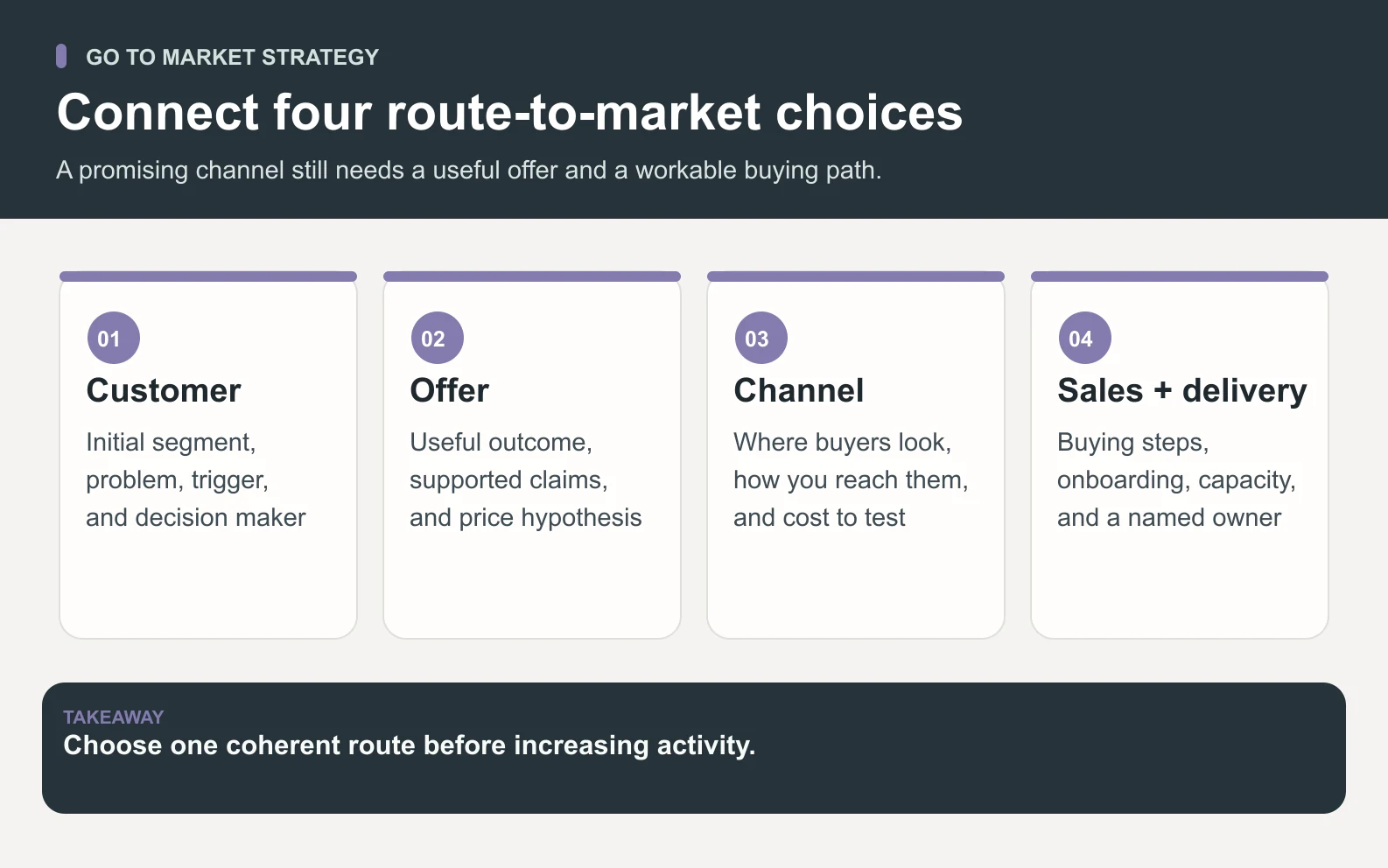
Compare two or three candidate routes using the same questions. Can you reach the selected segment? What proof will they need? Who handles the next step? How long might the decision take? What selling and delivery resources does each route require? Prefer written reasons to an elaborate numerical score that disguises weak evidence. Mark unknowns and identify a small test that would resolve the decisive one.
For example, a niche service could compare relevant partner introductions with paid search. Introductions may provide context but depend on partner commitment. Search may reach active demand but requires a suitable landing page, budget, and follow-up. Neither route is automatically better. Choose based on the buying situation and the resources available to test it properly, with a fallback if access does not materialize.

4. Check the economics and the delivery limit
Build a small model for the unit you actually sell: one project, one order, or one customer-month. Start with the realized selling price after discounts. Subtract the variable costs required to deliver that unit, including paid fulfillment, usage, materials, and a consistent allowance for delivery labor. The remainder is available for acquisition, overhead, and profit; it is not automatically profit.
Track acquisition costs separately so you do not count the same hour twice. Include relevant cash expenses and the selling time used to obtain customers. Founder time still has a capacity cost when no salary leaves the bank that day. State the hourly assumption clearly. During a pilot, record research and setup work separately from recurring selling work because the next batch may have a different cost structure.
- Contribution per sale = realized price minus the variable delivery costs assigned to that sale.
- Pilot acquisition cost per customer = the stated pilot acquisition costs divided by new paying customers; if there are no customers, report the spend and zero sales rather than inventing a finite ratio.
- Delivery capacity = available delivery hours divided by expected hours per customer, rounded down and reduced when operational constraints require it.
For a recurring product, do not justify heavy acquisition spending with a guessed lifetime value. Show the margin from an observed period and flag retention as unknown when you lack mature cohorts. Include onboarding and support demands in the capacity view. New sales can create a queue that makes the offer harder to fulfill even while the sales dashboard improves.
Run a downside case before approving the route. What happens if half as many prospects buy, delivery takes two extra hours, or payment arrives later? A route can look attractive per sale and still exceed the cash or time available during the pilot. Set a spending cap and a maximum number of concurrent customers. The owner should know which limit stops new commitments first.
5. Worked example: a focused service with an assisted sale
The following business, prices, workload, and thresholds are entirely fictional. Shelfway offers a fixed-scope inventory workflow setup for small specialty retailers. Its first segment is an owner preparing to open a second shop while maintaining stock records in spreadsheets. The first offer covers one shared tracking template, setup using approved exports, and a handoff session. It excludes custom point-of-sale integrations and ongoing bookkeeping.
Shelfway compares a self-service template purchase, an assisted setup, and referrals from retail advisers. It chooses adviser introductions followed by a short owner-led qualification call. The hypothesis is that a recommendation provides context while the call identifies unsuitable data and integration requirements before a sale. This is a proposed route, dependent on real adviser participation; it has not been proven by the example.
Scroll horizontally to view all columns.
| Illustrative assumption | Calculation or limit |
|---|---|
| Selling price | $1,200 per fixed-scope setup. |
| Delivery cost | 6 hours × $50 internal hourly allowance + $80 variable expenses = $380. |
| Contribution before acquisition and overhead | $1,200 − $380 = $820 per setup. |
| Pilot acquisition resources | $120 cash + 10 selling hours × $50 = $620; separate from delivery. |
| Pilot target | 3 paid, completed setups; an illustrative decision threshold, not a forecast. |
| Acquisition cost at that target | $620 ÷ 3 = about $206.67 per customer. |
| Contribution after pilot acquisition at target | 3 × $820 − $620 = $1,840 before overhead, other setup costs, and taxes. |
| Delivery capacity | 24 available delivery hours ÷ 6 hours = 4 setups; target of 3 leaves 6 hours of buffer. |
The pilot allows four weeks and up to forty suitable introductions, subject to the acquisition cap. An introduction counts only when the retailer meets the segment definition and agrees to the next conversation. The owner logs unsuitable referrals separately. Three sales out of forty introductions would describe this small pilot; it would not establish a dependable future conversion rate.
Before launch, Shelfway sets its gate: consider another capped pilot if at least three customers buy and complete the agreed scope, delivery averages no more than six hours, and no unresolved issue prevents the promised handoff. Change the offer if buyers want the service but consistently require excluded integrations. Pause if the channel cannot provide appropriate introductions within the limits. A missed gate needs an explanation, not a retroactive rewrite of the target.
If only two customers buy, acquisition cost becomes $310 each and modeled contribution after acquisition becomes $1,020 before the remaining costs. That positive figure alone does not satisfy the original demand gate. If delivery instead takes eight hours each, contribution falls to $720 per setup and capacity falls to three. Recalculate both money and capacity before deciding what to change.
6. Run a bounded pilot and review the evidence
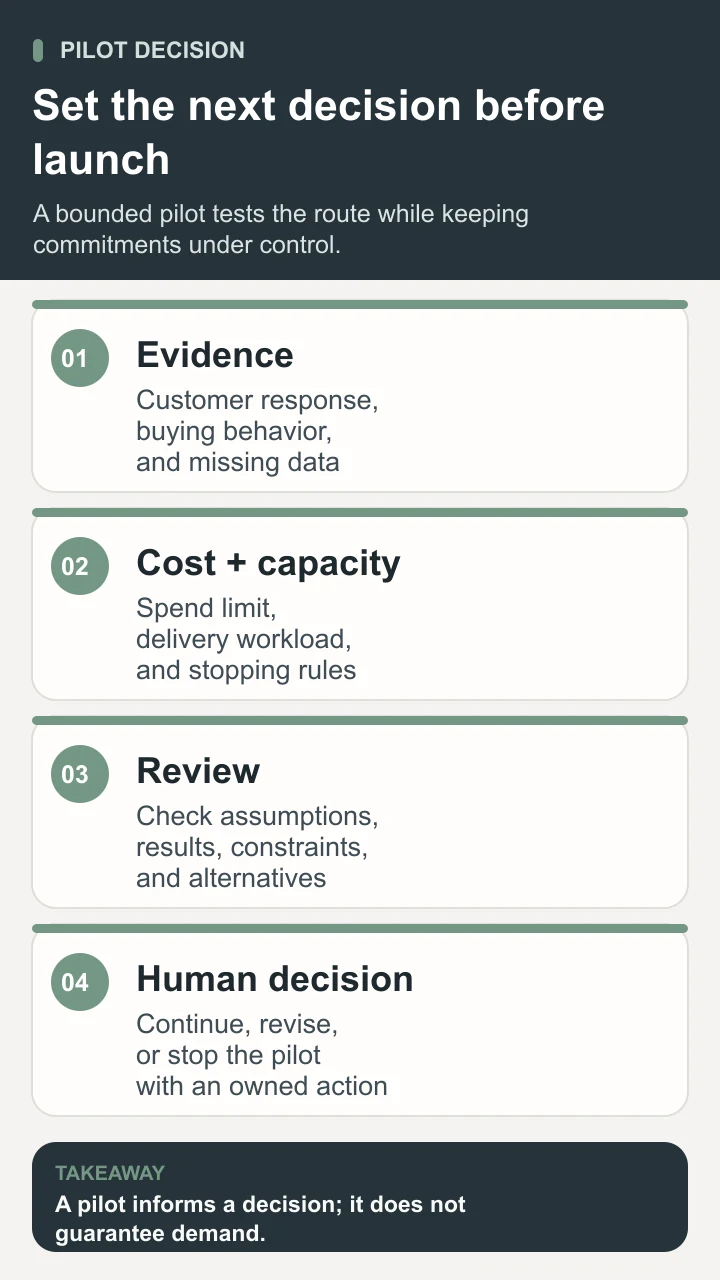
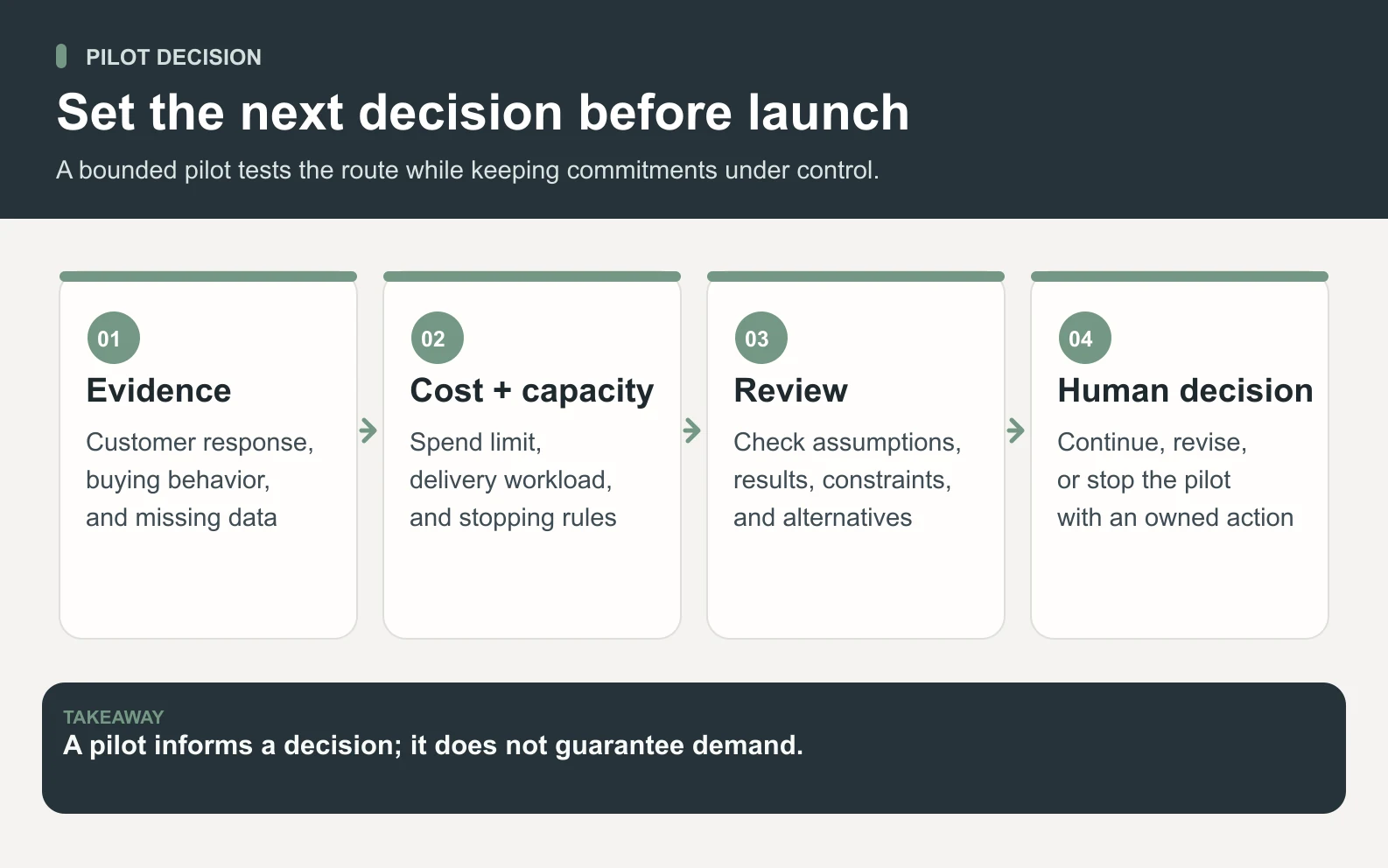
Write the pilot decision before producing a full launch campaign. Name the hypothesis, audience, offer version, route, responsible people, customer limit, cash cap, and review date. Define the stages you will count: suitable inquiry, qualified conversation, proposal, paid order, completed delivery, and any repeat use relevant to the offer. Keep the same definitions through the review period.
Keep source and outcome records together. For web campaigns, Google Analytics supports campaign parameters such as source, medium, and campaign in tagged URLs. Use consistent names where appropriate, then connect those visits to the actual sales and delivery records you are allowed to use. A click is an observed step, not proof that the route produced a profitable customer.
Prepare the strategy review with Space Office
A useful starting assignment is one review packet for one offer. Give Hydrogen the current offer, approved customer notes, competitor URLs, cost assumptions, available selling and delivery hours, and a named decision owner. Supply authorized exports or explicitly approved account access where needed. Missing access and missing evidence should appear as gaps; choosing a specialist does not automatically grant access to your accounts.
- 1Sodium organizes the approved research into buyer situations, alternatives, supporting sources, and contradictions. Customer interviews still require real participants and appropriate permission.
- 2Oxygen turns that evidence into a small route comparison, a proposed offer, explicit assumptions, and pilot decision gates. It explains why the proposed route fits the available resources.
- 3Hydrogen coordinates the assignments and reviews the packet against the brief. Unresolved questions and revisions remain visible for the owner.
- 4The human verifies evidence and arithmetic, chooses the route, and approves any spending, account access, customer promises, and launch actions.

Ask for a source-linked evidence summary, a route comparison, a checked calculation sheet, and an approval record. Inspect these against the live specialist roles and how Space Office works. The workflow can help prepare and review a strategy; it does not guarantee demand, sales, search rankings, or execution without authorization. After approval, the product launch guide covers assigning the launch deliverables.
Conclusion: choose the next commitment with evidence
A useful go to market strategy makes the next business commitment clear. You should know whom you are serving, why they might switch, how they will buy, what delivery requires, and what evidence would change your mind. Complete the worksheet for one offer, resolve the most consequential unknown, and approve a bounded pilot. Expand the route when customer behavior and operating results justify the next investment.
Sources and review notes
Reviewed against the linked primary sources on the checked dates. Search features and citations are selected by their respective platforms; no placement is guaranteed.
Frequently asked questions
What is a go to market strategy?
Go to market strategy is the set of choices connecting one offer to a defined customer, a reason to buy, a route to purchase, and a workable delivery model. It states the assumptions you will test and the evidence needed before committing more resources.
How is a GTM strategy different from a marketing plan?
A GTM strategy chooses how a particular offer will enter or reach a market, including selling and delivery. A marketing plan organizes the actions, owners, budget, and measurement for a period. The documents connect: an approved route should inform the plan's activities.
Does every business need product-led growth?
No. Product-led evaluation fits when customers can experience meaningful value through the product before a larger purchase decision. An offer that needs diagnosis, custom scope, or buyer approval may suit an assisted sale. Choose a route from the actual buying process and your capacity to support it.
How long should a GTM pilot run?
Choose a period long enough to observe the buying and delivery steps you need to evaluate, within a stated spending and capacity limit. Four weeks is an assumption in this guide's fictional example. A longer procurement cycle needs a different review window or carefully defined intermediate evidence.