Guide
Marketing Plan: Free Template and Small-Business Example
Build a marketing plan that connects a real customer need to a useful offer, an affordable set of actions, and a clear decision about what to do next.
By the Space Office team · Published · Updated · 16 min read
A marketing plan is a working document that explains which customers you want to reach, what you will offer them, how you will reach them, what the work will cost, and how you will judge progress. Write one by choosing a measurable goal, checking customer evidence, selecting channels, assigning owners, and setting a review date. Use the free worksheet and fictional small-business example below. In Space Office, Sodium can organize approved market research and Oxygen can prepare strategy options; Hydrogen coordinates and reviews their work. A human approves the audience, budget, claims, and final actions.

Key takeaways
- Choose one primary outcome and a time window, then record the starting point or mark the baseline unknown.
- Describe an audience through its buying situation and needs, using evidence you can inspect.
- Connect each channel to an offer, a customer action, an owner, and a spending or capacity limit.
- Measure business outcomes alongside useful early signals; impressions and clicks alone do not prove sales.
- Treat the plan as a set of decisions to review, with assumptions and unfinished research kept visible.
Use the marketing strategy guide to choose the audience, offer, credible advantage, and tradeoffs before assigning tasks and budgets in this plan.
Use the marketing funnel guide to turn one offer into stage questions, useful content, owned handoffs, and consistently defined enquiry-to-booking measurements.
For the online channel choices inside the plan, the digital marketing guide connects an audience task to a useful destination, a manageable pilot, and comparable operating records.
Download the free marketing plan worksheet. It is a plain-text document you can copy into your preferred editor or spreadsheet, with a planning outline, channel record, budget, measurement definitions, and review log. The visible template below contains the same core fields.
What should a marketing plan include?
Begin with the decisions someone must make. Who is the offer for? What problem makes it useful now? What should a potential customer do next? Who will prepare the work, approve it, and handle the response? A list of social posts leaves those questions unanswered. A useful plan makes the connection between a business goal and the specific activities that might help achieve it.
The U.S. Small Business Administration's marketing guidance includes target market, competitive advantage, sales, marketing actions, budget, and measurement. The worksheet here adds explicit evidence references and decision owners so a small team can inspect the reasoning and maintain the document. Its layout is an original working template, not a required industry standard.
Scroll horizontally to view all columns.
| Document | Main question | Useful output |
|---|---|---|
| Marketing strategy | Which customers and advantages will we concentrate on? | Choices about audience, positioning, offer, and how the business intends to compete. |
| Marketing plan | What will we do during this period, with which resources? | Goals, selected actions, owners, budget, measurement, and review decisions. |
| Content calendar | What needs to be prepared or published, and when? | Individual assets, deadlines, approvals, and distribution tasks supporting the plan. |
Use a scope that matches the decision. A new local workshop might plan its next eight weeks; an established company may need an annual direction with quarterly action plans. The right length depends on seasonality, sales timing, and the resources already committed. For a first version, choose one offer and one customer group. Expand when another group requires materially different evidence or actions.
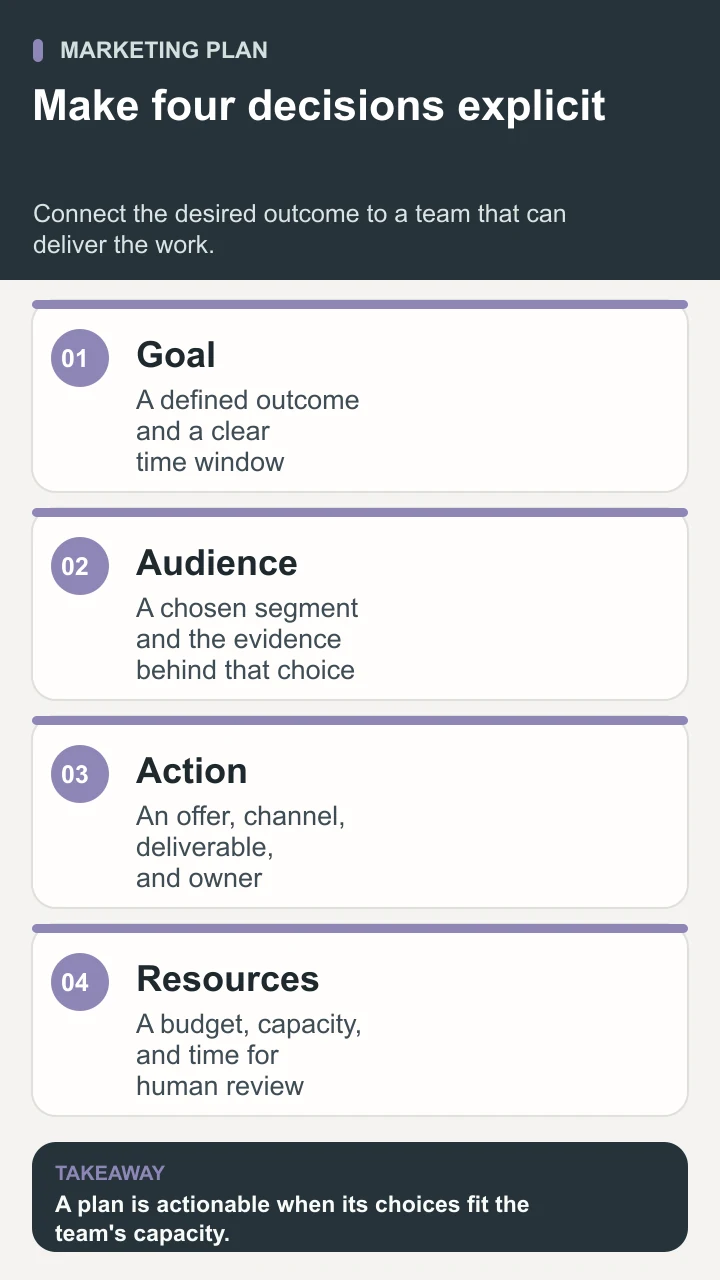
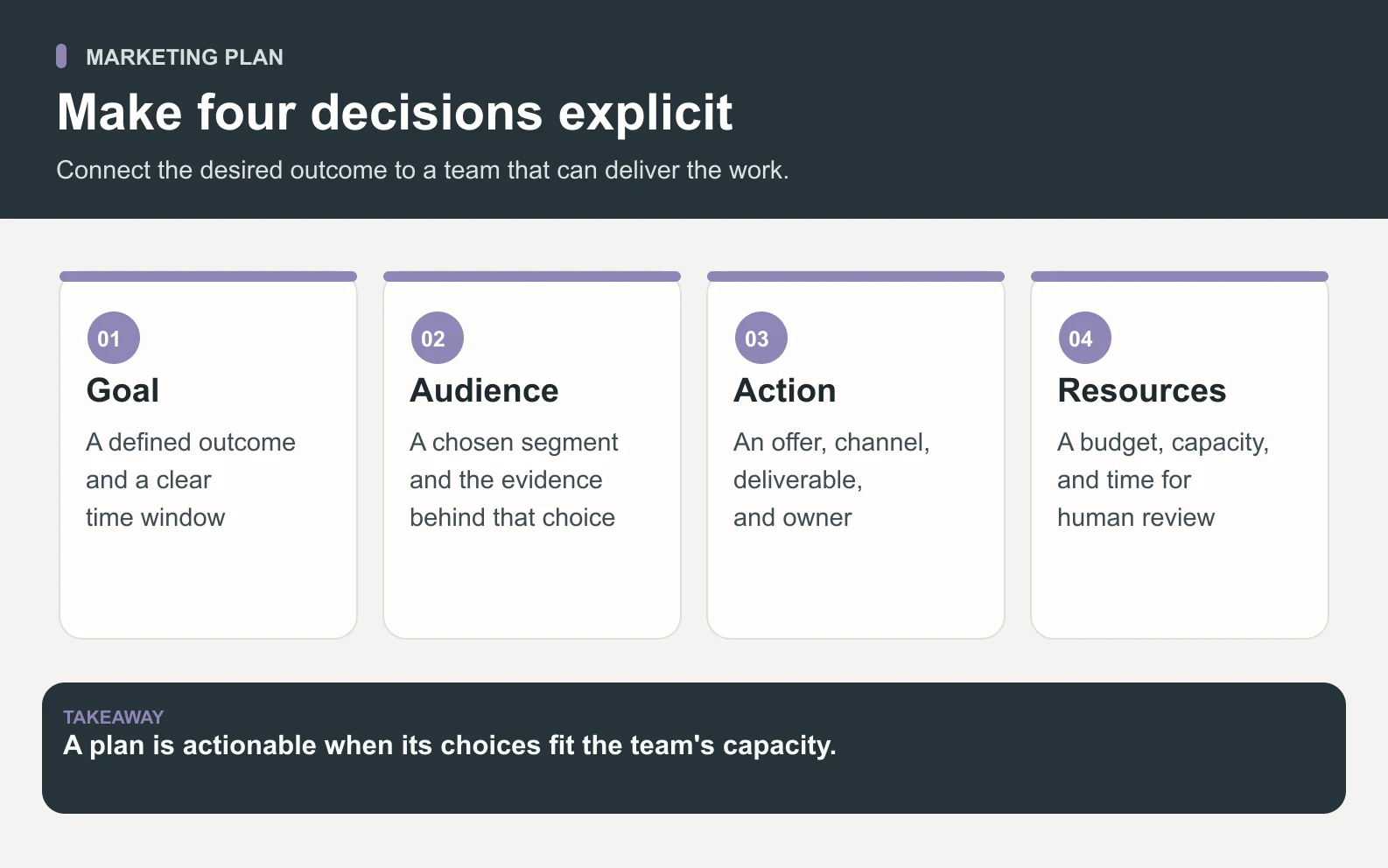
Copy the free marketing plan template
Keep the summary short enough to review together. Attach research notes and detailed budgets rather than squeezing everything onto one page. At the top, record the business, offer, period, document owner, version, and next review date. Mark the plan draft or approved. An approval should name the person who accepted it and the limits of that approval, such as a specific spending ceiling.
Scroll horizontally to view all columns.
| Planning field | What to write |
|---|---|
| Business goal | We want [defined outcome] for [offer] by [date]. The current comparable baseline is [value and period], or unknown. |
| Target audience | We serve [customer situation] with [need or trigger]. We are excluding [group] from this version because [reason]. |
| Evidence and gaps | Our decision uses [dated customer or market sources]. We still need to check [assumption], owned by [person]. |
| Offer and message | We provide [specific deliverable or experience] for [price or buying arrangement], supported by [verifiable proof]. |
| Channels and actions | We will use [channel] to help the audience [next action]. The asset, destination, owner, and deadline are [details]. |
| Budget and capacity | The cash ceiling is [amount], divided into [line items]. The available working time is [hours], with [delivery limit]. |
| Measurement | We will track [outcome] and [early signal], using [source, event definition, time window, and denominator]. |
| Ownership and review | [Person] approves claims and spending. On [date], we will continue, change, or stop based on [evidence and limits]. |
Write an unknown explicitly when you lack evidence. If you cannot yet identify where customers discover you, assign that research before committing the whole budget to a channel. If you cannot measure completed purchases, repair the measurement before using a dashboard to judge performance. A blank that names a next check is more useful than a confident number without a source.
Keep an evidence register beside the summary: source ID, collection date, relevant audience, observation, limitation, and permitted use. Link approved interview notes, sales records, or analytics exports there. A reviewer should be able to trace an important choice back to something more specific than a team member's memory. Store sensitive customer details in their appropriate source system rather than duplicating them throughout the plan.
Write the goal, audience, and offer before choosing channels
If you have not yet chosen whom to prioritize, use the target audience guide to compare candidate groups through their needs, buying situations, reachability, and evidence. Bring the resulting audience brief into this plan before committing to messages or channels.
- 1Choose the outcome. State the offer, unit of success, deadline, and starting point. For a workshop business, the outcome might be paid places in a defined course period. For a service business, it might be qualified consultations or signed engagements. Do not combine incompatible units into one target.
- 2Describe the buying situation. Record who needs the offer, what prompts the search, who decides, and what could prevent purchase. A useful segment might be first-time learners seeking an evening class within easy travel distance. Age and job title matter only when they change the decision.
- 3Check the evidence. Review relevant conversations, purchases, objections, and alternative options. Separate observations from explanations. A customer asking about evening availability supports investigating scheduling; it does not establish that everyone wants the same class time.
- 4State the offer. Explain what the customer receives, the practical limits, the buying step, and the evidence behind your claims. If the offer is still a proposal, label it that way and verify operational feasibility before promotion.
- 5Choose the message. Connect one useful benefit to credible supporting detail. Replace generic quality claims with facts a buyer can inspect, such as the class format, materials included, instructor background, or a genuine sample of the work.
SBA's market-research guidance distinguishes existing sources from direct customer research and suggests questions about demand, location, alternatives, and pricing. Use broad market data for context and relevant customer conversations for specific buying questions. Neither a large market estimate nor a handful of enthusiastic interviews establishes how many people will buy your offer during the planned period.

Include alternatives beyond direct competitors. A customer might choose a home kit, another hobby, or no purchase at all. Ask what would make your option worth the money and effort in that situation. If the missing detail concerns the buying experience, a customer journey map can help investigate it. Keep that deeper research linked to the plan without turning the plan into an unsupported biography of an imaginary buyer.
Match channels to the budget and the team's capacity
Select channels for a specific reason. Search content may help people investigating a problem; a partner newsletter may reach a relevant existing audience; paid promotion may let you test a defined message within a controlled spend. Each choice still needs evidence about audience fit and an actual destination. Popularity alone does not tell you whether a channel suits this offer or this planning window.
Complete one record per channel: audience, message, asset, destination, requested action, owner, deadline, cash limit, working time, and review method. Start with the channels the team can deliver and inspect. A business that can manage one useful guide and one partner collaboration should budget for those tasks realistically. Preparing accounts on several more platforms adds obligations even before meaningful results are available.
- Separate cash from time. List production, distribution, software, and other direct costs, then record the team's hours independently. Unpaid founder time still limits what can be delivered.
- Separate committed from optional spending. A booked venue or commissioned asset is different from an unspent test allowance. Record cancellation conditions and the person authorized to release additional budget.
- Check delivery capacity. More inquiries are useful only if someone can answer them and the business can fulfill the offer. Set response ownership before sending traffic to a form.
- Name dependencies. An advertisement may need a tested booking page, approved claims, suitable creative, and a working payment flow. Put those requirements before the launch date in the action list.
Avoid choosing a universal percentage of revenue as the answer to every budgeting question. Begin with the money the business can commit, the work required, and the uncertainties it wants to test. If estimated costs exceed the ceiling, reduce scope or sequence the work. Hiding the difference under an optimistic sales forecast leaves the owner unable to judge the actual commitment.
Worked example: an eight-week plan for a local workshop
Imagine a small pottery studio offering beginner evening workshops. Every number, observation, and business detail in this example is fictional and exists to demonstrate the worksheet. These are planning assumptions, not Space Office customer results, market benchmarks, or a forecast of what a real studio will achieve. The owner must replace them with actual evidence before using the plan.
Scroll horizontally to view all columns.
| Field | Illustrative completed entry |
|---|---|
| Goal and period | Sell 24 paid places across four six-person beginner workshops during an eight-week period. The comparable baseline is unknown. |
| Audience | Adults within practical travel distance who want an introductory evening activity and do not already have pottery experience. |
| Evidence | Fictional note E01 records questions about evening times; E02 records questions about included materials. The sample is small and excludes nonbuyers. |
| Offer | A beginner session with the materials and instruction specified on the booking page. The owner must verify the schedule, inclusions, and price before approval. |
| Channels | One local partner newsletter placement and one limited paid-promotion test, both leading to the same approved workshop information page. |
| Resources | A $900 maximum cash allowance plus 16 owner hours for marketing work. Teaching capacity remains four workshops with six places each. |
| Measurement | Paid bookings and cancellations by workshop date; channel-tagged visits and booking starts as supporting signals. Record direct and unknown sources separately. |
| Ownership | The studio owner approves the offer, pays invoices, handles inquiries, and reviews the plan at the end of weeks two, four, and eight. |
The cash allowance is allocated as $250 for booking-page and creative preparation, $350 for the promotion test, $100 for the partner placement, and $200 held in reserve: $250 + $350 + $100 + $200 = $900. The fictional amounts illustrate a complete allocation. They are not recommended market prices. The reserve stays unspent unless the owner approves a defined next action.
Sequence the work. In week one, verify the offer, prepare the page, test booking, and confirm the partner's audience and placement. In week two, release the approved initial activity. At the first review, check whether the activity happened and whether bookings can be traced reliably. Later reviews examine outcomes, available places, and remaining commitments. Closing promotion for a full workshop is an operational decision, even if an advertising dashboard still recommends more spending.
Suppose the first review finds visits and booking starts but no recorded paid bookings. Several explanations remain possible: the price or dates may be unsuitable, payment may fail, reporting may be incomplete, or people may need more time. Check the booking flow and records, then investigate the buying questions. Do not declare the channel ineffective or increase the budget solely because one count is low.
The plan also needs a capacity response. If customers request a fifth workshop, the owner checks instructor time, materials, and venue availability before offering it. If demand concentrates on one date, revise scheduling only when delivery remains feasible. Marketing decisions should preserve the offer the customer actually bought. An attractive target is not permission to promise unavailable capacity.
Measure outcomes and write the next decision
Define the outcome before installing another dashboard. In this example, a paid booking means a completed payment for a specific workshop place. A booking start is a different event. Cancellations and refunds need separate handling. Record the reporting window and counting rules so two people can reproduce the same answer from the underlying records. Payment records and analytics may describe different moments in the purchase process.
Google Analytics defines a key event as an event measuring an action particularly important to the business. Choose and test the event that matches your goal. Marking a page view as important does not turn it into a sale. For the studio, confirm that the booking event fires under the intended conditions and that repeat visits do not inflate the business outcome.
Use consistent campaign labels where appropriate. Google's campaign-URL guidance explains how UTM parameters identify campaign traffic and notes that values are case-sensitive. Keep a shared naming record so the same newsletter does not appear under several spellings. Test the destination link and reporting before the placement. Campaign labels improve organization; they do not reveal every influence on a customer's decision.
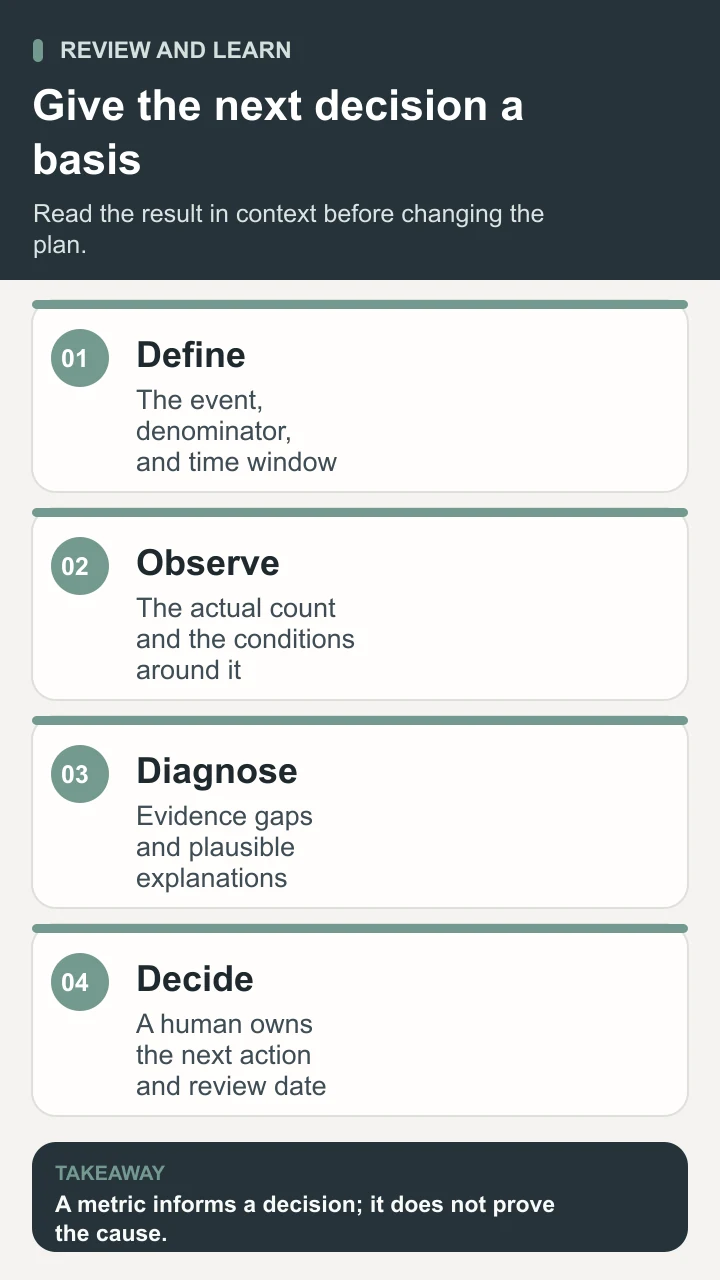
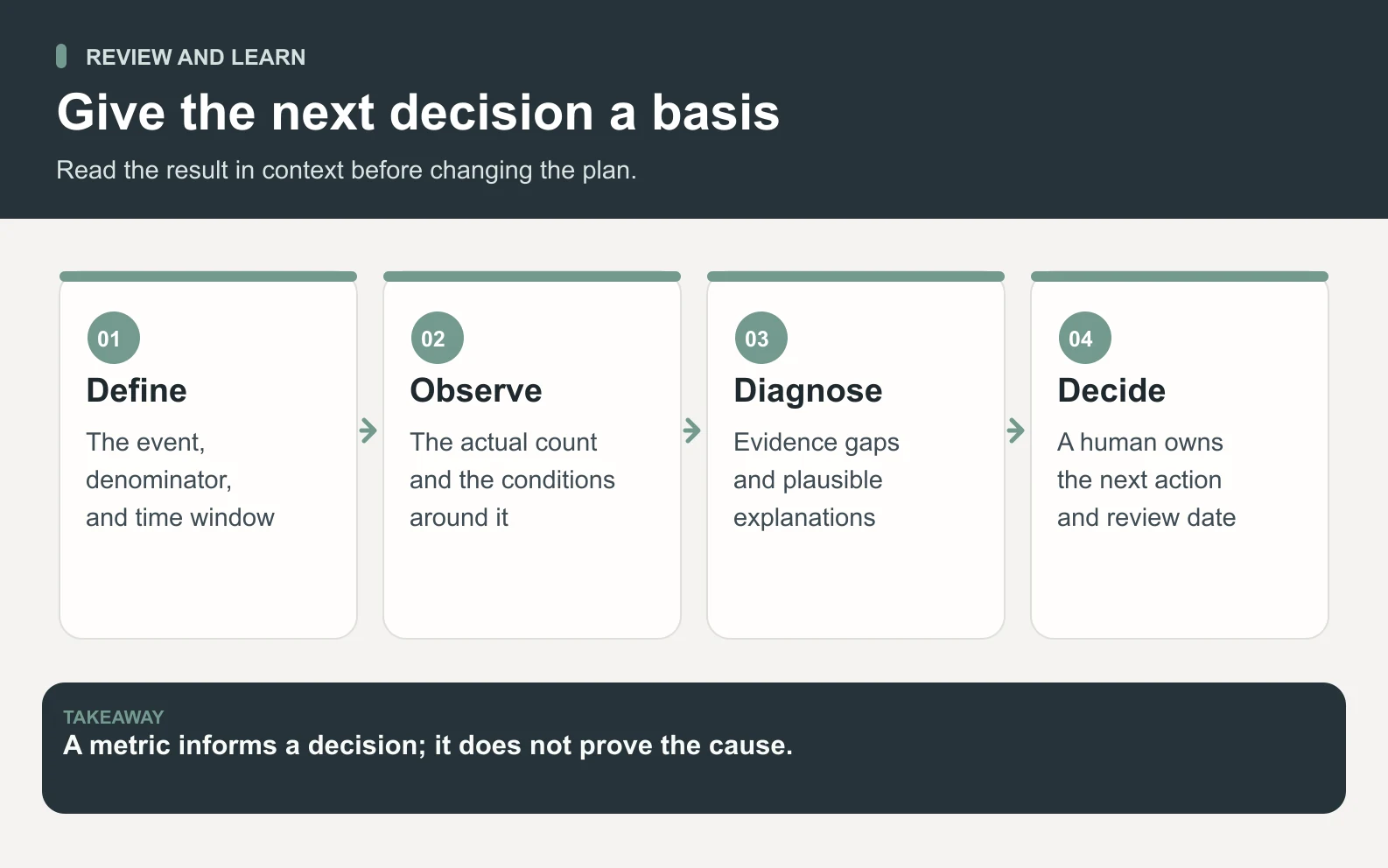
For search activity, use the correct signal. Search Console's documentation distinguishes impressions, clicks, position, and click-through rate; CTR is clicks divided by impressions. Read those signals for the relevant pages, queries, and period. More impressions may mean broader exposure, while bookings still depend on the audience, offer, destination, and buying experience. A planning document cannot guarantee a ranking or a particular number of clicks.
Report counts beside rates. Four bookings from 100 measured eligible visits is a 4% visit-to-booking rate under that definition; two from 20 is 10%. Both are invented arithmetic examples, and the second does not establish a better channel. Small samples, different audiences, repeated visits, and missing tracking can change the interpretation. Do not combine paid bookings in one channel with form submissions in another and label the comparison conversion rate.
Finish each review with a short decision record: what happened, what remains uncertain, what changes next, who owns it, and when it will be checked. Separate a tracking repair from a change to the offer. Preserve the previous version and note significant changes such as new dates, prices, or destinations. Otherwise, the next review may attribute a change to the wrong cause.
Prepare and review the plan with Space Office
For a bounded planning assignment, select Oxygen, the Strategy & GTM (CMO) Specialist, and Sodium, the Market Research & Intelligence Specialist, from the live specialist roster. Supply the offer facts, approved customer notes, relevant market sources, current results, available budget, delivery capacity, and human decision owner. State which systems or files are accessible and what actions are authorized. A request to draft a plan does not automatically grant advertising-account access or permission to publish.
- 1Sodium organizes the supplied research into audience evidence, alternative options, and unanswered questions. Research gaps remain visible; generated customer statements are not presented as interviews.
- 2Oxygen turns that packet into proposed goals, offer choices, channel priorities, a resource allocation, and measurement definitions. Assumptions stay labeled and spending proposals stay within the supplied ceiling.
- 3Hydrogen coordinates the handoff and reviews the combined draft for consistency, unsupported claims, missing owners, and unresolved inputs. The review packet includes the plan, evidence register, and decisions that still need a person.
- 4The human owner checks the sources, confirms feasibility, and approves the final choices. Campaign spending, account changes, outreach, and publication require the corresponding authorization and access.

Use the AI-team briefing guide to specify the required output and acceptance criteria. Once the plan is accepted, the separate guide to running marketing without a marketing hire covers ongoing weekly execution. This article's worksheet is the planning document that establishes the choices those recurring tasks should follow.
Finish your marketing plan with one owned next step
A marketing plan is ready for its first review when another person can identify the audience, offer, goal, actions, resource limits, and evidence behind them. Download the worksheet and fill the fields you can support today. Name an owner for each important unknown. Then choose the first action that can be delivered, measured, and reviewed within your actual capacity.
If research organization or strategy drafting is slowing that work, see how Space Office coordinates specialist assignments. Oxygen and Sodium can prepare a reviewable packet from approved inputs, with Hydrogen coordinating and reviewing. Your team still decides what to promise, spend, and publish. The useful outcome is a clear next decision grounded in evidence, followed by a record of what happened.
Sources and review notes
Reviewed against the linked primary sources on the checked dates. Search features and citations are selected by their respective platforms; no placement is guaranteed.
- U.S. Small Business Administration: Manage Your Business, Marketing and Sales — checked
- U.S. Small Business Administration: Plan Your Business, Market Research — checked
- Google Analytics: Collect Campaign Data with Custom URLs — checked
- Google Analytics: About Key Events — checked
- Google Search Console: What Are Impressions, Position, and Clicks? — checked
Frequently asked questions
What is a marketing plan?
Marketing plan is the name for a working document connecting a target audience and offer to business goals, channels, actions, owners, budget, and measurement over a defined period. It records what the business intends to do, why those choices are reasonable, and when someone will review the results. It should distinguish verified evidence from assumptions.
How do I write a simple marketing plan for a small business?
Choose one offer, one audience, and a measurable outcome with a deadline. Record the customer evidence, select a manageable set of channels, and assign a cost, owner, and next action to each. Define how the outcome will be counted, set a review date, and keep unfinished research visible. The free worksheet provides those fields in an editable plain-text format.
How long should a marketing plan be?
Make the summary long enough to explain the decisions and short enough for the responsible people to review together. A small business can start with a one-page outline and supporting records for evidence, actions, and costs. More complex offers may need additional detail. Page count matters less than whether the audience, spending limits, ownership, and measurement are clear.
How much should I budget for marketing?
Start with the amount the business can commit and the actual costs of the proposed work. Include production, distribution, software, and other direct expenses, while tracking staff or founder time separately. Distinguish committed spending from an optional test reserve. The fictional $900 example illustrates allocation; it is not a recommended budget or a prediction of results for another business.
Can AI create a marketing plan?
AI can organize approved research, compare options, and draft a plan from supplied business facts. It cannot replace missing customer evidence or approve the business's commitments. In Space Office, Sodium supports research, Oxygen supports strategy, and Hydrogen coordinates and reviews. A human checks the claims, budget, feasibility, and final actions. Account access and publication are not automatic.