Guide
Value Proposition: How to Write One, with Examples
Build a value proposition around a specific customer, a useful outcome, and a reason to believe you. Use the worksheet and worked example to turn evidence into a message you can test.
By the Space Office team · Published · Updated · 16 min read
A value proposition explains why a specific customer should choose your offer: the useful outcome, how you provide it, and the evidence that makes the promise credible. Write one by researching the customer's situation, choosing a meaningful benefit, and connecting it to a verified capability. Then test understanding and behavior. In Space Office, Sodium can organize approved customer research and Oxygen can develop positioning options. Hydrogen coordinates and reviews the work; a human verifies the promise and chooses the message.

Key takeaways
- Choose one customer situation before deciding which benefit to emphasize.
- Connect the proposed outcome to a real capability and checkable evidence.
- Include the customer's current workaround when comparing alternatives.
- Separate a clear message, a desirable offer, and proven commercial results.
- Use customer feedback to decide whether to keep, revise, or reject the draft.
The marketing strategy guide puts the value proposition into a wider set of audience, offer, channel, and resource choices.
Download the free value proposition worksheet. This original plain-text worksheet includes an evidence log, drafting prompts, and a test decision record. Copy it into a document and fill the gaps before polishing the headline. The fictional approval-tool example below shows how to use it without inventing customer results.
What a value proposition needs to explain
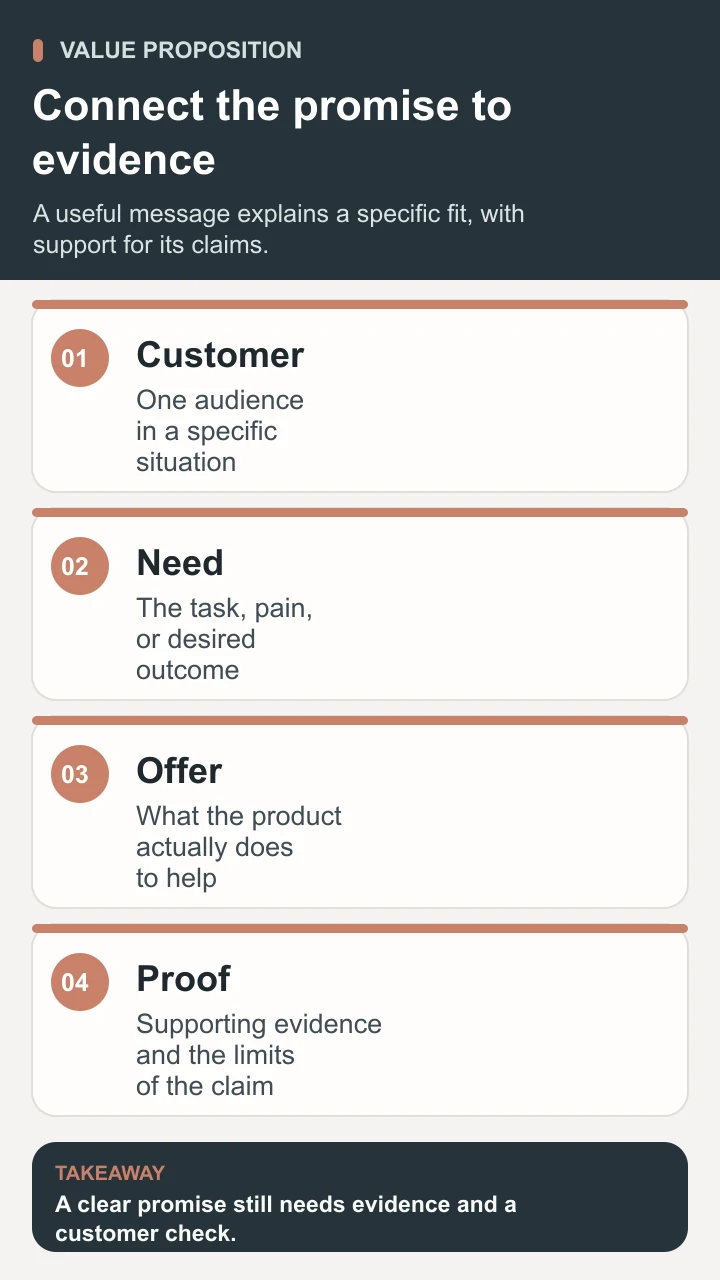
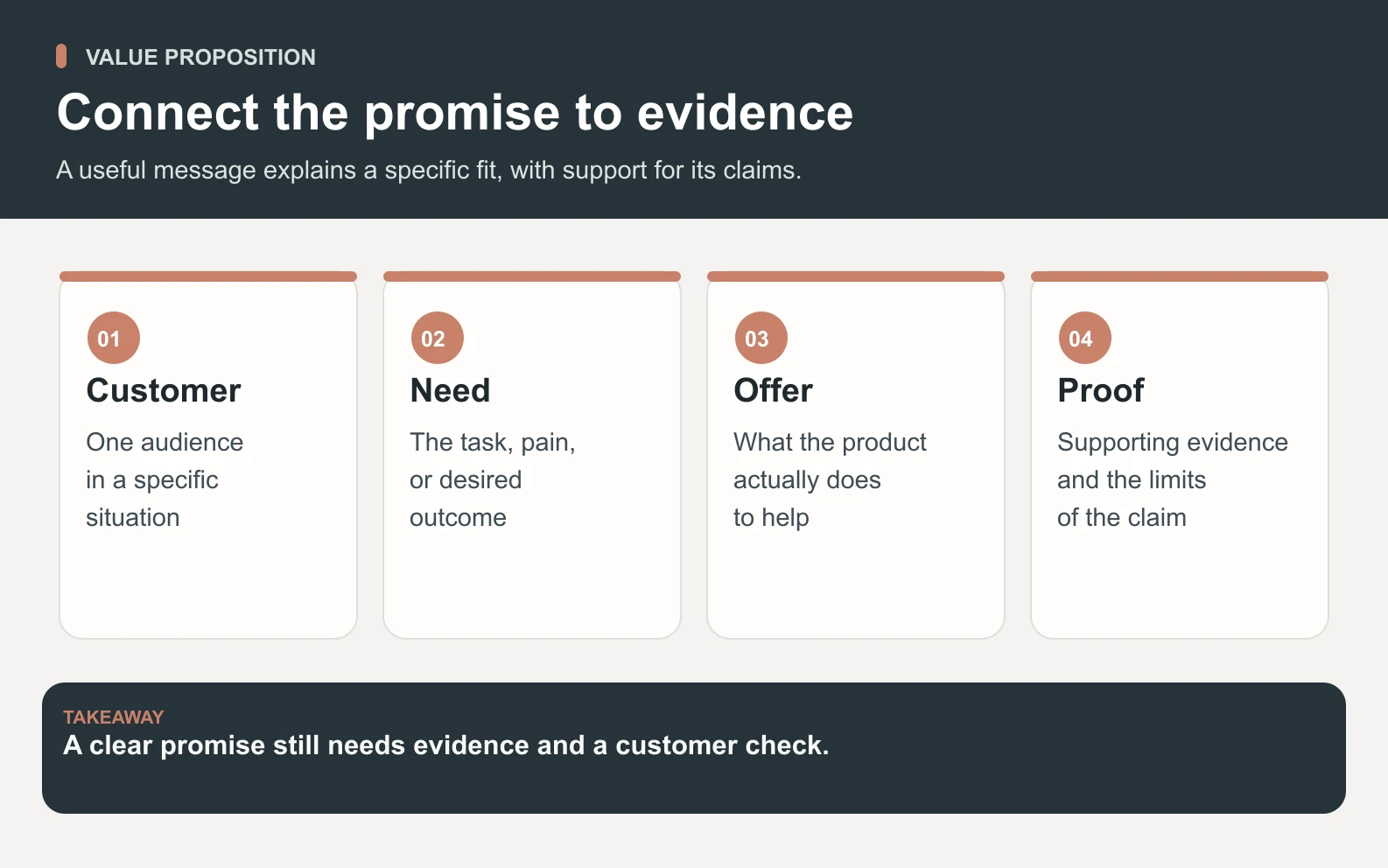
A visitor deciding whether to investigate your product needs enough information to recognize a relevant offer. What can they do with it? Why would that matter in their situation? What makes the promised benefit believable? A statement such as powerful solutions for modern teams leaves all three questions unanswered. Adding a concrete task, such as collecting client approval for a design, gives the reader something they can evaluate.
Shopify's guide to writing a value proposition connects the offer to customer benefits and reasons to choose it. Apply that principle by separating the feature from its relevance: a shared review page is a feature; knowing which version a client approved is the useful outcome. The second statement still needs the first to explain how the product helps.
Scroll horizontally to view all columns.
| Element | Question to answer | What makes the answer useful |
|---|---|---|
| Customer | Who is making which decision or doing which task? | A recognizable situation, such as a small design studio collecting a client's final approval. |
| Need | What difficulty or desired outcome matters in that situation? | A specific problem, such as feedback and approval referring to different versions of a design. |
| Offer | What does the product or service actually provide? | A verified capability, such as keeping a file, comments, and a recorded decision together. |
| Proof | Why should someone believe the promise, and where does it stop? | A demonstration or documented result, with conditions such as supported file types and reviewer access. |
A slogan may express the brand in a memorable phrase. A positioning statement may explain internally which market and alternatives the company wants to compete against. A value proposition gives a prospective customer a reason to consider the offer. You can develop them together, but do not force a short slogan to carry evidence, audience detail, and product explanation on its own.
The public expression can be a headline, a supporting sentence, and a nearby demonstration. It does not have to be one overloaded sentence. Put the essential benefit first, explain the mechanism underneath, and provide proof where readers can inspect it. If a crucial condition changes who can use the product, make that condition visible before the call to action.
Start with customer evidence and the real alternatives
Choose a narrow initial audience and the moment when the problem becomes important. Design teams, for example, include freelancers collecting a single approval, agencies coordinating several client stakeholders, and internal teams managing formal review. Their software requirements and buying concerns may differ. A useful first draft describes one situation well enough that you can find people who have experienced it.
Strategyzer's guidance on common canvas mistakes cautions against mixing different customer segments and describing customers only through the lens of your own solution. Keep an agency owner's purchasing concerns separate from a client's reviewing task. Then check whether the offer can satisfy both without pretending their priorities are identical.
Use recent support conversations, sales notes, interviews, and observed workflows that you have permission to use. Record the source, date, situation, and the exact observation. Mark whether something is a customer report, an observed action, or your interpretation. A note that someone could not locate an approved file is different from the conclusion that every agency needs a new approval platform.
GOV.UK's interview guidance recommends open, neutral questions and concrete accounts of experience. Ask someone to describe their most recent review: what arrived, what they did next, and where they checked the decision. Avoid introducing your preferred answer by asking whether a single approval page would make their life easier. Keep a record of the actual problem before discussing a proposed solution.
Include the option of doing nothing. Your competitor may be a familiar combination of email, shared folders, and a project manager who remembers where everything is. That arrangement has advantages: no migration, known habits, and an existing budget. A new tool must offer a worthwhile improvement after accounting for setup, changed behavior, access restrictions, and the risk of losing context.
Use a compact evidence table rather than a folder of unranked quotes. Add one row for each important claim, with its supporting observation and what would contradict it. Our competitive analysis worksheet can help compare alternatives on consistent criteria. A customer journey map is useful when you need to understand the wider experience before choosing the particular moment your offer will address.

Write a draft with the free worksheet
The worksheet starts with facts and ends with a test. Fill it in roughly before trying to make the words sound polished. An empty evidence field is useful: it tells you what needs checking. Replacing that gap with a confident adjective can make a draft look complete while hiding the most important uncertainty.
- 1Name the customer and situation. Specify the person doing the work, the buying decision if different, and the event that makes the task urgent.
- 2Choose one important outcome. State what the person wants to accomplish and how they currently try to accomplish it. Keep any unverified need labeled as a hypothesis.
- 3Connect the outcome to a capability. Explain the action your product makes possible. Check current product behavior, support requirements, and the conditions under which that action works.
- 4Attach evidence. Reference a demonstration, product documentation, customer observation, or properly described measurement. Match the strength of the wording to what the evidence actually establishes.
- 5Draft the message and the next check. Write the headline and supporting sentence, then identify the question a customer session or product test should answer before publication.
A drafting prompt you can adapt
For [customer in a specific situation], [offer] helps you [important outcome] through [verified capability]. You can check this by [evidence]. It applies when [essential condition]. Use the prompt to organize your thinking, then rewrite it in the language your customer uses.
The phrase verified capability matters. If your application stores comments but does not record explicit approval, do not promise an approval record. If a service produces a draft that the customer must edit, say what is delivered and who makes the final decision. Make the wording useful even when a buyer reads it without the context of your sales presentation.
For a more detailed offer-design exercise, Strategyzer's official Value Proposition Canvas separates a customer profile from the value an offer creates. Its customer side considers jobs, pains, and gains; its offer side connects products and services to them. The download in this article is our simpler original writing worksheet, not a reproduction of that canvas or evidence that product-market fit has been established.
Write two or three substantially different options if the evidence supports more than one emphasis. One might foreground finding the approved version; another might foreground giving a client a clear decision request. Changing convenient to effortless creates little useful learning. Changing the benefit tests a different explanation of why someone would care, which you can investigate directly.
Worked example: a design approval tool
Consider an imaginary product called ReviewHarbor for small design studios. This is an illustrative example, not a Space Office customer, a tested product, or a performance report. Assume its current product can display a design file, collect comments, and record approval against a selected version. It cannot force a client to reply or guarantee that a project finishes on time.
The first draft is: The ultimate collaboration platform for better creative work. It gives a broad category and a positive feeling but does not explain the task. A more useful hypothesis is that studio owners care about knowing which design a client accepted before production begins. The next step is to look for evidence of that problem in real projects, not declare the hypothesis a customer insight.
Scroll horizontally to view all columns.
| Worksheet field | Illustrative entry | What still needs verification |
|---|---|---|
| Customer and situation | A small studio owner preparing a client-approved design for production. | Whether this person owns the approval process and can change the tools used. |
| Need and current alternative | Identify the accepted version without reconstructing email threads and shared-folder history. | Whether that reconstruction happens often enough to justify another tool. |
| Offer | Keep a design version, comments, and the client's recorded decision together. | Whether the actual product preserves the version and decision as the draft claims. |
| Proof and conditions | Show a sample project from upload through approval, including the reviewer experience. | Supported file types, account requirements, later edits, and access to old decisions. |
A candidate headline is: Know which design your client approved. The supporting sentence is: Keep each design version, its feedback, and the recorded client decision together before you send work to production. A nearby demonstration should show exactly that sequence. The message explains an outcome and a mechanism without promising fewer revision rounds, faster approvals, or a quantified saving that the example cannot substantiate.
Now examine the tradeoff. If clients must create an account, the team should test whether that requirement prevents participation. If changes after approval produce a new version, the screen and message should make the distinction clear. The proposition becomes weaker if the product hides precisely the detail it promises to clarify. Better words cannot repair that product mismatch; the owner must change either the capability or the claim.
The same exercise works outside software. A fictional repair service could emphasize collecting and returning a repaired appliance, provided its coverage and scheduling support that promise. A fictional bookkeeping service could emphasize a reviewed monthly close packet, provided it states what records customers must supply. In both examples, the practical service and its conditions explain the value more clearly than an unsupported claim to be the best.
Test understanding, relevance, and behavior separately
First test whether people understand the offer. Show the draft in the setting where it will appear, including the supporting sentence and demonstration. Ask the intended audience to explain what they think the product does, who it is for, and what would happen after the next step. Record misunderstandings before explaining the answer. Once you supply the missing context, you are testing your explanation rather than the message.
Next investigate relevance. A participant may describe the offer accurately and still have no reason to want it. Ask how they handle the task now, what they would keep about that process, and what would make changing worthwhile. For ReviewHarbor, a client portal already included in another product may be sufficient. That is useful evidence about fit, even if the participant likes the new headline.
Strategyzer's testing roadmap distinguishes testing customer needs, the proposed offer, and willingness to pay. Keep those questions separate in your own plan. Compliments about wording do not establish purchase intent. A request for a demonstration is a stronger action than a favorable opinion, but it still does not demonstrate ongoing use or retention.
Scroll horizontally to view all columns.
| Question | Useful check | What it cannot establish alone |
|---|---|---|
| Is it understood? | Ask intended readers to explain the offer in their own words. | Whether the problem is important enough to change behavior. |
| Does it matter? | Discuss a recent relevant task and compare the current workaround. | Whether a person will use or pay for the proposed product. |
| Will someone act? | Offer a truthful next step, such as an available demo or clearly scoped pilot. | Whether the product will deliver durable value after that first action. |
If you compare live page variants, define the audience, conversion event, traffic allocation, and decision rule before interpreting the result. Avoid changing the headline, price, signup flow, and acquisition source together and attributing any movement solely to the proposition. Small or uneven samples may leave the result uncertain. Report the observations and limits instead of declaring a winner because one version produced an extra inquiry.
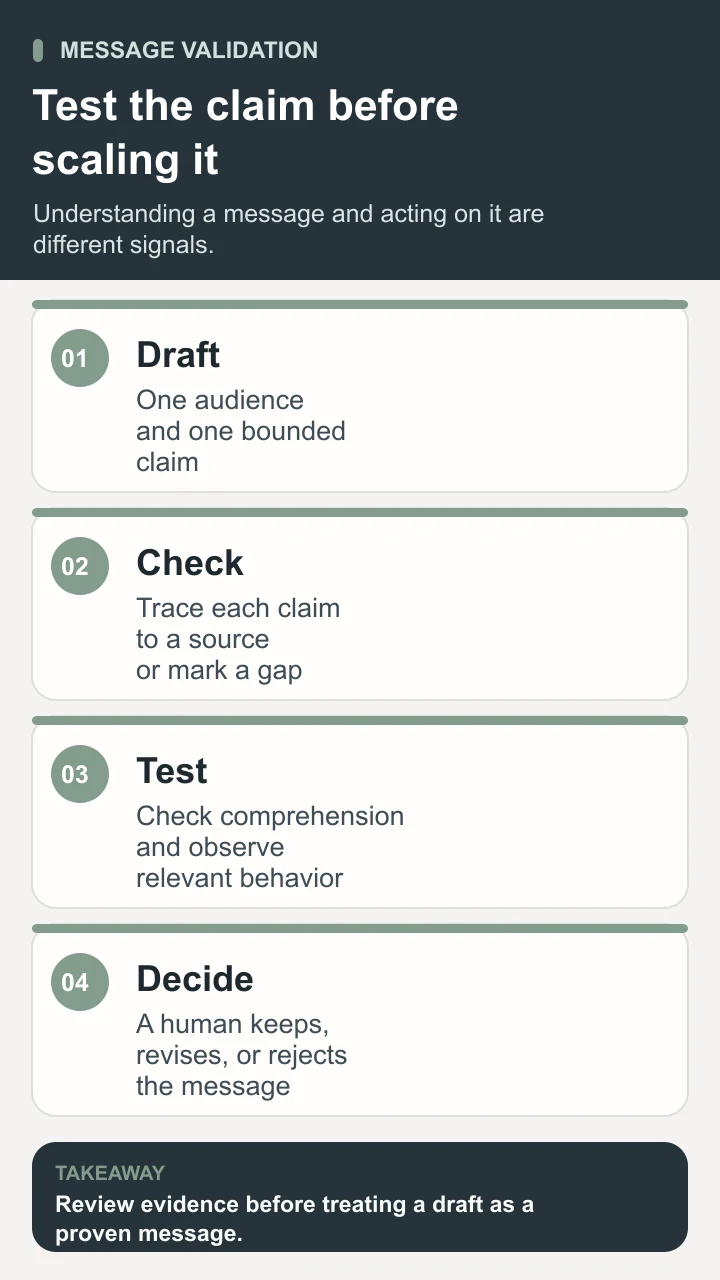
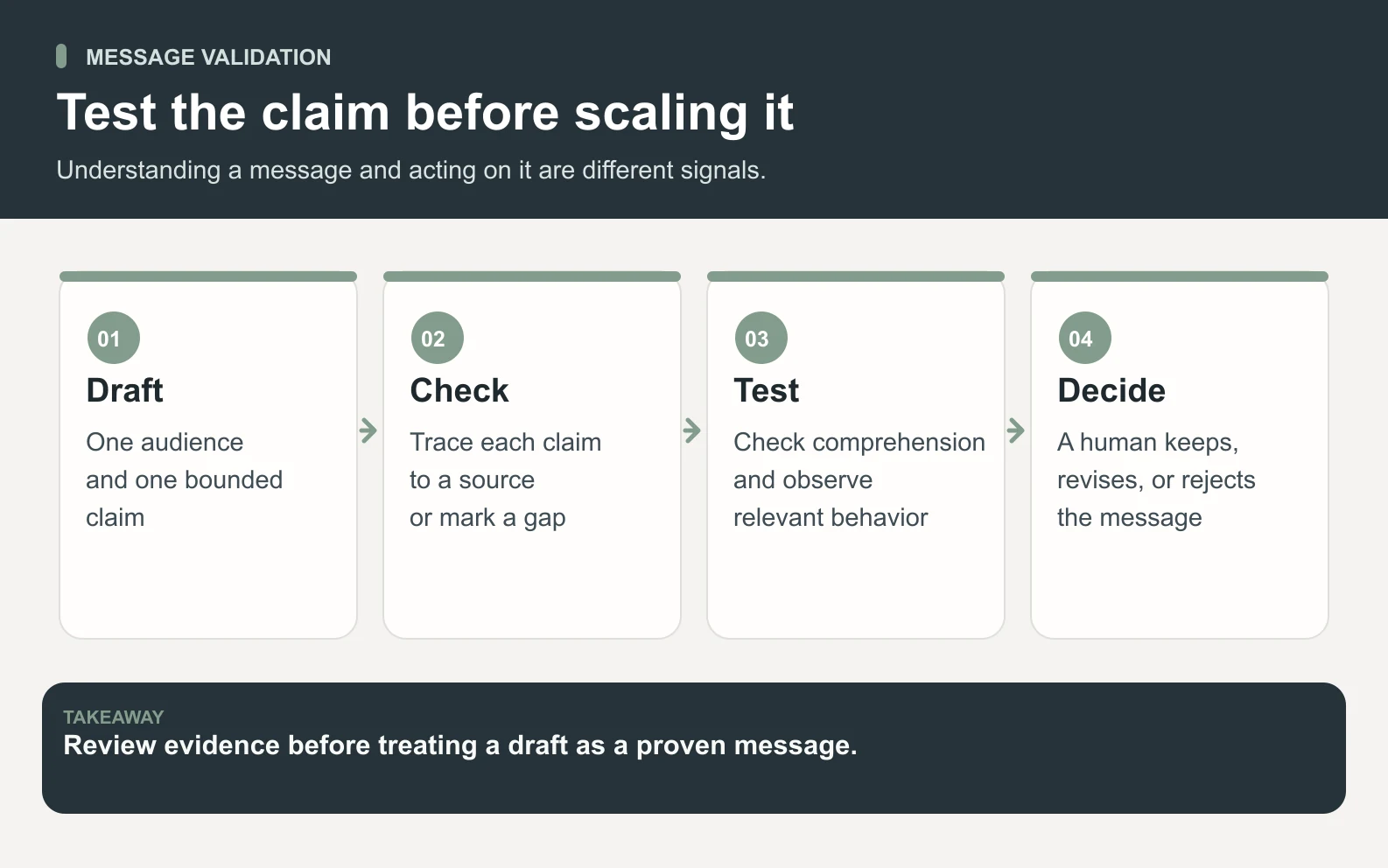
Keep the test record useful for the next person. Save the exact message version, what participants saw, the questions asked, observed actions, and the decision. Record a rejected draft too, with the reason it failed. Otherwise a memorable phrase can return months later after everyone has forgotten that readers misunderstood it or the product could not support it.
When the message is understood and you have enough eligible traffic to compare versions, follow the A/B testing guide and experiment worksheet. It explains random assignment, sample planning, and uncertainty so a higher observed conversion rate does not become an unsupported winner claim.
Use Space Office to prepare a reviewable message packet
A bounded Space Office assignment is to prepare two evidence-backed message options for one audience and one page. Supply approved research notes, current product documentation, the existing page, known alternatives, and any claim restrictions. Name the person who can verify product behavior and approve public wording. The team needs these inputs or explicitly granted access; it does not automatically have your customer records or analytics accounts.
Sodium, the Market Research & Intelligence Specialist, can organize the supplied evidence and flag unanswered customer questions. Oxygen, the Strategy & GTM Specialist, can develop options around the audience, benefit, and alternatives. Hydrogen coordinates those contributions and reviews the packet. The human owner checks original sources, confirms the capability, chooses the message, and decides whether any additional research is needed.
- An audience statement with the situation and current workaround made explicit.
- An evidence log linking each important claim to an approved source or marking it unverified.
- Two distinct message options, each with a headline, explanation, proof requirement, and important conditions.
- A test plan naming the next uncertainty, responsible person, and decision the evidence will support.
Use the packet to review the claim before asking for more copy variants. Nitrogen can support a later copywriting pass if that specialist is part of your team, but the first assignment can stay focused on research and strategy. See the current specialist roster and how coordination and review work to choose an appropriate setup. Assisted access is requested through contact.

This workflow prepares a decision; it cannot manufacture missing research, guarantee a conversion improvement, or publish to your accounts without an authorized workflow. Customer approval to use a quotation is also separate from permission to analyze internal notes. Keep sensitive details out of the public draft, and preserve enough source context for the owner to check whether the proposed wording remains faithful to the evidence.
Choose a promise you can explain and support
A useful value proposition makes one buying decision easier. It identifies the customer situation, explains a worthwhile outcome, and shows how the offer can deliver it under stated conditions. The work is complete enough for a first test when a reader can understand the message and the owner can trace its important claims to evidence. A polished sentence without that connection remains a hypothesis.
Start with the worksheet, choose one audience, and write the most specific promise your current product supports. If the evidence is thin, the next useful deliverable may be an interview plan or a capability check. If the claim is sound but misunderstood, improve the explanation. Keep the message only when the available evidence supports the decision you are making, and revisit it when the offer or customer situation changes.
Sources and review notes
Reviewed against the linked primary sources on the checked dates. Search features and citations are selected by their respective platforms; no placement is guaranteed.
- Shopify: Value Proposition: How To Write One and Examples — checked
- Strategyzer: The Value Proposition Canvas — checked
- Strategyzer: Five Common Mistakes to Avoid When Using the Value Proposition Canvas — checked
- GOV.UK Service Manual: Using In-depth Interviews — checked
- Strategyzer: Roadmap to Test Your Value Proposition — checked
Frequently asked questions
What is a value proposition?
Value proposition is a business term for an explanation of why a particular customer should choose an offer, connecting an important outcome to what the product or service provides and why the promise is credible. It helps someone recognize relevance and evaluate the offer. A strong draft makes its audience, benefit, mechanism, and supporting evidence clear without claiming results the business cannot substantiate.
What is a simple example of a value proposition?
For an imaginary design approval tool, Know which design your client approved is a candidate headline. A supporting sentence could explain that the tool keeps each version, its feedback, and the recorded decision together. This is an illustrative message, not a proven commercial result. The product must actually support those functions, and research must check whether the intended audience values them.
How long should the statement be?
Use enough space to explain the benefit and how it is delivered. A headline with a short supporting sentence is a practical starting point, with proof and important conditions nearby. There is no word count that makes a proposition effective. If readers cannot explain the offer after seeing it, investigate the missing meaning before making the sentence shorter.
How does a value proposition differ from a unique selling proposition?
A value proposition explains the overall reason an audience should consider the offer. A unique selling proposition emphasizes a distinctive reason to choose it over alternatives. The ideas can overlap in the same message. A meaningful distinction needs evidence: calling a feature unique is weak if competitors provide it too or if customers do not care about the difference.
Can AI write the message for me?
AI can organize supplied research, draft options, and check whether a message matches documented capabilities. It cannot establish customer demand by generating plausible opinions. In Space Office, Sodium can support research organization and Oxygen can develop positioning options, with Hydrogen coordinating and reviewing the work. A human verifies the evidence, approves claims, and makes the final decision about publication and testing.