Guide
Affiliate Marketing: How It Works, With a Practical Example
Build an affiliate marketing pilot around a useful recommendation, clear program terms, and a review of approved results. Includes a free planning worksheet.
By the Space Office team · Published · Updated · 16 min read
Affiliate marketing is a commercial arrangement in which a publisher or partner can earn a commission when a referral meets a program's agreed conditions. Choose a reader problem, evaluate the product and terms, publish a useful recommendation with an appropriate disclosure, and reconcile approved actions before judging earnings. In Space Office, Magnesium can research partner fit and Nitrogen can prepare the brief and copy; Hydrogen coordinates and reviews their work. A human verifies evidence, commercial terms, and the final publication decision.

Key takeaways
- Choose a product because it helps the reader complete a real decision.
- Record the qualifying action, attribution rules, exclusions, and payment conditions before planning earnings.
- Keep product evidence, personal experience, and unverified assumptions visibly distinct.
- Review disclosures and paid-link handling in the actual published format.
- Separate clicks, attributed orders, approved commissions, payments, and operating costs.
Download the free affiliate marketing worksheet to record reader fit, evidence, program terms, publication checks, and commission reconciliation. It includes the fictional desk-light example used below. For a broader plan covering owned assets and distribution, use the separate content marketing guide.
What affiliate marketing means for each participant
The publisher helps someone evaluate an offer and may receive compensation for a qualifying referral. The merchant supplies the offer and defines the program. The customer decides whether to buy. A network or software platform may help administer tracking and payments. Shopify's overview explains this performance-based relationship and the role of tracked links. The exact qualifying event comes from the individual program's terms.
Start by naming which participant you are. A creator choosing a program needs to understand the product, audience, evidence, and compensation rules. A merchant recruiting partners needs to define a suitable customer, an acceptable recommendation, and an operational process for checking referrals. Those are connected tasks, but the responsibilities and costs differ.
Scroll horizontally to view all columns.
| Participant | Work to clarify | Evidence to retain |
|---|---|---|
| Publisher or partner | Who the recommendation helps, what was examined, and how the relationship is explained | Product notes, approved sources, the published asset, and disclosure review |
| Merchant or program owner | Which action qualifies and how attribution, exclusions, and payment work | Dated terms, product facts, order decisions, and commission records |
| Customer | Whether the offer fits their need and the stated conditions | Clear product information and access to the merchant's current purchase terms |
| Platform or network, when used | Which records it supplies and which decisions still belong to the parties | Tracking documentation, reports, and a route for resolving discrepancies |
Compensation alone does not tell you whether the relationship is worthwhile. A high advertised rate can still produce little approved income if the audience needs a different product, the qualification rules are restrictive, or the work costs too much. Conversely, a genuinely helpful recommendation may earn nothing. Treat audience usefulness and commercial viability as separate checks that both need an answer.
Choose a reader problem before choosing a program
Write the buying question in a sentence: a remote worker needs a desk light that fits a shallow table without obstructing a monitor. That is a task you can investigate. A broad ambition to promote office products does not tell you what to compare, which evidence matters, or what a reader should learn before following a link.
Use approved audience questions, your own relevant experience, and permitted customer research to identify recurring decisions. Keep the origin of each question. A request from one enthusiastic customer is useful evidence of that customer's problem; it does not establish demand across an entire market. The target audience worksheet can help define who the recommendation is intended to serve.
Create an evidence record before drafting. For the light example, record the dimensions you measured, which surface you used, what the instructions state, and any limitation you observed. A specification copied from the manufacturer is a manufacturer statement. A feature you personally checked is an observation. A claim about long-term reliability requires different evidence from a short inspection. Keep those distinctions in the final article.

If you cannot evaluate the product properly, reduce the scope. You might explain how to compare published specifications and state that you have not tested the items. Do not turn a research summary into a first-person review. Decide whether there is enough useful material to publish at all; adding a referral link does not fill an evidence gap.
Read the terms and design a small pilot
Capture the program's current terms with the date and source before committing production time. Write unresolved questions in a separate column and ask the program owner for clarification. A summary from an old tutorial or another affiliate's experience is insufficient when the current agreement says something different. Keep the merchant's commercial approval separate from approval of your content.
- 1Define the qualifying action. Record the purchase, lead, subscription, or other event that can become eligible, including the applicable customer and product restrictions.
- 2Record attribution rules. Identify how referrals are assigned, how long the relevant window lasts, and what happens when several partners, devices, or codes are involved.
- 3Identify exclusions and reversals. Note how cancellations, returns, invalid referrals, self-purchases, or other program-specific conditions affect a reported action.
- 4Read channel and asset permissions. Confirm whether the intended article, newsletter, video, paid placement, product image, or brand wording is allowed.
- 5Record payment conditions. Separate the commission calculation from approval timing, payout timing, payment thresholds, and any stated deductions.
- 6Set a pilot boundary. Choose one reader question, one content asset, a production limit, a review owner, and a date for reconciling the available records.
Use those answers to build a practical plan rather than an earnings forecast. For example, prepare one comparison guide and a permitted newsletter mention, then reserve time to test links and review the first report. If a key term remains unclear, hold the commercial component while you resolve it. The content can still be useful without treating a speculative payment as earned income.
Publish a recommendation people can inspect
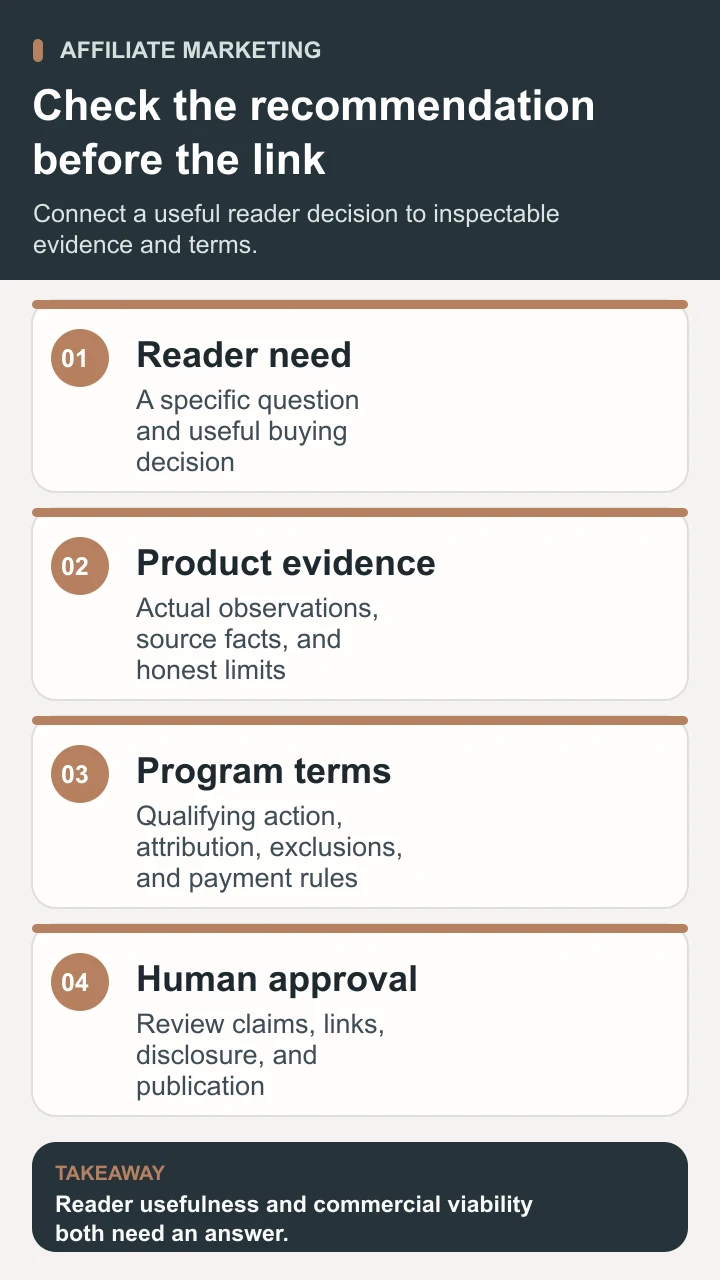
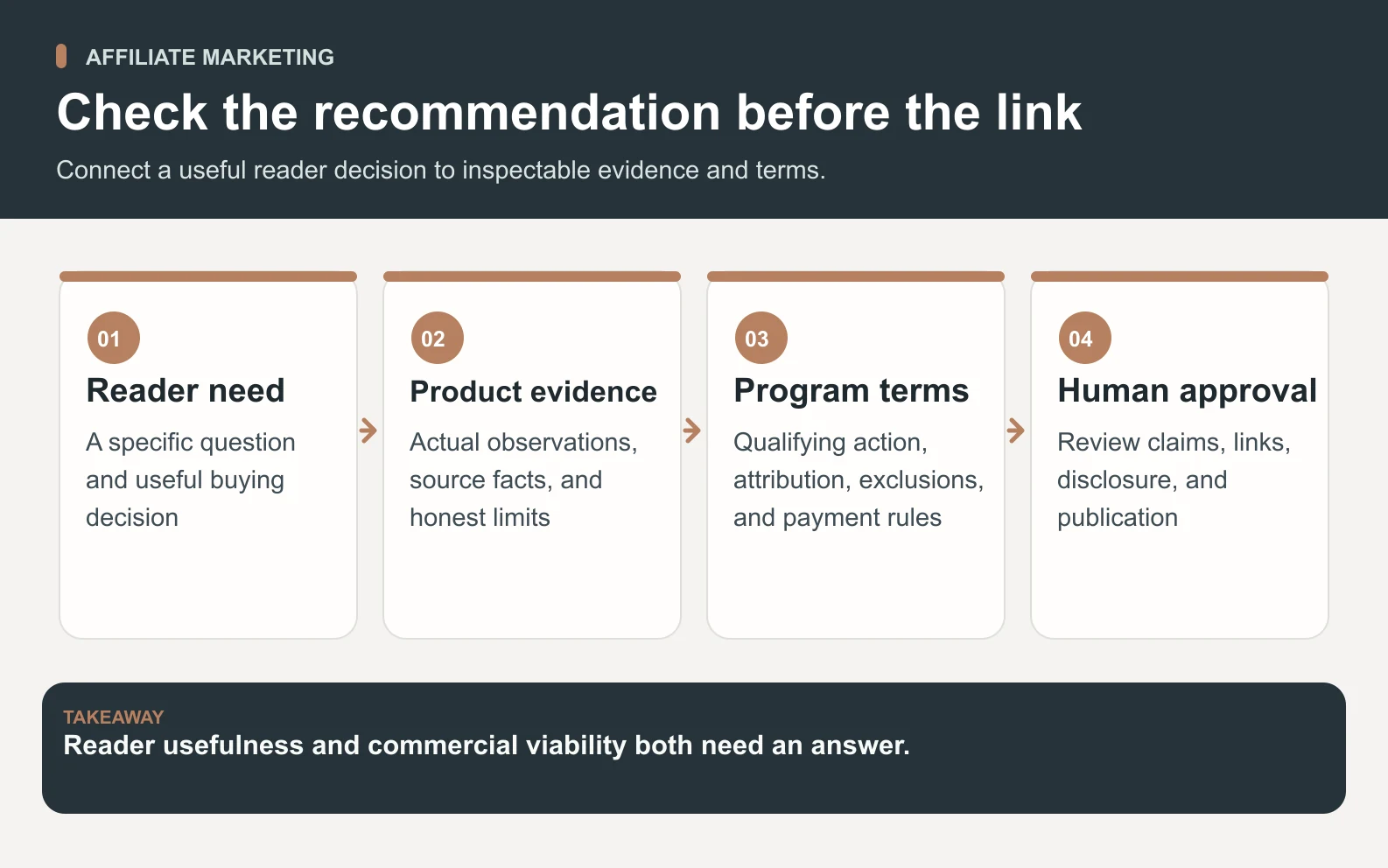
A useful recommendation explains its criteria before presenting a conclusion. Show the task, the relevant comparison, what you examined, and when another option may fit better. For a shallow desk, mounting space and adjustment range may matter more than a long feature list. Include the limitation that could change the reader's choice, even when it makes the offer less attractive.
Give the page an original contribution: a measured fit example, annotated setup, documented comparison, or explanation of a tradeoff. Label the basis of the recommendation beside the claim. A reader should not need to search a distant methodology page to discover that an apparent test was only a review of published specifications. Keep prices and availability tied to a checked source and date when you mention them.
For US-facing endorsements, the FTC's endorsement guidance (PDF) addresses clearly understandable disclosure of material commercial relationships, including affiliate compensation. Draft plain language explaining that purchases through the link may generate a commission and review its placement with the recommendation. Check applicable requirements for the audience and channel. A disclosure does not supply missing evidence for the product claim itself.
Have the site owner review the technical link implementation. Google recommends identifying paid links with the sponsored attribute, while also accepting nofollow for that purpose. That markup serves search systems; readers still need understandable disclosure. Test the final destination and the program's tracking method. A campaign label in analytics is not, by itself, proof that a commission will be credited.
Worked example: a publisher evaluates a desk-light partnership
Imagine a fictional specialist publisher that teaches people how to set up small home offices. It has examined a desk light and prepares a guide explaining the space needed for its base, adjustment limits, and suitable desk layouts. The merchant permits the planned guide and newsletter placement. Every program rule, cost, rate, and result in this example is invented for the calculation; it is not a real offer, customer case, or performance benchmark.
The example program pays 8% of an approved order's eligible value. In the matched review period, the publisher records 240 valid outbound clicks and the program reports 12 attributed orders. Nine are approved, two are returned, and one remains pending. Each approved order has $80 of eligible value under the fictional terms. The publisher keeps the order states visible rather than multiplying all reported orders by the rate.
Scroll horizontally to view all columns.
| Record | Illustrative amount | Interpretation |
|---|---|---|
| Valid outbound clicks | 240 | Visits sent through the tracked placement in the stated review group |
| Attributed orders | 12 | Reported orders before approval decisions |
| Approved / returned / pending | 9 / 2 / 1 | Only the nine approved orders enter the approved-commission calculation |
| Eligible approved order value | 9 × $80 = $720 | A program-defined commission base, not publisher income |
| Approved commission | $720 × 8% = $57.60 | Approved earnings before the publisher's costs and any later permitted adjustments |
| Illustrative production cash cost | $90 | A separately recorded cost that excludes unpriced owner time |
The approved-order rate for this matched group is 9 divided by 240, or 3.75%. It is not a prediction for future visitors. Approved commission less the stated cash cost is $57.60 minus $90, or negative $32.40. This is a limited cash comparison, not a complete profit calculation: it leaves out owner time, other operating costs, taxes, and any subsequent adjustments. Payment received must also be checked separately.
The owner now has a useful decision. If readers use the fit guide but the partner economics remain poor, the guide may deserve maintenance while that commercial arrangement needs revision. If readers repeatedly ask about a different desk type, improve the underlying answer. More links or more traffic would not automatically solve either problem.

Prepare a reviewed Space Office partner brief
Give the team a bounded preparation task: return a partner-fit note, a dated terms checklist, one evidence-backed content brief, and a review log. Supply the audience question, permitted research, product facts, your actual observations, brand constraints, and the program documents you are authorized to share. Identify confidential information that must stay out of the draft.
- 1Magnesium, the Community & Partnerships Manager, researches relevant partner fit from the approved sources and prepares a shortlist with unresolved questions. A research result does not establish program admission or authority to agree terms.
- 2Nitrogen, the Content & Copy Specialist, turns the selected evidence into a useful outline, comparison language, and disclosure draft. It labels the difference between supplied experience, source facts, and information still needing verification.
- 3Hydrogen coordinates the handoff and reviews whether the materials agree with the brief. Missing terms, unsupported claims, and conflicting instructions return for clarification.
- 4The human owner checks the product evidence, program conditions, commercial arithmetic, link implementation, and final content. The owner decides whether to apply, agree terms, publish, or make any external contact.
Ask for an inspectable packet, with source links and a clear status for every open question. For example, a draft may be complete while permission to use a product photo remains unresolved. That asset stays out of the approved version until the owner resolves the gap. Check the live specialist roster and how Space Office works when scoping the team. Account access and public actions require the customer's authorized setup and decision.
Reconcile results and maintain the recommendation
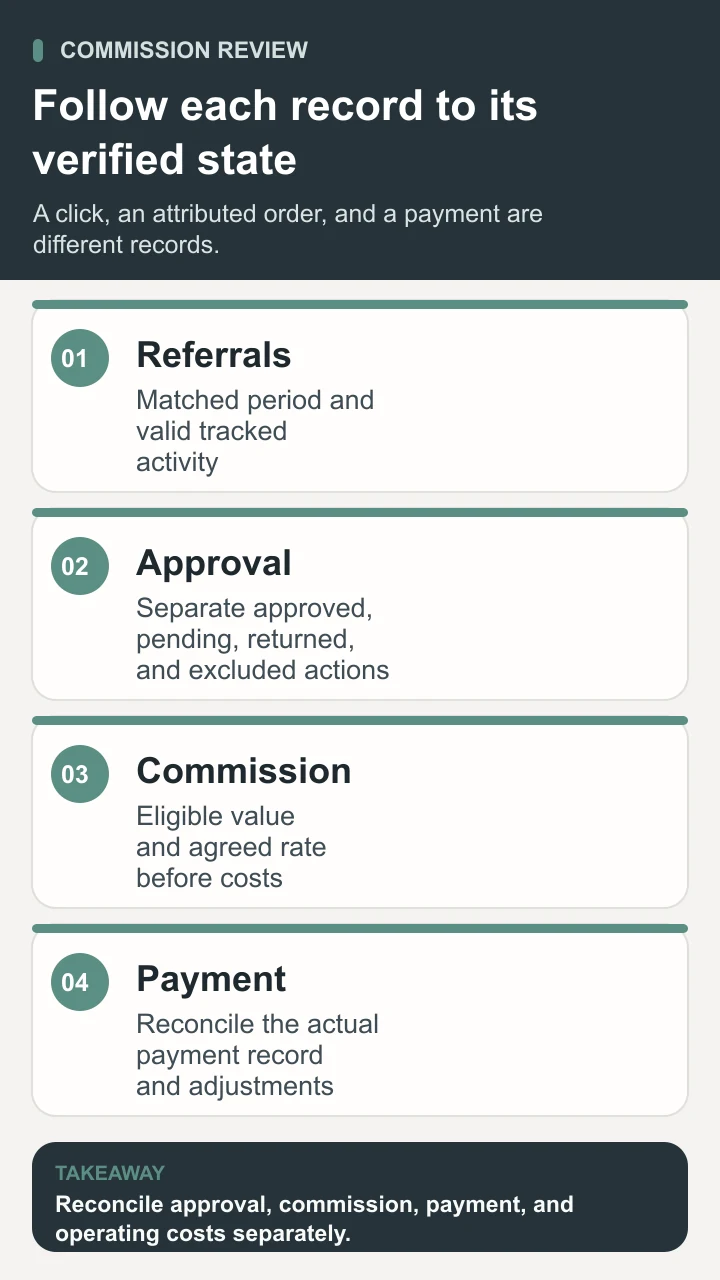
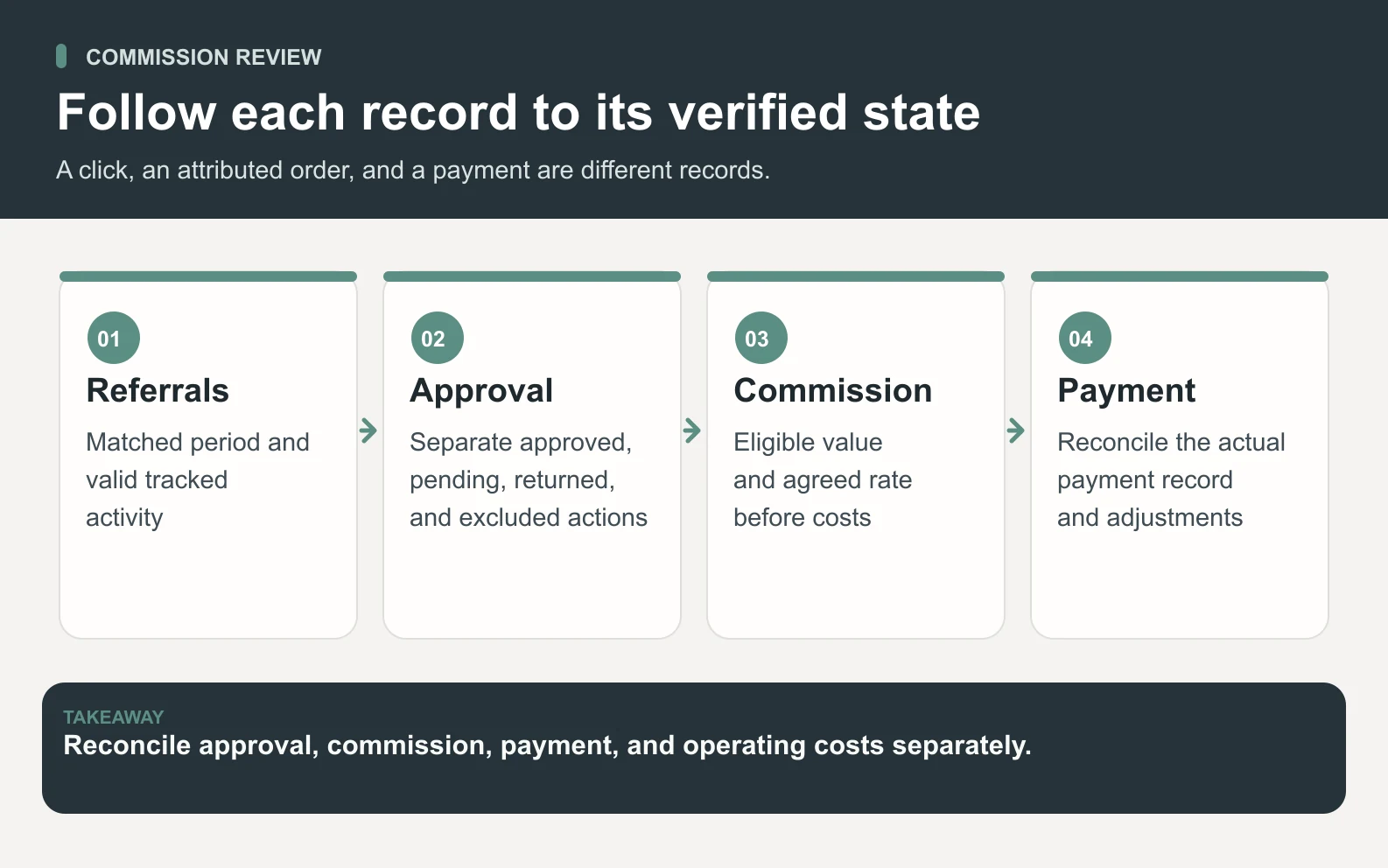
Keep a small reconciliation log with the content version, placement, reporting period, valid clicks, attributed actions, action status, eligible commission base, rate, approved commission, and payment record. Store only the data you are permitted to retain. Use an appropriate identifier to match records without copying unnecessary customer information into the content workflow.
Compare reports before explaining a difference. A publisher's outbound clicks, a merchant's sessions, and a program's attributed actions may use different definitions and windows. Missing matches may reflect timing, exclusions, measurement limits, or a genuine tracking problem. Document the discrepancy and ask the responsible owner for evidence. Do not silently replace one system's count with another.
Schedule a maintenance check for the recommendation itself. Revisit product availability, changed specifications, broken links, altered program terms, and reader questions. Remove or correct claims you can no longer support. Keep an appropriate record of substantive changes so later reporting can distinguish an updated recommendation from a change in distribution or seasonal interest.
Review effort as well as activity. Record the time needed to gather evidence, make revisions, answer questions, and reconcile reports. A relationship that creates repeated exceptions may need a smaller scope or a different partner. Use the marketing plan guide to compare that effort with other ways the business could serve and reach the same audience.
Make affiliate marketing useful before expanding it
Start affiliate marketing with a recommendation you can defend, a reader who benefits from it, and terms you can explain. Complete the worksheet, review the real published asset, and reconcile the first available reporting group before expanding. Keep the useful answer current, make the commercial relationship understandable, and let verified records guide the next decision.
Sources and review notes
Reviewed against the linked primary sources on the checked dates. Search features and citations are selected by their respective platforms; no placement is guaranteed.
Frequently asked questions
What is affiliate marketing in simple terms?
Affiliate marketing is a commercial arrangement where a publisher or partner can earn a commission when a referral satisfies a program's conditions. The publisher creates a useful recommendation, the customer makes a decision, and the program evaluates the qualifying action. The commission depends on the actual terms, attribution, and approval rules; a click or reported order does not necessarily mean a payment is due.
How is affiliate marketing different from influencer marketing?
Affiliate marketing describes a compensation arrangement linked to qualifying referrals. Influencer marketing describes a collaboration with a creator to reach and help a relevant audience. A creator campaign can use a fixed fee, affiliate commission, or a combination. Define the deliverables, evidence, permissions, and compensation separately so everyone understands what work is being purchased and what results can trigger payment.
Can a beginner start without a large audience?
A beginner can begin by researching a narrow reader problem and producing a useful, accurately scoped answer. Program admission and permitted channels depend on the chosen program. A small audience does not establish that the economics will work, and a large audience does not establish product fit. Set a manageable production limit, preserve evidence, and evaluate approved outcomes and costs before treating the activity as a business model.
Can AI prepare an affiliate recommendation?
AI can organize approved product facts, research partner fit, prepare comparison criteria, and draft copy for review. It cannot create genuine product experience by inventing a test or guarantee that a program will approve a referral. In Space Office, Magnesium and Nitrogen prepare the scoped packet, Hydrogen coordinates and reviews it, and a human verifies evidence, terms, permissions, and the publication decision.