Guide
Influencer Marketing: Plan a Small, Measurable Campaign
Make influencer marketing a reviewable collaboration: choose a relevant creator, agree useful work, check the claims, and measure what the campaign actually shows.
By the Space Office team · Published · Updated · 16 min read
Influencer marketing is a collaboration in which a business works with a creator to communicate with a relevant audience. Start with one audience need, verify creator fit, agree the deliverables and commercial terms, review the claims and disclosures, and evaluate comparable results. In Space Office, Magnesium can research creator fit and Nitrogen can prepare the brief and copy; Hydrogen coordinates and reviews their work. The customer supplies approved facts and access, and a human approves commitments and publication.

Key takeaways
- Choose a creator using audience and work evidence, rather than follower count alone.
- Define the useful deliverable, review process, compensation, and reuse permissions before production.
- Keep creator experience truthful and product claims tied to approved evidence.
- Check disclosure placement in the actual post, video, or live format.
- Separate platform activity, site visits, deduplicated orders, costs, and evidence of incremental results.
Download the free influencer marketing worksheet to record creator-fit evidence, campaign terms, the content brief, publication checks, and results. It includes the fictional four-week desk-kit campaign below. For your wider channel program, use the separate social media marketing guide.
What influencer marketing includes
A creator contributes a way of explaining something to an audience that already follows their work. The business contributes a relevant product, useful evidence, and an agreed scope. The collaboration needs to make sense to the person encountering the content. Mailchimp's definition describes the relationship between a business and an individual with an audience; your planning work is to establish why that relationship should help this particular reader or viewer.
The task might be demonstrating a setup, explaining a buying decision, showing an approved use case, or inviting suitable people to an event. Write that task before selecting a format. A polished video is a poor deliverable if the audience needed a simple compatibility checklist, and a large audience provides little guidance about which people actually have the problem.
Scroll horizontally to view all columns.
| Arrangement | What to define | What to evaluate |
|---|---|---|
| Fixed-fee content | The exact deliverable, revision scope, timing, and agreed fee | Whether the work met the brief and helped the intended audience |
| Product supplied to a creator | What was provided, whether content is agreed, and how the relationship is explained | The actual content and its evidence; a supplied product does not promise a favorable opinion |
| Affiliate compensation | Qualifying actions, attribution, exclusions, approval, and payment rules | Approved referrals and commercial records alongside content quality |
| Content reuse or paid amplification | Specific assets, permitted uses, duration, access, and separate approval | Whether the agreed use fits the campaign and the available permissions |
One campaign can combine arrangements. For example, a creator might receive a fixed production fee and a separately defined referral commission. The affiliate marketing guide explains that second model. Keep the creator's deliverable, permission to reuse it, and any performance payment in distinct parts of the brief. That makes the cost and the acceptance decision easier to inspect.
Choose creator fit with source evidence
Define the target audience, the question you want to answer, and the audience's next useful action. Then inspect creators who already explain related work. Review several relevant samples rather than choosing from a single popular post. Record the source URL, date, topic, format, and the reason it belongs in the shortlist.
Look at the quality of the interaction as well as its apparent size. Do people ask questions related to the product task? Does the creator answer with useful detail? Are the examples appropriate for the intended audience? A discussion about setting up a shallow desk can be more relevant to a desk-kit business than an unrelated viral clip. These are fit observations, not a claim that one audience will convert better.
Ask the creator for relevant recent audience and content information they are permitted to share. Note the period and definitions behind the figures. A screenshot of reach from one unusually popular post is different evidence from a series of comparable posts. Keep unavailable demographics or traffic sources marked unknown. Do not estimate them from a person's appearance, name, or a few comments.

Use a small evidence table with criteria, observations, uncertainties, and a next question. For example, the creator's desk tutorial may show clear explanations, while the audience's buying location remains unknown. The next step is to ask for an appropriate source, not to give the creator a precise score that hides the gap. The human campaign owner decides whether the available evidence is sufficient to approach the creator.
Build a brief both sides can use
A useful brief defines the outcome while leaving the creator room to explain it naturally. Begin with the audience task and the information required for a fair decision. Supply verified facts and explicit boundaries. A request to make the product look amazing invites avoidable interpretation; a request to demonstrate how the supplied kit fits a shallow desk gives the creator something concrete to investigate.
- 1State the reader task and next action. Specify what the audience should understand and where a relevant viewer can find further information.
- 2Define each deliverable. Name the format, platform, scope, length range where useful, publication window, and what source files or reports must be handed over.
- 3Supply the evidence packet. Include approved product facts, exclusions, current destination information, source links, and points the creator must verify through their own experience.
- 4Record the commercial and usage decisions. Clarify compensation, payment conditions, permitted reuse, editing, paid distribution, duration, and any unresolved questions for the owner.
- 5Set the review process. Name the reviewer, factual checks, disclosure review, revision scope, approval status, and what happens if the product or timing changes.
- 6Specify reporting. Agree the period, available platform definitions, link or code records, source of order decisions, and the date for a joint review.
Make disagreements visible before production. A creator may find that the product does not fit their own desk or that the proposed demonstration would exaggerate a benefit. Give them a route to report that finding and revise the scope. Approval should confirm accurate work; it should not pressure someone to manufacture experience or a favorable opinion.
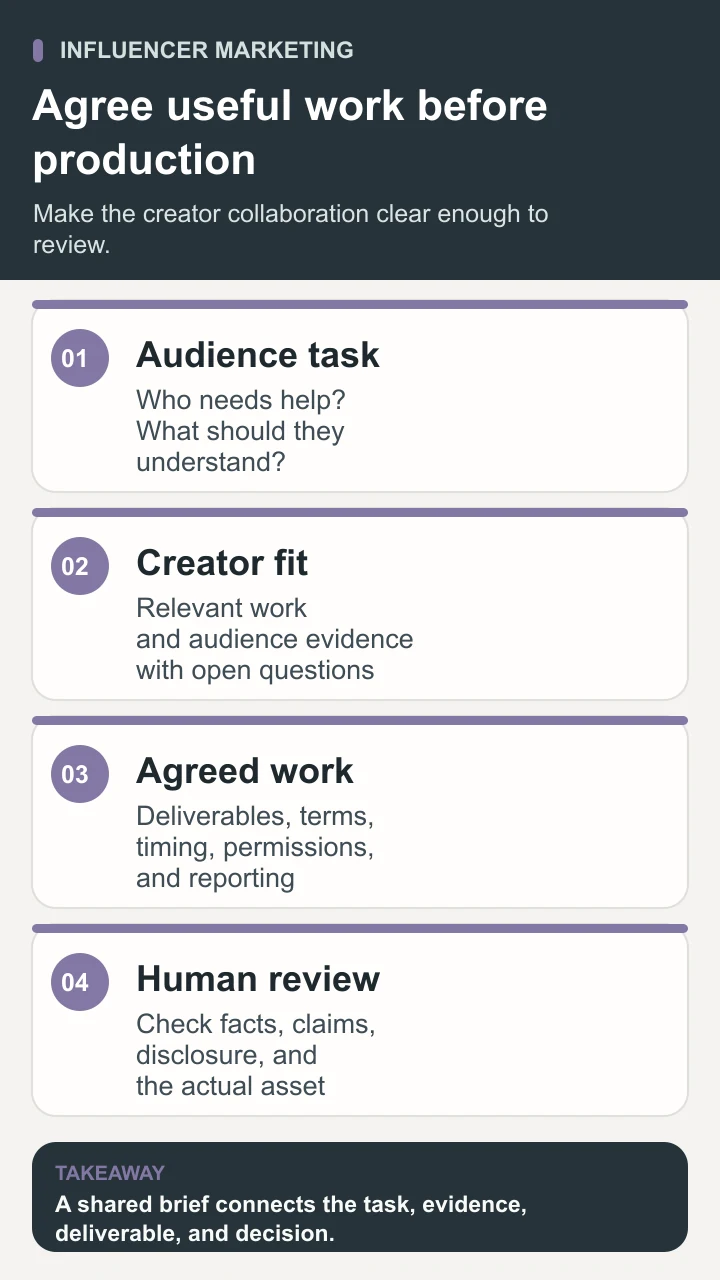
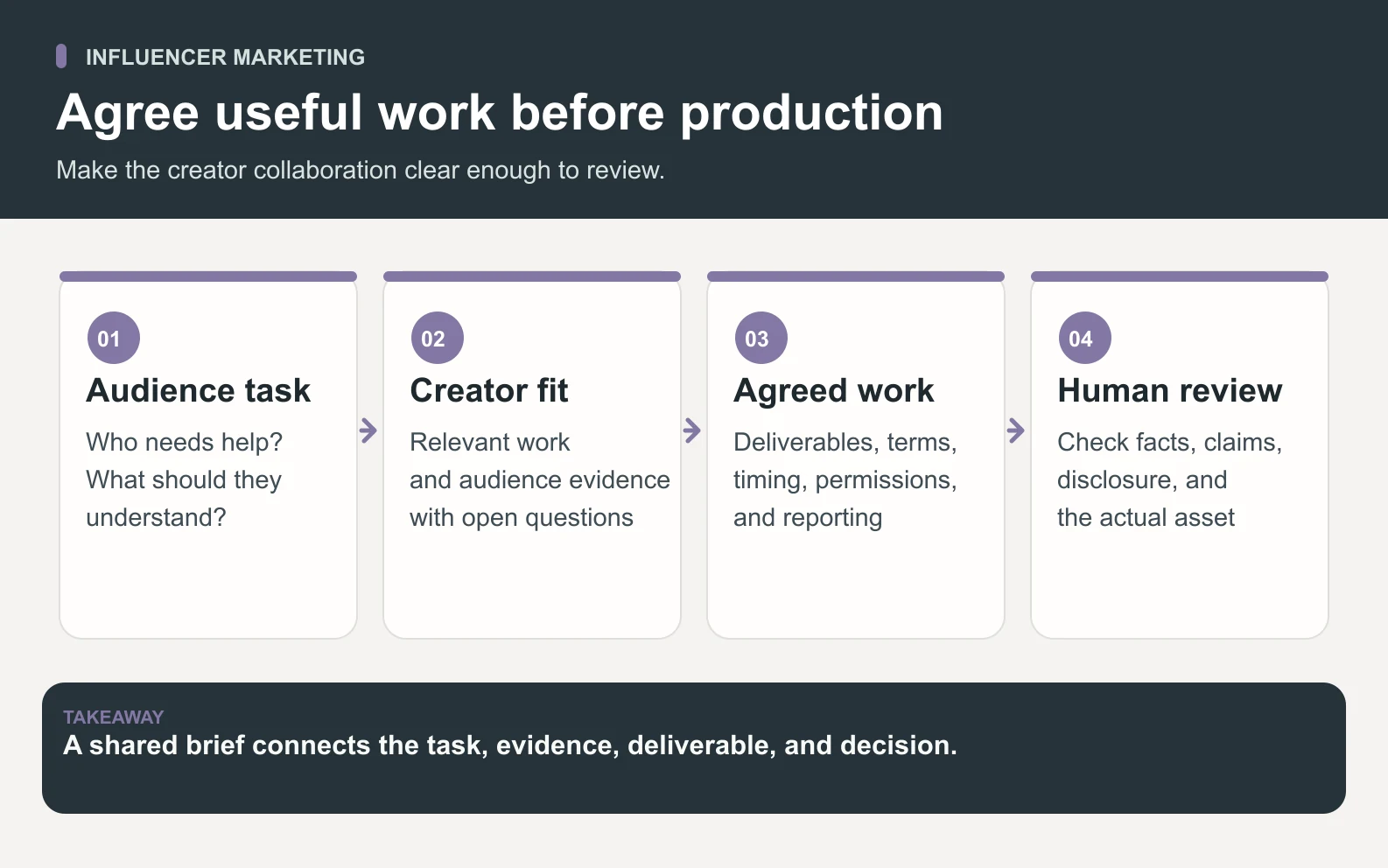
Keep one current version of the brief. Record changes to the destination, product facts, deliverables, and permissions with an owner and date. If a scope change affects the fee or publication window, resolve that commercial decision before treating it as an instruction to the creator. A concise change log prevents different people from approving different versions.
Worked example: a desk-kit business runs a four-week pilot
Imagine a fictional business selling a $75 desk-organization kit. It wants suitable remote workers to understand whether the kit fits a shallow work surface. The owner selects two creators whose work includes practical office setup tutorials. Each agrees to one LinkedIn demonstration post with an approved destination link. All business details, fees, counts, and results here are invented for a planning exercise; they are not a customer case or a recommended benchmark.
Scroll horizontally to view all columns.
| Week | Planned work | Decision before proceeding |
|---|---|---|
| 1: Fit and scope | Review creator evidence, supply the kit, and resolve the brief and commercial terms | The owner and creator understand the task and can deliver it accurately |
| 2: Demonstration | Creator examines the kit and drafts the explanation from their real observations | Product claims, limitations, destination, and disclosures can be reviewed |
| 3: Publication | Publish the approved version, retain a copy, and assign ownership of relevant questions | The actual post matches the approved scope and working destination |
| 4: Review | Collect agreed reports and reconcile merchant orders by identifier | Continue, revise, or stop using the available evidence and total effort |
The fictional cash budget is $600 in creator fees, $100 in sample and delivery costs, and $150 in other production support: $850 total. Human owner time is tracked separately and has not been priced into this example. The owner approves this limit before making commitments and does not treat additional revisions or reuse as automatically included.
During the matched reporting period, the two link-bearing posts record 12,000 combined reported impressions and 180 outbound clicks under the same platform definitions. The click-through rate for those records is 180 divided by 12,000, or 1.5%. The combined impression count is not a count of unique people. Site analytics separately records 150 sessions; clicks and sessions are different observations and need not match.
The merchant's fictional order log contains six approved orders linked to the campaign links and five approved orders using the creator codes. Three order identifiers appear in both groups. The deduplicated total is 6 plus 5 minus 3, or eight approved orders. At $75 each, that is $600 in recorded order revenue for this exercise. Adding the two report totals without matching identifiers would incorrectly report eleven orders.
Recorded revenue is below the $850 cash budget even before product costs and owner time are considered. This is not a complete profitability calculation or proof that the campaign caused eight additional orders. The owner checks margin, returns, measurement limits, and the quality of audience questions before deciding what to change. An uncontrolled two-creator pilot cannot establish the counterfactual of what would have happened without the activity.
Review disclosures, claims, and reuse permissions
For US-facing work, the FTC's endorsement guidance (PDF) covers material connections such as payments or free products, noticeable and understandable disclosure, and truthful, supported endorsements. Review the actual post or video and preserve the creator's experience. A demonstration on one desk does not establish universal compatibility. Check requirements relevant to the audience, product, and location rather than assuming a platform label settles every question.
Platform requirements are another part of the review. YouTube's branded-content guidance describes notifying the platform about commercial relationships and the disclosure label it adds. If the deliverable uses YouTube, check the current controls and relevant policies for that upload. A campaign brief should name the responsible account owner rather than assuming a specialist can change channel settings.
Check the intended reuse before preparing derivatives. Record which asset may be used, on which account, for which purpose, and for how long under the agreement. Ask separately about editing, paid amplification, voice or likeness use, music, and material supplied by other people where relevant. These questions belong in the owner's permission review; a delivered file does not by itself answer them.
Finally, inspect the destination. The product shown, its limitations, availability, and offer should agree with the landing page. Test the link in the actual format and assign someone to handle relevant questions or corrections after publication. If stock, specifications, or the offer changes, the campaign owner needs a clear route to update or pause the affected work.
Prepare the campaign with Space Office
Scope one preparation packet: a sourced creator shortlist, a campaign brief, a claim-and-disclosure review sheet, and a reporting template. Supply the audience definition, approved product facts, budget limits, source material, actual creator observations when available, and permission boundaries. Mark records that cannot be shared and accounts the team is not authorized to access.
- 1Magnesium, the Community & Partnerships Manager, researches relevant creators and records fit evidence, source dates, and questions. Sourcing a candidate does not mean the creator has agreed to participate.
- 2Nitrogen, the Content & Copy Specialist, prepares the brief, supported talking points, and response drafts from approved inputs. The creator and owner supply and verify any first-person experience.
- 3Hydrogen coordinates the handoffs and reviews the packet against the objective, evidence boundaries, and requested deliverables. Unsupported claims and missing decisions return for revision.
- 4The human owner checks the sources, commercial terms, permissions, claim support, final assets, and measurement plan. The owner decides whether to contact a creator, commit a budget, approve publication, or authorize reuse.

Cobalt, the Multi-Platform Content & Organic Distribution specialist, can help adapt an approved lesson for an agreed organic format when that task is in scope. Adaptation still needs appropriate permissions and human approval. Check the live roster and coordination workflow when choosing the team. Role assignment does not automatically grant access to a creator's account, publish a post, or authorize advertising spend.
Read the results and decide what changes
Agree the measurement log before publishing. Record the asset and version, creator, platform, publication time, reporting window, impressions or views under their actual definition, outbound actions, recorded visits, and approved outcomes. Preserve each system's terminology. If one platform reports views and another reports impressions, do not silently combine them into a single reach claim.
For links you control, Google Analytics documents campaign parameters for identifying referred traffic. Keep a consistent naming record and test the destination. Parameters such as utm_source, utm_medium, and utm_campaign help label visits; they do not prove incrementality or settle which orders a commercial agreement should credit. Match relevant order identifiers before adding link and code reports.
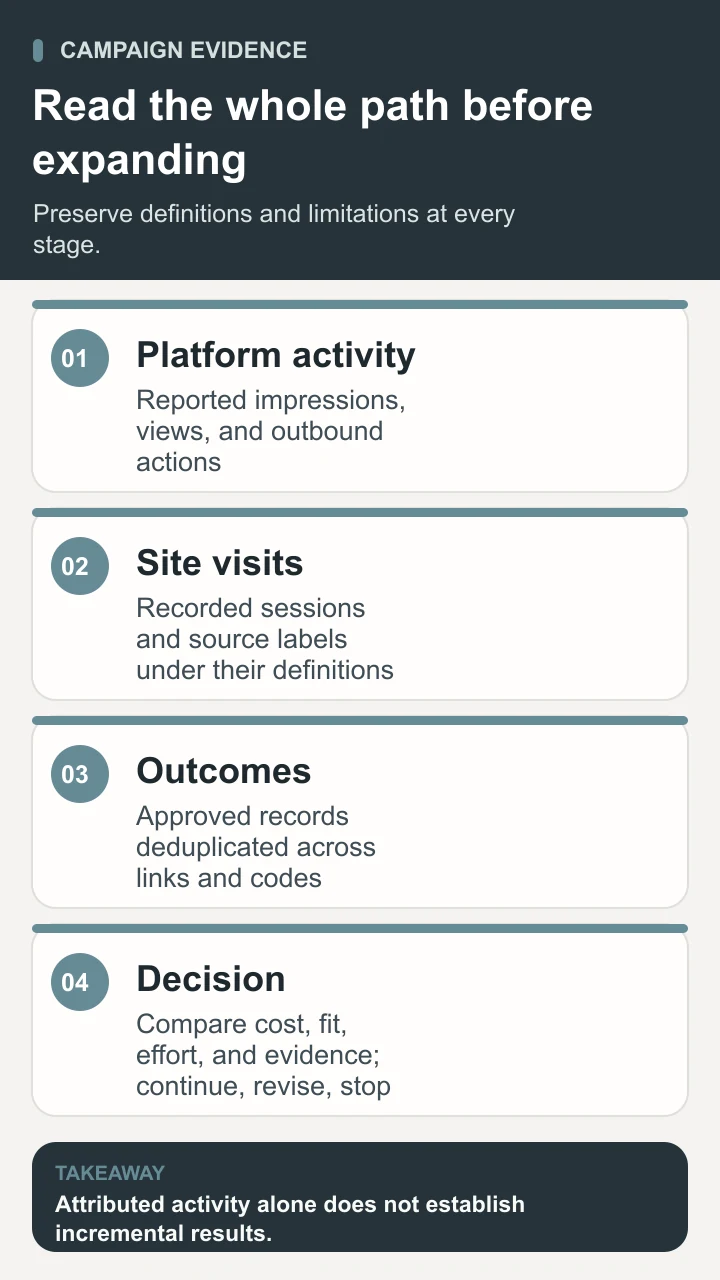
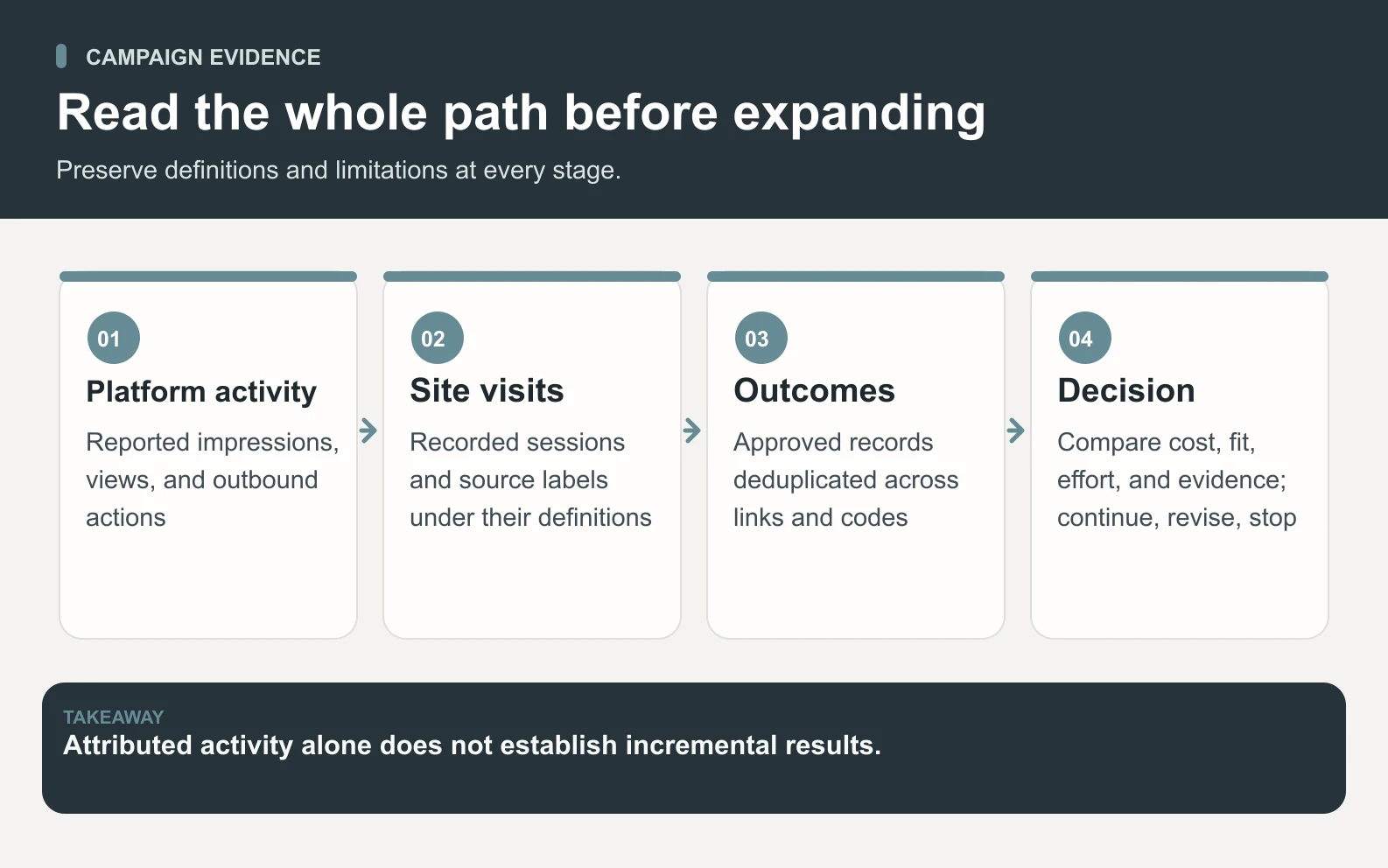
Use qualitative evidence to explain the counts. Collect relevant questions, corrections, objections, and examples of confusion without copying unnecessary personal information. A post may generate modest traffic while exposing a missing compatibility detail the business should fix. A high click count may lead to unsuitable visits. Inspect the actual questions and destination before deciding that a bigger creator is the answer.
End the review with one decision and the reason for it. Continue when the useful work, fit, and economics justify further effort. Revise a specific problem when the evidence identifies it. Stop or narrow the activity when the product, audience, or review capacity does not fit. Record who owns the next action and what evidence would change the decision. Keep the wider budget choices in the marketing plan.
Keep influencer marketing tied to evidence
Start influencer marketing with one audience task and a creator who can explain it credibly. Agree the work, preserve truthful experience, inspect disclosures and permissions, and review the real deliverable before publication. Use the worksheet to connect the brief with the reporting log. Expand only when the combined evidence, cost, and human review effort support the next collaboration.
Sources and review notes
Reviewed against the linked primary sources on the checked dates. Search features and citations are selected by their respective platforms; no placement is guaranteed.
Frequently asked questions
What is influencer marketing in simple terms?
Influencer marketing is a collaboration between a business and a creator who communicates with an audience. The creator may explain a product, demonstrate a process, or help people evaluate an offer. The parties need to define the useful work, compensation, evidence, disclosure, permissions, and review process. The arrangement can support a business objective, but participation or audience size does not establish a result.
How should a small business choose its first creator?
Begin with the audience problem and inspect relevant work samples, audience information the creator can appropriately share, and the quality of task-related discussion. Record sources and uncertainties. Choose a manageable pilot and agree what the creator will produce before committing. A follower count can provide context, but it cannot replace evidence that the content and audience fit the actual offer.
Is a gifted product the same as a guaranteed positive review?
A supplied product and a favorable opinion are separate matters. Define whether content is agreed, preserve the creator's truthful experience, and review the applicable disclosure requirements. If the creator finds that the product does not fit the proposed demonstration, resolve the scope rather than inventing an experience. The campaign owner should retain the relevant agreement and review the actual content before approving its use.
How do you measure an influencer campaign?
Keep platform activity, outbound actions, recorded site visits, and approved outcomes in separate fields with matched periods and definitions. Deduplicate orders that appear in both link and code reports. Compare relevant revenue with creator fees, samples, production, product costs, and human effort where available. Explain measurement gaps and avoid claiming that attributed activity proves additional sales caused by the campaign.
Can AI manage the campaign preparation?
AI can organize approved research, prepare a creator-fit note, draft the brief, and structure a review log. In Space Office, Magnesium and Nitrogen prepare scoped work and Hydrogen coordinates and reviews it. Humans and creators supply genuine experience and make the final decisions about facts, compensation, permissions, contact, publication, and reuse. Those responsibilities remain visible throughout the workflow.