Guide
Content Marketing: A Practical Strategy With Examples
Make content marketing useful to your audience and your business: answer a real question, distribute the answer, and learn from what readers do next.
By the Space Office team · Published · Updated · 15 min read
Content marketing is the planned creation and distribution of useful material that helps a defined audience solve problems and make decisions, while supporting a business goal. Start with a customer question, produce an answer you can substantiate, choose where people will encounter it, and measure the next meaningful action. In Space Office, Oxygen can help shape the strategy and Nitrogen can prepare the copy; Hydrogen coordinates and reviews their work. A human verifies the claims and approves publication.

Key takeaways
- Choose a reader problem connected to an offer your business can actually deliver.
- Give each asset a specific job, useful evidence, and an appropriate next step.
- Match the format to the task: a checklist helps execution; a comparison helps a choice.
- Plan distribution and maintenance before increasing publishing volume.
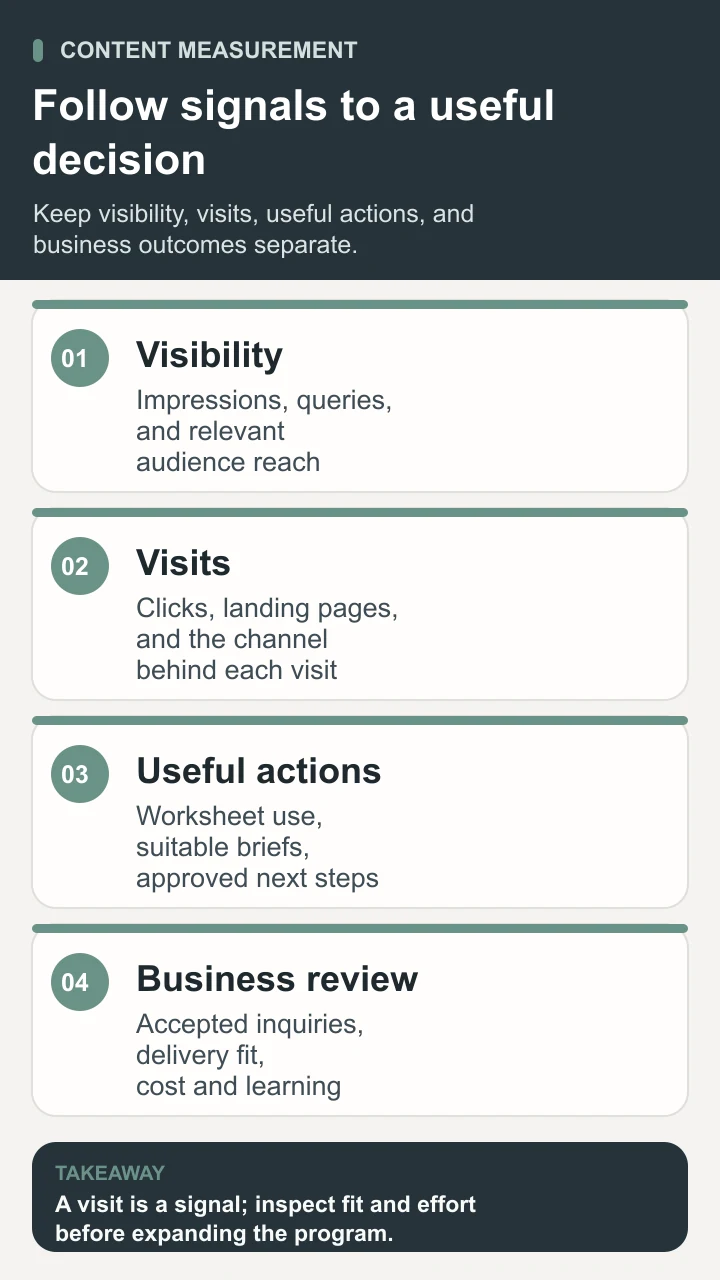
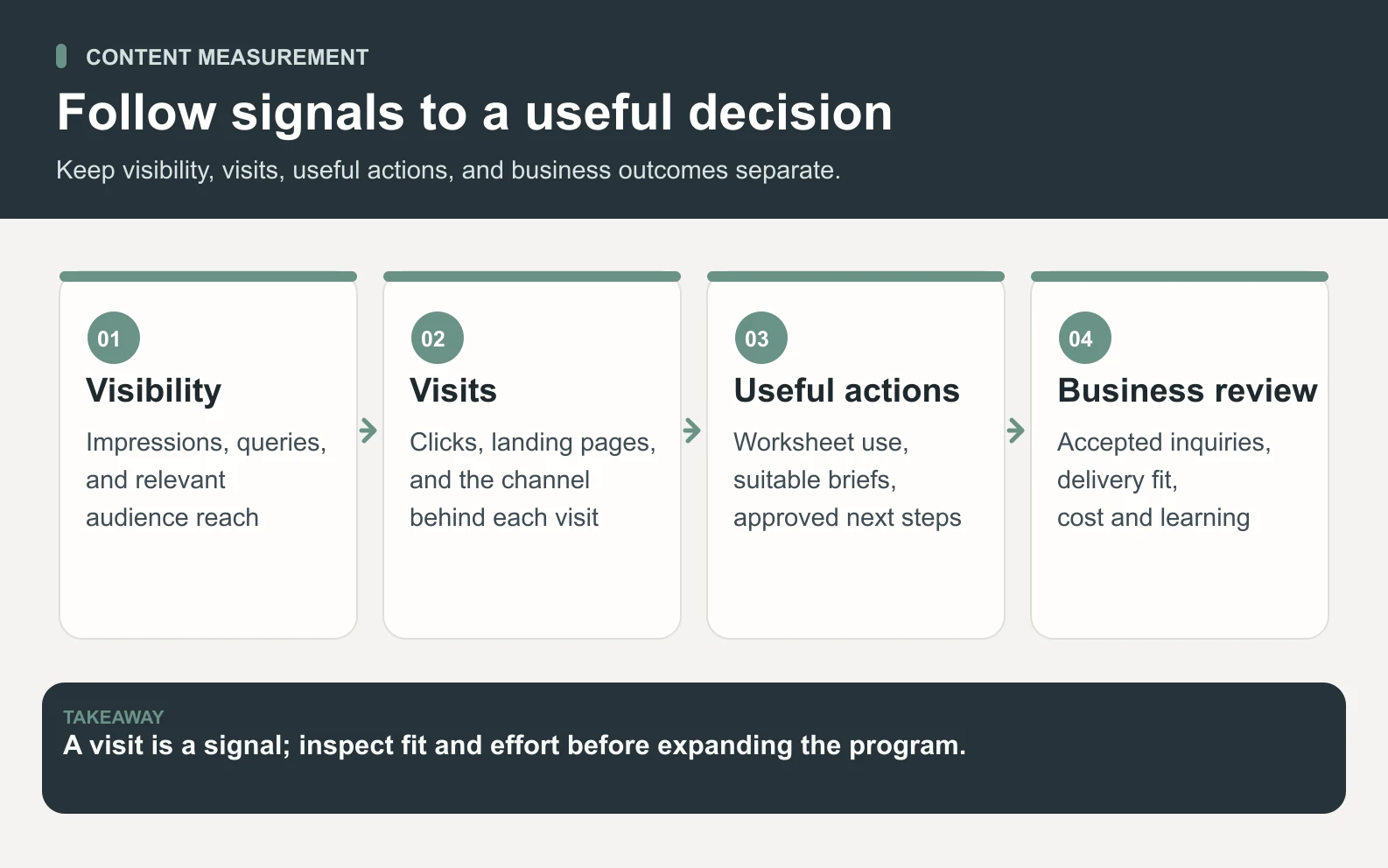
- Separate impressions, visits, useful actions, and business outcomes when measuring results.
For producing an individual asset, the content creation guide turns the reader task into an evidence packet, draft, useful visuals, and a checked release, with a free production worksheet.
For the wording on an individual offer page, the copywriting guide shows how to turn approved facts into a headline, useful explanation, and clear next action, with a before-and-after example and a free brief worksheet.
When a useful recommendation also has a commercial referral relationship, the affiliate marketing guide explains how to review program terms, preserve product evidence, disclose the relationship, and reconcile approved commission records.
Download the free content marketing worksheet to turn this guide into a small, reviewable program. It includes a question inventory, an asset brief, a distribution record, and a measurement log. The framework and fictional business example below are practical planning tools, not performance benchmarks.
What content marketing does for the reader and the business
The reader gets help with something that matters: understanding a problem, comparing approaches, preparing a purchase, or using something successfully. The business earns an opportunity to demonstrate its judgment and explain a relevant offer. These two purposes should reinforce each other. A guide can be useful to someone who never becomes a customer and still help suitable buyers recognize when the service fits.
The Content Marketing Institute's definition connects useful material, a defined audience, consistent distribution, and customer action. That makes the discipline broader than writing blog posts. A tutorial, newsletter, demonstration, comparison, or practical worksheet can serve the same purpose when it answers a genuine need and belongs to a coherent program.
Distinguish the content from the channel carrying it. A detailed tutorial is an asset; search, subscriber email, and a professional community are possible routes to that asset. SEO helps people discover and understand a relevant page. Advertising buys distribution. Neither replaces deciding what the reader needs to learn. Similarly, an attractive posting calendar schedules activity but does not explain why the activity deserves attention.
Keep the business goal specific. A service firm might want more complete project briefs, fewer unsuitable inquiries, or better-prepared consultation calls. A software business might help users complete a difficult setup. Choose one primary goal for the initial program. If every article must simultaneously create awareness, close a sale, train customers, and recruit employees, its purpose becomes difficult to evaluate.
Build the strategy around one audience and a useful question
Start with your target audience and the situation that makes a question urgent. Gather approved sales notes, support questions, project handoffs, and conversations. Write the question in the reader's language, preserve its source, and note what happened next. Three similar questions from the same customer are different evidence from three independent customers encountering the same obstacle.
- 1Define the reader and decision. Write who is trying to do what, when the problem occurs, and what they need to decide. Keep the scope narrow enough that a reader can recognize whether the answer applies to them.
- 2Check your right to answer. Identify relevant experience, approved examples, current product facts, and primary sources. If the answer requires expertise you do not have, involve a qualified reviewer or choose a task you can cover responsibly.
- 3Check the existing site. Assign the question to an existing page when that page already owns the topic. Create a new page when it has a distinct reader job. Record the relationship so that several near-identical articles do not compete for editorial attention.
- 4Choose the next useful action. This might be completing a checklist, examining a service scope, trying a demonstration, or submitting a suitable brief. The action should follow naturally from what the reader just learned.
- 5Set the limit and review date. Name the owner, available production time, reviewer, distribution route, and evidence needed to continue. A small program you can maintain is more useful than a large calendar awaiting approvals.

Use search research to understand wording and intent, then compare it with the audience evidence. Large estimated search demand does not prove that your business can help those searchers. Keep the wider budget, channel priorities, and commercial targets in your marketing plan; this document explains which answers the content program will create and maintain.
Choose content types by the job they help someone complete
Format should follow the difficulty of the task. Showing an interface may need a demonstration; comparing alternatives may need a table; gathering project inputs may need a template. Begin with one format your team can produce accurately. A format becomes expensive when it requires expertise, production, review, or maintenance that nobody has accounted for.
Scroll horizontally to view all columns.
| Reader task | Useful format | Acceptance check |
|---|---|---|
| Understand a problem | Explainer or illustrated guide | Defines the issue, gives an example, and states its limits. |
| Choose an approach | Comparison or decision checklist | Uses relevant criteria and explains when each option fits. |
| Complete a process | Tutorial, demonstration, or worksheet | Includes inputs, steps, expected output, and failure checks. |
| Evaluate a supplier | Verified case study or annotated sample | Distinguishes real evidence from illustrative material. |
| Keep improving | Subscriber newsletter or update | Adds a useful lesson or change worth returning for. |
An original artifact can make a familiar subject worthwhile. Show an annotated brief, an example with corrections, a worked calculation, or a checklist that someone can use immediately. Explain why each element matters. A list of tips without a usable example often leaves readers doing the difficult translation themselves. Test the asset by asking a colleague to complete its task without additional instructions.
For a template, include both a blank copy and a small completed example. Mark required inputs, explain unfamiliar fields, and describe what a finished version should enable. Watch the tester use it: where do they hesitate, supply the wrong information, or need a separate explanation? Revise those points before designing more promotional material. The download earns its place by reducing work for the reader.
Repurpose the lesson rather than mechanically copying the same paragraph everywhere. A guide can supply one newsletter example, a short visual explanation, and a sales-call reference. Each version should stand on its own at the length the channel allows. Check that a shortened version preserves qualifications; a cautious finding must not become a sweeping promise in a headline or graphic.
Worked example: a presentation studio builds a small program
Imagine a fictional two-person presentation studio serving agencies with an upcoming client pitch. It designs slides from approved customer material. It does not invent commercial claims or write financial forecasts. The owner sees that incomplete handoffs cause repeated clarification. Every business detail here is illustrative; this is not a Space Office customer story or a report of measured results.
The program's reader is an agency account lead preparing a deck for design. Its primary question is: What should we send a presentation designer before work starts? The business goal is better-qualified, more complete briefs. The initial answer will explain required content, editable files, brand assets, deadlines, review ownership, and permissions to use client material.
Scroll horizontally to view all columns.
| Asset | Reader value | Appropriate next step |
|---|---|---|
| Pitch-deck handoff guide | Explains which materials prevent avoidable clarification. | Use the downloadable brief before requesting a quote. |
| Completed fictional brief | Shows the difference between a vague request and usable input. | Compare your current brief with the annotated example. |
| Scope and readiness checklist | Clarifies whether the studio's service fits the work. | Submit a brief only when the scope and timing fit. |
The example brief contains a concrete correction. Replace make our slides professional with: reorganize the supplied 18-slide deck using the approved brand kit, preserve the approved claims, and flag unclear content for the account lead. Add the presentation date, a named reviewer, and which files may be shared. This teaches a transferable handoff skill while demonstrating the studio's delivery boundaries.
For the first month, the owner schedules one main guide, one completed sample, and two short email lessons for existing subscribers. These are planning choices, not a recommended universal cadence. The designer checks whether the example can actually be delivered. The owner tests the worksheet and contact form. If review capacity is tight, the sample waits; quality checks remain part of the work.
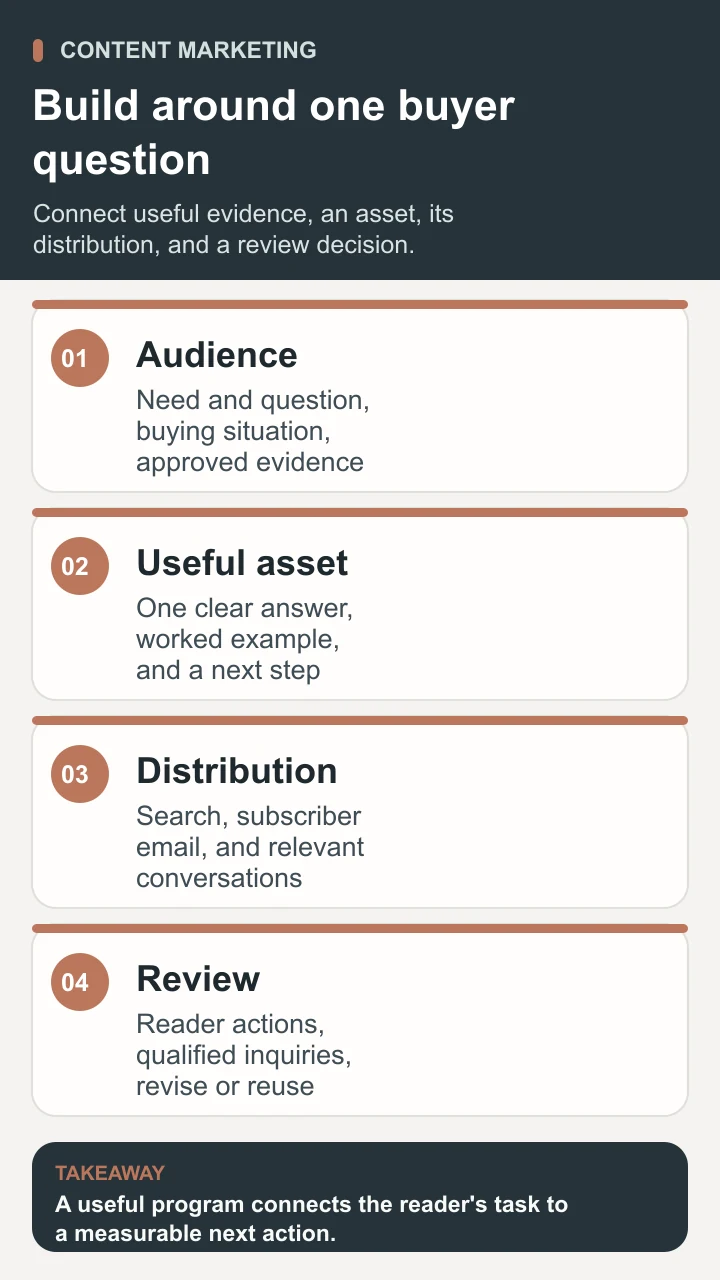
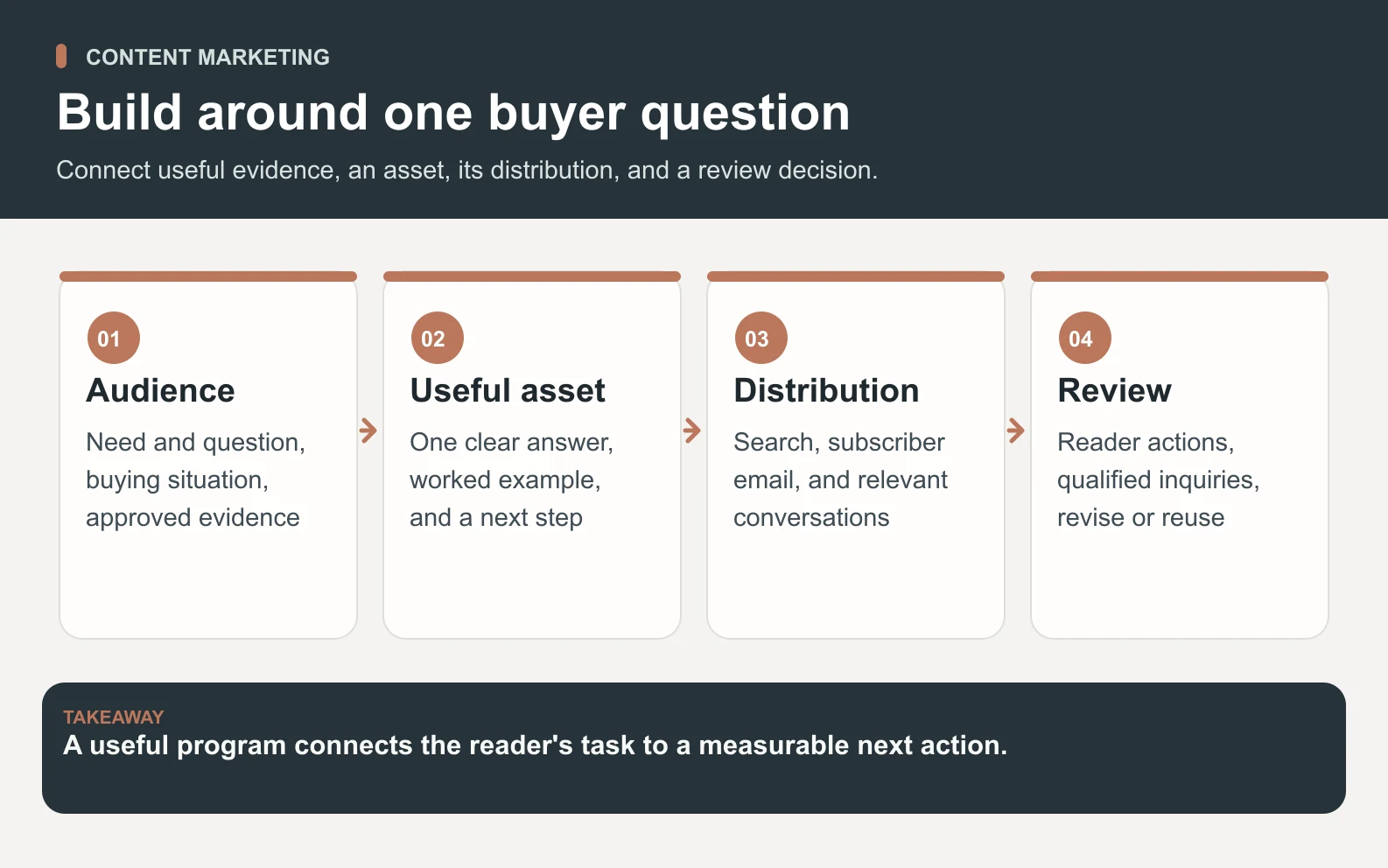
This program can fail even if the writing is clear. The audience may rarely commission design, the studio may be unable to meet typical deadlines, or readers may need writing rather than slide formatting. Record these objections. More publishing does not resolve a mismatch between what the audience needs and what the business offers.
Produce a sourced draft and a reviewable Space Office handoff
A useful production brief includes the reader question, intended answer, approved evidence, original contribution, exclusions, next step, and reviewer. Add the exact deliverables: for example, one guide, one worksheet, and two email drafts. State which customer details must be removed and which sources can be used. Missing permissions or unavailable records remain gaps to resolve.
Keep a compact editorial board with one row per asset: question, owner, evidence ready, draft ready, reviewer, distribution date, and maintenance date. An item awaiting a source is research in progress; an item awaiting approval is a draft. This makes the real bottleneck visible. When reviews accumulate, finish the current work or reduce scope before adding more assignments to the calendar.
Google's people-first content guidance asks whether a page serves an intended audience, provides original value, and leaves people able to accomplish their goal. It also encourages clear authorship. Apply those questions during review: inspect the evidence, test the instructions, and make the contributor or team visible. A cited source does not substitute for checking the claim yourself.
- 1Oxygen, the Strategy & GTM Specialist, uses the approved audience evidence and business goal to propose the program. Request the question priorities, asset purpose, distribution choices, and measurement assumptions as a reviewable brief.
- 2Nitrogen, the Content & Copy Specialist, prepares the guide, worksheet language, and channel drafts from that brief. Ask for source links beside factual claims, consistent scope, and explicit flags wherever evidence or approval is missing.
- 3Hydrogen coordinates the handoff and reviews the specialist output against the brief. The review checks whether the pieces agree, whether the next step is appropriate, and whether unsupported promises have entered the copy.
- 4The human owner verifies the evidence and example, tests the download and links, and approves the final version. Publication, account access, sending email, and customer commitments need their own authorized setup and decision.

If search discovery needs specialist attention, Neon, the SEO & Discovery Specialist, can help with keyword research, internal links, and metadata using approved access and sources. Adding a role does not automatically connect an account or authorize publication. Check the live roles and workflow overview when scoping the work. For a deeper delegation process, use the AI content workflow guide.
Distribute the answer where relevant people already look
Before publication, name a primary discovery route and a realistic supporting route. For the studio, search can serve people actively looking for a handoff checklist, while subscriber email can help existing contacts prepare upcoming work. Sales colleagues can also share the guide when it directly answers an inquiry. Keep the destination stable so improvements benefit future readers and existing links.
Google's SEO Starter Guide explains that links help Google discover pages and that descriptive URLs and well-organized, useful content support understanding. Give the article a clear title, link to it from genuinely related pages, and check that its main content is accessible. These practices support discovery; they do not establish a ranking position or guarantee a search appearance.
Write the distribution message around a specific problem. Instead of announcing a new blog post, describe the missing input the checklist helps someone catch. Share in communities only when the resource answers the conversation and fits the community's rules. A useful response may need no link. For ongoing channel planning, the separate social media marketing guide covers that broader program.
For external campaign links you control, use a consistent naming record. Google Analytics documents UTM parameters for identifying referred campaign traffic. A subscriber email might use source=studio-newsletter, medium=email, and campaign=deck-handoff, entered as the corresponding utm_source, utm_medium, and utm_campaign parameters. Test the destination and measurement setup before relying on the report; keep confidential information out of link parameters.
Measure useful actions and decide what to improve
Build the review around a decision: improve the answer, change distribution, clarify the offer, or continue the program. Record the page version, channel, period, relevant audience, and collection limits. Establish a baseline when one exists. A new page has no comparable history, so its first period establishes observations rather than proving an increase caused by the content.
Scroll horizontally to view all columns.
| Layer | Useful evidence | Question for the next review |
|---|---|---|
| Visibility | Search impressions, relevant queries, or channel reach | Did the intended audience have a chance to encounter the answer? |
| Visits | Clicks and landing-page visits by source | Does the promise attract people with the question we answer? |
| Useful actions | Worksheet use, relevant replies, or completed briefs | Can readers take the intended next step? |
| Business fit | Accepted inquiries, scope fit, and review cost | Does the program help people the business can serve? |
Consider an entirely fictional measurement exercise. A page records 2,000 search impressions and 60 search clicks in a period: its click-through rate is 60 divided by 2,000, or 3%. The same program records eight submitted briefs, of which five fit the service. The fit rate among those briefs is 5 divided by 8, or 62.5%. Neither percentage is a benchmark or evidence of revenue.
Do not divide the eight briefs by the 60 search clicks unless measurement establishes that those submissions came from that same visitor group and period. Some people may arrive through email, return later, or submit more than once. Record unattributed inquiries separately. A customer's explanation of which resource helped can add context, while remaining self-reported evidence rather than a complete attribution model.
Diagnose the smallest plausible problem first. Relevant impressions with few visits may justify reviewing the title and the searcher's intent. Visits with no worksheet use may indicate a confusing download or an answer that already completed the task. Many unsuitable briefs may mean the scope is unclear. Inspect actual pages, forms, and inquiry details before deciding that more traffic is the remedy.
Include maintenance in the decision. Assign an owner to check source changes, broken downloads, outdated examples, and recurring reader questions. Record substantive edits and compare later periods with seasonal and channel differences in mind. Keep a useful page, improve an incomplete one, and consolidate genuinely overlapping answers when appropriate. A larger content inventory creates value only when people can still find and use it.
Make content marketing a repeatable learning process
Start your content marketing program with one audience, one important question, and one answer worth using. Complete the worksheet, approve the supporting evidence, and give the asset a distribution route and an owner. At review, ask whether it helped suitable readers take a meaningful next step and what needs to change. Expand from that evidence, while continuing to maintain the answers people already rely on.
Sources and review notes
Reviewed against the linked primary sources on the checked dates. Search features and citations are selected by their respective platforms; no placement is guaranteed.
Frequently asked questions
What is content marketing in simple terms?
Content marketing is a planned way to help a specific audience through useful articles, videos, examples, tools, or other material while supporting a business goal. It includes deciding what to create, distributing it, maintaining it, and evaluating what readers do next. The material should answer a real need and make any commercial next step relevant and clear.
What is the difference between content marketing and SEO?
Content marketing decides how useful material serves an audience and a business objective across channels. SEO concerns discovery and understanding through search. They overlap when an article answers a relevant search question, but a subscriber lesson or customer workshop can serve a content program without depending on search traffic. Plan the reader's task before choosing the discovery route.
How often should a small business publish?
Choose a cadence that covers research, production, factual review, distribution, and maintenance within the team's actual capacity. Begin with one important question and an asset you can finish well. Add another when the first has a working distribution route and a useful review process. There is no single publishing frequency that establishes quality, demand, or a ranking outcome.
Can AI create the content for this program?
AI can help organize approved evidence, prepare outlines, draft copy, and adapt a verified lesson to different formats. It cannot supply missing customer evidence by inventing experience or results. In the Space Office workflow, Oxygen and Nitrogen prepare scoped work, Hydrogen coordinates and reviews it, and a human checks factual accuracy, usefulness, permissions, and the publication decision.