Guide
Market Research: Methods, Steps, and a Worked Example
Use market research to reduce a specific uncertainty: choose the methods, record the evidence, explain its limits, and decide what deserves a small test.
By the Space Office team · Published · Updated · 14 min read
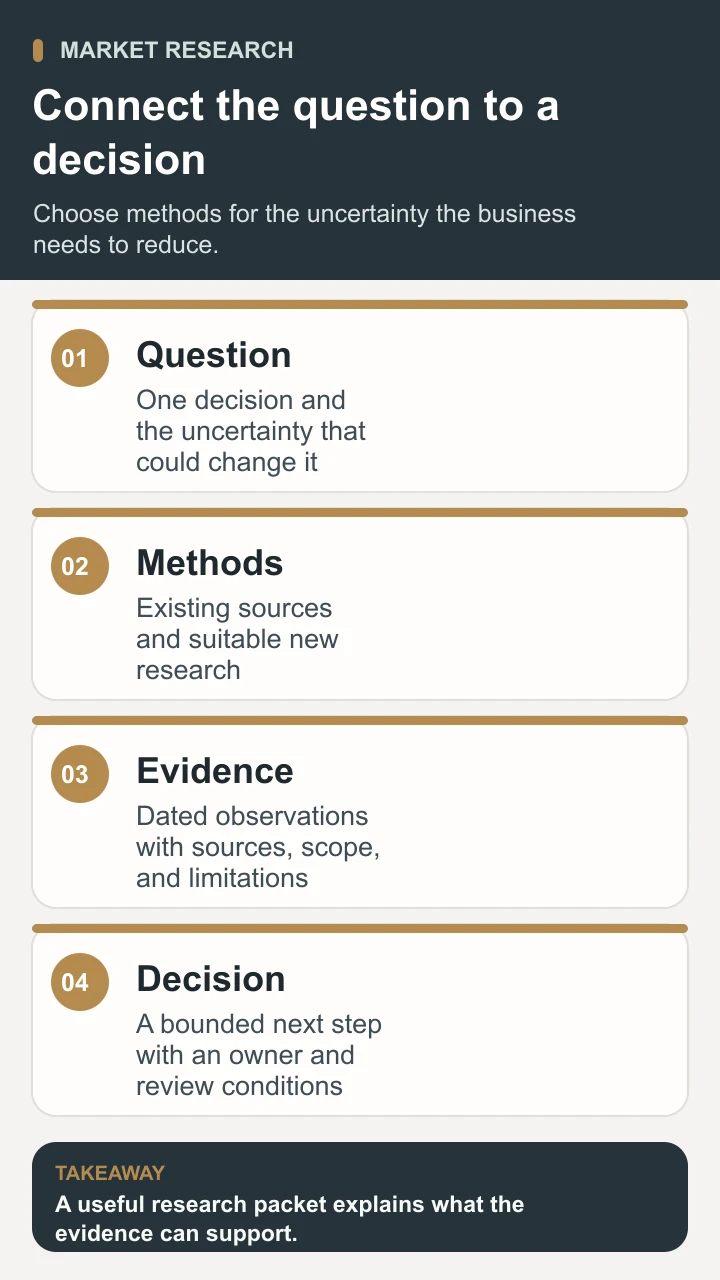
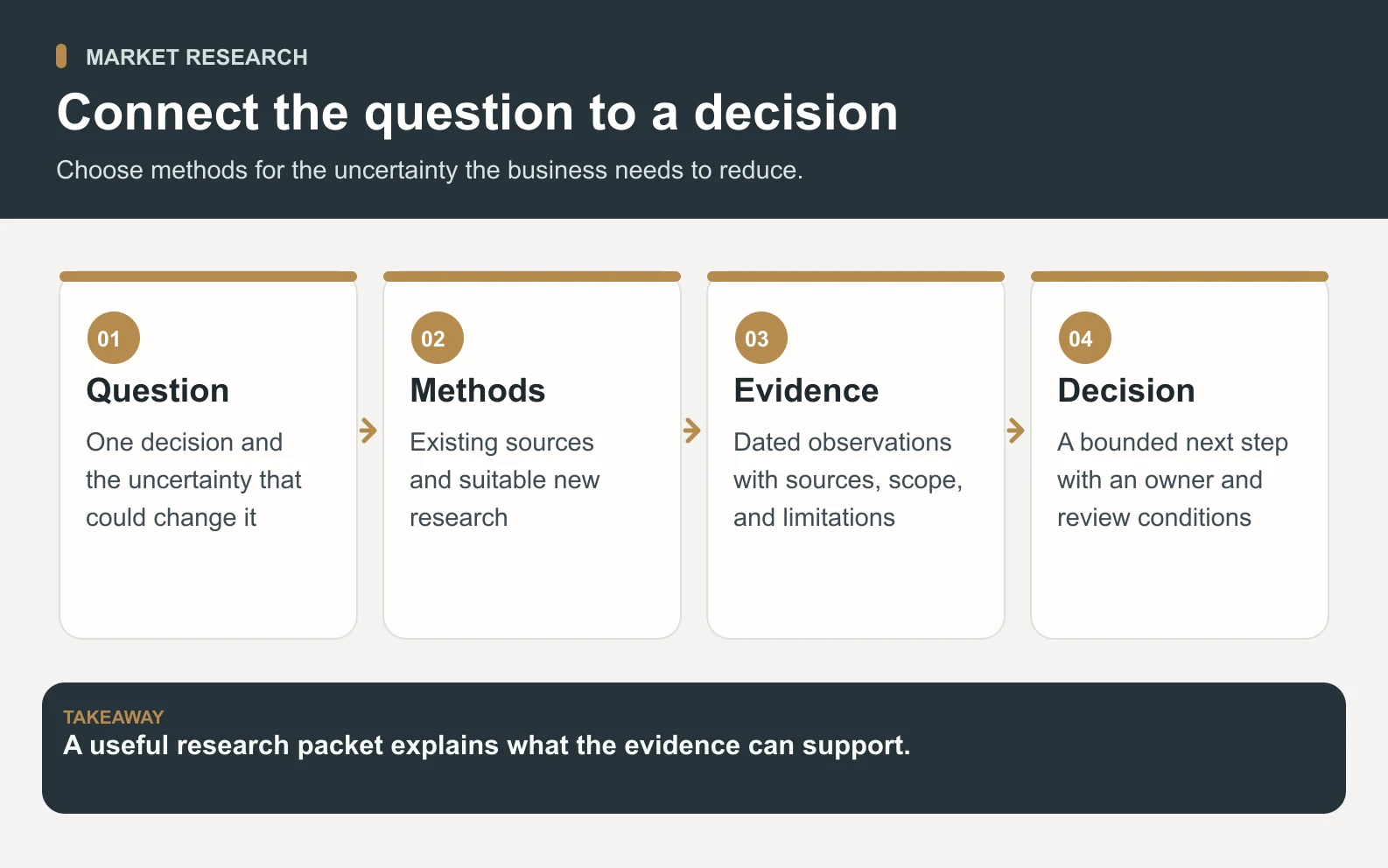
Market research is the systematic gathering and interpretation of information about a market, customers, and alternatives to support a business decision. Define the question, choose suitable existing sources and direct research methods, collect evidence, examine its limits, and decide what to test or change. In Space Office, Sodium can prepare research and synthesis, Oxygen interpret the business implications, and Hydrogen coordinate and review. A human authorizes access and recruitment, verifies decisive evidence, and approves the next action.

Key takeaways
- Start with a decision and the uncertainty that could change it.
- Choose methods according to the question; interviews, surveys, and existing records answer different needs.
- Keep source dates, scope, recruitment, question wording, and missing evidence visible.
- Separate an observation from its interpretation and from the action it might justify.
- Use a small research exercise to inform a bounded decision, without claiming population demand from a convenient sample.
Download the free market research worksheet for a decision brief, method plan, evidence log, interview prompts, and review record. The coworking example is fictional. Use the target audience guide when the unresolved decision is which audience to serve; this guide focuses on how to investigate a defined business question.
Start market research with a decision
Write the decision before collecting information. A neighborhood coworking operator might ask whether an evening meeting-room package for local training organizers deserves a limited trial. That is more useful than a broad request to research the coworking industry. The audience is already defined; the unresolved questions concern the need, practical conditions, and willingness to make an actual booking.
List the information that could change the decision. The operator may need to understand recent venue-search problems, typical timing requirements, available alternatives, and constraints on staffing the room. Separate these from facts the business itself must verify, such as opening hours, capacity, access, and the price it is prepared to offer. Research participants cannot establish the operator’s own delivery capability.
The SBA’s market-research guidance asks businesses to examine demand, location, market size, saturation, pricing, and other relevant conditions. Select the parts that matter to the current decision. An industry’s national revenue may provide context while saying very little about whether a particular room should open on Tuesday evenings.
End the brief with the decision owner, time boundary, permitted sources, recruitment boundaries, and expected output. Define what evidence could support a test, what would rule it out, and what would remain unknown. These conditions can evolve as you learn, but record the changes so an attractive finding does not quietly rewrite the question.
Choose methods for the uncertainty you need to reduce
Primary research collects new information for the current question, such as interviews or a purpose-built survey. Secondary research uses existing material. That can include published studies and approved historical business records gathered for another purpose. Do not confuse these categories with qualitative and quantitative evidence: a new survey can produce numbers, while an existing interview transcript can contain qualitative detail.
When research needs to lead into a testable solution, the design thinking guide connects the evidence to a problem frame, alternative concepts, and a small prototype test.
Qualtrics’ methods overview describes research as gathering and interpreting information about customers, markets, and competitors, with methods chosen for different questions. Choose from the uncertainty rather than from a favorite tool. A survey is not automatically more rigorous than an interview; its usefulness depends on who answers and what the questions establish.
Scroll horizontally to view all columns.
| Method | Useful question | Important limit |
|---|---|---|
| Existing records | What requests or behavior has this business already recorded? | Customers and recorded contacts may exclude much of the market |
| Secondary source review | What context and alternatives are already documented? | Different dates, geography, definitions, or incentives may limit relevance |
| Interviews | How did someone make a recent decision, and what constrained it? | Recall and recruitment shape the account; a few interviews do not estimate prevalence |
| Survey | How do the selected respondents answer consistent questions? | Question wording, coverage, nonresponse, and sampling affect interpretation |
| Offer or booking test | Will suitable people take a specified real action? | The tested offer and conditions limit what can be concluded |
Combine methods when they address different parts of the same question. The coworking operator could review existing enquiries, inspect current venue information, interview organizers about recent bookings, and then consider a limited offer test. Each step should add something the previous source could not establish. More documents repeating the same unsupported claim do not create independent confirmation.
Choose a manageable depth. A low-cost, reversible offer test may need a different research investment from a large lease commitment. This guide’s worksheet supports a small operating decision. It does not provide a statistical study design for every market-size estimate or high-stakes investment.
Collect sources and recruit beyond convenient voices
For each source, record its author or organization, publication or collection date, geography, audience, definitions, and the specific claim it supports. Keep the source URL or approved file reference. If a report concerns a national category, do not silently relabel its figures as local demand. A current page also does not prove that every underlying data point was collected recently.
Keep a short evidence register instead of pasting entire reports into the brief. Give each useful record an ID, a narrow observation, and a limitation. Note when two reports repeat the same original dataset. For published venue offers, capture the actual conditions and checked date; a promotional headline alone may omit hours, minimum bookings, or what the room includes.
Recruit from the people relevant to the decision, and document how you found them. A small interview set might include past customers and organizers who have never used the space. Interviewing only enthusiastic regulars can leave the barriers experienced by noncustomers unexplored. It still does not make a small, purposively recruited set representative of all local organizers.
State the invitation and participation conditions clearly, use permitted contact routes, and agree how notes or recordings may be used. Collect only information needed for the question. These practical boundaries belong in the research plan before invitations go out. When you cannot reach a relevant group, record the gap rather than filling it with an AI-generated respondent.
Keep competitor comparison bounded. If alternatives emerge during interviews, investigate the facts that affect the current decision. Use the competitive analysis template for a consistent buyer-alternative matrix. The broader research packet should also examine customer behavior, the operator’s own records, and unresolved assumptions.
Ask clear questions about real decisions
Draft the questions around something the participant can recall and explain. The coworking operator needs to understand a recent venue decision, including the timing, alternatives, approval process, and difficulties. An enthusiastic reaction to an attractive hypothetical room is weaker evidence about what someone will actually book.
Pew Research Center’s question-writing guidance explains that wording and order can affect answers, and recommends clear, specific questions. Pretest the draft with an appropriate person to see what they think each question means. Check whether the wording asks about one idea and whether the response options allow a truthful answer.
- 1Ask the organizer to walk through the most recent time they needed a meeting or training venue.
- 2Clarify what prompted the search, the required date and duration, and which constraints were known at the start.
- 3Ask which alternatives they considered and what led to the final decision, including who approved it.
- 4Explore any difficulty with timing, access, room setup, or the booking process without suggesting the answer.
- 5Ask what happened afterward and which details remain uncertain; separate an observed action from an opinion about a future offer.
For a survey, specify a relevant reference period and offer response choices that fit the question. Include an appropriate way to say not applicable or uncertain when needed. Avoid combining issues such as price and accessibility into one satisfaction question if separate answers would change the business decision. Preserve the exact question wording with the results.
Take notes that distinguish the participant’s account from the researcher’s interpretation. Mark a direct quote only when it is a faithful, permitted record; otherwise use a labeled summary. AI can help prepare or organize notes, but it cannot supply missing conversations as evidence. A polished invented quote makes the research packet less reliable.

Separate evidence, interpretation, and uncertainty
An evidence statement describes what a source records. An interpretation explains what that observation may mean. A proposed action says what the business could do next. Keep all three visible so a reviewer can disagree with the interpretation without losing the underlying observation.
Scroll horizontally to view all columns.
| Field | What to record |
|---|---|
| Observation | The narrow fact or participant account, with source ID and date |
| Interpretation | The possible explanation relevant to the decision |
| Other explanation | A plausible alternative or conflicting record |
| Limit | Who or what the evidence does not cover |
| Next check | The fact or behavior that would help resolve the uncertainty |
Compare findings across methods without forcing agreement. A request log may show weekday-evening enquiries while some interviewees describe weekend needs. Those findings could concern different situations, or the recruitment could have favored a particular group. Keep the disagreement in the decision memo and explain what another source could help clarify.
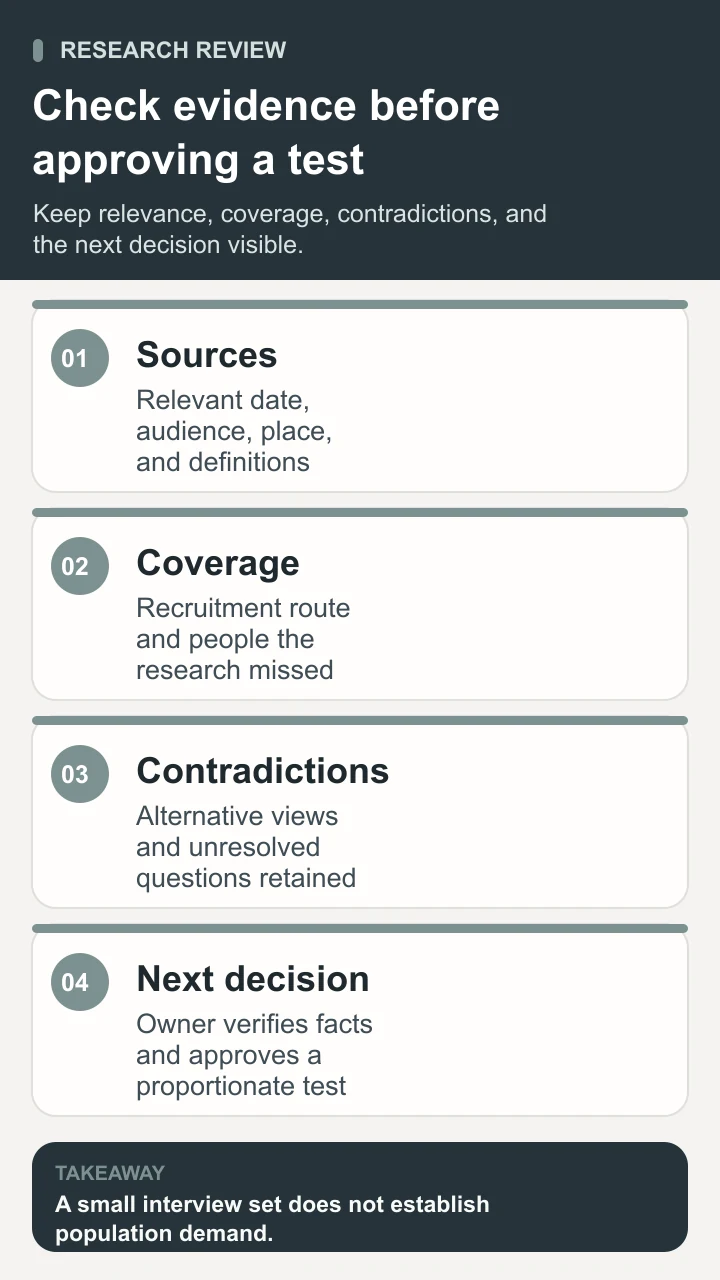
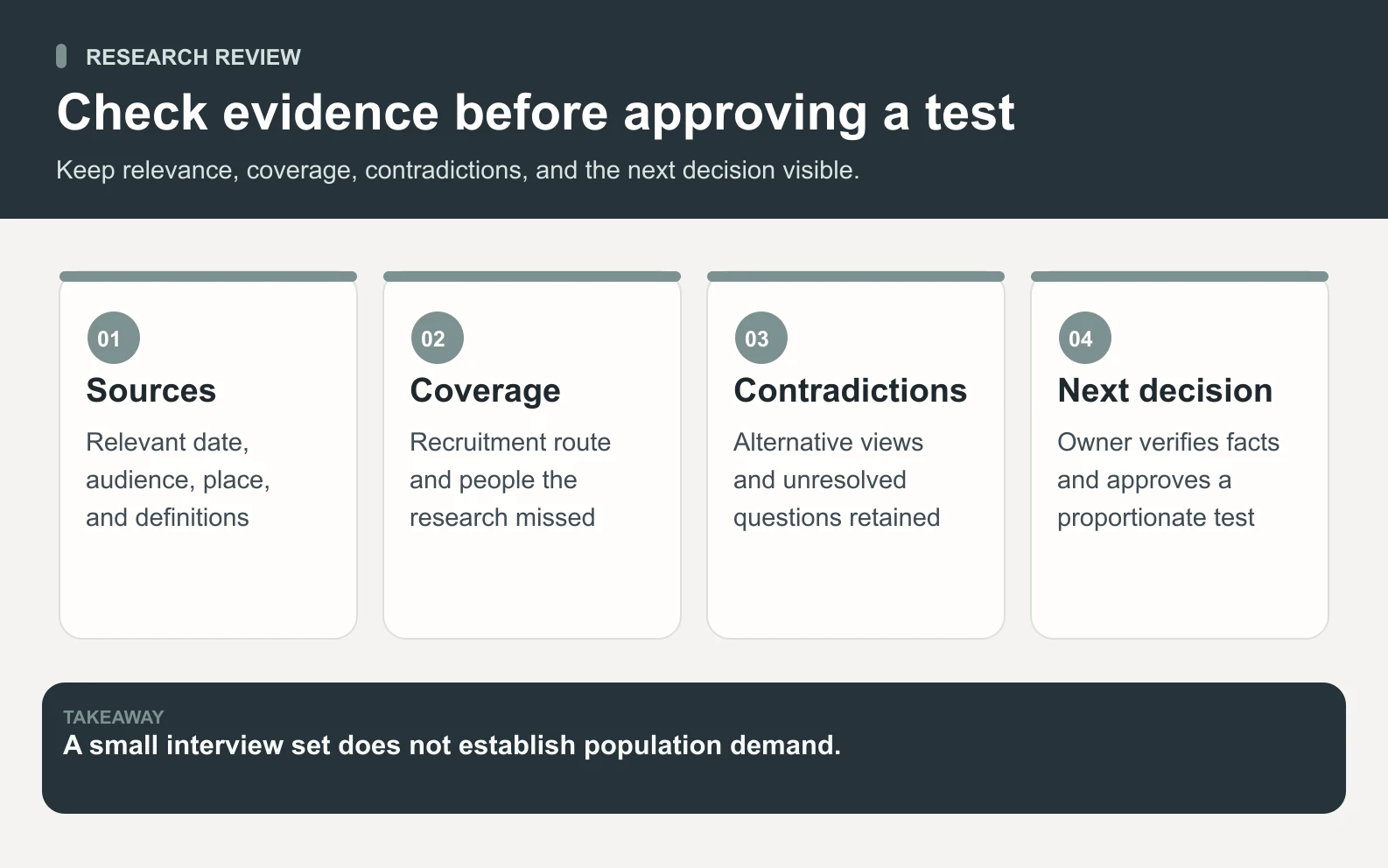
Report counts with their unit and denominator. Four of six interview participants is a description of that set. It should not become a claim about the percentage of the local market that wants the offer. Do not attach a conventional margin of sampling error to a convenience interview set. If a population estimate is required, use an appropriate research design and expertise.
Keep a visible unknowns list. Missing prices, unverified venue access, outdated market figures, and people you could not recruit can materially affect the decision. Confidence should reflect the quality and relevance of the evidence, not the visual polish of a slide or the number of times a summary repeats its conclusion.
Worked example: test an evening meeting-room offer
This fictional example illustrates a research process. It is not customer research conducted by Space Office, a market-size estimate, or a measured demand result. A neighborhood coworking operator is considering a Tuesday-and-Thursday evening meeting-room package for local training organizers. The room and audience already exist; the decision is whether a small evening offer deserves a real test.
The operator reviews twenty deduplicated enquiry organizations from the preceding six months. Ten records requested weekday evenings, six requested daytime, and four did not specify timing. This is a record of contacts the space received. It excludes people who never contacted it and may reflect how the current website describes the space.
The operator also plans six purposively recruited interviews, one organizer per organization: three past customers and three noncustomers. In this invented completed record, four describe weekday-evening timing as the main unresolved need in their most recent venue search, while two describe a weekend need. Three of the six say they would consider the proposed offer. That statement of interest is recorded separately from an actual booking.
Scroll horizontally to view all columns.
| Source | Observation in the example | Limit or next check |
|---|---|---|
| 20 existing enquiry organizations | 10 weekday-evening requests + 6 daytime + 4 unspecified = 20 | Self-selected historical contacts; clarify the unspecified records if relevant |
| 6 organizer interviews | 4 recent weekday-evening needs + 2 weekend needs = 6 | Purposive small set; not a measure of local prevalence |
| Stated interest question | 3 of the 6 would consider the offer | No purchase has occurred; the actual price and conditions still matter |
| Operator’s delivery check | Evening staffing, access, calendar, and costs need confirmation | The operator must verify these before approving a real offer |
The past-customer interviewees may also appear in the historical log. Do not add twenty and six and report twenty-six independent respondents. The records answer different questions. The apparent evening pattern gives the operator a reason to investigate, but it does not establish how many local organizers will buy or what price they will accept.
The proposed next step is a three-week Tuesday-and-Thursday pilot: six available evenings with at most one booking each evening. Before approval, the owner verifies the actual room conditions, staffing, availability, costs, and offered price. As a fictional local decision rule, the operator wants at least three distinct organizations to complete a paid booking during the pilot, then reviews the economics and operating problems before repeating it.
That threshold is a teaching assumption chosen for this example, not a universal validation rule or proof of profitability. Reservations, expressions of interest, paid completed bookings, repeat organizations, and cancelled bookings should remain separate records. A result below the threshold could lead to a revised offer, more investigation, or no further test; it need not be explained away.

Prepare a research packet with Space Office
Give Hydrogen a brief containing the decision, the approved offer and audience, the relevant period and location, existing evidence, permitted sources, recruitment permissions, and practical constraints. Identify who can answer delivery questions and who approves the next action. Choosing an agent does not automatically connect private records or authorize contact with participants.
- 1Sodium prepares the research plan, source register, question draft, and synthesis from permitted evidence, keeping observations and uncertainty traceable.
- 2Oxygen examines what the findings mean for the proposed offer and prepares bounded options, decision criteria, and unresolved business questions.
- 3Hydrogen coordinates and reviews the returned work, checking that the conclusions are supported and the packet answers the original brief.
- 4The human owner verifies decisive records, authorizes recruitment and access, resolves delivery facts, and approves any pilot, spending, or publication.
Ask for one usable packet: the decision brief, methods and recruitment note, dated evidence register, synthesis with conflicting findings, and a short next-step memo. Verify that any interview findings come from actual supplied records or authorized research. If no participants have been interviewed, the output should be an interview plan rather than a findings report.
Use the live specialist roster and Hydrogen workflow to check the roles, and current pricing when planning the setup. This example uses Sodium and Oxygen for research and business interpretation. Human knowledge of the real operation remains essential to the final decision.
Use market research to choose a bounded next step
Write the final memo around the question: what did the evidence establish, which interpretation is most useful, what could still change it, and what decision follows? Include the sources and assumptions needed to challenge the recommendation. A concise explanation of a major uncertainty is more useful than a large appendix that hides it.
Define what the next test will observe and when the business will review it. For the room example, the next evidence concerns completed paid bookings under a specific price, availability, and operating process. It should also record cancellations, staff effort, and practical problems. The research packet does not turn an unlaunched offer into a proven source of revenue.
When the decision is how to turn an approved offer into first paying customers, continue with the customer acquisition guide. Keep research findings and acquisition results linked but distinct: an account of past problems can inform an offer, while a completed purchase is a different kind of evidence.
Good market research reduces a defined uncertainty without pretending to remove every risk. Start with a decision, use methods that can answer its questions, preserve the limits and contradictions, and choose a next action proportionate to what the evidence can support.
Sources and review notes
Reviewed against the linked primary sources on the checked dates. Search features and citations are selected by their respective platforms; no placement is guaranteed.
Frequently asked questions
What is market research?
Market research is the systematic gathering and interpretation of information about customers, markets, and alternatives to support a business decision. It can combine existing sources and new research, with methods selected for the question and conclusions limited by the evidence.
What is the difference between primary and secondary research?
Primary research collects new information for the current question, such as interviews or a dedicated survey. Secondary research uses existing material, including published sources and approved records collected for another purpose. Either can contain qualitative detail or quantitative data.
How can a small business start market research?
Write one decision and the uncertainties that could change it. Review relevant existing evidence, choose an appropriate method for what remains unknown, document sources and recruitment, then prepare a short decision memo. Keep missing information visible and choose a bounded next action.
How many interviews prove that a market exists?
There is no universal interview count that proves market demand. Interviews can reveal situations, language, constraints, and possible explanations. A small purposive set does not estimate population prevalence. Use an appropriate study design for a population estimate and actual behavior to examine a specific offer.
How can Space Office help with market research?
Sodium can prepare research and synthesis, Oxygen interpret the business implications, and Hydrogen coordinate and review. Supply a defined decision, approved facts, and permitted evidence or access. A human verifies decisive claims, authorizes recruitment, and approves the next test or action.