Guide
Customer Acquisition: Strategy, Costs, and a Worked Plan
Build a customer acquisition plan that connects a suitable audience, a credible offer, and a verified first purchase with costs you can explain.
By the Space Office team · Published · Updated · 15 min read
Customer acquisition is the process of attracting suitable prospects and converting them into new customers. Define what counts as a first purchase, choose an audience and credible offer, plan the channels and follow-through, then compare verified new customers with the costs of acquiring them. Space Office’s Oxygen can prepare the strategy, Silicon the paid-channel and measurement work, and Hydrogen the coordination and review. A human verifies business facts and approves budgets, launch, and sales commitments.

Key takeaways
- Count a verified first purchase separately from a visit, enquiry, or repeat order.
- Choose channels around the buyer’s task, the offer, and the team’s ability to follow through.
- Match the acquisition cost period, included expenses, and new-customer definition.
- Keep revenue, delivery contribution, acquisition cost, and profit distinct.
- Use a bounded pilot to make the next decision; a small result does not prove a scalable or incremental effect.
Evaluate the value of acquired customers with the customer lifetime value guide. It separates observed revenue from lifetime assumptions, checks equal-age cohorts, and compares margin and acquisition costs without treating a forecast as spending approval.
Download the free customer acquisition worksheet to define the first-customer event, plan a pilot, and check its arithmetic. The office coffee-maintenance example is fictional. For the earlier task of attracting and assessing enquiries, use the lead generation guide.
Define what customer acquisition means for your offer
Start with the event your business can verify. A newsletter subscriber, an enquiry, a sales conversation, and a first paid order are different events. For an office maintenance service, the chosen event might be a new organization completing and paying for its first service visit. For a subscription, the business may define a first paid subscription, with explicit treatment of trials, cancellations, and refunds.
Amazon Ads’ acquisition guide describes acquisition in terms of bringing in new customers, typically through a first purchase or subscription. Record your own operational definition before the campaign starts. Specify the unit, such as a person, account, or buying organization, and the record that establishes the event. Changing the definition after seeing a result makes comparison difficult.
Scroll horizontally to view all columns.
| Record | What it establishes | What it does not establish |
|---|---|---|
| Visit | A recorded session reached the page | A unique person, a suitable prospect, or a purchase |
| Enquiry | Someone submitted a request | Commercial fit or a completed sale |
| Qualified opportunity | The request meets the stated fit conditions | A commitment to buy |
| New customer | The defined first-purchase event is verified | Retention, future purchases, or profitability |
Decide how to match repeated contacts to the same buying unit using authorized business records. A second request from an existing customer is useful activity, but it is not a second new customer. Keep unresolved matches visible. If the available records cannot distinguish new and returning buyers, report that limitation instead of presenting a precise acquisition count.
Choose an audience, offer, and buying trigger
Name a group the business can actually serve and a reason it might buy now. An office coffee-maintenance provider might focus on small offices with supported equipment and a service location inside its operating area. The trigger could be an overdue routine visit or an office manager seeking a maintenance arrangement. These are hypotheses to verify with real enquiries and conversations, rather than facts inferred from a job title.
Use the target audience guide to resolve audience selection before buying traffic. Then write the offer in concrete terms: what is included, the relevant conditions, the next action, and what happens afterward. The maintenance business must distinguish an enquiry from a confirmed service appointment. Availability, equipment compatibility, scope, and the final quote remain business decisions.
Make the supporting evidence easy to inspect. A service description, approved example of the work, realistic response process, and clear contact route may answer more useful questions than a broad claim about being the best provider. Our value proposition guide helps connect a reader’s problem with an offer the business can substantiate. Do not invent reviews, customer logos, or results to make an early campaign seem established.
Check capacity alongside demand. If the business can handle only a few new visits, the pilot should respect that limit. Decide who reviews enquiries, who gives quotes, who confirms appointments, and who updates the records. A campaign that creates unanswered requests has exposed an operating constraint; more traffic alone will not resolve it.
Select channels you can operate and measure
Choose a small set of channels with a clear reason for each. The question is where a suitable buyer can encounter the offer while trying to solve the relevant problem. Shopify’s acquisition guide discusses channels including websites, content, email, events, ads, and referrals. Their availability does not mean every channel belongs in the same pilot.
Scroll horizontally to view all columns.
| Channel | Useful hypothesis | Preparation and review |
|---|---|---|
| Paid search | A buyer is actively looking for the service | Approved targeting, budget, page, tracking, and a spending owner |
| Partner referrals | A relevant partner already meets suitable buyers | Accurate offer explanation and an agreed referral handoff |
| Helpful search content | Buyers need an explanation before contacting a provider | A useful page, credible evidence, and time to observe discovery |
| Targeted outreach | A specific organization has a relevant, evidenced need | Verified fit, permitted contact route, a factual message, and human approval |
For each channel, name the reader, message, destination, intended action, operating owner, cost limit, and review date. Make its assumptions explicit. Paid traffic can test a page under a chosen budget, but it does not prove that organic discovery will behave the same way. A partner introduction may carry trust that an unfamiliar ad does not.
Use one clearly described offer across the initial comparison where practical. If the price, audience, service scope, and follow-up process all change at once, a difference in observed results will be difficult to interpret. Preserve meaningful channel differences in the notes rather than calling a small, uncontrolled pilot a scientific comparison.
Plan the follow-through before launch. Check that forms work, the receiving inbox is monitored, source information can be retained, and the owner can handle a suitable request. A channel plan is incomplete when it ends at a click. Avoid splitting a small budget across many channels merely to produce a long activity report.

Design the route from first contact to first purchase
Describe the few decisions that move a suitable prospect toward buying. The maintenance company needs to understand the equipment, location, requested work, and timing before confirming a service. The buyer needs to understand the actual scope and price. A useful route makes those questions answerable without promising an appointment that the business has not confirmed.
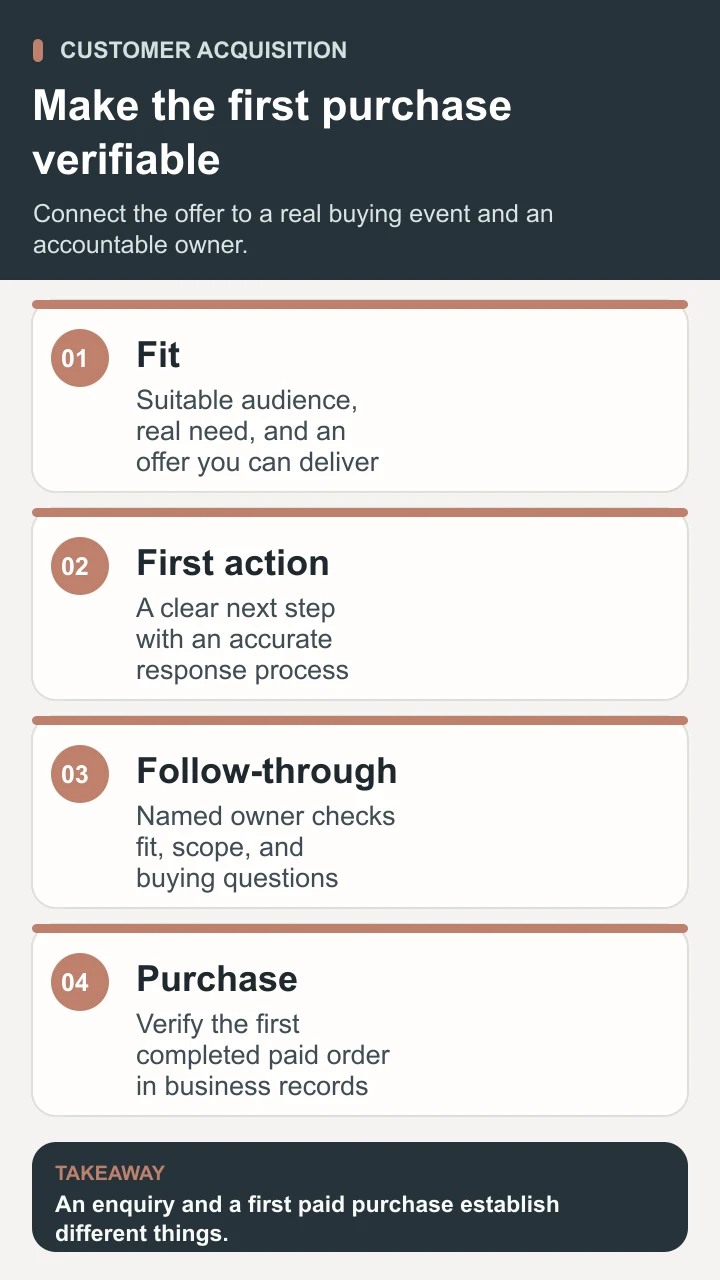
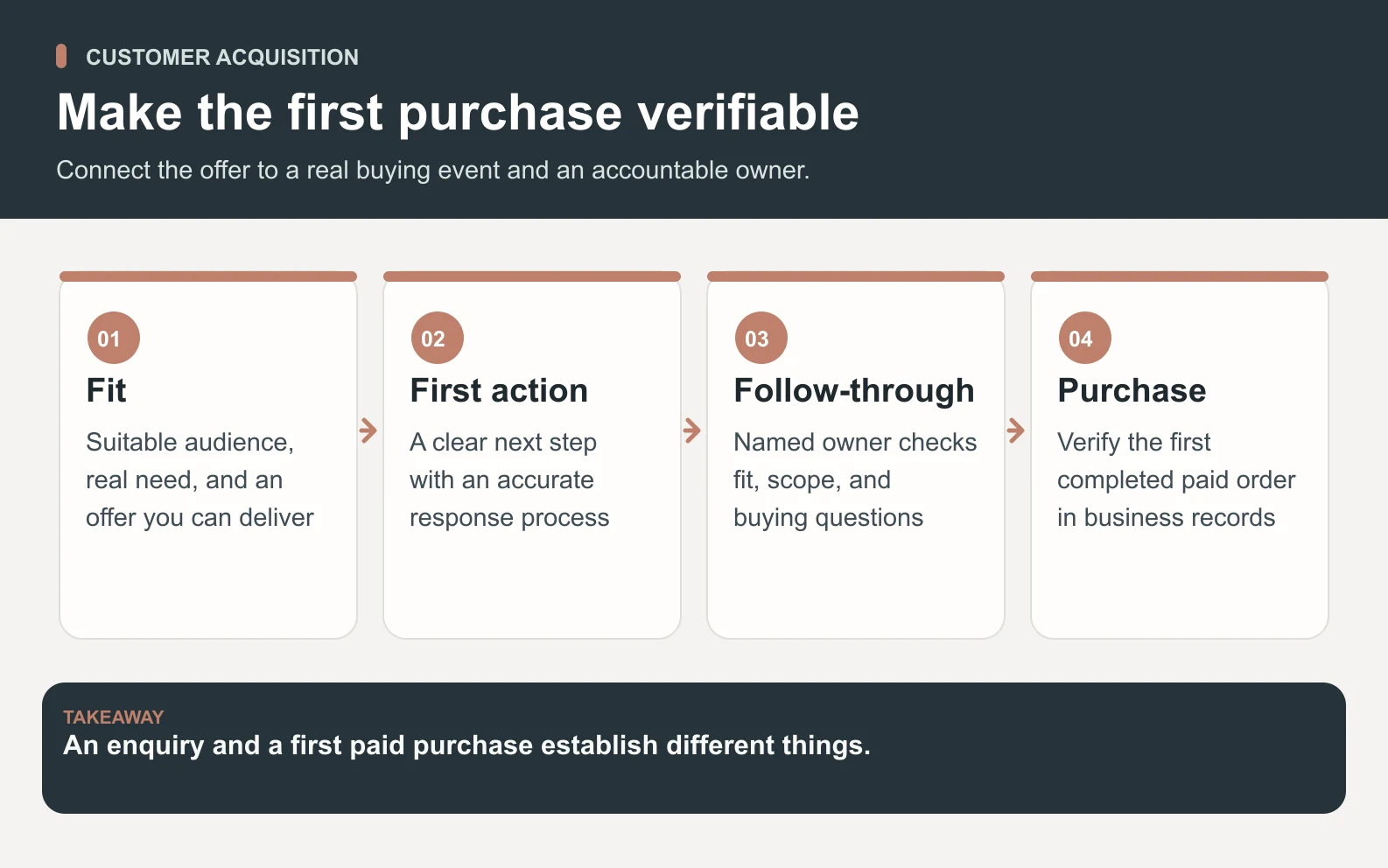
- 1Give the prospect a clear first action and an accurate explanation of the response process.
- 2Assign an owner to review fit and resolve missing information using the stated criteria.
- 3Prepare the appropriate quote or purchase step from approved facts; let the authorized person make commercial commitments.
- 4Verify the first completed paid purchase in the business records, then hand the customer to the person responsible for delivery and follow-up.
Set review conditions for cases that stop progressing. A request may be outside the area, concern unsupported equipment, or lack enough information for a quote. Record the reason and the next appropriate action. An unresolved opportunity should not become a customer just because a reporting deadline arrives.
Use a customer journey map when you need to examine confusing touchpoints across the wider experience. Here the acquisition record has a narrower purpose: establish what happened between the initial route and a first verified purchase. Keep the agreed customer definition stable while allowing the process itself to improve from evidence.
Calculate customer acquisition cost on a defined basis
Customer acquisition cost, or CAC, relates acquisition expenses to new customers. IBM’s explanation includes marketing costs and sales expenses. A practical formula is: defined sales and marketing acquisition costs divided by verified new customers associated with that scope. State the period, cost allocation, customer unit, and exclusions beside the result.
Include relevant advertising, content or creative production, sales follow-up time, and allocated tools when those belong to the pilot. Keep a source for each amount and distinguish an assumed staff-hour rate from a measured cash payment. An ad-platform spend total is not automatically the full cost of acquiring the customers recorded in your sales system.
Match the numerator and denominator. If a campaign runs for thirty days but prospects buy later, choose a follow-up window and keep the cohort identifiable. Include the follow-up work in the cost basis. A same-month snapshot can be useful for operating review, but it can mix today’s expenses with customers generated by earlier activity. Do not quietly alternate between these methods.
Customer value needs another calculation. Revenue is the amount earned from the sale under the chosen accounting basis. Revenue less the defined direct delivery costs gives a contribution measure for this example; acquisition expenses and fixed overhead still need consideration. Future repeat purchases may improve the picture, but a hope of retention is not an observed customer lifetime value.
If there are no verified new customers, the ratio has a zero denominator. Report the spend and zero new customers; do not label the result a zero-dollar CAC. If source matching, refund treatment, or cost allocation is incomplete, show a provisional result with those limits. A precise division cannot repair an unreliable input.
Worked example: an office coffee-maintenance pilot
This invented example illustrates the method, not a Space Office customer result or an acquisition benchmark. A provider tests paid search and partner referrals for the same approved on-site maintenance offer. The campaign runs for thirty days, and the owner follows its enquiries through day sixty. A new customer is a new buying organization that completes and pays for its first service visit by that cutoff.
Scroll horizontally to view all columns.
| Recorded source | Landing-page sessions | Distinct valid enquiry organizations | Fit confirmed | First paying organizations |
|---|---|---|---|---|
| Paid search | 120 | 12 | 7 | 2 |
| Partner referrals | 80 | 8 | 5 | 2 |
| Total | 200 | 20 | 12 | 4 |
The twenty enquiries are deduplicated organizations associated with these routes in the example records. Twelve meet the provider’s stated location, equipment, and scheduling conditions. Four complete the first paid visit. The two hundred sessions are context about recorded visits, not two hundred unique people or organizations. Ratios that use sessions and company counts should not be described as person-level purchase probabilities.
Scroll horizontally to view all columns.
| Cost item | Illustrative calculation | Amount |
|---|---|---|
| Paid-search spend | Recorded pilot spend | $300 |
| Approved page and creative assets | Assigned production cost | $100 |
| Sales follow-up | 6 hours × $25 assumed hourly cost | $150 |
| Allocated tools | Recorded pilot allocation | $50 |
| Defined total | $300 + $100 + $150 + $50 | $600 |
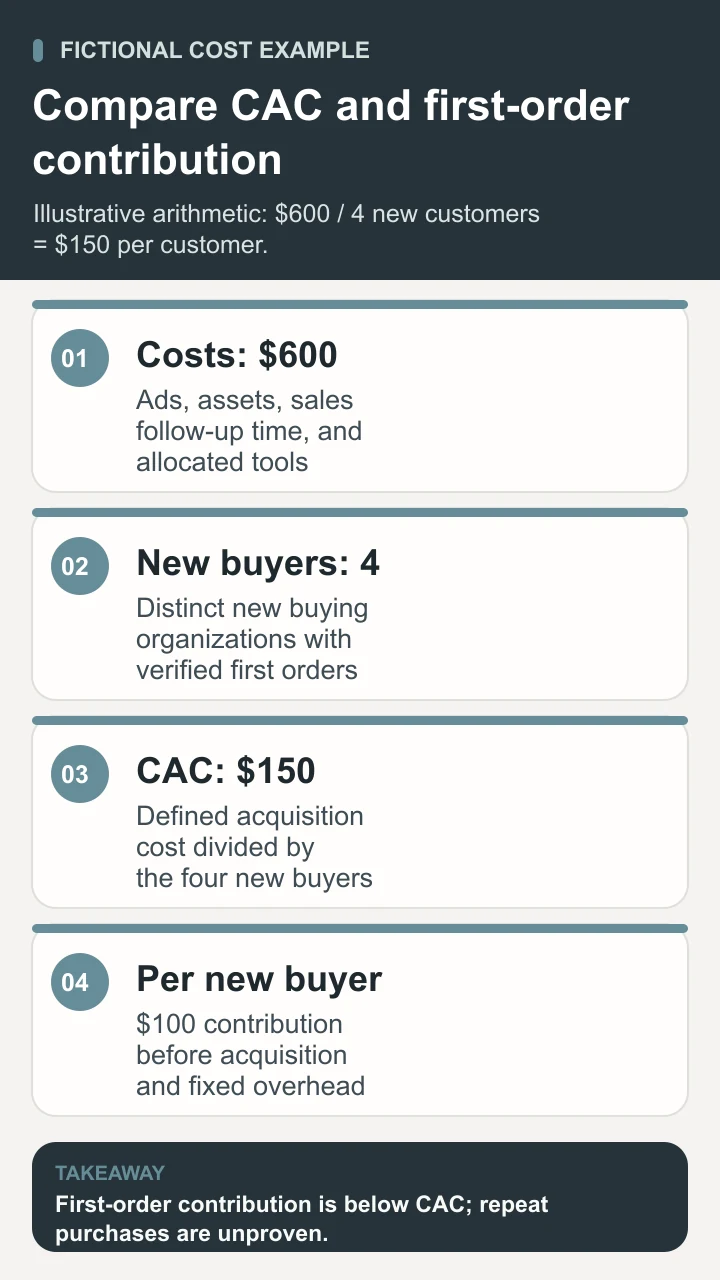
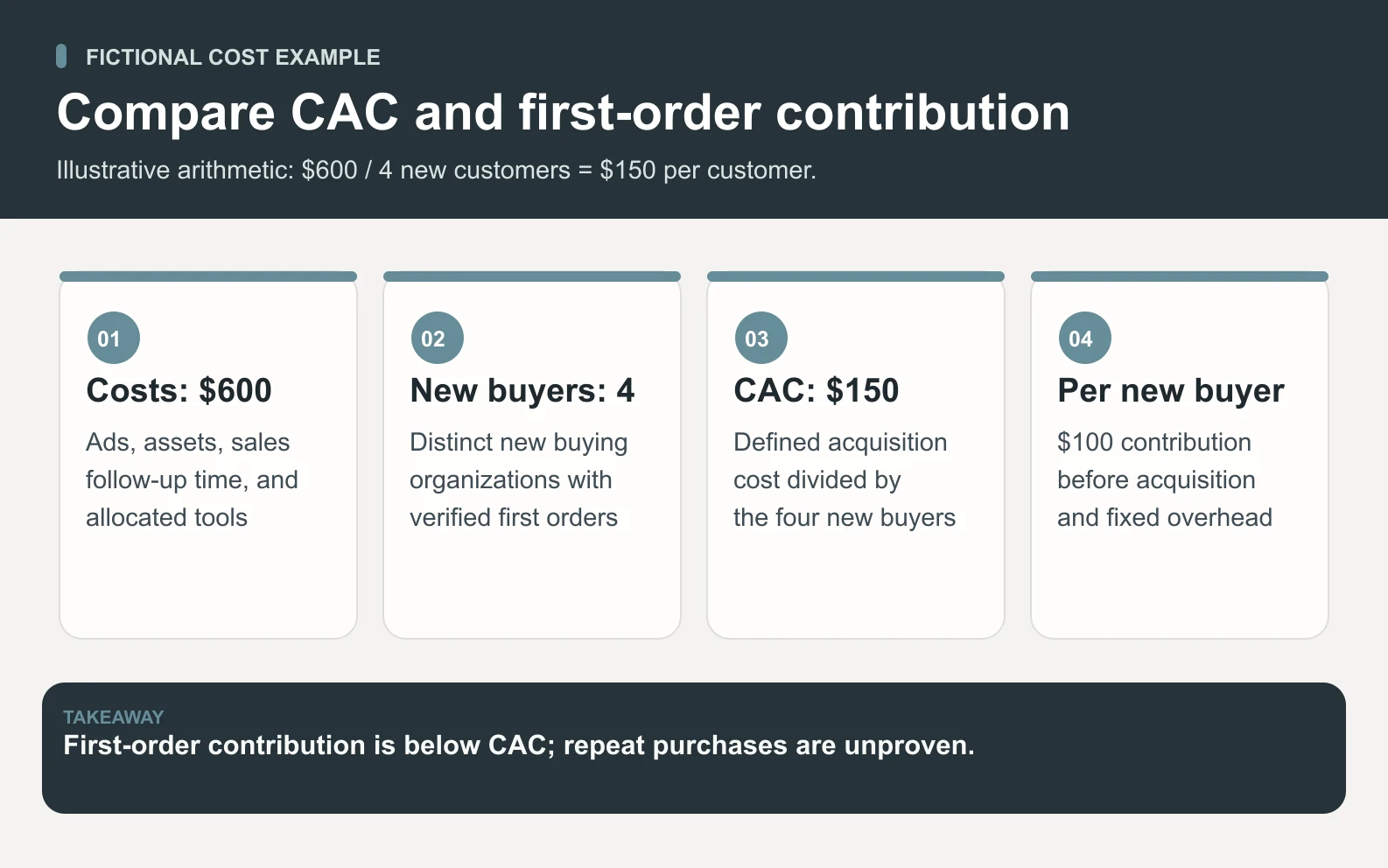
On that stated basis, CAC is $600 divided by four new customers, or $150 per new customer. The same total divided by twenty valid enquiry organizations is $30 per enquiry, which answers a different question. Dividing only the $300 ad spend by all four new customers would mix one channel’s partial cost with a blended customer count.
Assume each first visit produces $250 of revenue and has $150 of direct delivery costs. Four visits produce $1,000 of revenue and $600 of delivery costs, leaving $400 of contribution before acquisition expenses. After the $600 defined acquisition cost, the example is $200 below recovering those combined costs, before fixed overhead. Per customer, $100 of first-order contribution is less than the $150 CAC.
All amounts are invented US dollars. Taxes, fixed overhead, and longer-term purchases are excluded from this simplified illustration. It does not establish net profit or a forecast. The owner should not claim that future maintenance visits will recover the difference until actual repeat business supports that assumption.
Each channel records only two first customers, and the shared costs have not been allocated by channel. The table therefore does not establish a reliable channel winner or channel-specific CAC. It also does not prove that all four purchases were additional sales caused by the pilot. The next decision might be to inspect the lost opportunities and cost assumptions before authorizing another bounded test.

Use Space Office to prepare a reviewed acquisition pilot
Give Hydrogen one approved brief: the real offer, intended audience, operating area, capacity, first-customer definition, existing buying process, cost boundaries, dates, and decision owner. Supply permitted channel, enquiry, and purchase records or authorized access when the task requires it. Mark unavailable evidence rather than asking the team to infer private sales outcomes from website activity.
- 1Oxygen prepares the audience-and-offer hypothesis, channel rationale, follow-through responsibilities, and the pilot’s decision criteria.
- 2Silicon prepares the paid-channel plan, tracking checks, cost basis, and acquisition calculations from the available evidence.
- 3Hydrogen coordinates those assignments and reviews the returned plan, calculations, assumptions, and unresolved questions.
- 4The human owner checks service facts and customer records, approves any account access or spending, authorizes launch, and decides whether to continue.
Request a compact packet: one pilot brief, a channel table, a first-purchase definition, a cost worksheet, and a dated review note. Verify a few decisive source records yourself. If an invoice cannot be matched or a cost is estimated, the packet should say so. Naming an agent does not connect an advertising account or give it authority to make sales commitments.
Check the live specialist roster, Hydrogen’s review workflow, and current pricing when choosing a team. This example uses Oxygen and Silicon because its task is acquisition strategy and paid-channel preparation. Specialist work can organize the plan and evidence; people remain responsible for the offer, budget, customer promises, and final business decision.
Review customer acquisition before expanding
Review the completed buying event and operating constraints as well as traffic. If suitable enquiries do not progress, inspect the actual reasons: fit, timing, unclear scope, unanswered questions, or the purchase process. If the business cannot respond or deliver consistently, resolve that constraint before increasing reach. A lower click cost is not sufficient evidence that the whole acquisition process improved.
Preserve the offer version, audience, dates, channel settings, expenses, and record-matching rules with each review. Compare like with like and allow for the sales cycle. Distinguish a descriptive pilot result from an estimate of additional customers caused by a channel. An experiment designed to test that causal question needs its own credible comparison; the worked table alone does not supply one.
End with one decision: continue within the same boundary, revise a specific weak point, collect missing evidence, or stop. Name the owner and next review condition. Good customer acquisition practice connects a useful offer to verified first customers and costs the business can explain, then uses that evidence to decide what deserves another investment.
Sources and review notes
Reviewed against the linked primary sources on the checked dates. Search features and citations are selected by their respective platforms; no placement is guaranteed.
Frequently asked questions
What is customer acquisition?
Customer acquisition is the process of attracting suitable prospects and converting them into new customers. Define the first-purchase event and customer unit, verify it in business records, and evaluate the sales and marketing costs associated with acquiring those customers.
How is customer acquisition different from lead generation?
Lead generation creates and assesses enquiries or potential sales contacts. Customer acquisition follows the buying process through to a defined new-customer event, such as a completed first paid purchase. An enquiry, qualification, or quote does not by itself establish that event.
How do you calculate customer acquisition cost?
Divide the defined acquisition costs by verified new customers associated with the same scope. Record the period, marketing and sales expenses, allocation method, customer definition, and exclusions. In the fictional example, $600 divided by four new customers gives $150 CAC.
Which customer acquisition channel should a small business choose?
Choose from the buyer’s situation, the offer, available operating capacity, evidence, and budget. Start with a small set you can explain and review. A channel’s popularity or low click price does not establish that it will produce suitable customers profitably for your business.
How can Space Office help with customer acquisition?
Oxygen can prepare the acquisition strategy and Silicon the paid-channel and measurement work, with Hydrogen coordinating and reviewing. Provide approved facts and permitted records or access. A human verifies the evidence and approves budgets, launch, commercial commitments, and the next decision.