Guide
Personal Branding: A Practical Strategy With Examples
Make personal branding practical: explain who you help, show evidence of your work, and share useful ideas in a voice you can stand behind.
By the Space Office team · Published · Updated · 15 min read
Personal branding is the deliberate work of making your expertise, values, and contribution understandable to the people you want to reach. Start with a specific audience, a truthful promise, and examples that support it; then align your profile, public work, and everyday behavior. In Space Office, Iridium helps organize your positioning, voice, and proof, while Nitrogen can edit the resulting copy. Hydrogen coordinates and reviews their work. You verify the claims and approve what becomes public.

Key takeaways
- Choose the opportunity you want and the people who need to understand your contribution.
- Support your positioning with work samples, accurate attribution, and permission to share.
- Explain your judgment through examples instead of relying on impressive adjectives.
- Keep your public promise consistent with the work and boundaries you can maintain.
- Review relevant conversations, inquiries, and feedback alongside visibility numbers.
For a company or product identity, use the business branding guide. It focuses on an approved promise, visual and writing rules, and the customer touchpoints a team needs to maintain.
Download the free personal branding worksheet to build a positioning statement, proof bank, profile checklist, and first publishing brief. The approach below is designed for founders, consultants, and professionals who need their work to be understood. The worked example is fictional; it demonstrates decisions and language, not customer results or a promise of reach.
What personal branding should make clear
A useful professional reputation answers several questions: What do you understand? What can you contribute? How do you work? When should someone involve you? Your public description supplies part of that answer. The experience of working with you supplies the rest. If the description promises meticulous research but your examples lack sources, the mismatch matters more than a polished headline.
The American Marketing Association's overview connects the practice to a person's experience, career, and impression on an audience. Harvard Business School Online emphasizes communicating value and checking that the narrative is accurate and coherent. For a small business owner, a practical application is to make a particular contribution recognizable and easy to verify.
Choose an outcome before choosing a platform. A founder may want suitable partners to understand a product decision. A consultant may want inquiries for a defined service. An employee may want colleagues to recognize a capability needed on a new project. These goals call for different examples and relationships. A large audience with little connection to the goal can create more work without resolving the original problem.
Keep the scope human. You can be known for a useful specialization without turning every private interest into content. Decide what remains private, which employer or client information requires permission, and what topics you cannot speak about from experience. Those boundaries help you publish consistently without treating your whole life as material. An honest account of what you are learning can be useful when it is clearly presented as learning.
Choose an audience and write a promise you can defend
Start with the people whose decisions you can help. Describe their situation, their problem, and the reason your experience is relevant. Use actual conversations, project requests, or feedback where available. If you are still choosing the audience, use the target audience guide first. This exercise concerns your individual contribution to that audience, rather than the full market your business could eventually serve.
- 1Name the opportunity. Write one concrete aim, such as being considered for accessibility reviews of small SaaS products. Replace broad ambitions like becoming influential with a situation in which someone could sensibly choose your help.
- 2Name the audience's decision. Identify what they are trying to decide, what makes that decision difficult, and which evidence they would need before trusting you. Keep the audience recognizable without inventing personal details.
- 3List your relevant experience. Include projects, responsibilities, training, and lessons you can explain. Separate work you led from work you supported, and separate completed work from capabilities you are still developing.
- 4Draft the promise. Try: I help [specific people] with [specific task] through [approach I can demonstrate]. Add a boundary where needed. The sentence is a working description, not a guarantee of business results.
- 5Ask someone to interpret it. Show the statement and one example to a colleague or potential reader. Ask what they would contact you about and what remains unclear. Their answer tests clarity; a polite compliment does not.
For example, 'visionary growth expert helping everyone succeed' gives a reader little to evaluate. 'I help independent software teams explain complicated onboarding steps through clearer product copy and annotated walkthroughs' names an audience, task, and method. It still needs supporting work. If the person has only practiced on their own prototype, they should describe that experience rather than imply a portfolio of paying clients.
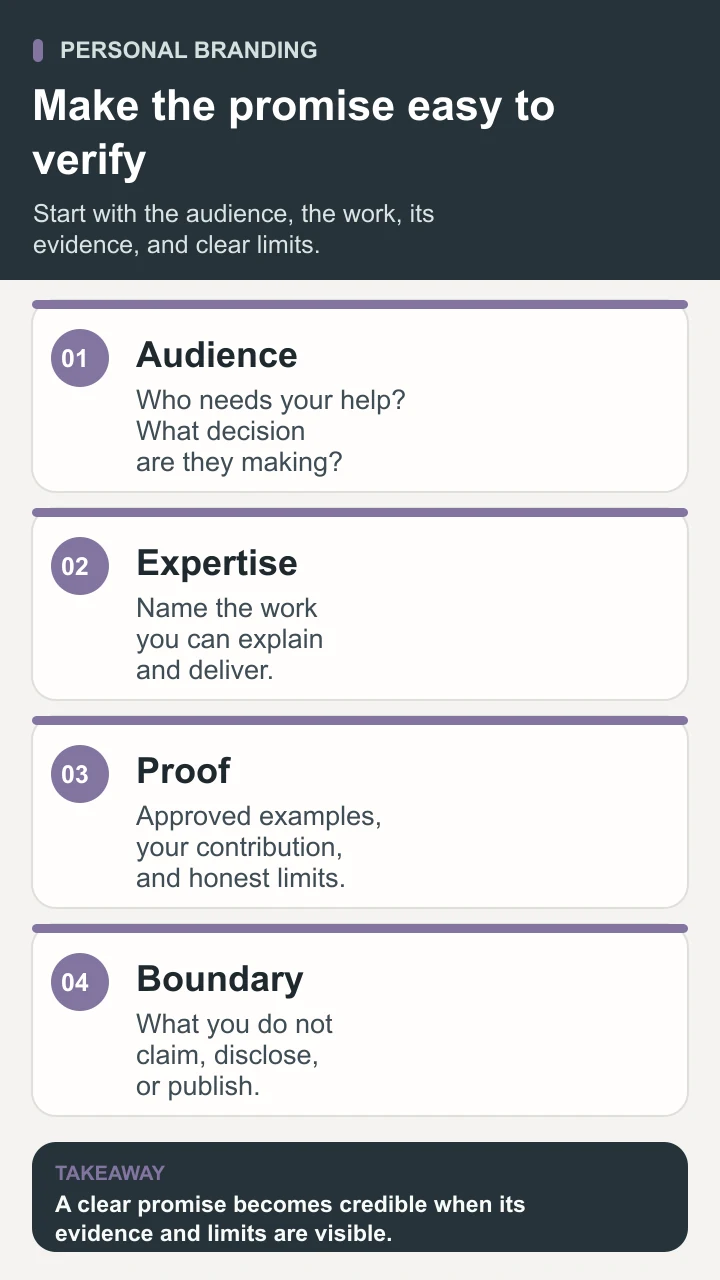
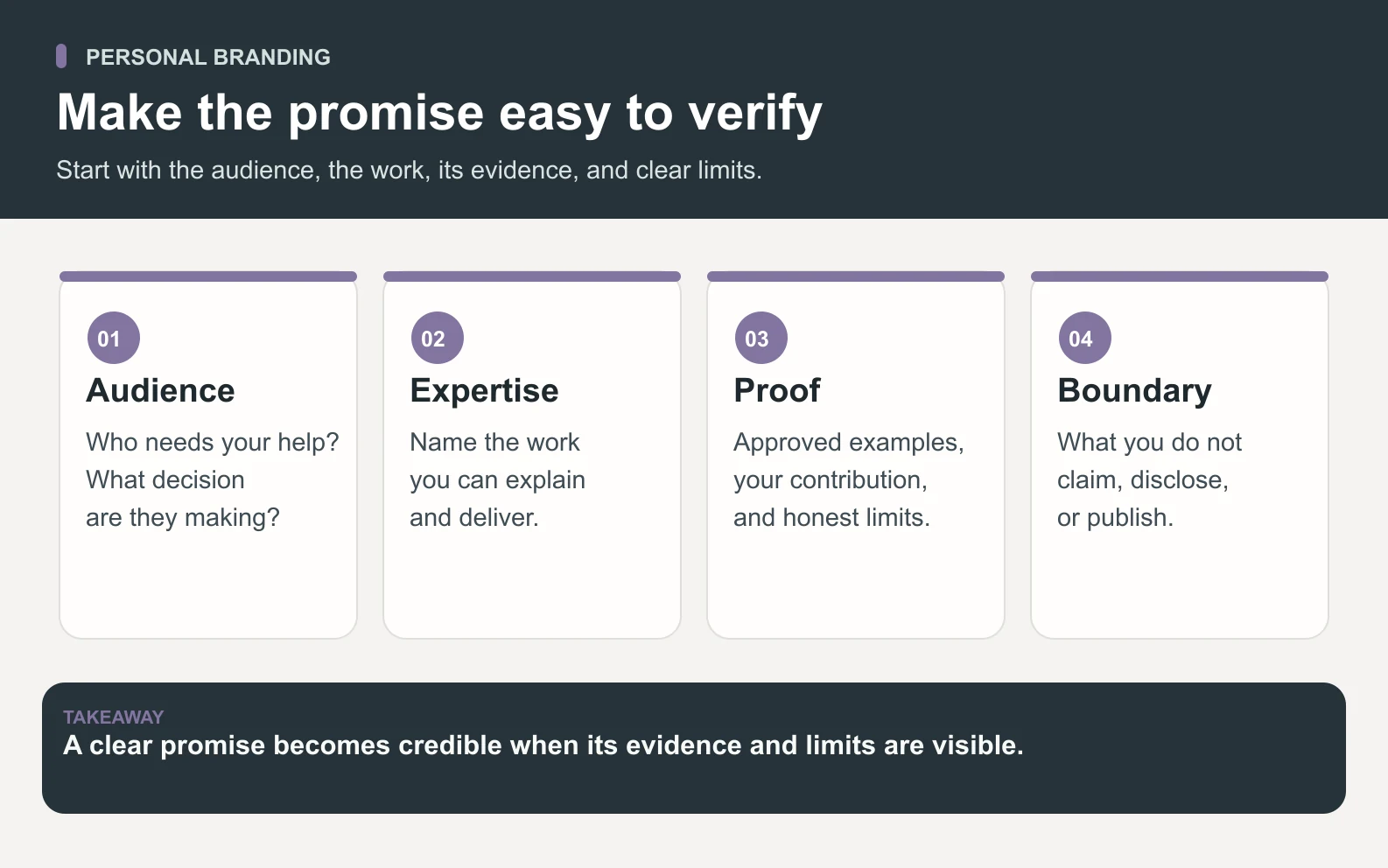
A positioning statement should also leave room to grow. Choose a useful starting focus, then revisit it when your work changes. You do not need a unique invented category or a claim that nobody else can do the job. A specific combination of experience, working method, and reader problem can explain why your perspective is worth examining. The value proposition guide helps connect that contribution to a credible offer.
Build a proof bank before filling a publishing calendar
A proof bank is a small collection of material that supports what you say about your work. Include the artifact, context, your contribution, source, sharing permission, and limitations. A useful entry might be an approved before-and-after document, a public demonstration, a project retrospective, or a recommendation you have permission to quote. The purpose is to recover the facts when drafting, rather than relying on memory or reconstructing a flattering story.
Scroll horizontally to view all columns.
| Field | Record | Review question |
|---|---|---|
| Claim | The specific skill or judgment the example illustrates | Does the material support this exact claim? |
| Context | The problem, constraints, date, and intended reader | Would missing context change the interpretation? |
| Contribution | What you did and who else contributed | Are you accurately describing your part? |
| Evidence | An approved artifact, source link, or documented observation | Can a reviewer inspect the original? |
| Permission | What may be public and what must be removed | Has the right person approved this use? |
| Limit | Unknown outcomes, small samples, or incomplete work | Could a reader mistake an example for a proven result? |
Distinguish a demonstration from a result. An annotated redesign can show how you reasoned about a form. It cannot establish that the form improved completion unless you have a suitable measurement. A testimonial describes one person's experience; it does not prove every customer will have the same one. When you lack outcome data, explain the decision, alternative, and tradeoff the artifact illustrates. There is useful teaching value in showing the reasoning accurately.

If you cannot share client work, create a clearly labeled independent example using public or invented inputs. Explain that it is a demonstration, identify your assumptions, and avoid implying endorsement from a company you mention. Removing a client name may not remove identifying details. Ask the owner what can be shared, or use a different example that teaches the same method without exposing the original project.
Capture your voice alongside the evidence. Save a short explanation in your own words: what you noticed, why you chose that approach, what you would change, and where you disagree with common advice. These notes give an editor something real to preserve. They also make it easier to reject a smooth draft that introduces an opinion you do not hold or makes your involvement sound larger than it was.
Make your profile and public work tell the same story
Choose one primary place where the intended audience can understand your work and take an appropriate next step. It might be a professional profile, a portfolio, a personal site, or a relevant community. Review the first screen: can a new visitor identify your work, see one supporting example, and understand how to contact you? A clear introduction and a small set of relevant examples are a manageable starting point.
On LinkedIn, distinguish your identity from your organization's presence. LinkedIn explains that profiles represent people and Pages represent organizations. A founder can connect the two while keeping personal experience separate from company capabilities. Write 'I led the research interviews' when that is your contribution, and 'our team built the product' when the result belongs to a team.
- Headline: describe your role or contribution in language the intended reader recognizes. Remove unsupported superlatives and unexplained acronyms.
- Introduction: explain the problem you work on, your approach, and the experience behind it. Include a useful boundary when it affects fit.
- Evidence: link a few relevant examples and explain what each demonstrates. Test the links as a visitor with no special access.
- Next step: make the appropriate action clear, such as reviewing a service scope, discussing a suitable project, or reading a demonstration.
Check visibility deliberately. LinkedIn's public-profile documentation explains that public display depends on settings and that search engines can take time to reflect changes. Inspect the public view and choose which sections you want available. A profile update does not ensure a search result or a particular position. Keep private contact details and examples behind the boundaries you intended.
Choose evidence appropriate to the work. A developer might introduce maintained projects through a GitHub profile README, while a consultant might publish an annotated sample brief. A researcher might explain a method and its limitations. Use the format that lets a reader examine the contribution; you do not need every profile type simply because it exists.
Worked example: turn one real capability into a useful presence
Consider Maya, a fictional independent presentation designer. She wants inquiries from small software teams preparing customer demonstrations. Her starting profile says 'creative storyteller, strategic thinker, design lover.' The description contains no obvious task or evidence. Her goal for the first month is to explain one service clearly and make two useful examples available. This is a planning scenario, with no assumed audience growth or sales results.
Maya's revised statement is: 'I help small software teams turn complicated product demonstrations into clear presentation stories. I map the audience's questions, edit the narrative, and design slides around the decision.' Her actual experience supports editing and design. She leaves fundraising advice out of the claim because she has no basis to promise that expertise. This boundary makes the service easier to understand and the examples easier to choose.
Scroll horizontally to view all columns.
| Step | Public item | What it teaches | Before publishing |
|---|---|---|---|
| Week one | Profile introduction and annotated sample deck | How Maya organizes a demonstration around customer questions | Label the sample fictional and explain her contribution |
| Week two | Short post explaining one slide decision | Why a feature list became a problem-and-example sequence | Show the original reasoning without claiming a measured conversion lift |
| Week three | Checklist for preparing a design brief | Which inputs make a presentation review possible | Remove confidential questions and avoid promising a universal formula |
| Week four | Reflection on feedback and a revised example | What readers misunderstood and how the explanation changed | Separate observed feedback from Maya's interpretation |
Her first post could open: 'This demo slide asked the audience to remember six features before explaining the problem. In this fictional example, I moved the customer question first and kept one feature as supporting evidence.' That opening gives a reader something to inspect. A sentence such as 'This framework doubled revenue for every client' would require evidence Maya does not have and would distort the purpose of the demonstration.
The example suggests three reusable content themes: explaining a design decision, preparing better inputs, and discussing tradeoffs. These themes arise from the work rather than from unrelated trending topics. Maya can answer questions in a relevant community and link an example when it helps. For channel selection and a publishing schedule, use the social media marketing guide; her individual positioning and proof remain the foundation here.
Set a realistic production limit. If Maya has one hour available each week, a short annotated example may be maintainable while a daily video series is not. She can save questions during ordinary work, choose one useful lesson, and leave time to respond. An unsustainable schedule creates pressure to repeat thin ideas or publish unchecked claims. The constraint should shape the format before the calendar fills up.
Use Space Office to prepare the work while keeping your judgment
Space Office's live specialist roster includes Iridium, the Personal Brand & Creator Strategy Specialist. Its role covers the brand profile, positioning, point of view, voice capture, story and proof bank, ghostwriting, distribution planning, and inbound signals. Nitrogen, the Content & Copy Specialist, can edit a chosen profile or article draft. This is a useful pairing when the bottleneck is organizing real experience into clear communication.
- 1Provide the inputs: the opportunity you want, audience description, current profile, approved work samples, your own explanations, and sharing restrictions. Identify missing evidence instead of asking the team to fill it with plausible stories.
- 2Ask Iridium for a small foundation packet: a positioning statement, three supported themes, a voice note, and a proof bank. Each suggested claim should identify its evidence and any unresolved permission or attribution question.
- 3Give Nitrogen one output to edit: an introduction and one short teaching post, for example. Require the draft to preserve your meaning, credit collaborators, link the approved example, and mark claims that need your answer.
- 4Let Hydrogen coordinate and review the packet against the brief. It should catch inconsistencies between the profile, example, and public promise and return unresolved issues for your decision.
- 5Review as the named person. Confirm the facts, voice, privacy boundaries, and implication of every result claim. Decide whether to revise, publish, or keep the work private. Publishing and account changes require the appropriate access and authorization.
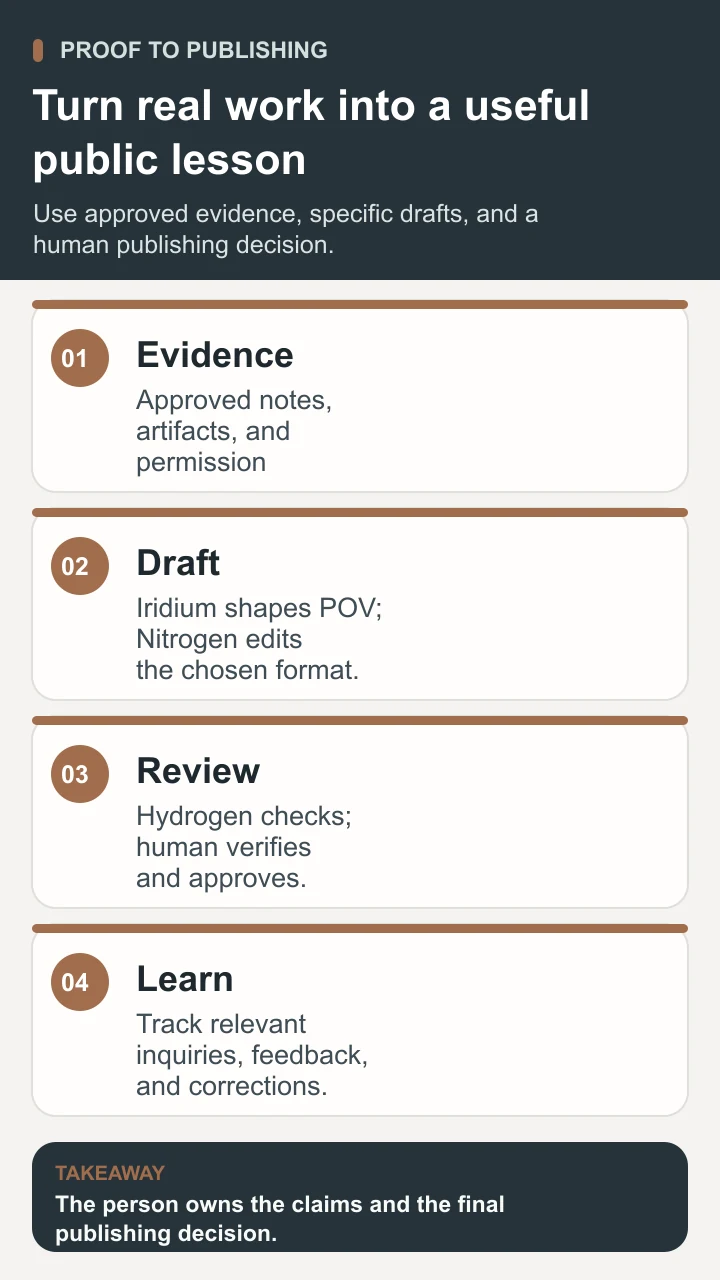
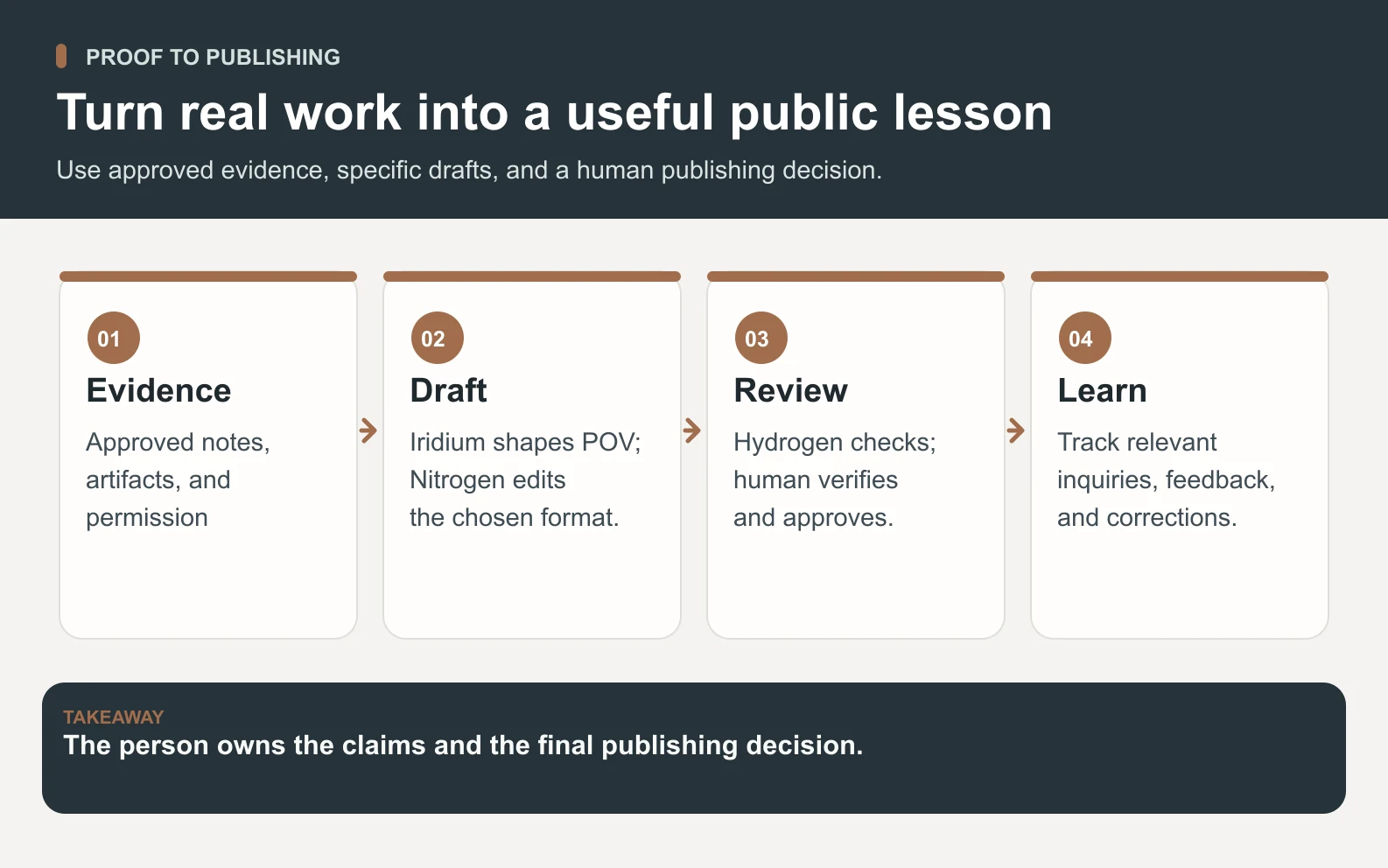
A useful brief might say: 'Use these two approved samples and my recorded explanation to draft a profile introduction and a post about one decision. Keep my contribution separate from the team's. Do not invent client names, quotations, results, credentials, or opinions. Flag anything that requires permission. Return drafts for my approval.' The delegation guide explains how to specify inputs and acceptance checks in more detail.

Your accounts, private history, and permission to reuse material are not automatically available to an AI specialist. Supply approved inputs or explicitly authorized access. Hydrogen's review does not replace your knowledge of what happened. See how the workflow works and current pricing when choosing a team. A managed drafting process cannot guarantee followers, leads, publication, search ranking, or recognition from other people.
Review personal branding through relevant opportunities and feedback
Keep a simple record of what you published, whom it was intended to help, the evidence used, time spent, and responses received. Separate distribution from understanding. Impressions indicate that content was shown under a platform's definition; they do not demonstrate that a suitable person understood your work. Record useful questions, relevant introductions, suitable inquiries, and corrections that reveal a gap in the explanation.
For an inquiry, note what the person says prompted it and whether the requested work matches your scope. Preserve uncertainty when they encountered several sources. Two relevant conversations can inform your next example, but a small number does not establish a reliable conversion rate or prove one post caused the opportunity. Review the quality of fit and the effort required before increasing the publishing commitment.
On your own site, make authorship and supporting experience easy to inspect. Google's guidance on helpful content encourages clear information about who created material, useful sourcing, and content that serves an audience. Apply that as a quality check: explain the author, show the example, and make the limits visible. It is not a formula for a first-page result.
Personal branding becomes useful when your public description, evidence, and behavior agree. Start with one promise you can support, one profile a reader can understand, and one example that teaches something. Use the worksheet to make the next draft specific. Revise the promise when experience changes, correct errors when you find them, and let the next piece of real work supply the next thing worth sharing.
Sources and review notes
Reviewed against the linked primary sources on the checked dates. Search features and citations are selected by their respective platforms; no placement is guaranteed.
- American Marketing Association: Personal Brand — checked
- Harvard Business School Online: Personal Branding, What It Is and Why It Matters — checked
- LinkedIn: Public Profile Visibility — checked
- LinkedIn: Differences Between a Profile and a Page — checked
- Google Search Central: Creating Helpful, Reliable, People-First Content — checked
- GitHub Docs: Managing Your Profile README — checked
Frequently asked questions
What is personal branding?
Personal branding is the deliberate practice of communicating your expertise, values, and contribution so relevant people can understand what you do and when your help fits. It includes your public descriptions, examples, relationships, and behavior. A credible presence connects those elements to real experience and accurately describes your role, limitations, and evidence.
How do I start if I have a small audience?
Choose a specific reader and task, then prepare one clear introduction and one useful example. Ask a few relevant people what they understand from the material. You can use independent demonstrations, learning notes, or approved work samples without claiming a large client history. Begin with evidence you have permission to share and a pace that leaves time for feedback.
Is a personal brand the same as a company brand?
A personal brand concerns an individual and their experience, perspective, and contribution. A company brand concerns the organization and what it offers. They can support each other, particularly for a founder, but keep the attribution clear. Do not present a whole team's result as one person's achievement or imply that your personal view is an official company position without agreement.
Do I need to post every day?
There is no universal daily requirement in this method. Choose a pace based on your available evidence, review time, and ability to respond. One useful explanation may take longer than a short observation. Track whether the work serves the intended reader and your goal; reduce the frequency if maintaining it requires repeated ideas, invented stories, or skipped checks.
Can AI write in my voice without inventing my experience?
AI can help organize and edit material when you supply your own explanations, approved examples, and clear boundaries. It cannot establish that an experience happened or that you hold an opinion. Ask for claims to be tied to sources, review every first-person statement, and reject unsupported additions. You remain responsible for whether the final words accurately represent you.
How long does it take to build a useful reputation?
There is no fixed timeline. Your starting relationships, relevant work, audience, and consistency affect what people can observe, and recognition is their decision. Set an initial review period for your own work rather than a deadline for becoming known. Check whether the profile is clearer, examples are stronger, and conversations better match your scope, then decide what to maintain.