Guide
Branding: Meaning, Examples, and a Practical Brand Brief
Build branding from a promise you can prove, then turn it into words, visuals, and customer experiences your team can use consistently.
By the Space Office team · Published · Updated · 16 min read
Branding is the deliberate work of shaping how people recognize, understand, and experience a business. It connects a clear promise with evidence, language, visual identity, and everyday delivery. In Space Office, Oxygen can prepare positioning and Nitrogen can develop messaging; Boron can translate approved direction into design guidance. Hydrogen coordinates and reviews, while the business owner approves the promise and final assets.

Key takeaways
- Choose a specific customer situation and a promise the business can actually deliver.
- Build a short evidence-based brief before choosing a logo, colors, or a tagline.
- Give writers and designers practical rules with examples of acceptable and unsuitable work.
- Check the website, packaging, and customer messages together so the same promise survives each handoff.
- Test comprehension and delivery; a consistent appearance alone does not prove trust or commercial impact.
Download the editable branding brief and review checklist. This guide follows a fictional small ceramic studio called Hearth Bowl. Its customers, observations, promise, and assets are teaching examples, not customer research or measured Space Office results.
What branding means in everyday business decisions
The American Marketing Association’s branding overview describes a brand through the distinctive features that identify an offering and explains related concepts such as identity and positioning. Branding is the work of making those choices coherent in practice. A person should be able to understand what your business offers, recognize it again, and find that the experience supports the expectation you created.
Think of the last message a buyer sees before paying. If your website sounds patient and helpful but the order confirmation is vague and abrupt, two parts of the business are setting different expectations. A new logo would not resolve the missing information. The useful branding decision might be to explain the next step in a calm, specific way and ensure the team can fulfill it.
Scroll horizontally to view all columns.
| Concept | What it decides | Useful output |
|---|---|---|
| Brand | The identity and associations people attach to the business. | A recognizable business with a meaning customers can describe. |
| Positioning | The customer situation and reason to choose this offer. | An internal statement with an audience, alternative, and credible difference. |
| Visual identity | How the business looks across usable assets. | Logo versions, color pairings, typography, and layout examples. |
| Voice and tone | How the business speaks in different situations. | Writing principles and examples for routine and sensitive messages. |
| Marketing | How the offer reaches people and creates demand. | A campaign or channel plan using the approved brand direction. |
This guide focuses on a business brand. A founder building an individual professional reputation has a related but distinct task; use the personal branding guide for that scope. Similarly, choosing a campaign objective belongs in a marketing strategy. You do not need to rebuild your entire identity every time you publish a campaign, introduce a seasonal product, or learn that a headline needs clarification.
For a small company, the first useful result is often a one-page brief plus a handful of examples people can follow. A large presentation becomes wasteful if nobody knows which paragraph controls the website or who may approve a packaging change. Give each rule an owner, a real use case, and a current source of truth. Start with the touchpoints customers actually encounter.
Start with customer evidence and a credible promise

Begin with a specific buying situation. Hearth Bowl makes small-batch ceramic bowls and sells them through its own shop. For the exercise, the owner wants to serve people buying a practical housewarming gift. That is a useful starting situation because it names a job the buyer needs done. “People who like beautiful things” leaves too many different expectations unresolved.
Gather approved inputs: product specifications, care instructions, current packaging, recent customer questions, and permissioned feedback. Keep the exact observation next to its source and date. A question about whether a bowl is dishwasher safe supports a need for clear care information. It does not establish that every buyer ranks convenience above appearance, or that a competitor’s product is less durable.
Ask what the buyer needs to know before deciding, what alternative they would use, and which facts the business can demonstrate. The owner might choose a promise of a useful handmade gift with clear care guidance. That promise is narrower than “the world’s best ceramics,” but it gives the writer and designer concrete material. It also creates a check: does the package actually include the care information being promised?
- 1List a few recent customer questions without editing them into marketing language.
- 2Mark each statement as observed, inferred, or unknown, and keep its source.
- 3Choose one buying situation for the current brief.
- 4Write a candidate promise and the facts that would make it credible.
- 5Ask the owner to remove any claim the business cannot reliably fulfill.
Use market research when you need to investigate an unknown audience or alternative. Branding should consume that evidence rather than manufacture it. If five informal conversations are your only input, describe them as five conversations. They can suggest a question worth testing; they do not justify a statement about an entire market or a precise percentage of buyer preference.
Keep business constraints visible. Hearth Bowl may have variable firing schedules, limited packaging stock, and products that differ slightly by batch. Those facts should shape its language. A promise of identical products delivered the next morning would conflict with the example’s operation. A useful brand direction gives the team room to be distinctive while respecting what they can actually produce and deliver.
Write a branding brief your team can use
A practical brief answers a small set of connected questions: who is this for, what are they trying to do, what do we offer, why should they believe it, and how should the experience feel? Write in ordinary language. If a sentence could describe any shop in the category, make it more concrete by naming the situation, product, or proof. Keep aspirations separate from statements of present capability.
Scroll horizontally to view all columns.
| Brief field | Fictional Hearth Bowl decision | Review question |
|---|---|---|
| Customer situation | A buyer needs a practical housewarming gift. | Is this based on evidence we actually have? |
| Offer | Small-batch ceramic bowls with clear care guidance. | Does the product and package deliver this? |
| Promise | A handmade gift that is easy to choose and care for. | Can we explain what easy means? |
| Proof | Specific dimensions, clear photos, care card, stated dispatch window. | Are these details accurate for every featured item? |
| Personality | Warm, useful, and calm. | Can a writer show this with a real sentence? |
| Limits | No unsupported durability, delivery, or sustainability claims. | Which owner checks changes to these facts? |
The promise is a direction for decisions, not necessarily the public tagline. Your homepage might express it in a fuller sentence, while a small care card communicates it through clear instructions. The same internal idea can produce different surface copy. Repeating a slogan on every object can crowd out information the customer needs at that moment.
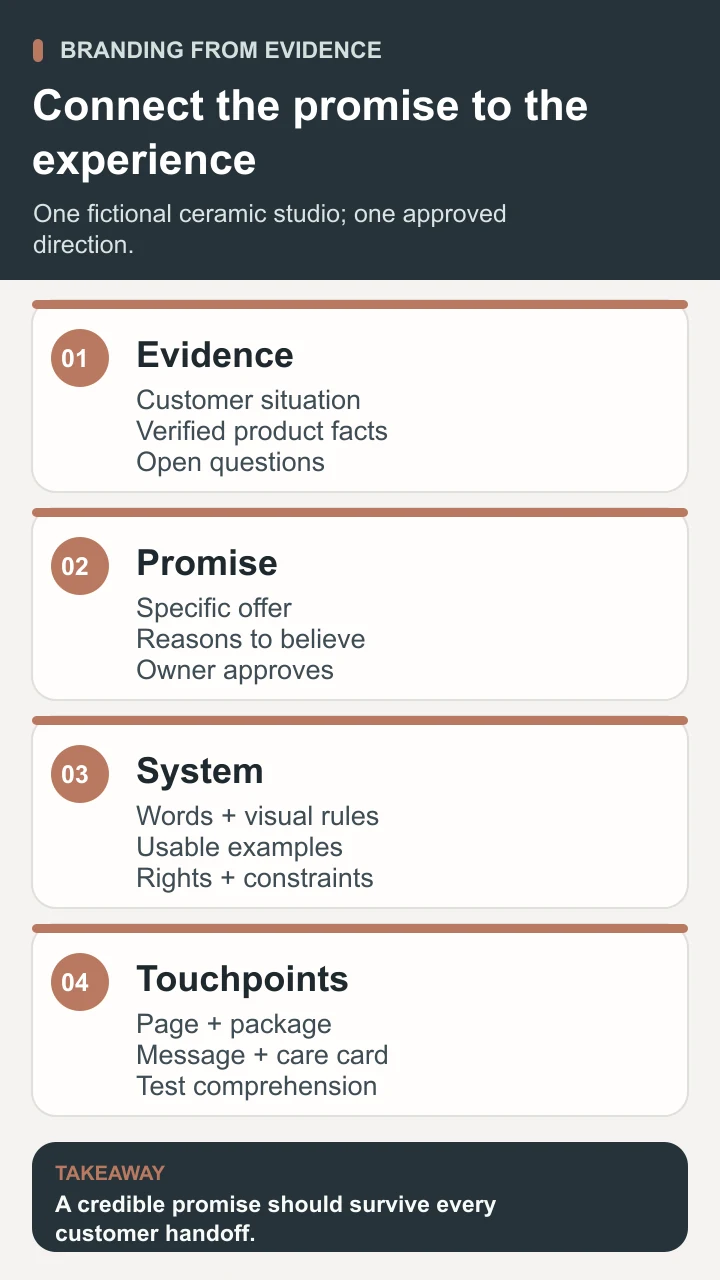
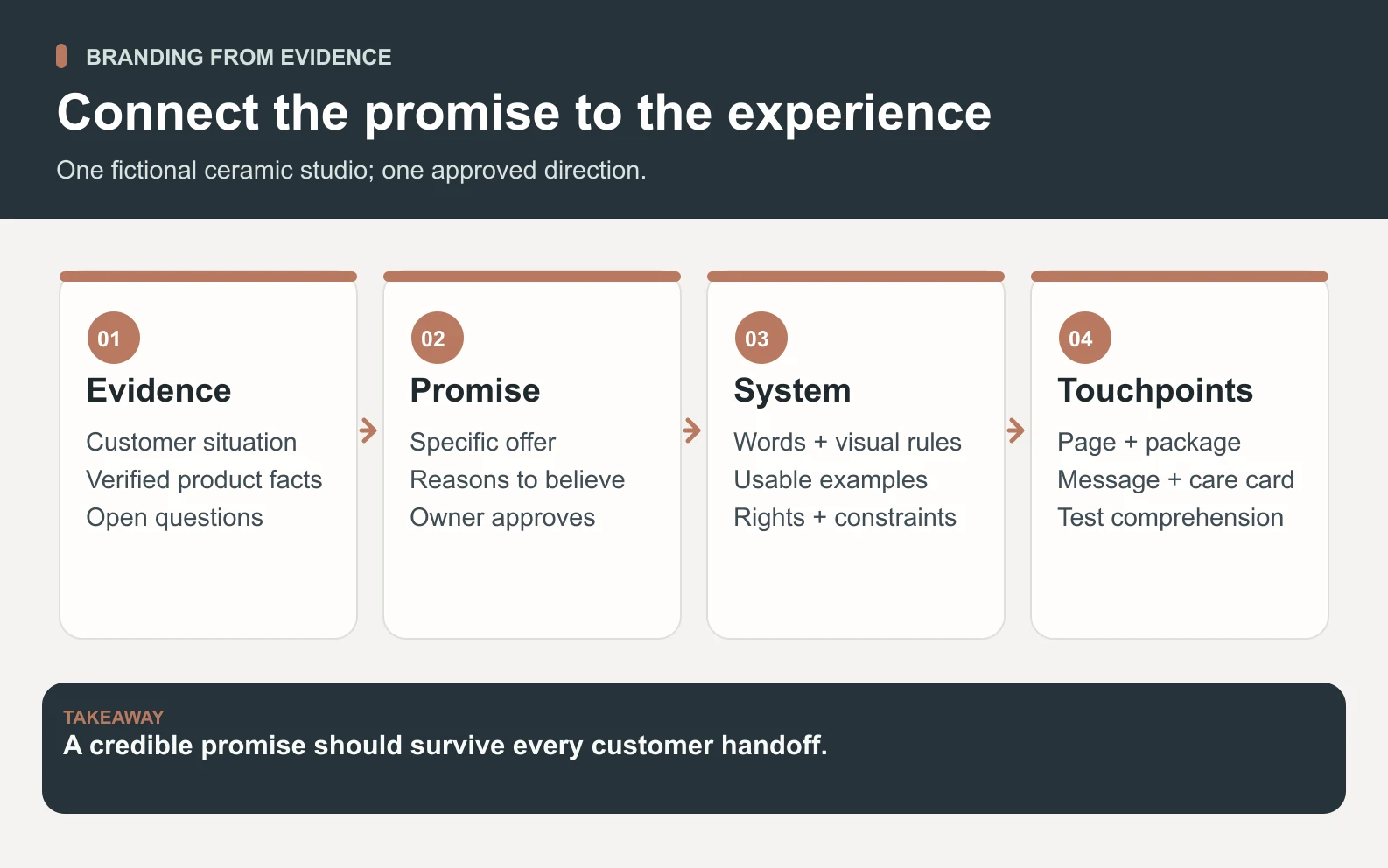
Give the brief an explicit exclusion. Hearth Bowl is not trying to look like a luxury collectible gallery in this exercise, and it is not promising low prices as its main distinction. These choices help a designer reject an otherwise attractive concept that sends the wrong signal. They also help a writer avoid phrases that suggest scarcity or prestige when the intended experience is relaxed and useful.
Finish the brief with acceptance criteria. A new visitor should be able to identify the product, understand the gifting use case, and find practical care information. A staff member should know where to check dispatch wording. A designer should be able to create a second card without inventing another palette. These checks turn an abstract preference such as “make it feel premium” into work that can be reviewed.
Turn the brief into a visual and verbal system
Start with a small reusable set: approved logo versions, color combinations, type styles, image direction, and a few layouts. Include the context where each item works. A mark that is clear on a large shop sign may disappear on a tiny care label. A pale background may work in a photograph but fail behind small text. The rules need to survive the actual production conditions.
Mailchimp’s own brand asset guidance is a concrete example of documenting name usage, logo presentation, and background variants. The lesson is to specify how your own assets should be used. A public asset page is not permission to copy another company’s identity or imply an affiliation. Create a system appropriate to the business, including the rights and licenses for fonts, photography, and artwork.
For Hearth Bowl, imagine a restrained terracotta, cream, and deep blue palette, a simple bowl-and-sun illustration, and clear product photography. Those are fictional design choices. The useful rule is to document which combinations carry text, which are decorative accents, and where a monochrome version is required. Provide final files in named folders so staff do not keep resizing an old screenshot of the mark.
For web text, W3C’s contrast guidance sets a minimum contrast ratio of 4.5:1 for ordinary text and 3:1 for qualifying large text, with stated exceptions. Check the actual foreground and background pair. Contrast is one accessibility check; it does not establish that the whole page is accessible or that printed colors will reproduce identically.
Writing guidance should show how a principle changes a sentence. “Warm and useful” could mean “Your bowl is packed. The care card is inside, and your dispatch update will follow by email.” It should not become a string of enthusiastic adjectives that hides the next step. An operational message must still state what happened, what the customer should do, and who can help.
Mailchimp’s voice and tone guide distinguishes a relatively consistent voice from a tone that responds to the reader’s situation. Apply that distinction to your own business: an order confirmation can sound welcoming, while a damaged-delivery response should prioritize clarity and care. The same personality need not produce the same joke, punctuation, or level of excitement in every context.
Review the same promise across customer touchpoints

Choose three or four high-use touchpoints before expanding the system. For Hearth Bowl, use a product page, a packaging label, an order confirmation, and a care card. Put them side by side. Check that product naming, tone, core colors, and the meaning of the promise agree. Then check what each surface uniquely needs: a care card needs instructions, while a product page needs enough detail to support a purchase decision.
Scroll horizontally to view all columns.
| Touchpoint | What the buyer needs | A useful review |
|---|---|---|
| Product page | Understand the bowl, size, appearance, and dispatch details. | Read on a phone and compare facts with the actual product record. |
| Packaging label | Recognize the maker and identify the item. | Print at actual size and check legibility and production constraints. |
| Order confirmation | Know the order state and next expected update. | Check wording against the real fulfillment process. |
| Care card | Use and care for the item correctly. | Have a person follow the instructions without extra explanation. |
Test comprehension with realistic tasks. Show a draft product page without explaining it, then ask what the person thinks is being sold, who it might suit, and what remains unclear. Ask them to find the care guidance. Record the answer before defending the design. A person agreeing that the page looks attractive tells you something different from their correctly understanding the offer.
Keep findings precise. If three participants miss the dispatch information, you have evidence of a problem in that draft and test context. You do not have a market-wide conversion estimate. Change the relevant layout or wording, test the revised task, and keep a note of what changed. Your first goal is a clearer experience, with commercial measures evaluated separately over an appropriate period.
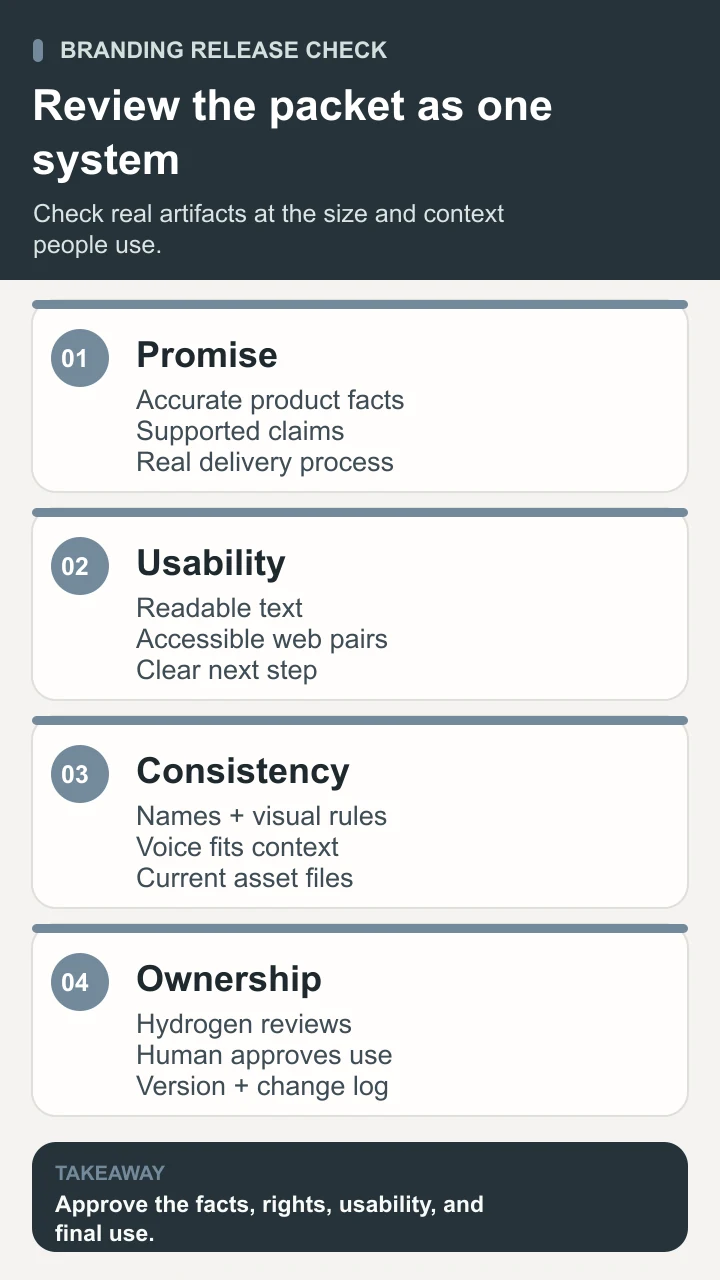
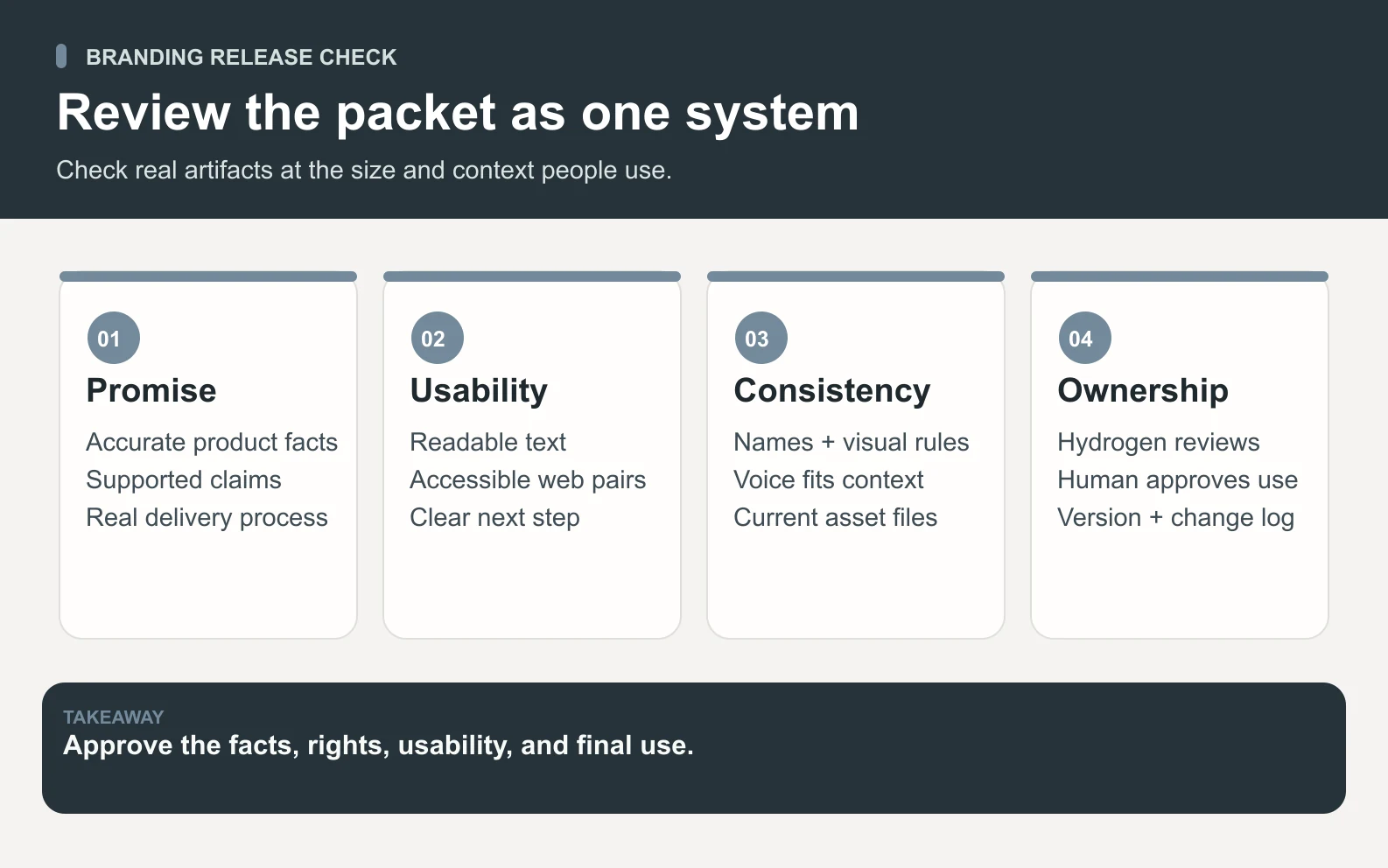
Use a simple change log after release. Record the asset version, owner, reason for change, and affected surfaces. Retire old files from the working folder while preserving any records the business needs. If the care instruction changes, update every relevant asset instead of treating the correction as a website-only task. The maintenance process is part of keeping the promise coherent over time.
Run a bounded brand workflow with Space Office
A useful Space Office assignment is a reviewed brand packet for one product line, with an internal brief and three draft touchpoints. The customer supplies approved product facts, available research, current assets, usage rights, business constraints, and the person who approves the work. Access to any design files, store platform, or customer material must be deliberately provided within the task’s scope.
Sodium can organize customer and competitor evidence when research is needed. Oxygen can turn approved evidence into positioning and go-to-market direction. Nitrogen can draft the message examples, and Boron can prepare the visual hierarchy, design-system guidance, and review notes. Aluminum can help prepare brand-consistent visual assets when the assignment requires them. Select only the roles the actual packet needs; the contributions do not require every specialist on every task.
Hydrogen coordinates the handoffs and reviews the outputs against the agreed brief. The human owner checks that the promise is true, resolves questions of taste and business priority, confirms asset rights, and approves the final use. Space Office does not automatically gain account access, publish a website, register a trademark, or establish legal clearance through this workflow. A finished packet still needs its named owner to accept it.
Specify the deliverable before starting: one brief with evidence labels, a compact visual and writing guide, three draft artifacts, and a list of unresolved decisions. Reject unsupported claims and vague rules that cannot be applied. The agent directory explains the current roles, and how Space Office works explains coordination and review. Those pages help you scope the work around a concrete output.
Effective branding becomes visible when the business makes the same credible promise understandable across its most important interactions. Begin with one customer situation, approve a brief, build a usable system, and test the touchpoints together. Expand only when the team can maintain the first set. The durable result is a shared basis for decisions and a customer experience the business can actually deliver.
Sources and review notes
Reviewed against the linked primary sources on the checked dates. Search features and citations are selected by their respective platforms; no placement is guaranteed.
- American Marketing Association: Branding — checked
- Mailchimp: Voice and Tone — checked
- Mailchimp: Brand Assets — checked
- W3C: Understanding Contrast (Minimum) — checked
Frequently asked questions
What is branding in simple terms?
Branding is the deliberate work of shaping how people recognize, understand, and experience a business. It connects a credible promise with language, visual identity, and the way the business delivers its offer.
Is branding the same as a logo?
A logo is one identifying asset. Branding also includes the promise, evidence, voice, visual system, and experiences surrounding the offer. A clear mark cannot resolve inaccurate product information or an experience that contradicts the promise.
What should a small business put in its first brand brief?
Include the customer situation, offer, promise, evidence, personality, constraints, owner, and a few acceptance criteria. Add examples for the touchpoints the team uses most. Mark assumptions and unanswered questions so they do not quietly become public claims.
How can you tell whether a new brand direction is working?
Start by checking recognition, comprehension, usability, and consistency in realistic tasks. Track relevant business outcomes separately with a clear baseline and time window. A small preference test or a polished identity does not establish higher sales, search rankings, or customer trust.
Can Space Office create the brand packet without my input?
The team needs approved facts, scope, assets, research, and any required access from the customer. Specialists prepare their assigned work, Hydrogen coordinates and reviews, and a human checks the claims, rights, business fit, and final use. Missing information remains an explicit gap.