Guide
SWOT Analysis: A Practical Guide, Worksheet, and Example
Use SWOT analysis to connect your strengths, weaknesses, opportunities, and threats to a real decision. Follow the worked example and download the evidence-and-action worksheet.
By the Space Office team · Published · Updated · 18 min read
SWOT analysis is a way to examine a business or project through four categories: strengths, weaknesses, opportunities, and threats. Strengths and weaknesses describe internal capabilities; opportunities and threats describe external conditions. Start with a specific decision, gather evidence, fill the four categories, and compare actions against your constraints. The matrix organizes information; it does not choose a strategy for you. In Space Office, Sodium can organize approved research and Oxygen can develop strategic options. Hydrogen coordinates and reviews the work, while a human verifies the evidence and selects the action.

Key takeaways
- Name the business decision and time horizon before collecting factors.
- Attach a source or an explicit assumption to every important entry.
- Keep an external opportunity separate from the action you might take to pursue it.
- Compare options against capacity and cost instead of counting items in each box.
- Give the selected action an owner, a review date, and a condition for changing course.
Download the free SWOT analysis worksheet. This original plain-text worksheet includes a decision brief, four-quadrant evidence log, option comparison, and action record. Copy it into your preferred document. The fictional web-studio example below shows how the fields work together; it is not a customer case study or a claim about business performance.
What SWOT analysis can tell you
The four letters stand for strengths, weaknesses, opportunities, and threats. A strength helps you do the work in question; a weakness limits that ability. An opportunity is a favorable condition outside the business, while a threat is an external condition that could make the decision harder or less attractive. The same business can produce different matrices for different decisions because relevance depends on the objective.
Business Queensland's SWOT guide separates internal business factors from external influences. Use that distinction to avoid mixing your abilities with market conditions. Having a reusable onboarding process is an internal capability. Customers asking for a service you do not yet offer may signal an external opportunity. Neither statement establishes that launching the service will be worthwhile.
Scroll horizontally to view all columns.
| Category | Question to ask | Example of a specific entry |
|---|---|---|
| Strength: internal and helpful | What can we reliably use to support this decision? | Our team has a documented maintenance checklist for the website platform under consideration. |
| Weakness: internal and limiting | What constraint or capability gap could obstruct the work? | Only one person can currently handle escalated maintenance requests. |
| Opportunity: external and helpful | What observed condition could make the proposed work valuable? | Existing clients have asked for continuing help after their websites launch. |
| Threat: external and limiting | What condition outside the business could make the offer harder to sustain? | Prospects compare the proposed service with competitors that advertise broader support coverage. |
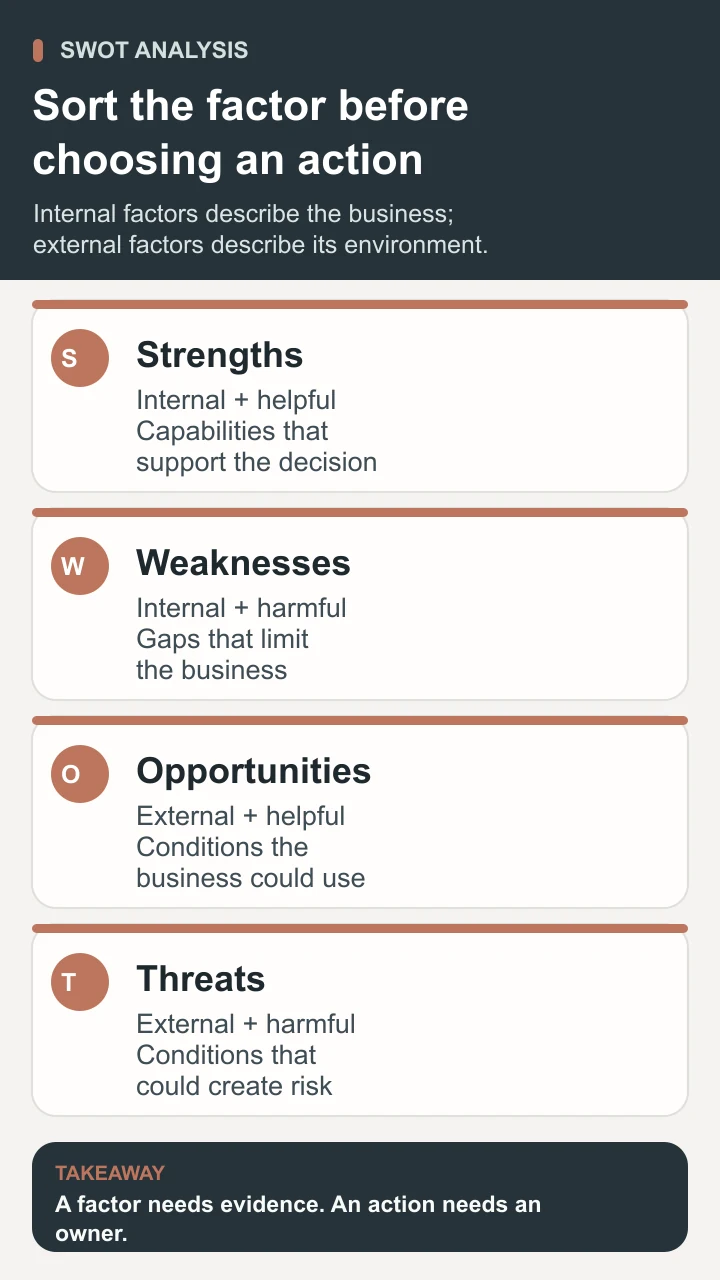
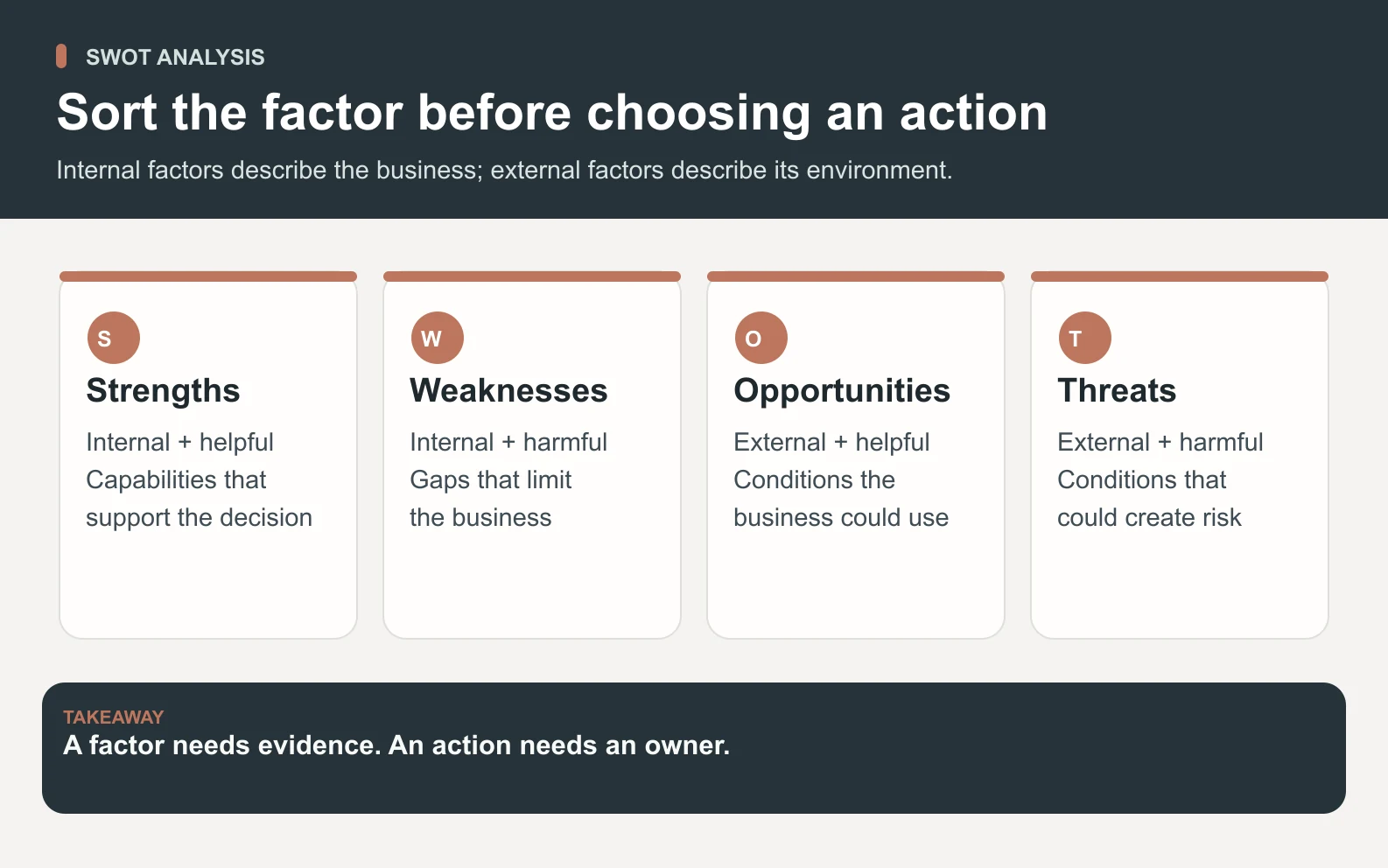
A matrix becomes misleading when its categories are treated as verdicts. A long strengths list does not outweigh one critical weakness, such as having no qualified person to deliver the promised service. A large market does not establish demand for your particular offer. Use the categories to expose relationships and questions, then assess which factors actually change the decision.
This exercise also has a different job from a detailed competitor comparison. Your own delivery constraints belong here even when competitors never see them. If you need to compare vendors, services, or customer alternatives on consistent criteria, use the competitive analysis template for that research and bring only the relevant findings into this matrix.
Set one decision and collect evidence that can change it
Write the decision as a question with a boundary. Should we pilot a monthly website-care service for existing clients over the next six weeks? is easier to investigate than How can we grow? The narrower question identifies a service, an audience, and a time horizon. It also gives contributors a reason to leave interesting but unrelated ideas outside this version of the analysis.
Record who can decide and what is fixed for this round. A small studio might have a maximum amount of delivery time available, no permission to hire, and a requirement to maintain current client commitments. These constraints belong in the brief. Otherwise, one contributor may assume a new support team while another assumes the existing developers will absorb the work.
- 1List the evidence needed for the decision: current capability, spare capacity, customer problem, available alternatives, and material dependencies.
- 2Identify approved sources for each question, such as operating records, recent customer conversations, product documentation, and dated competitor pages.
- 3Write the observation before interpreting it. Record who supplied it, when it was observed, and the scope it describes.
- 4Label uncertainty. Distinguish a documented fact, a reported experience, your interpretation, and an assumption that still requires checking.
- 5Ask a second person to challenge the entries that carry the decision. Keep disagreements visible instead of silently averaging them into agreement.
For example, three customers asked about updates is an observation if the notes support it. Customers will buy a monthly plan is an interpretation that requires more evidence. Ask what those customers wanted done, how often, what they currently do instead, and whether the proposed scope addresses their problem. A request for occasional help may not justify a recurring service.
When speaking with customers, use open questions about actual experiences. GOV.UK's interview guidance recommends neutral questions and concrete stories. Ask someone to describe the last time they needed a website change and how they resolved it. Asking whether an affordable care plan sounds useful can produce polite agreement without clarifying the work or buying decision.
Use only information you have permission to share. A summary of recurring support needs may be sufficient; a complete customer inbox usually adds unnecessary detail. Keep confidential commercial information in approved systems and provide the smallest relevant extract to collaborators. For an AI-assisted workflow, source access must be supplied or authorized; the presence of an agent does not grant access to private accounts.

Fill the four quadrants without turning guesses into facts
Use one factor per entry and explain its effect on the decision. Strong team is too broad to evaluate. Two developers can complete the proposed maintenance checklist, but only one can resolve escalations describes a useful strength and a related weakness. Split those claims so that training a backup person becomes an explicit option rather than a detail hidden under a positive label.
For strengths, identify capabilities the business can actually use during the chosen period. An impressive portfolio may help establish credibility, but it does not prove the team can provide continuing maintenance. An unused software license may be an asset, but it is not a working process. Ask what evidence would demonstrate the capability under the conditions of the proposed service.
For weaknesses, describe the constraint without blaming people. A single escalation owner is more actionable than the team is disorganized. Name its consequence: work may stop when that person is unavailable. Then check whether the problem can be reduced within the pilot's budget and time. Some weaknesses can be addressed; others should narrow the scope or delay the decision.
For opportunities, record a condition outside the organization and the evidence that it matters. Introduce a subscription is an action, so move it to the options section. Clients need help after launch is a potential opportunity, but investigate which clients, which tasks, and how they currently solve them. A broad trend can provide context without demonstrating demand in your own customer group.
For threats, explain the exposure instead of listing alarming topics. Competition is not specific enough. A competing plan includes weekend support, while our proposed offer covers weekdays identifies a difference buyers may care about. It becomes decision-relevant when you investigate whether the intended customers require that coverage. You do not automatically need to match every competing feature.
Scroll horizontally to view all columns.
| Rough entry | Why it needs work | More useful treatment |
|---|---|---|
| Opportunity: hire another developer | It describes your possible response, not an external condition. | Move hiring into the options list; record the actual demand or capacity evidence separately. |
| Strength: loyal customers | It does not explain which behavior supports the decision. | Describe relevant repeat work or referrals, with a source and period; do not assume future purchases. |
| Threat: difficult delivery | It may be an internal weakness or an external dependency. | Separate limited staff capacity from supplier outages or platform changes. |
| Weakness: no market demand | It confuses an external finding with an internal capability. | Record the demand evidence under external conditions and reassess whether the proposed offer is worthwhile. |
Allow a condition to have more than one effect when the reasoning is explicit. An established platform can make maintenance easier while creating dependence on its changes. Record the two effects separately and reference the same underlying source. Do not duplicate an identical point across boxes simply to make the matrix look balanced; an empty category is a prompt to investigate, not permission to invent.
Worked example: a web studio considers a website-care pilot
Imagine a small studio called Cedar Web deciding whether to offer monthly website care to existing clients. Every detail in this example is invented for teaching. Assume the studio has two developers, a documented checklist for one supported platform, and four hours of weekly capacity available for a pilot. Its current contracts take priority. The proposed service covers routine checks and small approved updates, with larger changes quoted separately.
The initial claim is that clients want peace of mind. That phrase is too vague to define a service. In the fictional research notes, clients ask who will handle routine changes and how to request help after launch. Cedar therefore investigates a narrower offer with explicit tasks, response expectations, and exclusions. It does not promise to prevent every outage or make a website permanently secure.
Scroll horizontally to view all columns.
| Factor | Illustrative evidence | Decision implication | Check before proceeding |
|---|---|---|---|
| Strength: a repeatable routine | A maintenance checklist exists for the supported platform. | A pilot can start with that platform rather than every website the studio has built. | Have both developers complete the checklist and record missing steps. |
| Weakness: a fragile support handoff | Only one developer handles escalations; the owner has allocated four hours weekly. | The pilot needs a backup path, limited enrollment, and explicit service boundaries. | Check coverage and log all delivery time, including communication and rework. |
| Opportunity: a recurring customer question | Fictional client notes describe uncertainty about getting help after launch. | Discuss the bounded offer with relevant existing clients before a broad launch. | Confirm the actual tasks, willingness to pay, and decision-maker. |
| Threat: expectations shaped by broader offers | Some alternative plans advertise support outside Cedar's proposed coverage. | The sales conversation must explain the coverage difference before enrollment. | Ask whether weekday coverage fits; decline customers whose needs exceed it. |
Consider a capacity assumption before choosing the pilot size. Suppose three clients each require thirty minutes of routine work per week. That uses ninety minutes. Reserving two more hours for communication and unexpected work produces a planned three-and-a-half-hour weekly workload within the four-hour limit. This is a planning assumption, not a measured delivery rate or proof of profitability. Onboarding time, software costs, and review time still need their own budget.
The matrix now changes the proposal. Cedar can offer a six-week pilot to at most three existing clients on the supported platform, after confirming an escalation backup. Enrollment remains optional, and the owner approves the commercial terms separately. If the first client needs more time than assumed, the studio can revise the plan before adding another. Filling three slots is not itself evidence that delivery is sustainable.
A different finding could produce a different answer. If customers mainly want urgent weekend repairs, the proposed service may be a poor fit. If a backup developer cannot be arranged, postponement may be sensible. The value of the exercise is that the reason for the choice is visible. The owner can revisit a specific constraint instead of debating whether subscriptions are generally a good idea.
Compare actions and choose a manageable next step
Once the factors are written, create a short list of possible responses. The list can include continuing as you are, investigating an uncertainty, reducing the proposed scope, or running a pilot. Do not force every factor to generate a separate project. Several factors may point to the same action, while one critical constraint may rule out an otherwise appealing option.
Business Queensland notes that SWOT does not itself prioritize issues or supply solutions. Add those decisions explicitly. For each option, write which evidence supports it, what it needs, what could make it fail, and what you would learn. A numerical score is optional; explaining a non-negotiable constraint is more useful than hiding it inside an average.
Scroll horizontally to view all columns.
| Cedar's option | Potential value | Main limit | Evidence needed |
|---|---|---|---|
| Launch broadly | Make the offer available to more prospects immediately. | The studio has not established delivery capacity or broader platform coverage. | Reliable workload data, coverage, and demand beyond the initial customer group. |
| Run the bounded pilot | Learn about a specific customer need and the actual delivery burden. | A small group cannot establish demand across the whole market. | Accepted terms, a backup owner, measured work time, and documented client feedback. |
| Postpone and investigate | Protect existing commitments while resolving an important uncertainty. | The business gets no operating evidence until it tests actual delivery. | A clear unanswered question, a research owner, and a date to reconsider. |
Write a decision record immediately after the discussion. Cedar's owner might authorize the bounded pilot only if escalation coverage is confirmed. The delivery lead records time against routine work, requests, rework, and review. The owner checks the record weekly and pauses further enrollment if the work exceeds the approved capacity or conflicts with existing commitments. Define that response before the team becomes invested in showing progress.
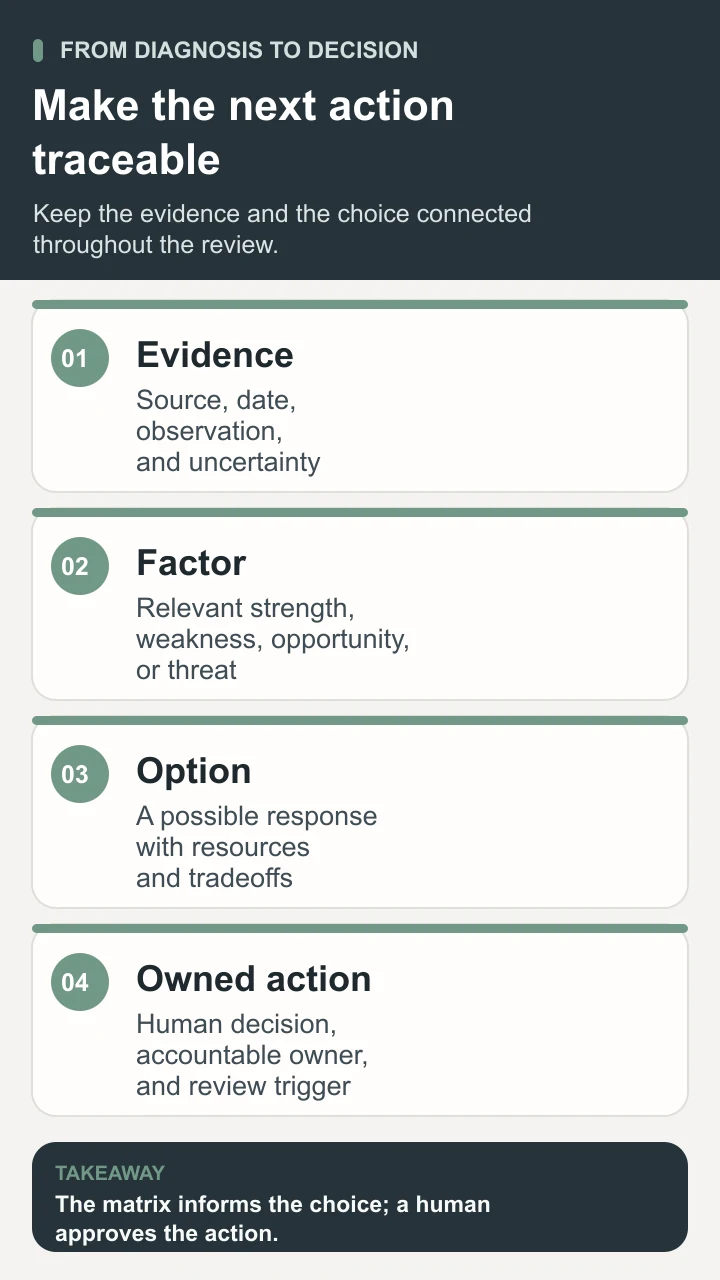
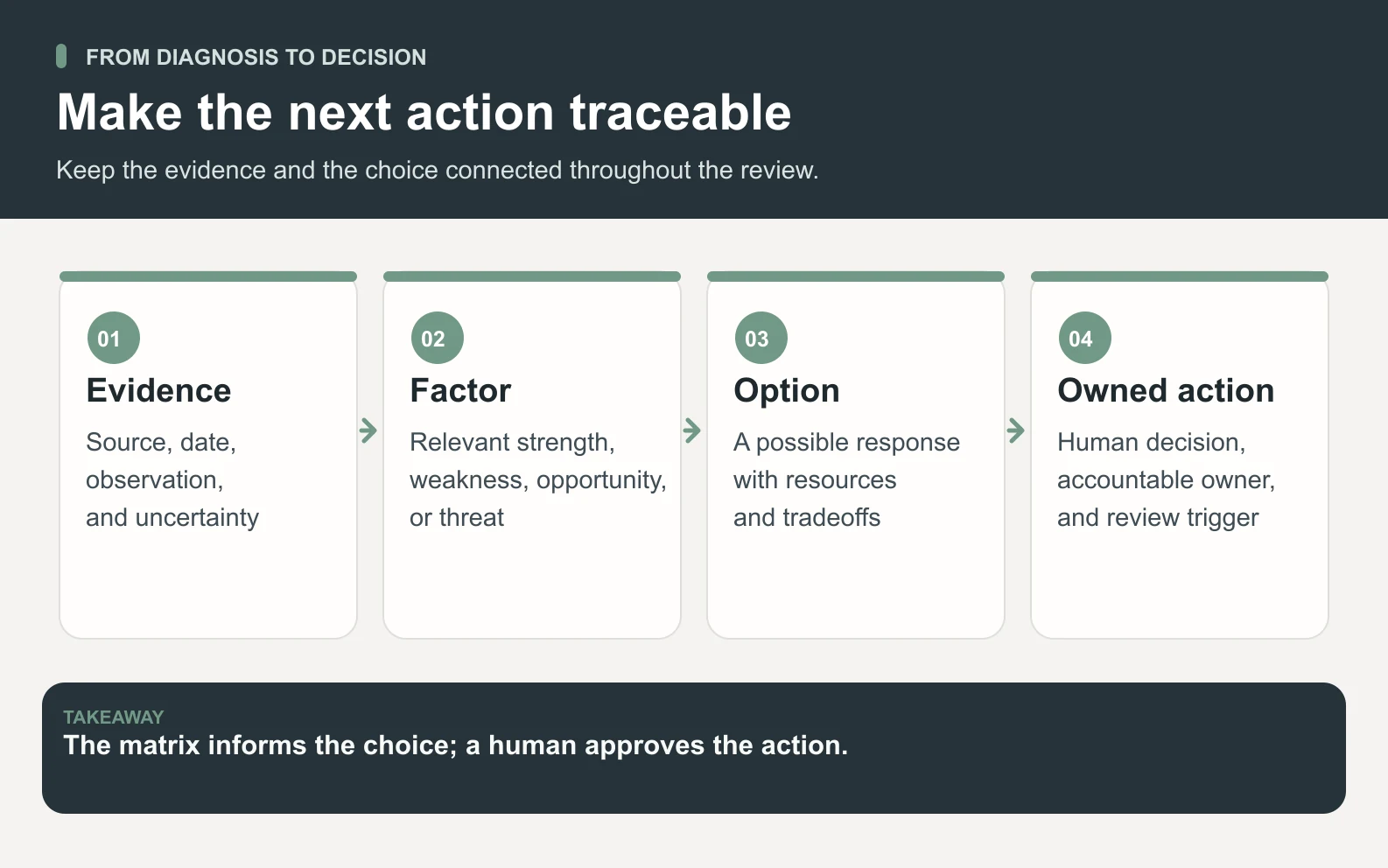
Keep communication work downstream of the decision. Once the offer is viable enough to test, use the value proposition worksheet to explain its benefit and conditions. Use the marketing plan guide when assigning channels, owners, budget, and measurement. A polished announcement cannot repair an unresolved delivery constraint.
Prepare a reviewed SWOT packet with Space Office
Give the team one bounded deliverable: a sourced matrix, a short comparison of options, and a decision record with unresolved questions. Provide the actual decision, operating constraints, current offer, approved evidence, and the human owner. If private records are needed, supply an authorized extract or explicitly approved access. Public research alone cannot establish your available capacity, customer commitments, or internal competence.
The live Space Office roster includes Sodium, the Market Research & Intelligence Specialist, and Oxygen, the Strategy & GTM (CMO) Specialist. Sodium can organize customer observations and competitor information into a source-linked research brief. Oxygen can use that brief and your constraints to develop strategic options. These are complementary contributions; a research summary should not silently become an approved business strategy.
- 1The human owner supplies the decision brief and approved materials, identifies confidential information, and explains who may approve the result.
- 2Sodium prepares the evidence log, separates observations from assumptions, and flags missing or contradictory information.
- 3Oxygen proposes a small set of actions with required resources, tradeoffs, dependencies, and questions that could change the choice.
- 4Hydrogen coordinates the handoff and reviews the packet against the brief, checking that conclusions remain connected to the supplied evidence.
- 5The human owner verifies material facts, chooses the action, authorizes any spend or external work, and sets the review date.
Make the acceptance criteria concrete. Every important factor should identify its source or assumption. Each option should state the capacity it needs. The final packet should show unresolved disagreements and the person responsible for checking them. Ask for a revised draft when a confident conclusion relies on an unverified premise; do not accept fluent prose as evidence that the premise is correct.

This workflow prepares work for a decision. It does not automatically open your business accounts, contact customers, change a service, publish a page, or authorize spending. The Space Office task flow explains coordination and review; contact the team to discuss assisted setup around the sources and permissions your workflow needs. A human remains accountable for the commercial choice and its consequences.
Keep SWOT analysis useful after the workshop
Save the matrix with a date and the decision it supported. Review it when a meaningful assumption changes: a key person becomes unavailable, observed demand differs from expectations, a dependency changes, or the pilot produces new workload evidence. A fixed meeting date can help, but an important change should not wait for the next scheduled workshop. Preserve the old version so the reason for a revised choice remains clear.
CIPD's factsheet describes the risks of insufficient evidence, unfounded assumptions, and excessive data collection. Guard against all three. A short matrix can still be unsupported; a large research folder can still avoid the decision. Focus the next check on the uncertainty most likely to change the action, and keep people with different operating perspectives involved.
For Cedar, the useful output is a reviewable decision about a defined service, backed by evidence and explicit limits. A successful workshop does not mean that the owner must launch. Choosing to narrow the pilot, gather missing information, or decline an unsuitable opportunity can be a sensible result. Record what would need to change before reconsidering.
Your SWOT analysis is ready to use when another person can follow the reasoning from source to factor to option to action. Finish the worksheet by naming the owner, the next observation, and the review date. Then use what happens to revise the decision. The four boxes provide structure; evidence, judgment, and follow-through give that structure value.
Sources and review notes
Reviewed against the linked primary sources on the checked dates. Search features and citations are selected by their respective platforms; no placement is guaranteed.
- Business Queensland: SWOT Analysis — checked
- CIPD: SWOT Analysis Factsheet — checked
- GOV.UK Service Manual: Using In-depth Interviews — checked
Frequently asked questions
What is a SWOT analysis?
SWOT analysis is a planning method that examines strengths, weaknesses, opportunities, and threats around a business, project, or decision. Strengths and weaknesses concern internal capabilities and constraints; opportunities and threats concern external conditions. Its purpose is to organize relevant information so people can compare possible actions. A completed matrix does not by itself prove demand, establish priorities, or determine which action should be approved.
What should I put in each of the four categories?
Use specific factors that matter to the decision. A documented delivery process can be a strength; limited available capacity can be a weakness. Evidence of an unmet customer need may indicate an opportunity; a supplier dependency or a relevant change in competing offers may be a threat. Include the source, date, and explanation of relevance. Avoid broad adjectives that nobody can verify or connect to the proposed work.
How is an opportunity different from an action?
An opportunity describes a favorable external condition, such as customers seeking a service that available alternatives do not adequately provide. An action describes what your business could do in response, such as testing a limited service offer. Keep them separate because several actions may address the same opportunity, and pursuing any of them may require capabilities or resources your business does not yet have.
Can a new business use SWOT analysis with little customer data?
Yes, provided the analysis clearly labels assumptions and does not treat a lack of evidence as confirmation. Start with capabilities you can demonstrate, constraints you know, relevant public information, and direct conversations with potential customers. Choose a next step that helps answer a material question. The first useful result may be a research task or a small test rather than a full launch decision.
Can AI complete the analysis for me?
AI can help organize supplied evidence, identify inconsistent statements, draft the matrix, and compare proposed actions. It can also invent plausible facts or overlook constraints that were never provided. Check material claims against their sources and keep unknowns visible. In Space Office, Sodium and Oxygen can prepare research and options, Hydrogen coordinates and reviews, and a human verifies the evidence and makes the final business decision.