Guide
Java: What It Is, Core Concepts, and a First Program
Understand Java by translating a small postcard-packing rule into a typed method, running a complete program, and checking its normal and boundary results.
By the Space Office team · Published · Updated · 16 min read
Java is a general-purpose programming language used to build applications from typed values, methods, and classes. Source code can be compiled into bytecode and run by a compatible Java runtime. In Space Office, Lithium can implement a bounded software task, Carbon can test it, and Hydrogen coordinates and reviews the work. A human approves the requirements, access, and final use.

Key takeaways
- Learn the difference between the language, development kit, compiler, and runtime before troubleshooting an installation.
- Turn one written rule into a method with explicit input types, limits, and expected results.
- Compile and run a complete, small example before adding frameworks or external services.
- Test zero, exact boundaries, one extra item, and invalid inputs against answers calculated independently.
- Keep a learning program separate from real inventory, shipping actions, and production access.
Before choosing an implementation language, the algorithm guide shows how to define a software objective, trace a scheduling rule, and test its result against independent expectations.
Download the complete Java example and the program review worksheet. The museum shop, postcard packs, capacities, and input limits are fictional teaching material. This program calculates a number and prints it; it does not create shipments or change stock.
What Java is and what the tools do
The official getting-started tutorial explains the compilation and execution cycle. You write source code in a text file, use development tools to translate it, and run the resulting application with a compatible runtime. This separation helps explain several ordinary beginner problems: a file can contain valid-looking text while the compiler cannot find it, or compilation can succeed while the wrong runtime is selected.
Use precise names for the pieces. Java is the language. A JDK, or Java Development Kit, provides tools for developing programs, including a compiler. The Java Virtual Machine executes bytecode. An editor helps you write and inspect files; it does not replace the development tools. A framework supplies conventions and libraries for a particular kind of application. None of these terms means that your actual business rule has already been implemented.
Choose the installation and release policy appropriate to your project using the distribution’s official instructions. Existing projects may require a particular supported release and dependencies. A tutorial should not silently become an upgrade plan for a working service. For this exercise, use an approved JDK that supports the conventional class and main-method form below. Check both compiler and runtime versions in the same terminal where you plan to run the example.
Java and JavaScript are separate languages. A similar name does not make their source files or execution environments interchangeable. Python offers another way to express a small program, while SQL addresses relational data. Choose a language around the project’s requirements, team knowledge, existing systems, and operating environment rather than assuming one label solves every task.
Read types, methods, and classes through one task
The language-basics guide covers variables, primitive values, operators, arrays, and control flow. In our example, an int represents a whole-number count within the range the application accepts. A variable names a value. A condition decides which branch executes. A method groups a calculation behind a name, accepting parameters and returning a result that a caller can use.
Scroll horizontally to view all columns.
| Concept | Meaning in the packing example | Reader check |
|---|---|---|
| Type | Both inputs and the result are integers. | A fractional quantity is outside this method’s input type. |
| Parameter | The caller supplies item count and box capacity. | Keep the order and meaning of both arguments clear. |
| Condition | Reject invalid values and handle an empty order. | Every accepted path returns an intentional result. |
| Return value | The method returns the required box count. | Returning a count is different from printing it. |
| Class | PackingDemo groups this small program’s methods. | The file name and public class name must agree. |
The classes and objects material explains how classes define state and behavior and how objects are created and used. This first example uses a static calculation: the caller does not need to construct a PackingDemo object before asking for a count. That is enough for a pure arithmetic rule. A larger design may use objects for orders, box specifications, or other concepts when those objects have meaningful responsibilities.
Separate the rule from presentation. The calculation method returns an integer; the main method chooses sample inputs and prints three lines. A future caller could display the same result in an interface without rewriting the rule. This separation also gives a tester a direct way to compare expected and actual values. Do not begin by combining a user interface, a database connection, and a shipping integration around an untested calculation.
Define the packing rule before writing code

Imagine a museum shop preparing identical postcard packs for storage. Each box can hold up to a fixed number of packs, and a partially filled final box is allowed. The question is the minimum number of boxes needed. This is a counting exercise: it ignores physical dimensions, weight, padding, shipping rules, cost, and whether suitable boxes are actually available. Those would be separate requirements in a real packing workflow.
The input contract accepts an item count from zero to 10,000 inclusive and a capacity from one to 1,000 inclusive. These are deliberately chosen teaching limits, not Java’s numeric limits or a logistics benchmark. A zero capacity is invalid because a box that holds no packs cannot solve the task. A negative order count is invalid because the exercise has no definition for returns or corrections.
Scroll horizontally to view all columns.
| Packs | Capacity | Expected boxes | Reason |
|---|---|---|---|
| 0 | 12 | 0 | Nothing needs a box. |
| 12 | 12 | 1 | One box fits exactly. |
| 13 | 12 | 2 | The extra pack needs another box. |
| 29 | 12 | 3 | Two full boxes hold 24; five packs need a third. |
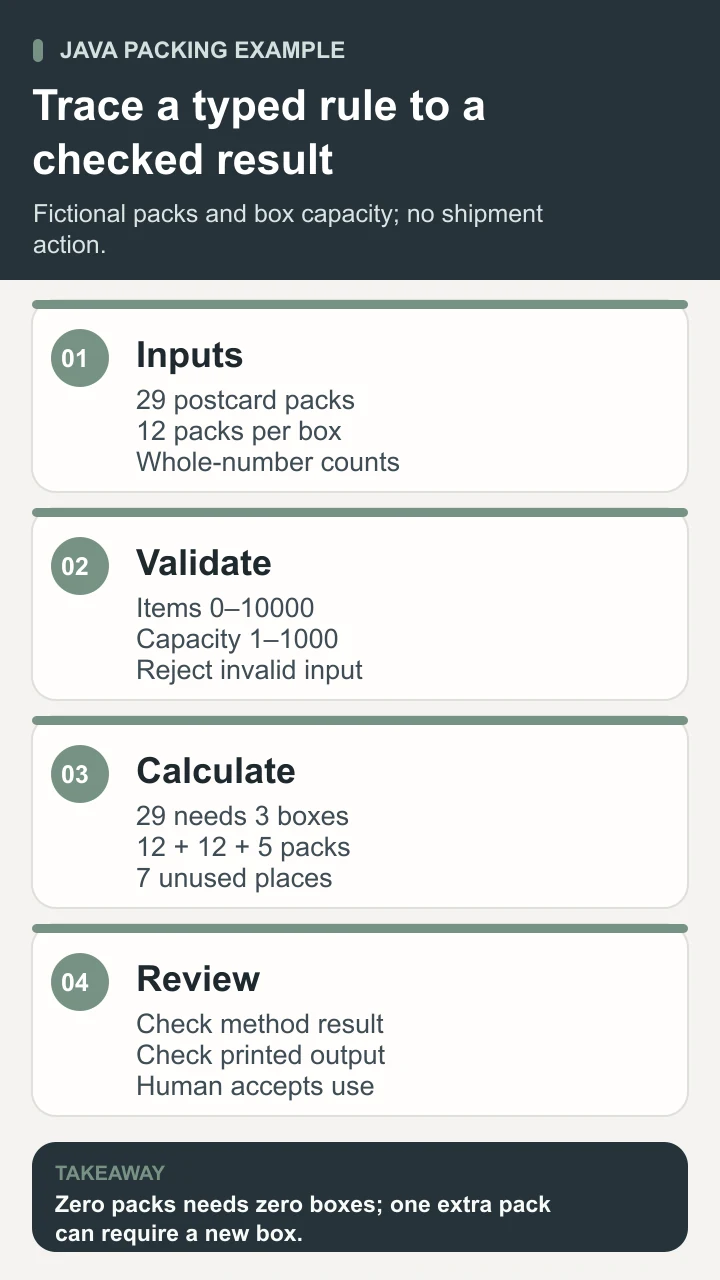
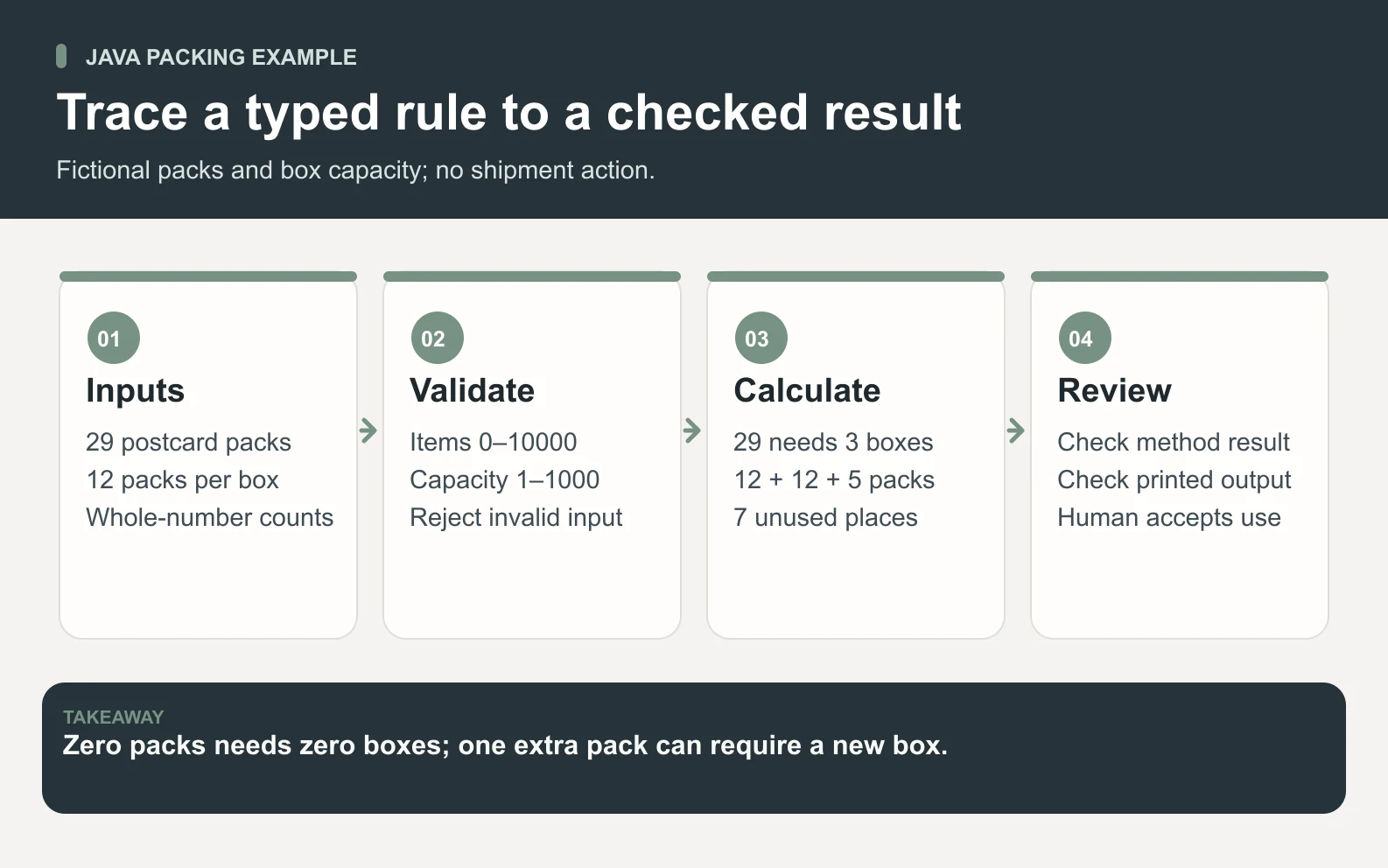
The sample result is three boxes, containing 12, 12, and five packs if you fill each earlier box first. Multiplying three by the capacity gives 36 available places, so seven places remain unused. The question asks for boxes, not unused capacity, and the method returns only the box count. Keeping those meanings distinct prevents a plausible arithmetic answer from being attached to the wrong field in a report.
Write the expected failure behavior too. Invalid input raises an exception instead of returning a believable zero. Zero already means a valid empty order, so reusing it as an error code would make two different states indistinguishable. If a real application needs a more detailed response, design that response with the caller rather than letting every caller invent a different meaning for the same number.
Compile and run the Java example
public class PackingDemo {
    public static int boxesNeeded(int itemCount, int capacity) {
        if (itemCount < 0 || itemCount > 10000) {
            throw new IllegalArgumentException("Item count must be 0 to 10000");
        }
        if (capacity < 1 || capacity > 1000) {
            throw new IllegalArgumentException("Capacity must be 1 to 1000");
        }
        if (itemCount == 0) {
            return 0;
        }
        return 1 + (itemCount - 1) / capacity;
    }

    public static void main(String[] args) {
        int itemCount = 29;
        int capacity = 12;
        int boxes = boxesNeeded(itemCount, capacity);
        System.out.println("Postcard packs: " + itemCount);
        System.out.println("Packs per box: " + capacity);
        System.out.println("Boxes needed: " + boxes);
    }
}The method first checks the item count, then capacity, then the valid empty case. For a positive item count, 1 + (itemCount - 1) / capacity calculates the box count using integer division. Subtracting one first means an exact multiple does not add an unnecessary box. With 29 and 12, the division is 28 divided by 12, giving two whole groups; adding one produces three.
This expression avoids floating-point rounding for this whole-count problem. The stated limits also keep every intermediate value comfortably within an integer’s range. Do not remove the limits while assuming the same arithmetic remains safe for arbitrary inputs. If a real requirement allows much larger counts or another numeric representation, review the range, overflow behavior, and tests as part of that change.
javac PackingDemo.java
java PackingDemoSave the complete download as PackingDemo.java in a learning folder. Confirm that your editor did not append an extra .txt extension. The compiler command creates a class file in this simple setup; the next command names the class without adding .java or .class. The expected lines are “Postcard packs: 29”, “Packs per box: 12”, and “Boxes needed: 3”. Compare all three with the approved sample.
If a command is unavailable, check installation and terminal configuration before changing the program. If the compiler reports an error, preserve the first useful message and its file and line information. A failed run is not evidence that the counting rule is wrong, and a successful run is not evidence that every possible input is handled. Diagnose the tool, syntax, and business-result layers separately.
Test boundaries and diagnose failures

The exceptions guide explains error handling through exceptions. Our method uses IllegalArgumentException for values outside its contract. That choice gives the caller a clear distinction between a returned count and rejected input. A user-facing application still needs to translate that failure into an understandable message without pretending the operation succeeded. It should retain enough diagnostic information for the responsible developer to reproduce the issue.
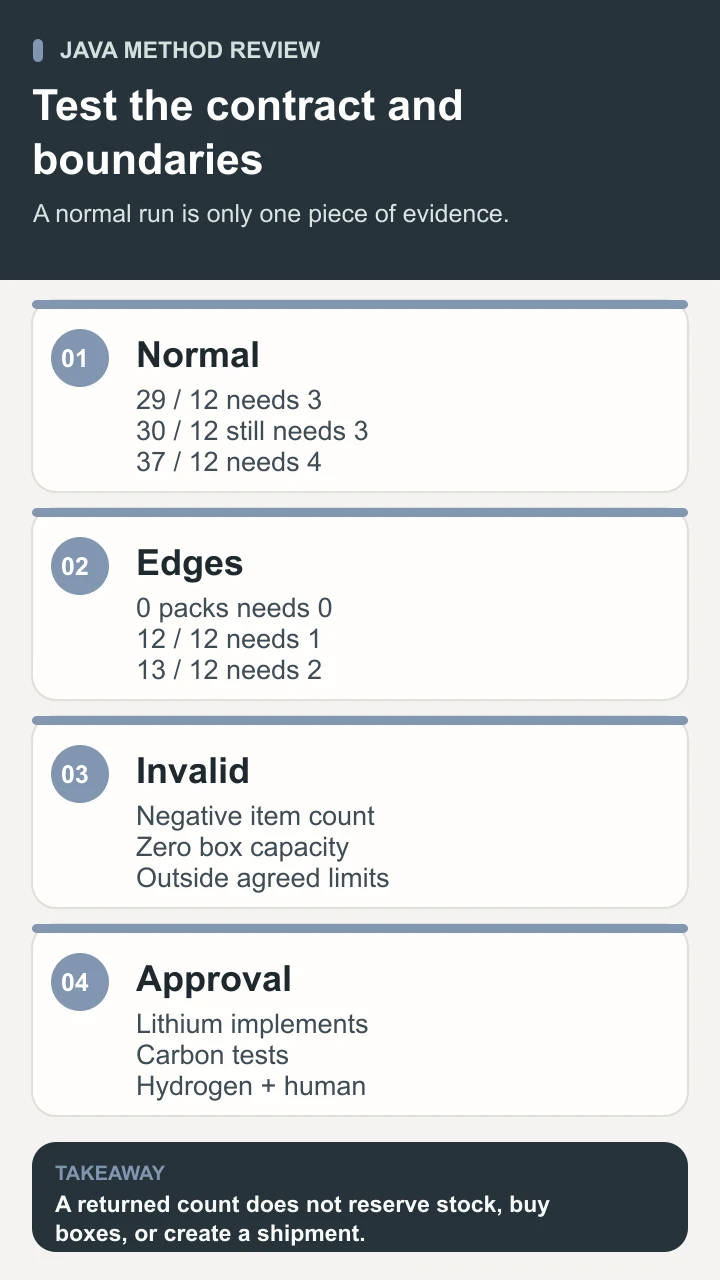
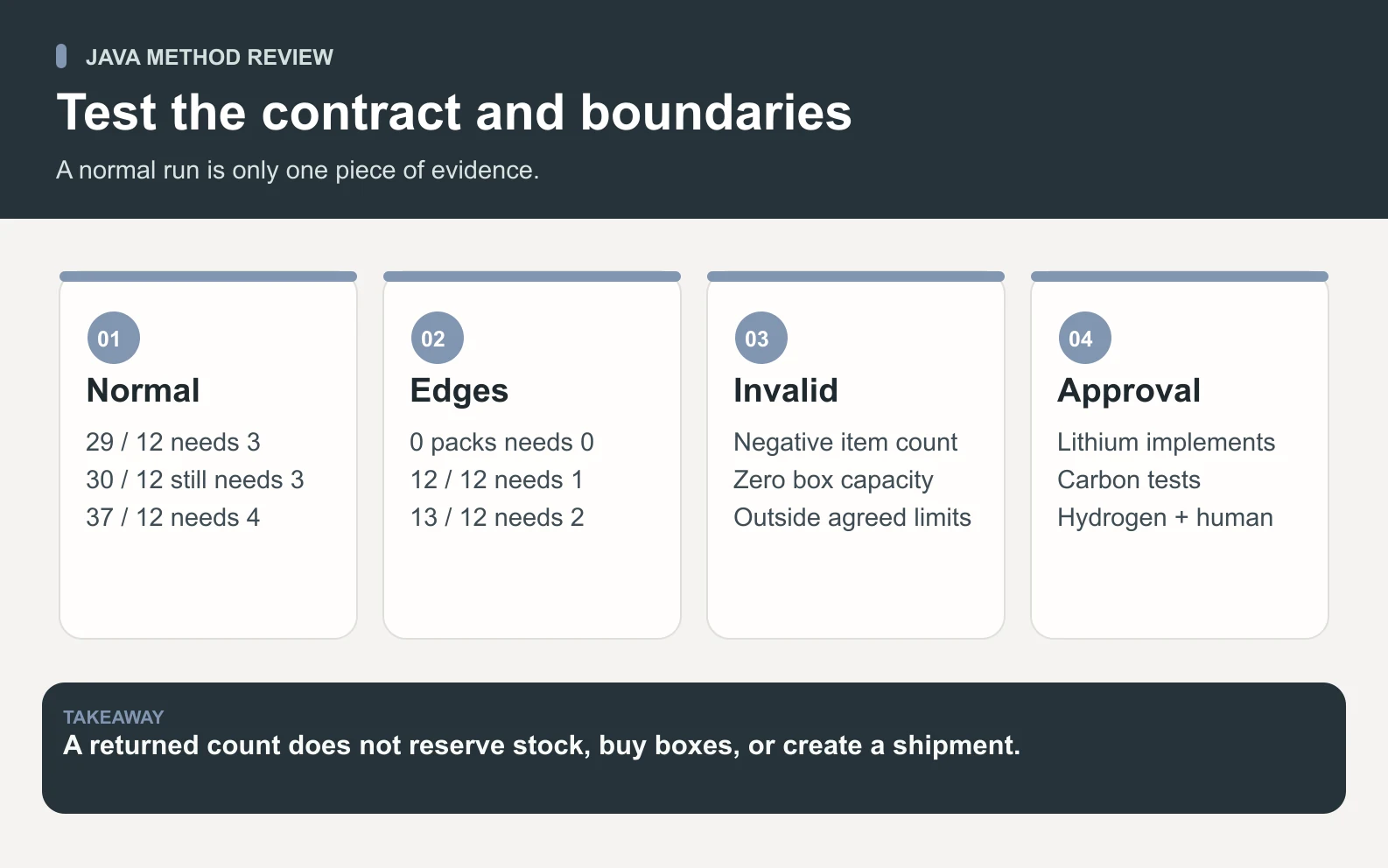
- 1Run the written normal cases: zero, one exact box, one item beyond capacity, and the 29-pack example.
- 2Test both accepted limits, including 10,000 items and capacity 1,000; the expected answer there is ten boxes.
- 3Test item counts below zero and above 10,000, and capacities below one and above 1,000; expect rejection.
- 4Change one valid input independently: 30 packs still need three boxes of 12, while 37 packs need four.
- 5Compare the returned integer directly with the expected value, then check the printed sample separately.
You can also verify a general property independently of the implementation. For a positive order, the returned boxes multiplied by capacity must hold every pack. One fewer box must be insufficient. With 29 packs and capacity 12, three boxes offer 36 places, while two offer only 24. These two comparisons check that the answer is sufficient and minimal. They are useful when adding valid test cases because they express the business requirement without repeating the method’s exact formula. For zero packs, check the separate contract that no box is required.
These checks address distinct failure modes. Testing 12 and 13 catches a rounding or off-by-one error. Testing zero catches the special empty case. Testing invalid capacities catches accidental division by zero or an undefined business state. Testing changed valid inputs helps show that the program is computing a rule rather than printing the expected demonstration answer regardless of its input.
Keep a compact test record containing the input pair, expected result or exception, actual result, and interpreter or toolchain context. When changing the method, rerun the relevant cases and explain any intentional behavior change. A screenshot of one terminal session is useful evidence for that sample, but it cannot replace the input-level checks. The worksheet provides room for both the ordinary calculation and the rejected cases.
Extend one responsibility at a time
The next useful extension might return a packing breakdown as well as a count, accept an approved list of orders, or display the result in an application. Each changes the contract. A breakdown needs a precise rule for the final box. A list needs identifiers and a policy for invalid entries. An interface needs clear input parsing and error messages. Name the new responsibility before selecting a library or creating extra classes.
Input parsing deserves its own review. A method accepting integers does not explain how text such as “12 boxes” should be interpreted. A future form must validate text, show understandable errors, and call the calculation with the correct units. Likewise, reading a database or API introduces source freshness, credentials, permissions, and failure behavior. Keep those concerns explicit instead of hiding them inside a function whose name promises only a calculation.
For an existing project, follow its conventions for packages, build tools, dependency management, and test frameworks. A learning folder with one source file is intentionally simpler. It does not establish how to deploy a service or maintain a production release. The cloud computing guide addresses hosting responsibilities, while the Docker guide explains packaging and runtime boundaries when containers are appropriate.
Use Space Office for a reviewed implementation packet
A practical assignment is one method, its input contract, and a test packet that demonstrates the agreed behavior. The customer supplies the business question, units, valid ranges, fictional or approved samples, expected failures, and relevant project conventions. Lithium can implement the software logic. Carbon can test accepted and rejected cases. Hydrogen coordinates and reviews the work against the brief, with unresolved assumptions clearly identified.
The human owner checks the meaning of a pack and a box, confirms the examples, decides whether the limits are appropriate, and approves any access and final use. Calculating three boxes does not reserve stock, buy materials, print labels, or authorize an external action. The agent directory and workflow overview explain how to scope this preparation and review process for the current roles.
Java becomes easier to learn when every language feature has a job in a small, explainable program. Start with typed inputs and one named rule, compile the complete example, and verify its result against independent calculations. Then extend one responsibility at a time, keeping the input contract, failure behavior, and acceptance evidence clear enough for the next person to maintain.
Sources and review notes
Reviewed against the linked primary sources on the checked dates. Search features and citations are selected by their respective platforms; no placement is guaranteed.
- Dev.java: Getting Started with Java — checked
- Dev.java: Java Language Basics — checked
- Dev.java: Classes and Objects — checked
- Dev.java: Exceptions — checked
Frequently asked questions
What is Java in simple terms?
Java is a general-purpose programming language for expressing application behavior with typed data, methods, and classes. Source code can be compiled into bytecode that a compatible Java runtime executes. A useful first program takes explicit inputs, applies a small rule, and returns a result a person can verify.
Is Java the same as JavaScript?
No. They are separate languages with different tools, syntax, and execution environments. The similar names do not make source files interchangeable. Choose the language and runtime required by the actual project rather than treating a browser JavaScript example as a Java program.
Do I need a JDK for this example?
The compile-and-run instructions use a JDK with javac and a compatible java runtime available in the terminal. Use an approved distribution and check the selected versions. An editor alone does not supply every required development tool, and an existing project may have its own release policy.
Why does an empty order return zero while invalid input fails?
An empty order is a valid state under this example’s contract and requires no boxes. A negative count or zero capacity has no valid interpretation here. Returning zero for those failures would confuse rejected input with a legitimate empty result. A caller should handle the exception explicitly.
Can Space Office implement a Java feature for my project?
A bounded software task can be assigned to Lithium with approved requirements and project context, while Carbon tests the behavior and Hydrogen coordinates and reviews the deliverable. A human approves business meaning, access, and release. The fictional packing method is a teaching example, not a claim that a production shipping workflow has been deployed.