Guide
Marketing Strategy: How to Make Choices That Guide Your Plan
Build a marketing strategy that explains who you serve, why they should choose you, and which activities deserve your limited time and budget.
By the Space Office team · Published · Updated · 16 min read
A marketing strategy explains which customers a business will serve, what value it will offer, why those customers should choose it, and how it intends to reach them. Create one by checking customer and competitor evidence, choosing a specific buying situation, defining a credible advantage, and deciding what to prioritize or leave aside. Space Office’s Sodium can organize the evidence and Oxygen can prepare strategic options. Hydrogen coordinates and reviews their work; a human owner verifies the facts and makes the final decisions about the offer, resources, access, and public claims.

Key takeaways
- Write choices that change what the business does; a list of channels is insufficient.
- Compare the customer’s actual alternatives, including doing the job without buying.
- Connect positioning to evidence, delivery capacity, and an offer someone can understand.
- Separate the strategic direction from the plan’s dates, tasks, owners, and budget.
- Choose a review question and decision rule before treating early activity as success.
Download the free marketing strategy worksheet to compare options and write a one-page decision. The home-organizing business and all of its operating assumptions below are fictional. Use the separate marketing plan template after choosing the direction, when you need activities, deadlines, ownership, and a budget.
What a marketing strategy should help you decide
A useful strategy lets two people make consistent choices without asking the owner about every post, enquiry, or partnership. They should understand which customer problem matters, what the offer includes, why the business is a credible choice, and what deserves less attention. If a proposed activity serves a different audience or requires an unsupported promise, the strategy should make that mismatch visible.
The American Marketing Association’s strategy guide distinguishes the long-term direction and value proposition from the actions in a marketing plan. This guide turns that distinction into a practical decision document. Its worksheet and fictional example are our own working method; they are not a universal standard or evidence that one particular strategy will produce growth.
Scroll horizontally to view all columns.
| Document | Decision it answers | Example for the organizing service |
|---|---|---|
| Strategy | Where will we concentrate, and why might customers choose us? | Help apartment movers set up one usable kitchen within a defined service area. |
| Plan | What will we do to support that choice during this period? | Prepare the offer page, brief two referral partners, and review enquiries each week. |
| Tactic | What specific action will we carry out? | Publish an approved checklist about preparing for a kitchen-organizing visit. |
Keep the business goal visible, but do not confuse it with the strategy. “Book more work” states an ambition. It does not explain whose work, which need, or why this provider fits. A stronger direction identifies a situation the team can serve well and a plausible route to reaching those customers. The plan then translates that direction into work the team can afford.
For a small team, one page is often a useful first constraint. It forces the owner to explain the choice without hiding behind a long channel list. Supporting evidence can live in an appendix. Someone reading the page should be able to say which enquiry belongs, which claim needs proof, and which tempting opportunity should wait.
Start with the customer’s situation and available evidence
Describe the moment that makes someone seek help. For the fictional organizer, an apartment move can leave the kitchen unusable just as the customer needs to return to work. That is more informative than a broad label such as “busy adults.” It suggests questions about timing, the rooms included, what the customer must prepare, and what a completed visit actually leaves them with.
The SBA’s market research guidance recommends examining demand, location, alternatives, and pricing, using existing research or direct customer research. Start with approved enquiry notes, completed-job records, and conversations about the buying decision. Record where each observation came from and when it was collected. Use the market research guide for choosing the research method.
Separate what customers said from your interpretation. “Can you help before Monday?” is an observation if it appears in an approved enquiry. “All movers want next-day service” is a much wider claim that the observation does not establish. Keep counts and sample limitations with the notes. A few conversations can reveal a useful question while leaving the size of the opportunity uncertain.
Examine the alternatives through the customer’s task. They might organize the kitchen themselves, ask a friend, hire a general organizer, buy storage products, or postpone the work. Compare the effort, uncertainty, scope, and availability of each route using information you can verify. A competitor’s public claim is evidence of its message; it is not proof of the quality of its delivery.
Write an evidence gap beside each important unknown. The owner may know that kitchen jobs fit the team’s skills but lack evidence about demand inside the proposed travel radius. That calls for a small research step before a large campaign. It does not justify filling a spreadsheet with guessed demand or treating a national search estimate as the number of local buyers.

Choose an audience, an offer, and a credible reason to buy
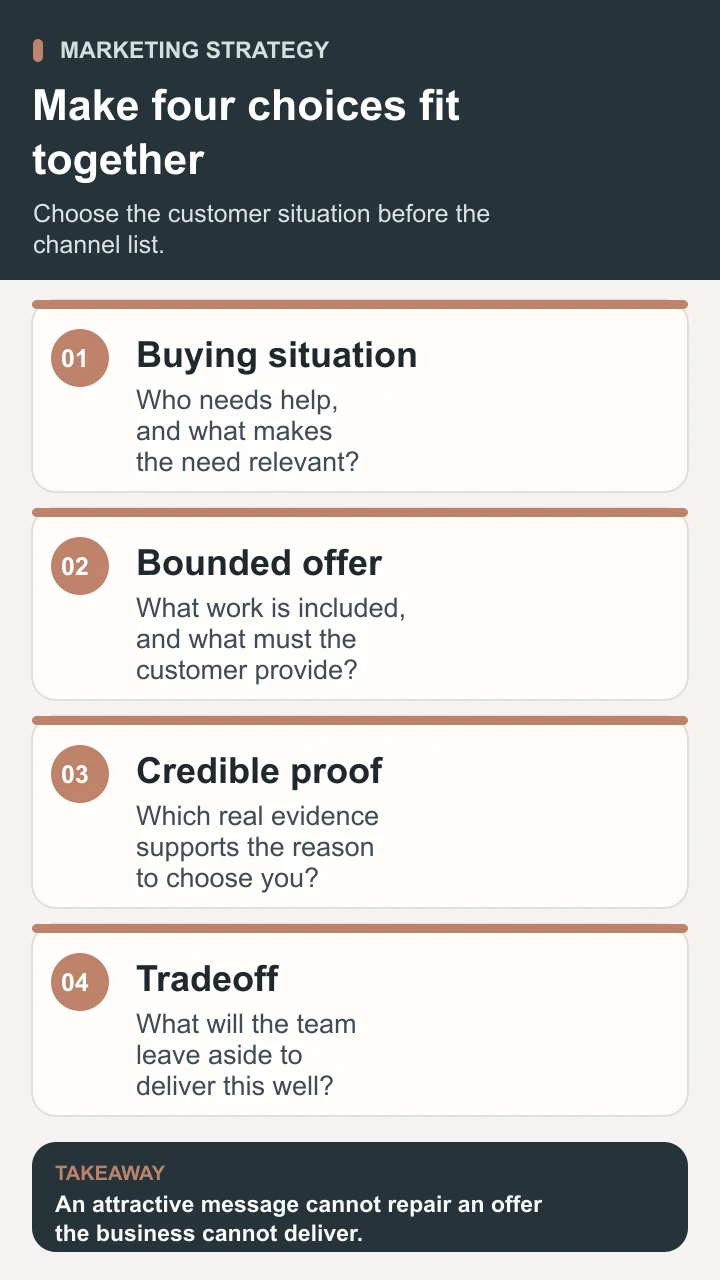
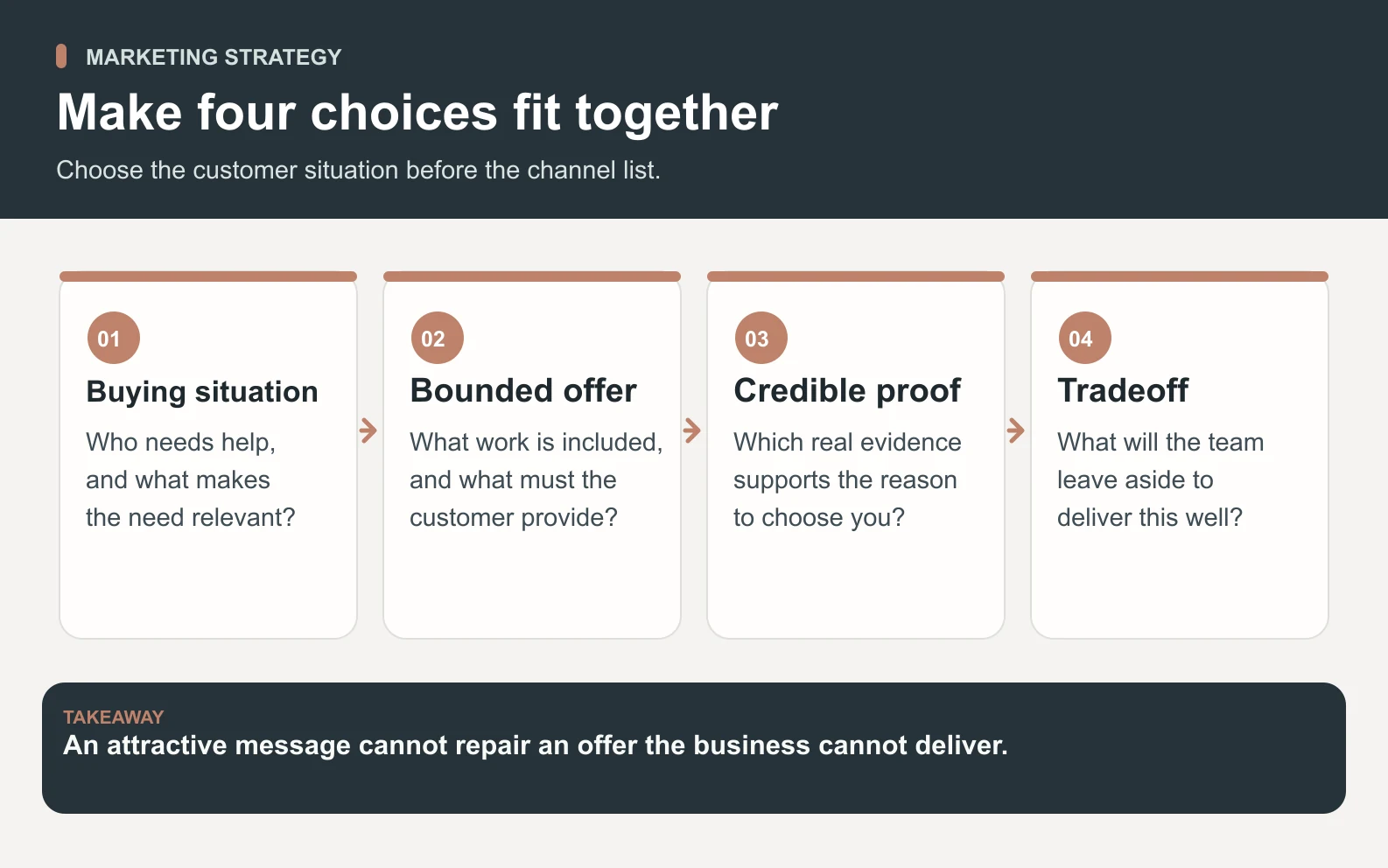
A choice becomes strategic when it changes how you use resources. The organizer compares apartment move-in kitchens with whole-home projects. Both may be legitimate services, but they require different scheduling, preparation, and customer expectations. Concentrating the first campaign on a bounded kitchen visit could simplify delivery. The owner must still check whether that service is useful and commercially workable.
- 1Audience and situation: identify who needs help, what has happened, and why the problem matters now.
- 2Offer: describe the work, its boundaries, the customer’s contribution, and the next step for checking fit.
- 3Reason to choose: connect a relevant customer concern with a capability and evidence the business can show.
- 4Tradeoff: name the work, customer group, or promise the business will leave outside this first focus.
- 5Route to market: explain how the intended customer could discover, assess, and contact the provider.
Positioning should explain a meaningful difference without inventing superiority. “A clearly scoped kitchen setup for apartment movers” says more than “the most trusted organizing experts.” The first can be supported by a real scope, preparation checklist, and approved examples. The second requires evidence for a comparative reputation claim that the fictional business does not possess.
Check the marketing mix against the positioning. The service itself must solve the stated task. The price and terms must fit the work and be approved by the owner. The service area and booking route must make delivery possible. The promotion must describe the same offer. An attractive message cannot compensate for a booking promise that the operating team cannot keep.
Use the value proposition guide to sharpen the customer benefit, then test it against the delivery reality. If the customer must buy supplies separately or remain available during the visit, say so. Useful specificity helps a suitable buyer assess the offer and helps the team decline work that would require a different service.
Compare strategic options before selecting channels
Put two or three genuinely different choices beside each other. Changing from one social network to another while serving the same customer with the same offer is usually a channel adjustment. Choosing a new customer situation, developing a different offer, or concentrating on an existing segment changes the direction more substantially. Make that distinction before committing to new work.
The AMA guide describes growth routes involving existing or new offers and markets: market penetration, market development, product development, and diversification. Use those categories to notice what must change. Serving current customers with an existing service and entering a new market with a new service require different evidence and operating preparation. The category alone does not tell you which option is best.
Scroll horizontally to view all columns.
| Option | What supports it | What remains uncertain | Deliberate limit |
|---|---|---|---|
| Apartment move-in kitchens | The team can define a single-room scope and preparation process. | Whether enough suitable movers need this help inside the service area. | No whole-home completion promise. |
| Ongoing wardrobe organizing | The owner has relevant organizing skills. | Repeat demand, visit frequency, and what customers will maintain between visits. | No recurring subscription until the service is validated. |
| Broad whole-home projects | A larger range of rooms may appeal to some households. | Scheduling, staffing, job variation, and the ability to estimate scope accurately. | Do not advertise unlimited rooms or guaranteed completion times. |
Assess the options using a few criteria with plain reasons: customer evidence, ability to deliver, access to the audience, resources required, and what the team would learn. Avoid giving arbitrary scores an appearance of precision. If the decisive criterion has weak evidence, the next decision may be a research step rather than a campaign launch.
Choose channels only after deciding how the customer searches for help and judges fit. A useful search page, a relevant moving-service referral, and an approved example may support the kitchen offer. An unrelated high-reach channel may produce attention without suitable enquiries. Use the digital marketing guide for the operating detail of an online channel pilot.
Write the one-page strategy and test its coherence
The fictional owner selects apartment move-in kitchens as a first focus, subject to validating demand and service economics. This is an illustrative decision, not the result of a market test. The strategy should state its uncertainty clearly enough that another person knows what evidence could change it. A tidy document should not make an untested assumption look settled.
Scroll horizontally to view all columns.
| Field | Fictional one-page statement |
|---|---|
| Business aim | Develop a repeatable kitchen-organizing offer that fits the current team’s available visits. |
| Customer situation | Apartment residents preparing a kitchen for daily use after moving, within an owner-approved service area. |
| Offer and boundary | A defined organizing visit with preparation requirements, exclusions, and availability checked before booking. |
| Reason to choose | Clear scope and preparation, illustrated with approved examples of comparable work. |
| Reach and assessment | A useful offer page and relevant referral conversations that lead to a fit check. |
| What waits | Whole-home promises, new geographic areas, and an untested recurring service. |
| Review question | Do suitable enquiries understand and choose this offer at terms the team can deliver? |
Run a coherence test by following one customer from the promise to delivery. Does the page attract the intended situation? Can the fit-check questions identify an unsuitable request? Does the quote describe the same scope? Can the team fulfil it without routinely adding unplanned work? Any break is a reason to revise the choice or the operating plan.
Ask what the business would stop doing if it accepted this direction. If the answer is nothing, the page may describe aspirations rather than priorities. The organizer might stop promoting broad whole-home packages during the pilot while continuing to handle existing commitments responsibly. A tradeoff is a resource decision, not an excuse to abandon customers or conceal available services.
Then build the execution plan. Assign the page, evidence collection, enquiry handling, and review meeting to named people. Set a spending ceiling and account for delivery capacity. The strategy can remain concise because the marketing plan holds the schedule and budget. Keep the documents linked so a change in direction reaches the people doing the work.
Use Space Office to prepare a decision you can inspect
Start with a bounded assignment: compare two service directions and return a strategy brief for owner review. Provide an approved offer description, anonymized enquiry themes, delivery constraints, public competitor URLs, any usable cost assumptions, and the decision deadline. Missing inputs should appear in the brief as gaps. Do not share customer details that are unnecessary for the comparison.
Sodium, the Market Research & Intelligence specialist, can organize customer evidence and public competitor information into a source-linked comparison. Oxygen, the Strategy & GTM specialist, can turn those findings into audience, offer, positioning, and channel options. These are the two selected specialists for this workflow. Hydrogen coordinates the handoff and reviews the resulting brief before the owner considers it.
Ask for a specific packet: an evidence table, two options, the recommended choice with reasons, the work left aside, unresolved questions, and a draft one-page strategy. Reject unsupported market-size estimates, invented testimonials, or claims of guaranteed demand. The human owner verifies the source facts, service capacity, prices, and final direction, then authorizes any spending, access, publication, or business change.
The live specialist directory explains the available roles, and how Space Office works describes the coordinated review model. Preparing a brief does not automatically connect an account, publish a page, or execute an advertising campaign. Use contact to discuss assisted setup for the actual task and inputs you can provide.

Review the strategy using decisions and business evidence
Before the pilot starts, define what you need to learn and how the records will answer it. For the organizer, the first question could be whether suitable enquiries understand the limited kitchen scope. Record each enquiry’s stated need, fit decision, quoted scope, booking outcome, and reason for declining where voluntarily provided. Keep those records separate from anonymous page visits.
Choose a review window that allows customers to decide and the team to deliver. Compare like periods and show the actual counts. More page impressions can indicate visibility, but they do not establish demand for the offer at its price. A small number of completed jobs can reveal delivery problems without establishing a stable booking rate or a causal marketing effect.
If you use Google Analytics, campaign URL parameters can identify which tagged campaigns referred traffic. Keep source, medium, and campaign names consistent. Those tags describe recorded traffic; they do not establish that the campaign caused a sale or identify every route a customer took. Combine web reporting with appropriately collected business records when assessing the strategy.
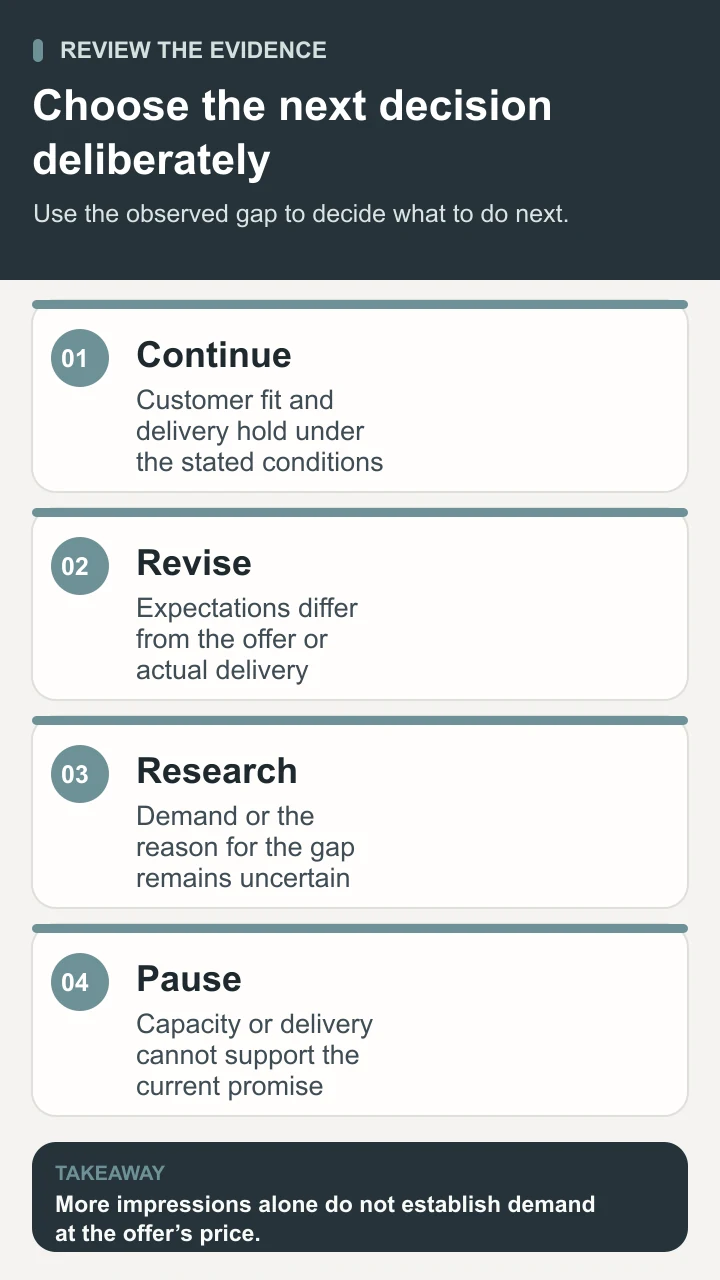
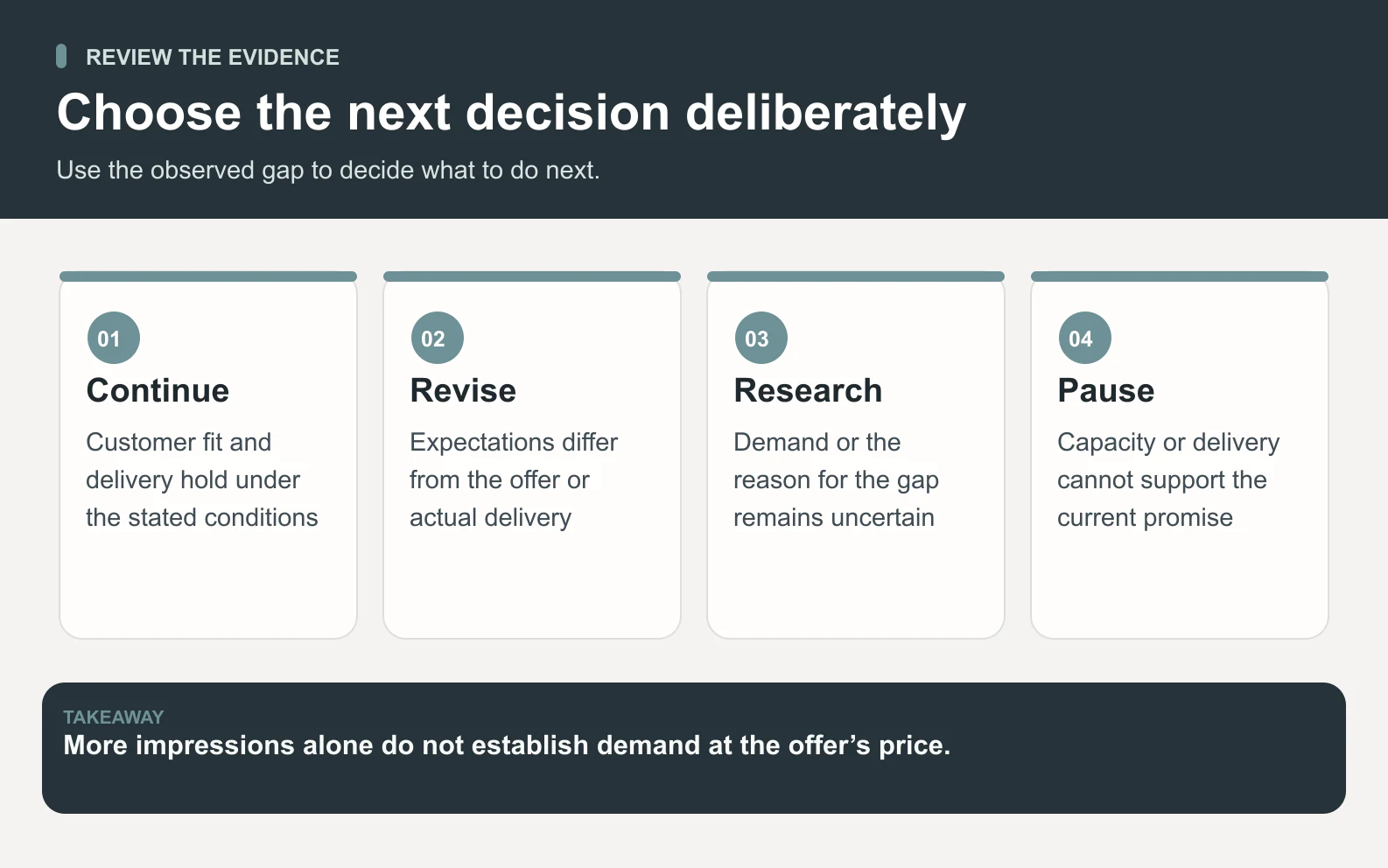
Use four possible decisions: continue the focus, revise an element, collect missing evidence, or pause the pilot. For example, repeated requests for work outside the scope could mean the audience or message is wrong. Strong interest with poor delivery fit could mean the offer needs redesign. Few visits and no suitable enquiries leave demand uncertain; they do not prove that the entire segment is unviable.
Preserve a short change log with the date, evidence, decision, and owner. If the business changes the price, service area, and page at once, the next review cannot isolate the effect of one change. That may be an acceptable operational choice, but the report must describe the combined change honestly. Use a designed test only when its assumptions and sample needs fit the decision.
Make the marketing strategy useful in everyday work
A marketing strategy earns its place when it helps the team choose an offer, answer an enquiry, assess a channel, and decline a distraction. Keep the customer situation, credible value, delivery boundaries, and review question together. The home-organizing example works as a decision exercise because each choice affects the next; it is not a promise that a narrow service automatically succeeds.
Complete the worksheet with one real decision and the evidence available today. Mark the largest unknown, choose the smallest useful next step, and name the person who can approve it. Once the direction is coherent, build its action plan. If you sell to organizations, the B2B marketing guide extends the method to account fit, buying groups, and evidence people can share inside a company.
Sources and review notes
Reviewed against the linked primary sources on the checked dates. Search features and citations are selected by their respective platforms; no placement is guaranteed.
Frequently asked questions
What is marketing strategy?
Marketing strategy is the set of choices a business makes about which customers to serve, what value to offer, why it can credibly compete, and how it intends to reach those customers. It guides resource allocation and the work the team leaves aside. A practical strategy states its evidence and assumptions so the owner can review it when the market, customer need, or delivery capacity changes.
What is the difference between a marketing strategy and a marketing plan?
The strategy explains the direction and reasons for the choice. The plan specifies the actions, owners, dates, budget, and measurements that put it into practice. They should describe the same audience and offer. If the strategy changes, update the plan so the people preparing pages, handling enquiries, and approving spending are working toward the new direction.
What are the main elements of a marketing strategy?
A useful first version includes a business aim, customer situation, offer, credible reason to choose, route to market, tradeoffs, and review question. Add evidence references and unresolved assumptions. The exact format can vary. The test is whether the document helps someone make a real choice and whether the business can deliver what it proposes.
How do you choose the right marketing channel?
Begin with where the intended customer looks for help, whom they trust, and what evidence they need before acting. Check that the channel can lead to a relevant page or conversation and that someone can handle the response. Start with a manageable test and a defined spending or time limit. Broad reach alone does not establish customer fit or business value.
Can AI write a marketing strategy for a small business?
AI can help organize approved evidence, compare options, and draft a decision document. It cannot establish missing customer demand, verify an unavailable cost, or decide what the owner is willing to commit. In the Space Office example, Sodium researches, Oxygen prepares options, and Hydrogen coordinates and reviews. A human verifies facts and approves the final direction and actions.