Guide
Copywriting: How to Write Clear Copy, With Examples
Make copywriting practical: explain a real offer, support its promises, and help the right reader choose a useful next step.
By the Space Office team · Published · Updated · 18 min read
Copywriting is writing that helps a specific audience understand an offer and decide whether to take an action. Start with the reader's question, verify the offer, explain a useful benefit, support the promise, and make the next step clear. In Space Office, Oxygen can prepare the audience and offer brief, Nitrogen drafts and edits the copy, and Hydrogen coordinates and reviews their work. The human owner verifies the facts and approves the final message and publication.

Key takeaways
- Write for one reader decision before choosing a headline or formula.
- Connect each benefit to an accurate feature, condition, or piece of evidence.
- Draft the headline, explanation, action, and practical details as one connected message.
- Use a reader check to find misunderstandings before evaluating persuasive performance.
- Treat copy quality, campaign activity, completed actions, and business results as separate observations.
When the copy is part of a wider instructional asset, the content creation guide shows how to keep source evidence, written steps, diagrams, downloads, and the final review consistent.
Download the free copywriting worksheet to collect offer facts, build a message, edit a draft, and record reader questions. It includes the fictional pottery-class example in this guide. For the wider publishing program around an individual piece of copy, use the separate content marketing guide.
What copywriting needs to accomplish
A person arriving on an offer page usually needs answers before they need enthusiasm. What is this? Is it suitable for me? What will I receive? What does it require? What happens if I continue? Copy gives those answers a useful order. Persuasion comes partly from making a relevant offer understandable, rather than adding stronger adjectives to an uncertain promise.
Mailchimp's introduction to copywriting describes action-oriented writing across marketing formats. In practice, the action changes the job: a product description helps someone evaluate an item, an email explains a reason to return, and a button names what happens next. Those pieces should agree about the offer even when their length and emphasis differ.
Scroll horizontally to view all columns.
| Copy | Reader question | Useful result |
|---|---|---|
| Offer page | Is this the right service or product? | Understand scope, evidence, conditions, and the next step |
| Advertisement | Why might this matter to me? | Recognize a relevant promise that the destination can support |
| Why am I receiving this now? | Understand the context and a suitable action | |
| Form or button | What am I agreeing to do? | Predict the action and the information needed |
Copywriting and content writing overlap. A detailed guide may teach a task while an offer page supports a buying decision. The useful distinction is the reader's immediate purpose, not a rule that one format must be short or aggressively promotional. A long page can still omit a crucial condition; a short sentence can explain the offer precisely.
Start copywriting with an evidence brief
Before drafting, write down the situation that brings the reader to this message. A beginner looking for a relaxed pottery class has different questions from an experienced maker seeking kiln access. Describe the task and constraints without inventing a psychological profile. Use real customer questions, approved research, or an explicit hypothesis. The target audience guide helps when that choice is still unclear.
Collect the offer in a small evidence sheet: what is provided, who it suits, what is excluded, price and inclusions, timing, location or availability, and the action the business can fulfil. Give each fact an owner and a current source. A service schedule, product specification, approved policy, or operating record is more useful than a copied competitor promise. Mark unknown details instead of filling the gaps with plausible language.
Translate a feature into a benefit through a specific use. Providing clay and firing may let a beginner attend without arranging those materials separately. It does not establish that every attendee will make a flawless bowl or discover a new career. Keep the connection narrow enough that the owner can explain why the benefit follows from the offer. Use the value proposition guide for a broader message about the business.
Separate facts that can be published from internal context. A customer complaint may reveal a confusing phrase, but that does not make the person's message an approved testimonial. Preserve the lesson without exposing private details. If a proof point is unavailable, explain the real process or show a relevant example; do not invent a quote, a customer count, a certification, or a performance result.
Build the message around one reader decision
Choose the decision this particular message should support. A first visit may need a clear explanation and a way to inspect available classes. A returning customer may be ready to select a date. Asking both people to make an immediate purchase can skip information that one of them still needs. Describe the next useful action in ordinary language before writing the final button label.
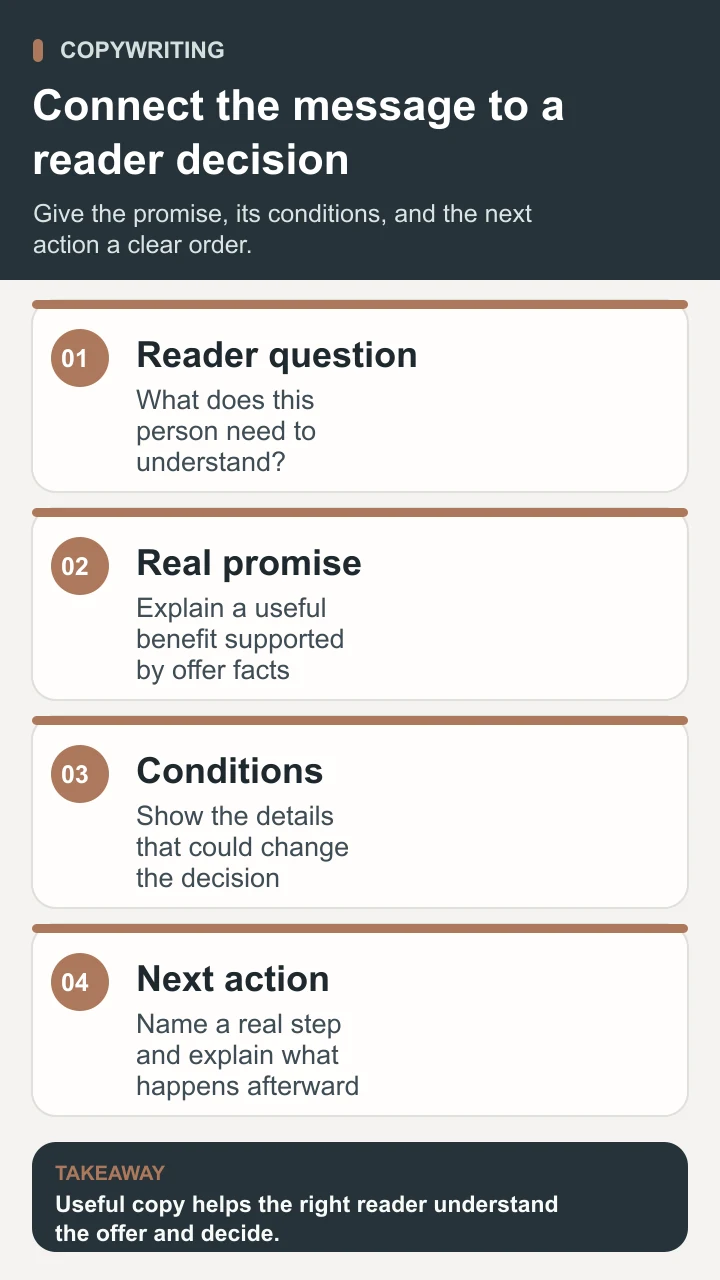
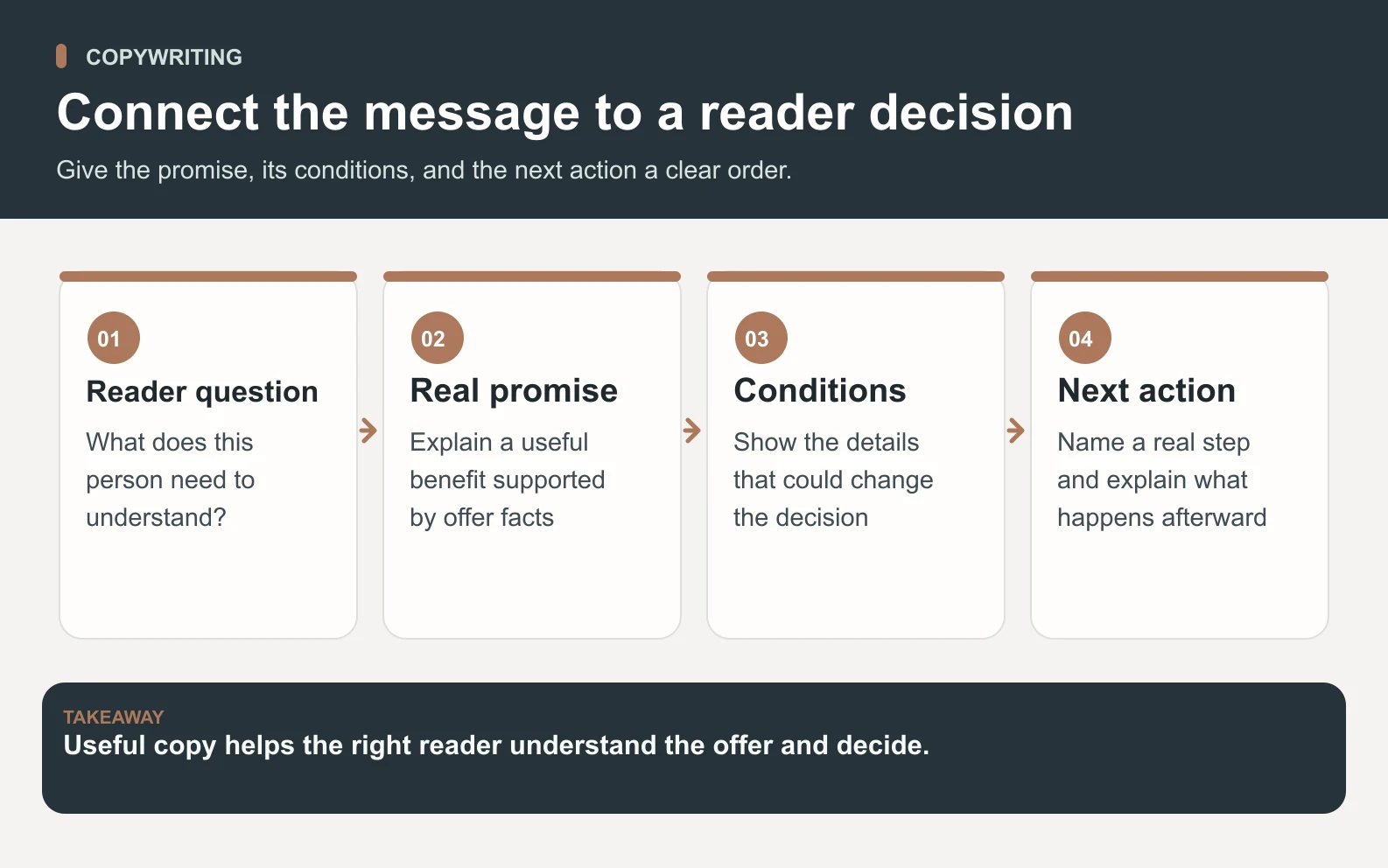
- 1State the reader's question: what must they understand or evaluate here?
- 2Name the offer and its relevant benefit in a sentence the owner can substantiate.
- 3Choose the strongest appropriate support: a concrete inclusion, demonstration, source, or authorized example.
- 4Identify the condition most likely to change the reader's decision, such as location, preparation, timing, or price.
- 5Specify a next action that exists and explain what happens after it.
Use this sequence to decide what deserves prominence. If collection takes several weeks, hiding that detail in a distant FAQ can leave someone with the wrong expectation. If no experience is required, make that suitability clear before discussing specialist techniques. The priority follows the reader's decision, not the order in which the business team supplied information.
Frameworks such as attention, interest, desire, and action can help organize a draft. They do not supply missing evidence or require an invented problem. Use a framework as a question list, then remove any step that repeats the message or pressures the reader without adding useful information. A well-informed decision to leave can be a better outcome than an unsuitable booking.
Draft the headline, explanation, and action together
Write a plain version first. Name the thing, the audience or situation it serves, and the reason it might help. A headline such as 'Beginner hand-building pottery class' communicates more than 'Unlock your creative potential' when the immediate task is identifying the activity. An expressive line can follow once the reader knows what the business is offering.
Use supporting copy to answer the next question rather than restating the headline. Explain what the person will do or receive, then add the condition needed to interpret that benefit. Group closely related details. Price, inclusions, and extra costs belong together; session length and collection timing describe different stages and should not be combined into an ambiguous promise about when the finished object is ready.
Make the action label specific to its destination. 'See class dates' should open the available-date view; 'Request an assessment' should not unexpectedly start a paid subscription. Put the explanation of the next step beside the action where it helps. If a response requires human review, state the actual response process rather than implying an instant commitment the business cannot make.
Draft the surrounding small words too: field labels, hints, errors, confirmation messages, and the explanation of any required information. 'Something went wrong' does little to help a reader recover. A truthful message such as 'Choose a session date before continuing' identifies a fix when that is the actual problem. Check these words in the working experience, because a persuasive page cannot repair a broken action.
For search-oriented pages, use the words people need to recognize the subject and answer their real question. Google's people-first content guidance emphasizes useful, reliable content for an intended audience. Repeating a phrase or padding a page does not make the offer more understandable. Put helpful detail where it serves the decision, then use the digital marketing guide to connect the page with appropriate channels.
Worked example: rewrite a pottery class page
This example is fictional and illustrates editing choices, not a customer campaign or a measured conversion improvement. A small studio offers a two-hour beginner hand-building class for adults. Each person makes one small bowl. The $65 price includes materials, glazing, and firing for that piece. The finished bowl is normally ready for collection about three weeks later. Available dates are shown in a calendar; each session has twelve places.
Scroll horizontally to view all columns.
| Element | Vague draft | Revised copy |
|---|---|---|
| Headline | Unleash your inner artist | Make your first hand-built bowl in a beginner pottery class |
| Explanation | An unforgettable creative experience | Spend two hours learning simple hand-building techniques in a guided adult class. No previous pottery experience is needed. |
| Price | Everything you need at one great price | $65 per person includes materials, glazing, and firing for one small bowl. |
| Timing | Take home something special | Your finished bowl is normally ready to collect about three weeks after class. The studio will email you when it is ready. |
| Action | Start your journey | See class dates |
| Next-step explanation | Limited availability. Act now! | Choose an available session and review the booking details before checkout. Each session has twelve places. |
The new headline names the activity and a concrete learning task. It does not promise artistic mastery. The explanation establishes beginner suitability without implying that a wheel-throwing course is included. Price copy identifies what the fee covers. Collection copy corrects the likely assumption that a fired bowl can leave with its maker at the end of the two-hour session.
The calendar remains the source for current availability. Twelve places describes session capacity; it does not justify claiming that only two are left unless the current booking record supports that statement. The owner also checks whether the quoted collection timing and included work still match the studio's actual process. If those facts change, the copy and booking confirmation must change together.
Keep a short editorial note beside the revision: which misunderstanding did this change address, and which source supports the replacement? For this example, the main corrections concern class method, included work, and collection timing. That note gives the next editor a reason to preserve the useful detail instead of replacing it with a more dramatic line that recreates the problem.
Edit for clarity, tone, and the reader's situation
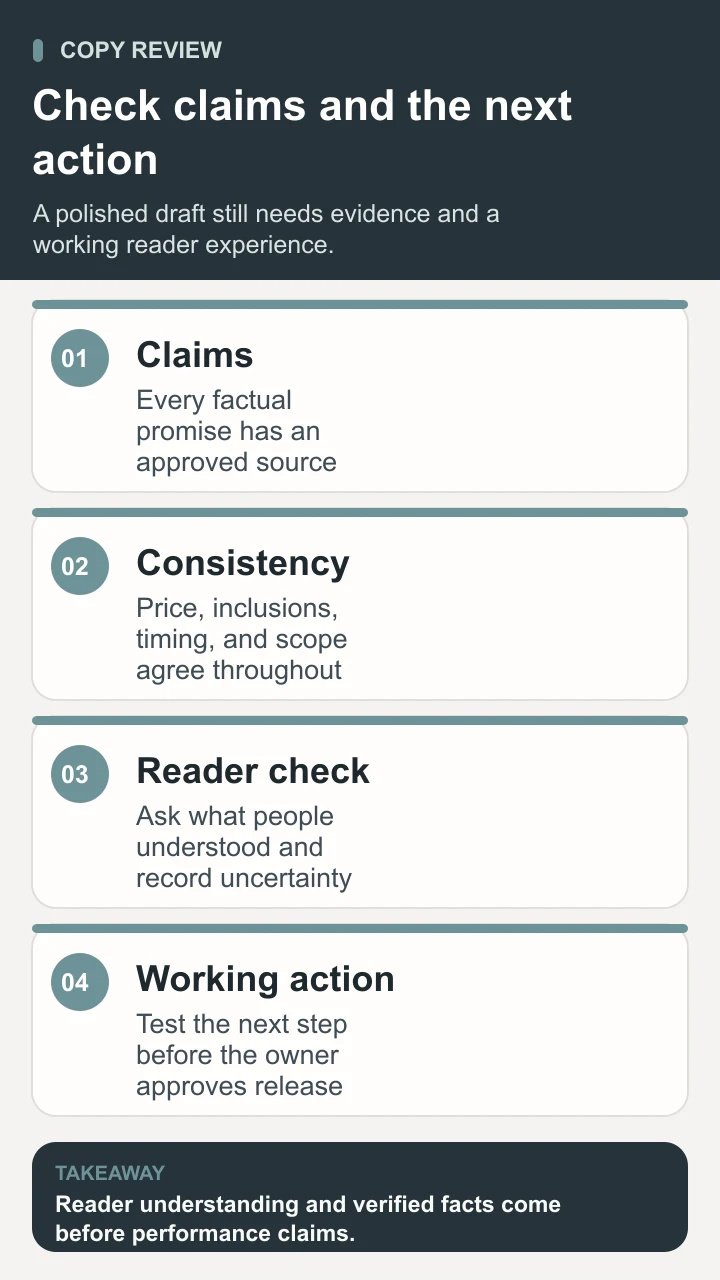
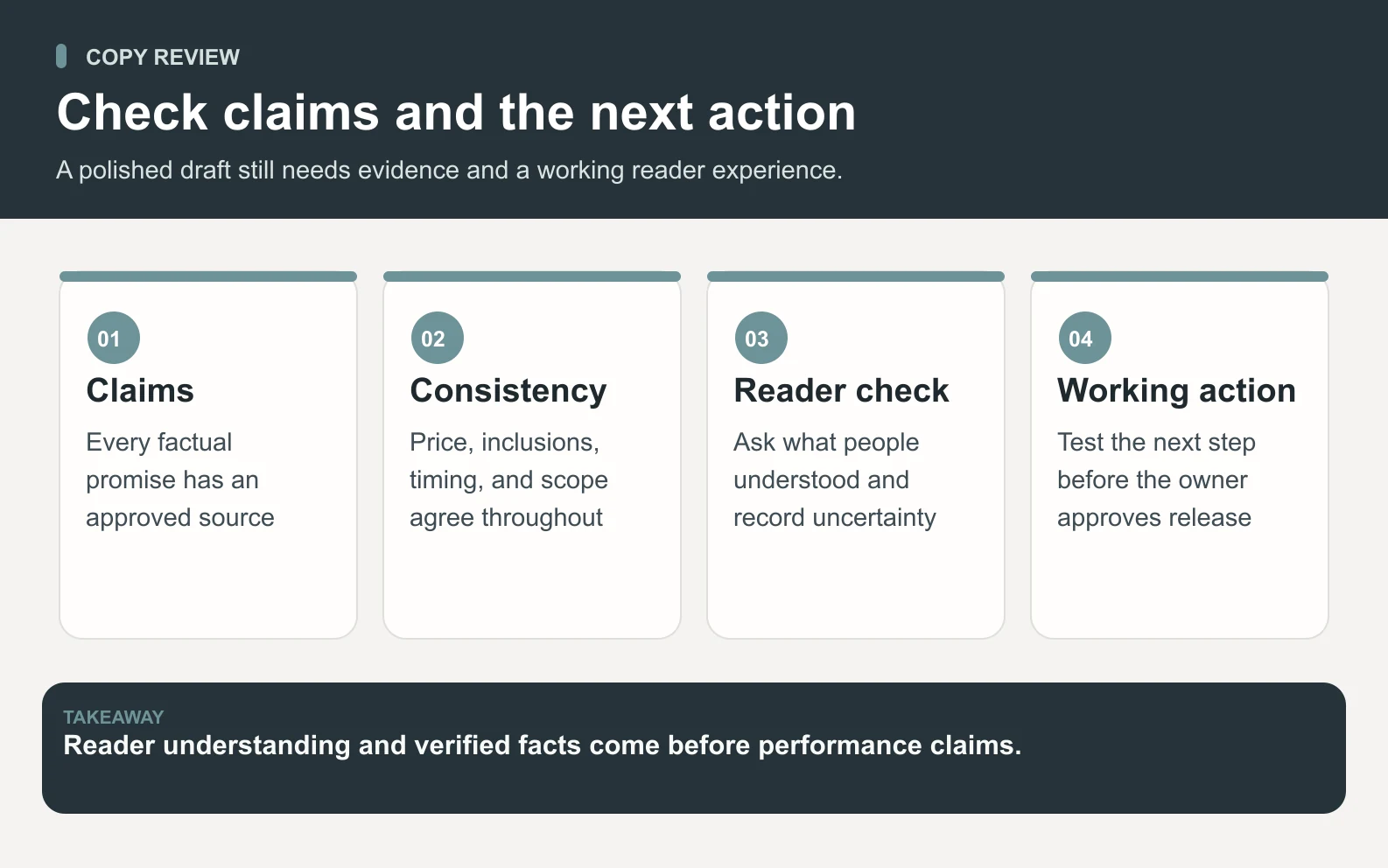
Run separate editing passes. First check meaning: does every sentence say what the business intends? Next check support: can the owner verify each factual promise? Then check usability: can a reader find the answer and predict the action? Finish with grammar, rhythm, and voice. Polishing a sentence before checking its meaning can make a wrong claim sound more convincing.
Choose words your audience can interpret. A practitioner may need a technical term; a beginner may need a brief explanation beside it. Remove vague qualifiers where a concrete detail is available. Read the text aloud to hear repeated ideas and awkward transitions, but also inspect it silently on a phone. A paragraph that sounds smooth can still bury its only useful fact at the bottom.
Keep a recognizable voice while adjusting tone to the situation. Mailchimp's voice and tone guide makes this distinction in its own editorial practice. A warm class introduction and a message about a delayed collection can come from the same studio without using the same level of excitement. Clarity and consideration matter more than forcing a joke into every message.
Ask someone resembling the intended audience to explain the offer after reading it. Use neutral questions: What would you do in the session? What is included? When would you collect the bowl? What happens after the button? Record the answer and the wording that caused uncertainty. A few reader conversations can reveal misunderstandings; they do not establish a population-wide conversion effect or justify a numerical performance claim.
Prepare a reviewed copy packet with Space Office
Give the team a bounded job: revise one offer page and its immediate action messages. Supply approved service facts, source documents, existing copy, actual customer questions you are permitted to share, voice examples, and the intended destination. Name an owner for unanswered questions. Remove personal information that is not needed to understand the writing task.
- 1Oxygen prepares a concise audience, offer, and reader-decision brief from the supplied evidence. Hypotheses remain labeled as hypotheses.
- 2Nitrogen drafts the headline, supporting copy, practical details, action label, and immediate response messages. It supplies alternatives with reasons rather than declaring an untested winner.
- 3Hydrogen coordinates the handoff and reviews the draft against the brief, highlighting unsupported claims, contradictions, and missing inputs for correction.
- 4The human owner verifies facts, tests the destination, checks the full reader experience, and approves the final wording and publication decision.
The deliverable should include the draft, a claim-to-source record, unresolved questions, and a short explanation of material edits. Check the live specialist roster and coordination workflow before choosing roles. Naming a specialist does not connect a publishing account or authorize an external action. Scope implementation or publishing access separately when it is actually needed.
Improve copywriting from reader evidence
After release, keep a dated copy version and record the question the change was intended to address. Check suitable evidence: repeated questions, misunderstood inclusions, form errors, completed bookings, and cancellations with a known reason. A click on the action is an activity; it is not automatically a completed booking, a new customer, or profitable work. Compare like periods and preserve the source and definition of each count.
A before-and-after improvement may also reflect different traffic, prices, availability, seasonality, or a repaired form. If you need to estimate the effect of a specific wording change, use the separate A/B testing guide to plan an appropriate comparison. Do not announce a winning variant from a handful of unmatched visits or treat a small reader check as a conversion experiment.
The next useful copywriting edit is often a precise answer to a real uncertainty: what is included, who the offer suits, how long something takes, or what the action means. Preserve accurate details, remove unsupported promises, and improve the connection between the reader's need and the service the business can fulfil. Clear copy gives the right person a better basis for deciding.
Sources and review notes
Reviewed against the linked primary sources on the checked dates. Search features and citations are selected by their respective platforms; no placement is guaranteed.
Frequently asked questions
What is copywriting?
Copywriting is writing that helps a particular audience understand an offer and decide whether to take a specific action. It includes headlines, offer pages, advertisements, emails, product descriptions, and the small messages around forms and buttons. Useful copy makes the promise, relevant conditions, and next step clear. Its claims should match facts the business can verify.
How can a beginner start writing copy?
Choose one page and one reader decision. Gather the offer's approved facts, write the reader's main question, and draft a plain explanation before trying more expressive wording. Add a supported benefit, the conditions that affect suitability, and a clear action. Ask an intended reader to explain the offer back to you, then revise the points they misunderstood.
What is the difference between copywriting and content writing?
The purposes overlap, but a specific piece of copy often supports an immediate decision about an offer or action, while educational content may focus on teaching a wider task. An article can contain action-oriented copy, and a product page can teach. Choose the format and level of detail from the reader's need instead of assuming that persuasive writing must always be short.
How do I know whether new copy works?
First check whether readers understand the offer and can use the next step. After publication, review defined activities and business outcomes using matched periods and sources. More clicks alone do not establish more suitable customers or a causal effect from the wording. A planned experiment may help answer a specific performance question when traffic, measurement, and sample size support it.
Can Space Office help with copywriting?
Nitrogen can draft and edit copy from approved facts and voice examples. Oxygen can prepare the audience and offer brief, while Hydrogen coordinates and reviews the work. Give the team one defined writing task and a human owner for missing information. A person verifies the claims, checks the destination, and approves publication; a draft does not establish a conversion improvement or authorize account access.