Guide
Conversion Rate Optimization: Diagnose, Prioritize, and Improve
Build a conversion rate optimization process that connects reliable measurement, observed user problems, clear copy, and carefully reviewed changes.
By the Space Office team · Published · Updated · 16 min read
Conversion rate optimization is the process of improving how effectively a website or app helps eligible visitors complete a defined, valuable action. Start by specifying the conversion and denominator, checking measurement, observing where people struggle, prioritizing evidence-backed changes, and evaluating outcomes alongside quality measures. Space Office’s Fluorine can prepare the CRO diagnosis and change hypotheses, while Nitrogen drafts clearer copy. Hydrogen coordinates and reviews the proposal; a human verifies the evidence, authorizes access, and approves the final implementation and release.

Key takeaways
- Define a valuable completed action and the eligible population before calculating a rate.
- Verify the form and event records before treating a dashboard drop-off as a user problem.
- Combine quantitative patterns with observed task difficulties; neither explains every cause alone.
- Repair confirmed defects, research uncertain causes, and reserve controlled experiments for suitable questions.
- Review enquiry quality, usability, and operational consequences alongside the headline conversion rate.
When the visitors arrive through ads, use the pay per click advertising guide to connect targeting, ad copy, destination checks, and qualified outcomes before changing the campaign.
Download the free conversion rate optimization worksheet to define a metric, record observations, and prepare one change proposal. The custom picture-framing studio, visitor counts, and form examples below are fictional. They teach diagnosis and arithmetic; they are not measured customer results or a forecast of improvement.
What conversion rate optimization should improve
Optimizely’s CRO overview describes improving the proportion of visitors who complete a desired action and outlines a process of defining goals, analyzing the funnel, developing hypotheses, and testing. A useful business application begins by asking whether the action helps the visitor accomplish something real. More button clicks are valuable only when they support the intended outcome.
For a custom framing studio, a visitor may want to find out whether a picture can be framed and request a useful quote. The business wants enough information to assess the work and respond accurately. A completed quote request can therefore be a reasonable conversion. Opening the form is an intermediate step. A finished framing job is a later commercial outcome, not the same event.
CRO can involve page content, navigation, form behavior, mobile usability, performance, signup, onboarding, or other steps in the experience. It does not begin with a universal list of button colors or a demand to remove every field. The right change depends on the task, the people attempting it, the evidence of difficulty, and what the organization needs to deliver the promised next step.
Scroll horizontally to view all columns.
| Workstream | Main question | How it relates to this guide |
|---|---|---|
| Acquisition | Are suitable people discovering the offer? | Changes the visitors reaching the experience and their expectations. |
| CRO | Can those eligible visitors understand and complete the useful next action? | Examines the experience and its measured outcomes. |
| A/B testing | Does a controlled comparison support a causal claim about a variation? | One evaluation method inside a broader improvement process. |
| Service delivery | Does the business fulfill the promise after the action? | Determines whether additional conversions become useful outcomes. |
For the studio, a misleading “instant quote” button would be a poor improvement if a person must inspect the measurements before pricing. Clear expectations may attract fewer unsuitable submissions while making the remaining enquiries easier to serve. Judge the experience using both completion and quality. The marketing funnel guide explains how this page fits the wider customer journey.
Define the conversion, denominator, and observation window
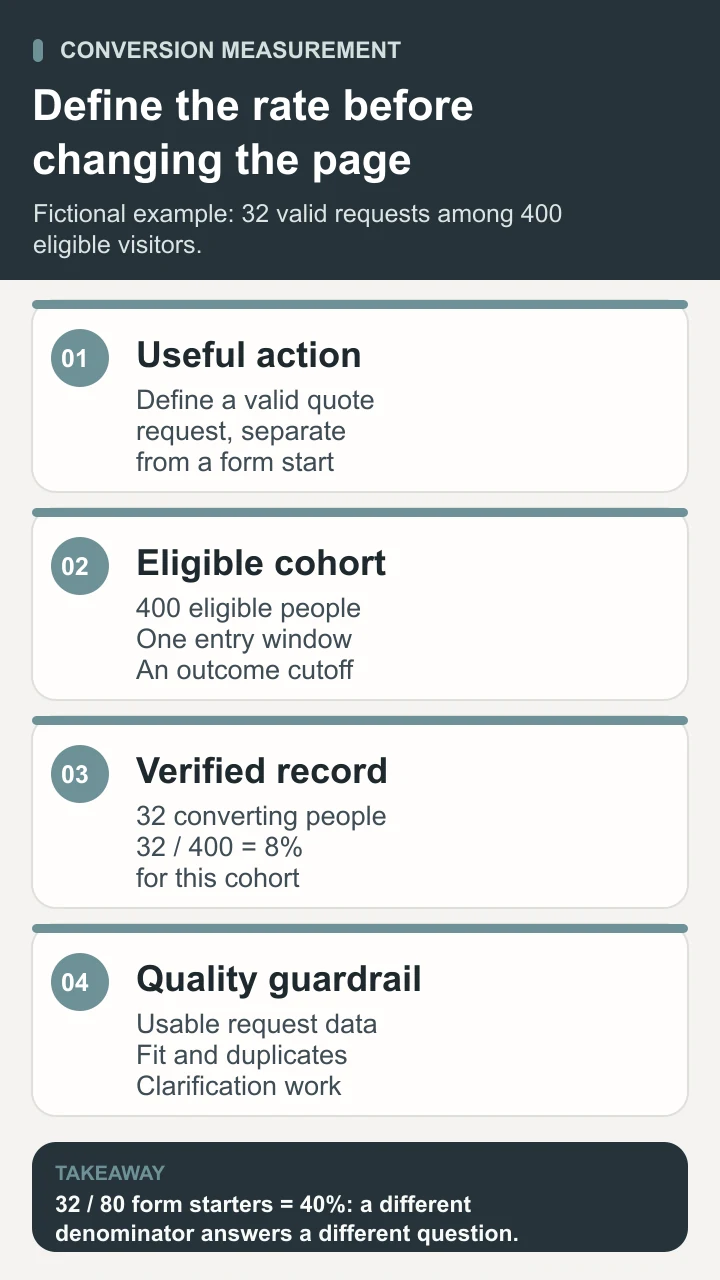
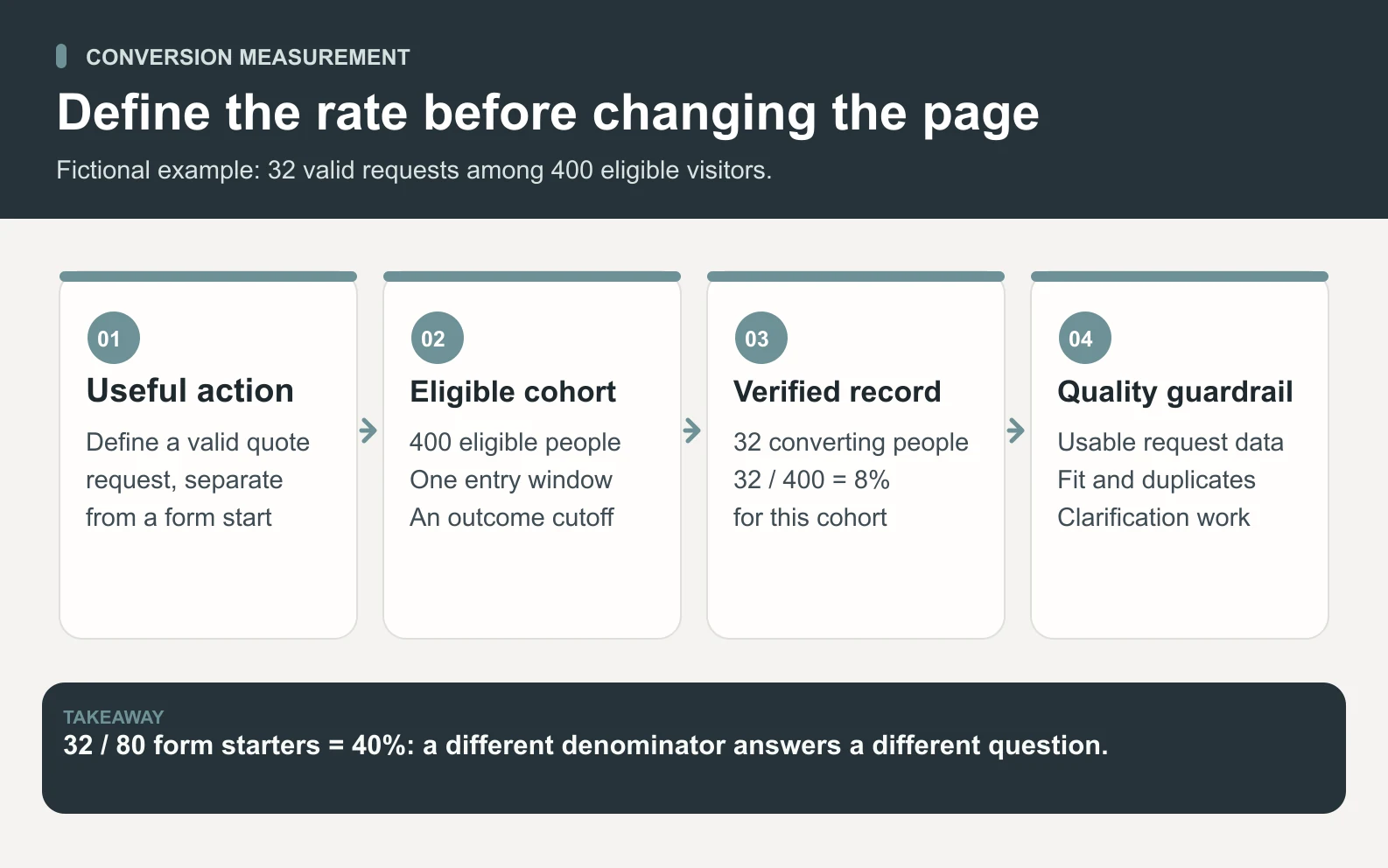
Write the metric in plain language before opening a reporting tool. Identify the completed action, which visitors had an opportunity to complete it, the counted unit, and the time window. A visitor-based rate, session-based rate, and form-start completion rate answer different questions. Do not divide a count of events by a count of people and assume the result is the proportion of people who converted.
For a person-based rate, use eligible unique people who completed the defined action divided by eligible unique people in the same cohort, multiplied by one hundred. Decide how people are recognized, which visits qualify, and whether each person can count once. Anonymous analytics identification is imperfect, so describe the measurement as the system can support it rather than claiming a perfect census.
Scroll horizontally to view all columns.
| Fictional cohort measure | Count or calculation | What it tells you |
|---|---|---|
| Eligible measured visitors | 400 people arriving at the quote page during the entry window. | The defined population with an opportunity to request a quote. |
| Visitors starting the form | 80 of those people. | A narrower group that began the task. |
| Visitors submitting a valid request | 32 of the original 400, within the stated outcome cutoff. | The chosen completion count after removing defined duplicates and tests. |
| Quote-request rate | 32 ÷ 400 × 100 = 8%. | Completion among the eligible measured visitors. |
| Form-start completion rate | 32 ÷ 80 × 100 = 40%. | Completion among people who started the form; a different denominator. |
Give the cohort an entry window, such as a particular month, and a separate cutoff for observing its outcomes. If a visitor enters on the last day and submits later, the rule should say whether that submission counts. Keep repeat visits, internal tests, duplicate requests, bots, and failed submissions consistent with the written definition. Exclusions should improve validity, not make the result look better.
Google Analytics describes key events as recorded actions important to the business. Marking an event as important does not verify that it represents a valid enquiry or a completed sale. Check the specific event, counting method, and reporting metric you use. A total event count is not automatically the numerator of a person-based rate.
Segment only when the split can answer a useful question. Mobile visitors, new visitors, and a particular campaign may encounter different problems, but tiny groups can produce unstable rates. Record the actual counts beside percentages. If the sample is too small to support a firm conclusion, keep the observation as a question for research rather than presenting a precise-looking explanation.
Check measurement and watch people attempt the task
Before interpreting a drop-off, perform the task yourself using a labeled test request. Check the full path on desktop and a real phone-sized layout: page loading, field labels, validation, submission, confirmation, owner notification, and the record used for reporting. A thank-you screen can appear even when a notification fails; a repeated click can create duplicate events without creating another useful enquiry.
Compare a small set of approved form records with analytics records using whatever reconciliation your systems reliably support. Note missing events, duplicated events, timing differences, and actions that occur outside the browser. Do not expect perfect agreement if the systems measure different units or have different consent and filtering behavior. Document the remaining limitation before relying on the rate.
Nielsen Norman Group’s usability-testing guide describes asking representative participants to perform realistic tasks while a facilitator observes behavior and feedback. For the studio, ask someone to find out how to request framing for a picture they own. Avoid instructions that name the button to click or tell them which field is confusing; those clues can hide the difficulty you need to understand.
Record behavior and interpretation separately. “The participant stopped at the size field and asked whether to include the existing frame” is an observation. “All mobile visitors abandon because of measurements” is a much larger conclusion. A few sessions can reveal a plausible problem worth investigating without establishing its prevalence or the improvement a revised field will cause.
Collect questions from staff who answer enquiries, too. They may repeatedly explain whether the quote is binding, which dimensions matter, or when someone will respond. Use approved summaries rather than copying unnecessary personal details into a planning packet. If staff disagree about the actual service promise, resolve that operating question before polishing the page copy.

Turn evidence into a prioritized change proposal
Create a short issue record for each candidate. Include the affected task, observed evidence, likely explanation, proposed change, expected mechanism, quality guardrail, effort, and uncertainty. Keep a source link or approved observation reference with it. A proposal without evidence may still be an idea, but it should not receive the same confidence as a reproduced failure.
For the studio, the observation about picture measurements suggests a specific hypothesis: explaining which dimensions are needed could help people complete the request accurately. Nitrogen might draft “Picture width × height, without the existing frame,” followed by a unit selector and an approved example. The owner must confirm those are the measurements the studio actually needs before anyone changes the form.
W3C’s form-label guidance recommends labels that describe each control’s purpose and an appropriate association between the label and its control. Clear visible instructions and correctly connected labels are concrete review tasks. They help people understand the input rather than making the form depend on disappearing placeholder text or unexplained symbols.
Scroll horizontally to view all columns.
| Observed issue | Bounded proposal | Evidence or check before release |
|---|---|---|
| Unclear picture dimensions | Specify what to measure and which unit to use. | Owner confirms the quoting requirements; task review checks whether instructions are understood. |
| A required photo blocks some requests | Ask whether a photo is essential at this stage or can be optional. | Operations confirms it can assess requests without forcing a later rework loop. |
| The page implies immediate pricing | Explain the real review and response process. | Owner approves the actual service promise and can meet it. |
| Submission errors discard entered information | Repair the reproduced failure and preserve valid input where appropriate. | Controlled tests cover errors, retries, confirmation, and duplicate handling. |
Prioritize using the severity and reach of the problem, the strength of the evidence, delivery effort, and the consequences of being wrong. A confirmed failure that prevents every mobile submission generally deserves attention before an unsupported preference for a different headline. Keep the reasoning visible. A numerical scoring formula can organize discussion, but its precision does not make uncertain assumptions more reliable.
Limit the first proposal to a coherent problem. Changing the audience, offer, headline, form, and follow-up at once may improve the overall experience, but it makes attribution harder. State whether the work is a necessary repair, a researched redesign, or an experiment. That label determines what evidence the team can reasonably claim afterward.
Choose between a repair, more research, and an experiment
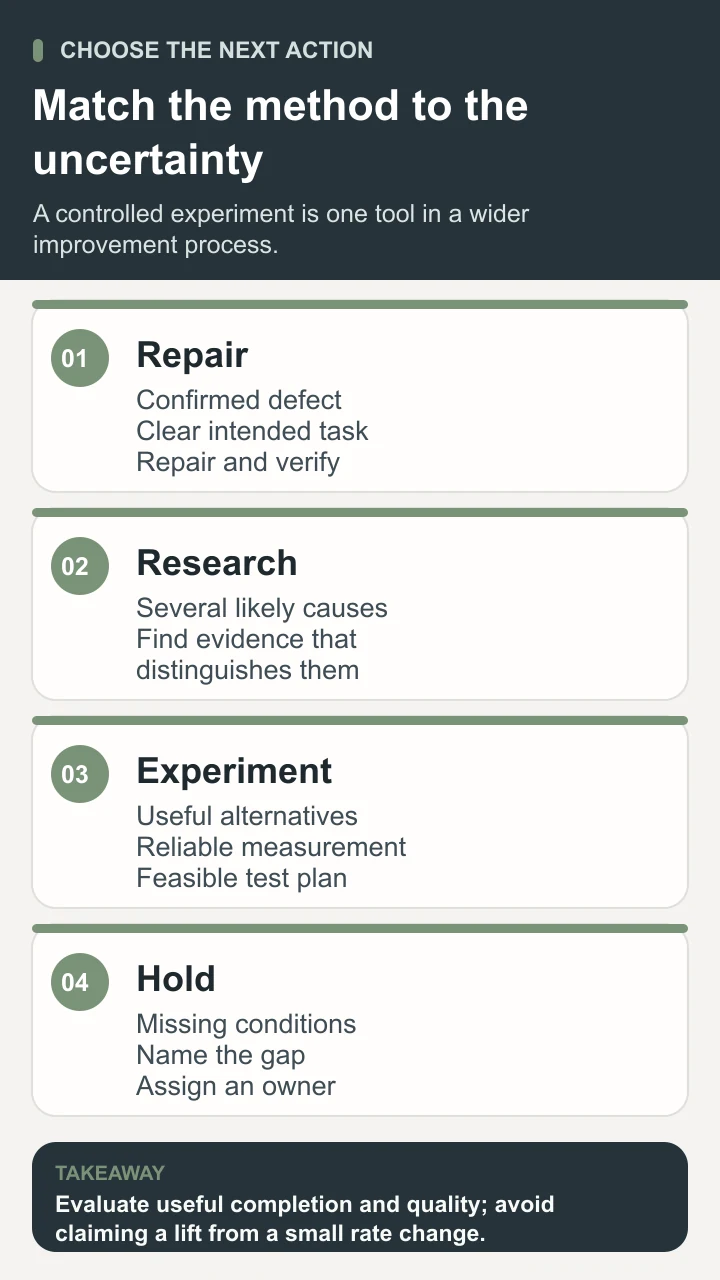
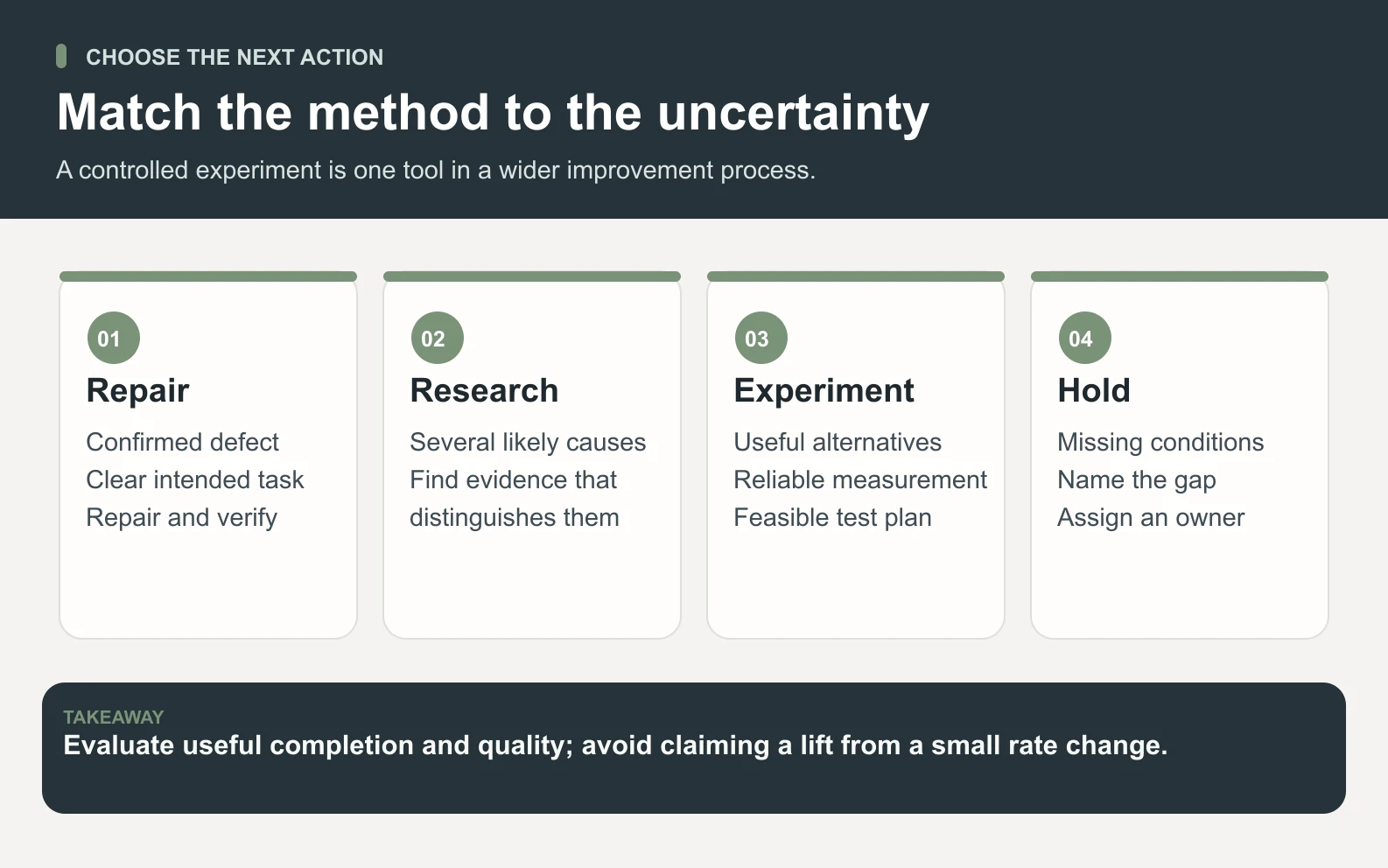
Repair a confirmed defect through the normal release process. A submit button that fails for the supported browser should work; withholding that repair from half of visitors is usually unnecessary for answering the operational question. Verify that the fix restores the task and does not break adjacent behavior. Separate that verification from any later claim about the size of a business improvement.
Research when the cause remains uncertain. A low request rate might reflect an unclear offer, unsuitable traffic, a pricing mismatch, technical failure, or a visitor who only wanted information. A dashboard cannot distinguish all of those explanations alone. Gather task observations or approved enquiry feedback that could change the proposed solution before spending time on a large redesign.
Use a controlled experiment when there are plausible alternatives, reliable assignment and measurement, and enough observations to answer a worthwhile question. Specify the primary outcome, eligible population, minimum effect of practical interest, sample and duration plan, and decision rule before starting. Use the A/B testing guide for experiment design and interpretation rather than treating a short before-and-after chart as a test.
- Repair: a reproducible defect or incorrect promise has a clear intended behavior. Fix it, verify the task, and monitor after release.
- Research: the observed pattern has several credible explanations. Gather evidence that can distinguish them before choosing a major change.
- Experiment: a meaningful comparison is feasible and the team can follow a prewritten measurement and decision plan. Preserve the conditions needed for a valid comparison.
- Hold: measurement, access, delivery capacity, or evidence is insufficient. Name the missing condition and an owner who can resolve it.
A small site can still make useful progress. It can correct inaccurate copy, repair broken controls, improve labels, and learn from observed tasks. It may need a long time to estimate a modest rate difference with useful certainty. Do not manufacture confidence by ending an experiment after a handful of submissions or repeatedly checking until one variation happens to appear ahead.
Prepare and review the change with Space Office
Give the team the page and offer, the approved metric definition, aggregate analytics exports, form requirements, representative issue notes, and the implementation constraints. Label which records are fictional or test-only. Use the least information needed for the task. If inspecting an account or changing the site requires access, the human owner must authorize that access separately; a URL or an export is not a deployment permission.
- 1Fluorine, the live CRO specialist, organizes the page or form diagnosis, reviews the tracking questions, and prepares evidence-backed hypotheses and a suitable evaluation approach.
- 2Nitrogen, the live Content and Copy specialist, drafts the explanation, instructions, and action text against the approved offer and observed questions. Unsupported claims remain unresolved.
- 3Hydrogen coordinates and reviews whether the proposed copy, form behavior, metric, quality guardrails, and acceptance checks agree with the evidence.
- 4The human owner verifies the facts and operating promise, approves access and the final change, and assigns implementation, release, monitoring, and rollback responsibilities.
Ask for one reviewable packet: the issue and evidence, proposed copy or annotated change, expected mechanism, implementation boundaries, acceptance checks, evaluation plan, and remaining uncertainties. This lets a developer or site owner understand what to change and why. It does not imply that a copy draft automatically changes a production website or that an agent can guarantee a conversion lift.
The live agent roster explains the relevant roles, and how Space Office works explains coordination and review. For assisted access to that workflow, use contact. Choose specialists for the actual bottleneck. If the offer itself remains uncertain, a page optimization brief may need to wait for a separate strategy decision.

Evaluate the whole outcome and decide what to do next
After release, confirm the task still works and record the version and date. Review the primary completion measure with the quality guardrails selected beforehand. For the studio, those could include valid dimensions, requests within the service scope, duplicate enquiries, staff clarification work, and customer complaints about the stated next step. More submissions accompanied by much more unusable information may be a poor tradeoff.
Keep traffic composition and operating changes with the review. A seasonal campaign can bring different visitors; a changed offer can affect demand; staff capacity can affect response and later orders. A before-and-after increase can be useful descriptive evidence while leaving causality uncertain. Report it with that limitation. A correctly run experiment can support a stronger comparison, but still needs its uncertainty and practical consequences assessed.
Do not optimize the rate by hiding prices the customer needs, creating false urgency, disguising subscriptions, or making refusal difficult. A visitor should understand the action and its consequences. In the framing example, requesting a reviewed quote should remain distinct from agreeing to buy. Clear expectations help the business evaluate whether the additional enquiries are ones it can actually serve.
Record a decision: keep the change, revise it, gather more evidence, revert it, or extend a properly planned evaluation. State the reason and next owner. A neutral result is useful when it prevents a weak assumption from becoming a permanent design rule. Keep an issue backlog so the team can return to unresolved problems without repeatedly redesigning the whole page.
A useful conversion rate optimization process makes a valuable task easier to understand and complete, then checks whether the business outcome improved under the stated conditions. Begin with an honest metric, verify the experience, and choose the smallest evidence-backed next action. Reliable learning and clear customer expectations are more useful than an unexplained percentage increase.
Sources and review notes
Reviewed against the linked primary sources on the checked dates. Search features and citations are selected by their respective platforms; no placement is guaranteed.
- Optimizely: Conversion Rate Optimization — checked
- Nielsen Norman Group: Usability Testing 101 — checked
- W3C WAI: Labeling Controls — checked
- Google Analytics: About Key Events — checked
Frequently asked questions
What is conversion rate optimization?
Conversion rate optimization is the process of improving how effectively a website or app helps eligible visitors complete a defined, valuable action. It combines measurement, user research, prioritization, changes, and evaluation. The goal should reflect a real customer and business outcome, with clear counting rules and quality checks rather than a higher click count alone.
How do you calculate a conversion rate?
Divide the eligible units that completed the defined action by all eligible units in the same population and window, then multiply by one hundred. For example, 32 converting visitors among 400 eligible visitors is 8%. Define whether the units are people, sessions, or another cohort, and keep the numerator and denominator compatible.
What is a good conversion rate?
There is no single rate that establishes success for every site. The action, audience, traffic source, price, service, device, and measurement rules can differ. Compare a clearly defined metric with relevant historical evidence and business requirements, while checking quality and uncertainty. An external benchmark is context only if its definition and population are actually comparable.
Is CRO the same as A/B testing?
No. CRO includes defining useful goals, checking tracking, researching difficulties, prioritizing changes, repairing defects, and evaluating outcomes. A/B testing is one method for comparing alternatives under controlled conditions. Some problems need an immediate verified repair or additional research; others are suitable for a planned experiment.
Can you improve conversions when traffic is low?
You can verify the task, correct inaccurate claims, repair broken controls, improve form labels, and observe representative users. Those actions can improve the experience even when a precise rate comparison is difficult. Be honest about the available counts and avoid calling a small before-and-after difference a proven causal improvement.