Guide
Marketing Funnel: Stages, Examples, and a Practical Plan
Plan a marketing funnel that helps people discover, assess, buy, and return, with clear stage definitions and counts your team can explain.
By the Space Office team · Published · Updated · 16 min read
A marketing funnel is a planning model for the steps between discovering an offer and becoming a customer, with follow-up after the purchase. Use it to match customer questions with useful content, a suitable next action, and a defined measurement. People can enter at different stages or revisit earlier questions. Space Office’s Oxygen can prepare the stage strategy and Nitrogen the copy. Hydrogen coordinates and reviews the packet; a human verifies the offer and approves access, spending, publication, and the final business change.

Key takeaways
- Use stages to organize customer needs; people do not follow a perfectly straight path.
- Give every stage a specific question, useful answer, next action, and owner.
- Define the counted unit, event, cohort, sequence, and observation window before calculating a rate.
- Separate broad impressions and sessions from a matched group of enquiries and buyers.
- Improve the clearest evidenced gap while keeping capacity and customer fit visible.
When an eligible visitor struggles to complete a useful page action, the conversion rate optimization guide connects measurement, task observations, and a prioritized change proposal.
Download the free marketing funnel worksheet to map questions, content, next actions, and measurement definitions. The beginner watercolor workshop is fictional, including its counts. Use the marketing plan guide when you need the wider schedule, budget, and operating priorities.
What a marketing funnel helps you decide
A funnel is useful when it explains what help a prospective customer needs next. Someone hearing about an activity for the first time may need a clear description. Someone comparing classes may need to understand skill level, materials, accessibility, and dates. Someone ready to book needs an accurate offer and a working booking route. These are different tasks, even if one page helps with several of them.
Amazon Ads’ marketing funnel guide uses awareness, consideration, conversion, and loyalty as a four-stage model, while acknowledging that there is no single universally accepted version. Use that structure as a practical starting point. The labels matter less than whether each stage identifies a real customer question and a business action that addresses it.
Set one primary question for the plan: what information and follow-through does a suitable beginner need before booking this workshop? The answer will guide the content and measurement. A diagram showing a shrinking audience without any explanation of the offer is incomplete. It cannot tell the instructor what to write, what to fix, or who should respond to a request.
Keep related tools distinct. A customer journey map examines a particular experience, including touchpoints and difficulties. A funnel organizes stage needs and defined progression. Customer acquisition focuses on bringing in new customers and evaluating acquisition economics. These views can support each other, but this guide concentrates on the stage plan and a coherent review of the resulting records.
Choose a scope small enough to operate. One audience, one offer, and one next improvement give a team a manageable first plan. If corporate workshops and individual beginner classes have different buyers and approval processes, map them separately. Combining them can hide the fact that one needs a procurement discussion while the other needs a simple seat booking.
Connect the four stages to specific customer questions
Begin with questions supported by approved enquiries, conversations, or service records. If those sources are unavailable, label the proposed questions as hypotheses. The fictional instructor starts with a recurring beginner concern: whether someone who has never painted can take part. That concern belongs in the explanation of the class, not only in a reply sent after the customer struggles to find an answer.
Scroll horizontally to view all columns.
| Stage | Customer question | Useful help and next action |
|---|---|---|
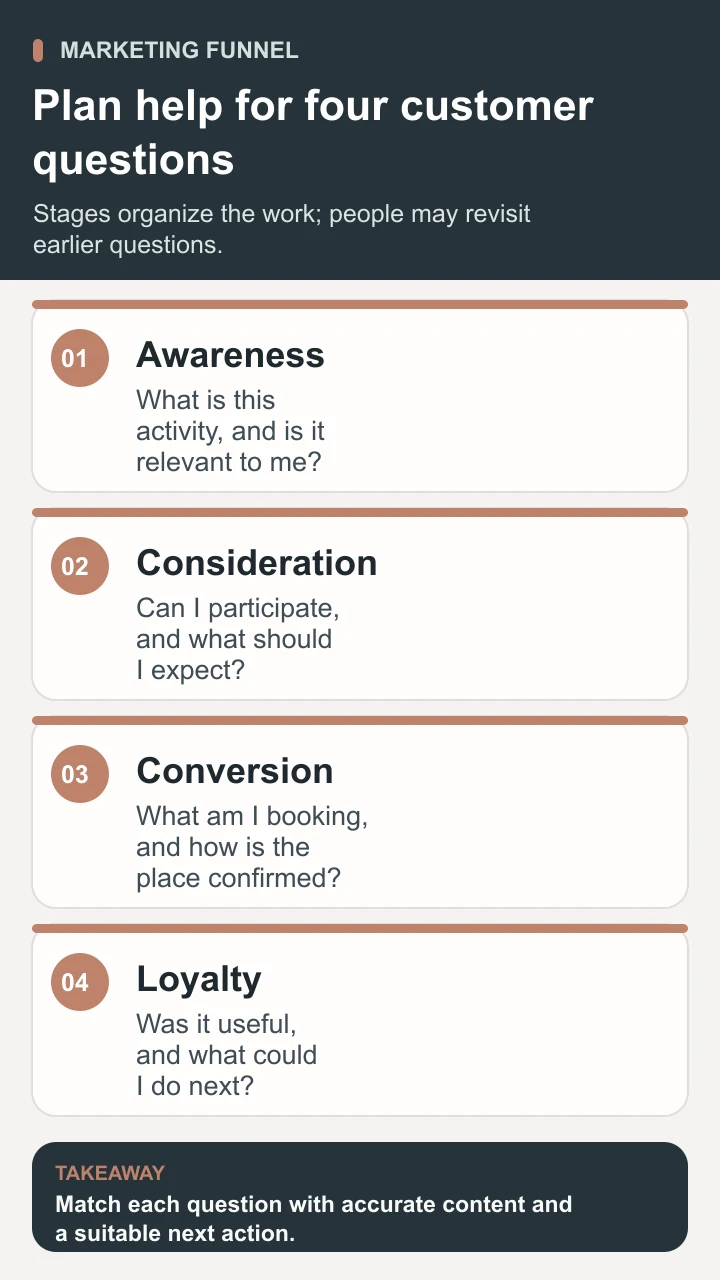
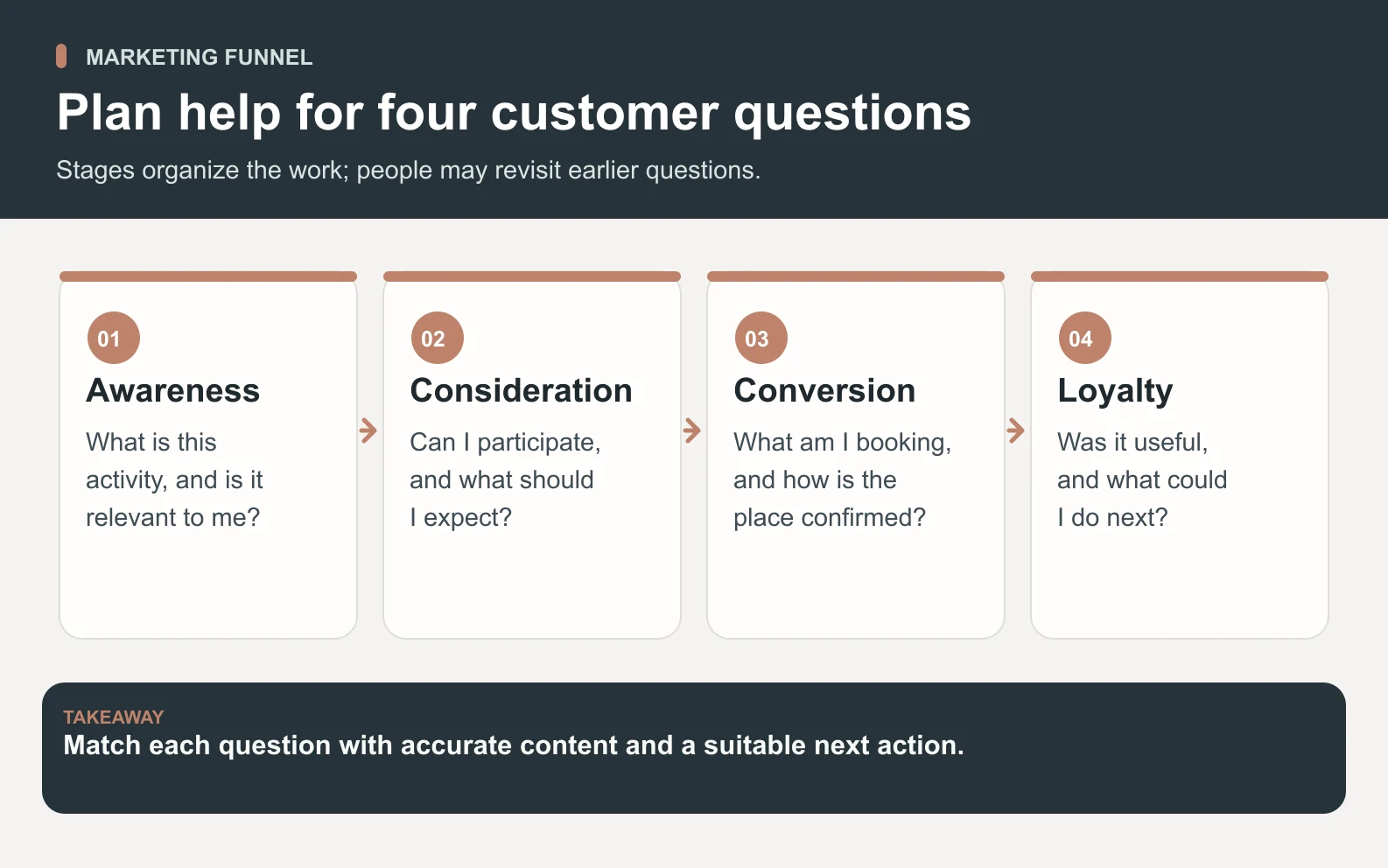
| Awareness | What is this activity, and is it relevant to me? | A plain introduction and genuine examples; read the class overview |
| Consideration | Can I participate, and what should I expect? | Clear beginner level, materials, venue, and timing; check available dates |
| Conversion | What am I booking and how is it confirmed? | Approved price and terms, accurate availability, and a working booking route |
| Loyalty | Was the experience useful, and what could I do next? | Practical follow-up and an optional relevant next class after delivery |
Awareness content should make the offer understandable. A short explanation of a beginner watercolor session can describe the activity and show approved examples of the materials. Consideration content should resolve fit questions. The instructor can explain whether supplies are included and what prior experience is expected. Neither task requires an inflated claim about transforming everyone into an artist.
At conversion, check the actual transaction. A request for a place, a provisional reservation, a payment, and an attended class are different states. Tell the customer what confirms the seat and what happens if the requested date is unavailable. The owner must approve all prices and conditions. Clear information protects the relationship as well as helping someone act.
After the class, make follow-up useful on its own. A care note about the materials or a recap of techniques may serve the learner before any further offer. A plan for loyalty is not evidence of loyalty. Record repeat participation only when it has actually occurred under a defined measurement. Keep operational class messages separate from optional promotional communication.
Design content and handoffs around the offer
For every stage, write four linked items: the customer’s question, the content that answers it, the appropriate next action, and the person responsible for follow-through. This turns a broad funnel sketch into work a small team can complete. A class page should not promise an immediate booking if a staff member still needs to check the date and confirm a place.
- 1Collect the owner-approved offer facts, including audience, scope, materials, dates, capacity, and any exclusions.
- 2List the questions that affect fit or confidence, with a source or an explicit hypothesis label.
- 3Assign a useful content item to each important question. Reuse one page when it answers several related needs clearly.
- 4Choose a next action that matches the customer’s readiness: learn, compare, ask, request a place, or complete a booking.
- 5Name who receives each action, what they verify, and how the customer learns the outcome.
Choose channels after you understand this route. A relevant search article may introduce the activity; a local partner may reach people interested in a beginner class; an approved email may help someone who asked for more information. Each route should lead to a destination that matches its promise. A general inspiration post and a dated booking page serve different purposes.
Test the handoff with a realistic scenario. On a phone, can someone find the materials list, check the venue and date, and understand how to request a seat? Does the receiving person see the necessary details? Can they decline an unsuitable request honestly? A funnel should make it easier to find a suitable offer, rather than pressure every visitor into becoming a lead.
Use the lead generation guide for the narrower work of attracting and assessing enquiries. Here, preserve continuity across stages: the class description, enquiry reply, and confirmation should agree. A persuasive introduction followed by contradictory conditions creates avoidable confusion. Fix that inconsistency before adding more traffic to the same route.

Define funnel measurements before calculating conversion
A planning model and a measured funnel are different things. The planning model helps decide what to provide. A measured funnel counts specified events for a defined group. Write down the unit first: people, accounts, sessions, requests, bookings, or orders. A percentage is only interpretable when its numerator and denominator belong together.
Use a measurement note with the event definition, inclusion rules, source, period, matching method, and owner. For example, “distinct people who submitted an eligible beginner-class enquiry during the first fourteen days” is a cohort definition. “All form submissions this month” could include duplicates, unrelated requests, or people already counted in an earlier period. They cannot be substituted without changing the question.
Google Analytics’ funnel exploration documentation explains that open funnels can admit users at different steps, while closed funnels require entry at the first step. The specified sequence affects which later steps are counted. If you use that report, inspect its actual entry, event, sequence, and time settings before interpreting it. A screenshot of a funnel alone does not establish those definitions.
Scroll horizontally to view all columns.
| Measurement choice | Example definition | Check before reporting |
|---|---|---|
| Unit | One distinct enquirer | Repeated contacts do not create new people |
| Entry group | Eligible enquiries received during days 1–14 | Excluded requests and unresolved duplicates remain visible |
| Progression | Booking request after the qualifying enquiry | The sequence and person match are supported |
| Outcome | One completed paid booking per person by day 28 | Cancellation and refund treatment is stated |
| Window | Entry cutoff day 14, outcome cutoff day 28 | Every included person has the intended follow-up opportunity |
Use only authorized records and the minimum information required for matching. An aggregate report may be enough for a planning review. If matching is unavailable, report separate counts and say the transition is unknown. Do not upload personal enquiry records to an unrelated tool simply to make a cleaner chart. The business should approve the data and destination for any analysis.
Worked example: a beginner watercolor workshop
The fictional instructor can deliver two classes with six seats each, giving twelve seats in this pilot. Each attendee books one seat. The offer and capacity remain fixed during the example. Broad activity reports show 1,600 advertising impressions and 260 website sessions. These are separate activity measures; the instructor has not established a matched person-level path from those impressions to the bookings.
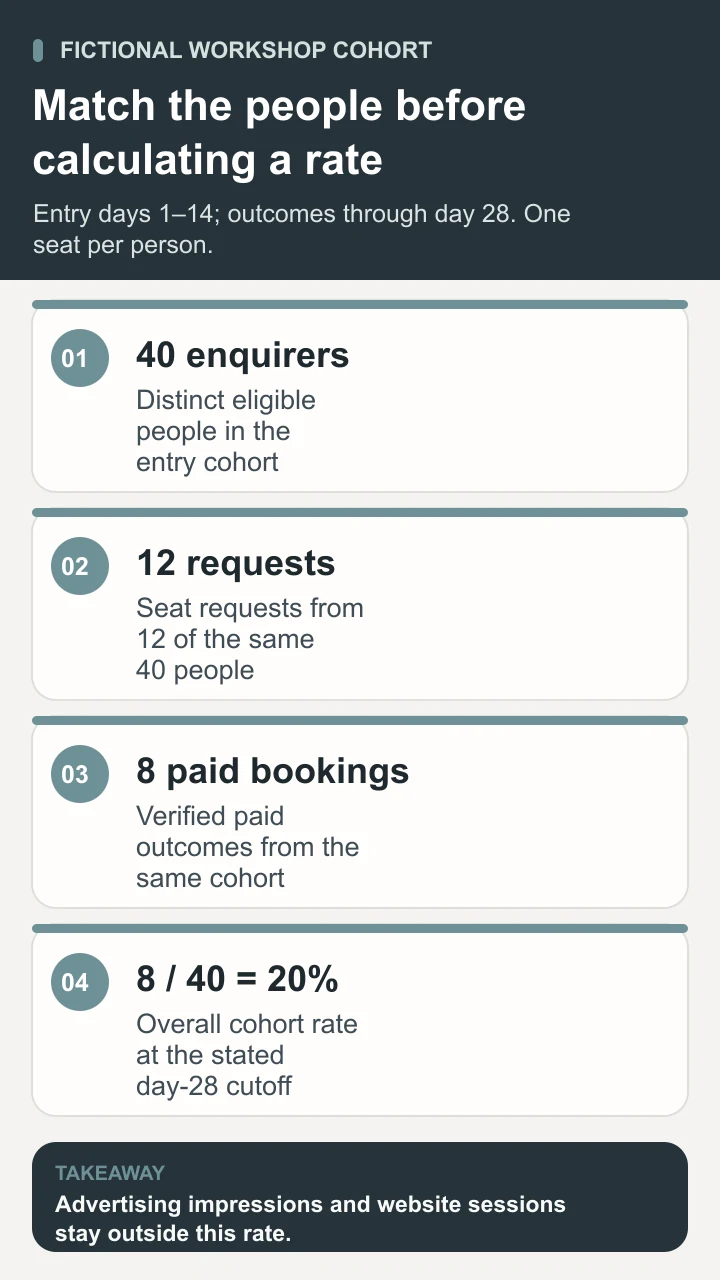
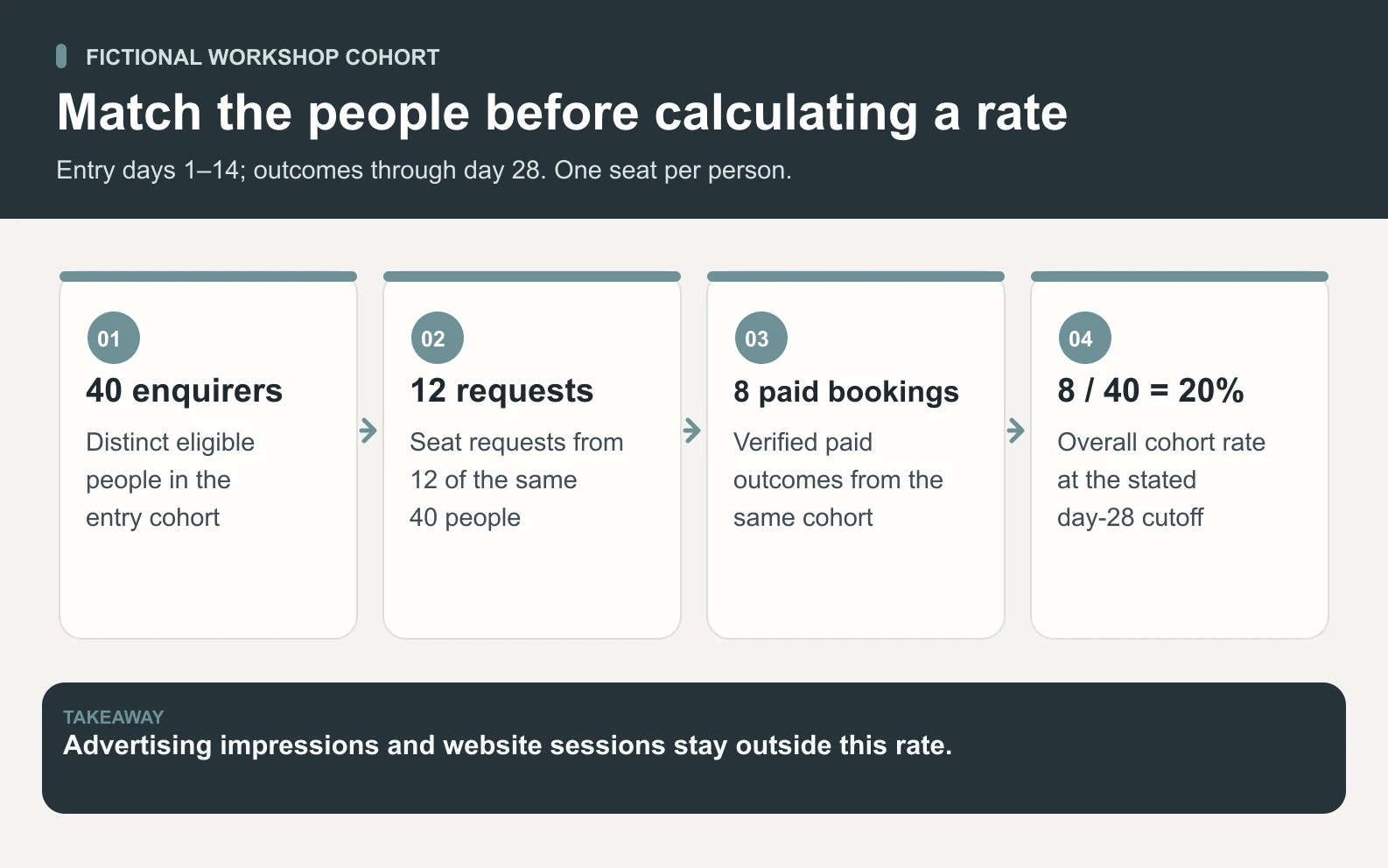
The business also maintains a distinct, authorized enquiry cohort. Forty different people submit eligible enquiries during days 1–14. Repeated messages from the same person are joined to that person’s record. Twelve of those forty later request a seat. By day 28, eight of the twelve have completed a paid booking, one seat per person, with no cancellations or refunds recorded at the cutoff. All eight are members of the original forty-person group.
Scroll horizontally to view all columns.
| Record | Count | What the count supports |
|---|---|---|
| Advertising impressions | 1,600 | Ad display activity; not 1,600 distinct prospects |
| Website sessions | 260 | Site activity; no established person-level match to the cohort |
| Distinct eligible enquirers | 40 | The defined entry cohort |
| Cohort members requesting a seat | 12 | A later request from 12 of those same 40 people |
| Cohort members with completed paid bookings | 8 | Eight verified outcomes by the stated cutoff |
| Available pilot seats | 12 | Capacity; not a marketing-stage denominator |
The enquiry-to-request rate is 12 ÷ 40 = 30%. The request-to-paid-booking rate is 8 ÷ 12, approximately 66.7%. The overall enquiry-to-paid-booking rate is 8 ÷ 40 = 20%. These percentages describe the stated cohort and cutoff. They are not conversion rates from advertising impressions or all website sessions. Four seats remain available, but seat availability is an operating measure rather than evidence about why someone did not book.
At the cutoff, twenty-eight enquirers have no recorded seat request, and four requesters have no completed paid booking. The records establish those states, not their reasons. Someone might prefer another date, need more information, or decide against the activity. The owner should investigate the questions people actually raised before attributing every missing outcome to weak persuasion.
Repeat attendance is unobserved in this example. A later follow-up plan therefore belongs in the proposed work, without a claimed retention rate. The eight paid bookings also do not establish profit, incremental demand, or acquisition cost. Use the separate customer acquisition guide if the next decision concerns the cost of bringing in new buyers.

Choose the next improvement from evidence
Start by checking whether the apparent gap is real. A broken booking notification, duplicate event, changed date range, or incomplete payment record can create a misleading drop. Ask the person responsible for the records to reconcile them. If a booking was confirmed offline, decide how it belongs in the agreed definition and record the basis for including it.
Next inspect the customer questions and handoffs. In this fictional scenario, the instructor finds repeated questions about whether materials are supplied and whether previous painting experience is required. That is a reason to review the class explanation. It is not evidence that a different color button or a larger advertising budget will solve the problem.
The proposed improvement is a clearer beginner-fit section placed near the class details, with approved materials information and a direct route to ask about unresolved needs. Nitrogen can draft it from the instructor’s facts. The human checks the promise, the venue details, and the booking process before publication. Preserve the previous version and the change date so the next review has context.
Choose a proportionate evaluation. The owner can check whether the information is findable and whether staff still receive the same questions, then review a later, consistently defined cohort. Small before-and-after counts can inform the next decision, but they do not isolate a causal effect. Seasonality, the audience mix, class dates, or the partner referral route may have changed too.
Include customer fit and delivery in the decision. More enquiries are not automatically better if they mostly concern an unsupported class type. Faster bookings are not a success if the business overbooks twelve seats. A useful review combines stage evidence with the ability to deliver the actual offer. Keep the action small enough that someone can own it and learn from it.
Turn the plan into a reviewed Space Office workflow
Give Space Office a bounded brief: prepare one stage plan and a revised beginner-fit section for this workshop. Provide the verified class facts, actual capacity, approved audience evidence, anonymized question themes, and dated aggregate counts with their definitions. If relevant records or account access are missing, list the gap. Do not imply that the team has connected to analytics, advertising, or booking tools merely because those tools exist.
Oxygen, the Strategy & GTM Specialist, can connect the audience, offer, stage questions, analytics requirements, and next improvement. Nitrogen, the Content & Copy Specialist, can draft the class explanation and follow-up copy from approved facts. Their current responsibilities are listed on the Space Office agents page. Choose these roles for the work described, rather than adding specialists without a recurring task.
Hydrogen coordinates the assignments and reviews the combined packet before delivery. Ask for a stage table, source notes, proposed page copy, a handoff checklist, and the measurement definitions. The owner verifies the offer and records, approves any access or spending, and makes the publication decision. Hydrogen’s review supports that process; it does not replace the instructor’s knowledge of the class or the customer.
Use clear acceptance checks. Every proposed claim should match an approved business fact. Every next action should reach an identified owner. Every reported rate should show its group, outcome, and cutoff. The packet should identify unresolved questions instead of disguising them as complete research. How Space Office works explains the coordination and review model for this kind of bounded work.
End the review with one decision and a date. The instructor might approve the revised materials explanation, keep the existing offer, and examine the next comparable enquiry cohort after it has had time to book. The instruction is concrete enough to implement and review. “Build a high-converting funnel” leaves the team without a definition of completion.
Keep the marketing funnel flexible and useful
People can discover a class through a friend, compare it on a website, ask a question in person, and return later to book. Think with Google’s research on purchase decision-making describes repeated exploration and evaluation between a trigger and a purchase. That is a useful reminder to keep explanations accessible wherever the customer needs them, rather than forcing everyone through one rigid sequence.
Maintain the stage plan when the offer or evidence changes. A new class level may introduce different fit questions. A new booking system may change the observable events. Preserve old definitions when comparing periods, and document any break in comparability. More elaborate reporting is only worthwhile when it answers a decision the business actually faces.
A marketing funnel becomes useful when it connects customer questions, accurate content, workable handoffs, and measurements that belong together. Start with one offer, define the stages, check the records, and improve the clearest gap. Keep the human decision and delivery capacity visible. The result is a practical plan the team can act on and revise as it learns.
Sources and review notes
Reviewed against the linked primary sources on the checked dates. Search features and citations are selected by their respective platforms; no placement is guaranteed.
Frequently asked questions
What is a marketing funnel?
Marketing funnel is a term for a model that organizes the stages from discovering an offer through considering it, buying, and engaging afterward. It helps a team plan useful content and next actions. A measured funnel additionally needs explicit event, cohort, sequence, and time definitions.
What are the main marketing funnel stages?
A common four-stage version uses awareness, consideration, conversion, and loyalty. Other models use different labels or more steps. Choose a structure that explains your customer’s questions and the work needed to answer them. Treat the stages as a planning aid; a person may enter later or revisit earlier questions.
How is a marketing funnel different from a sales funnel?
The marketing view often includes discovery, education, and ongoing engagement. A sales funnel usually describes the organization’s progression through enquiries, qualified opportunities, proposals, and purchase decisions. Definitions vary by business. Make the handoff, responsible person, and counted events explicit so the two views can work together.
How do you calculate a funnel conversion rate?
Divide the defined later-stage outcomes by the eligible earlier-stage group, then multiply by 100. Keep the unit, matching method, sequence, and observation window consistent. In the fictional workshop cohort, eight completed paid bookings among forty distinct eligible enquirers gives 20%. That does not establish a rate from advertising impressions or website sessions.
Can a funnel show why people did not buy?
Counts show where a defined progression was not recorded. They do not establish someone’s reason. Check tracking and business records first, then examine approved customer questions or conduct suitable research. Avoid calling every missing event a lost sale, because some people are unsuitable, still deciding, or have used an unobserved route.