Guide
Digital Marketing: Channels, Steps, and a Small-Business Example
Connect digital marketing channels to one customer task, a useful destination, and records that help you decide what to improve.
By the Space Office team · Published · Updated · 17 min read
Digital marketing is the use of online channels and digital experiences to help people discover, evaluate, and act on an offer. Start with a customer task, choose channels that can help with it, build a useful destination, and compare activity with verified business outcomes. In Space Office, Oxygen can prepare channel options and Nitrogen can draft the supporting copy; Hydrogen coordinates and reviews their work. The human owner supplies approved facts, checks the evidence, and approves spending, access, and publication.

Key takeaways
- Choose a customer decision and a useful next action before choosing platforms.
- Give search, paid placements, email, and social content different jobs rather than duplicating the same message everywhere.
- Check that the page, form, offer, and response process can fulfil the campaign's promise.
- Separate impressions, clicks, sessions, enquiries, completed work, revenue, and costs.
- Run a manageable pilot and use its evidence to continue, revise, or stop a specific activity.
For a focused paid-search campaign, the pay per click advertising guide explains the brief, message match, spending rules, measurement checks, and cost per qualified outcome.
For business customers, use the B2B marketing guide to connect channel choices with account fit, buyer questions, and a clear sales handoff.
Download the free digital marketing worksheet to record the audience task, channel choices, destination checks, four-week pilot, and measurement definitions. It includes the fictional bike-repair example below. Use the separate marketing plan template when you need the wider document covering budgets, owners, and business priorities.
What digital marketing covers
A customer might find a repair service through a search, inspect its service page, ask a question, and later return through an email. Those encounters belong to a connected experience. Publishing a post is one activity within that experience; it does not establish that the person understood the offer, could use it, or became a customer.
The American Marketing Association's overview describes a broad set of digital methods, including websites, search, email, social media, and online advertising. The practical question for a small business is which combination serves its customers and can be maintained with the available people, evidence, and money. An available platform is not automatically a useful channel.
Keep three layers visible. The strategy identifies whom to help and why the offer is relevant. The assets explain the offer: a page, demonstration, article, message, or other useful material. Distribution brings appropriate people to those assets. Measurement helps the owner decide whether the connection works. A channel can generate attention while the page or the actual service prevents a suitable person from proceeding.
Digital and offline work also need to agree. A repair page that promises collection must match the service area and available staff. An online appointment request needs someone to answer it. Before adding another campaign, walk through the existing path as a customer would and identify the next unanswered question or broken handoff.
Choose one audience and useful next step
Describe a buying situation instead of a broad demographic. For a mobile bike-repair service, a useful starting audience could be local commuters whose bicycle needs a scheduled repair and who cannot easily transport it to a shop. The relevant questions concern location, repair scope, collection arrangements, availability, and how to request a quote. The target audience guide provides a separate method for checking that audience definition.
Write the intended next action in plain language. Requesting an assessment, comparing compatible products, booking a consultation, and subscribing to a useful newsletter are different tasks. Choose an action the business can actually support. A newsletter sign-up is a poor substitute for answering an urgent service question, while an immediate purchase button may be unsuitable for work that needs inspection first.
Gather evidence from permitted customer questions, relevant search queries, actual service records, and direct conversations. Keep the source and date beside each observation. Three customers asking about collection establishes that those customers had a question; it does not establish the size of the whole market. Mark gaps before treating the observation as a campaign premise.
Set exclusions as carefully as inclusion. A business may serve only certain locations, products, languages, or repair types. Explain those boundaries early enough to help an unsuitable visitor make a decision. More enquiries are not useful when the owner must repeatedly explain that the requested work is unavailable. Give the response team the same scope information as the person writing the campaign.

Give each channel a specific job
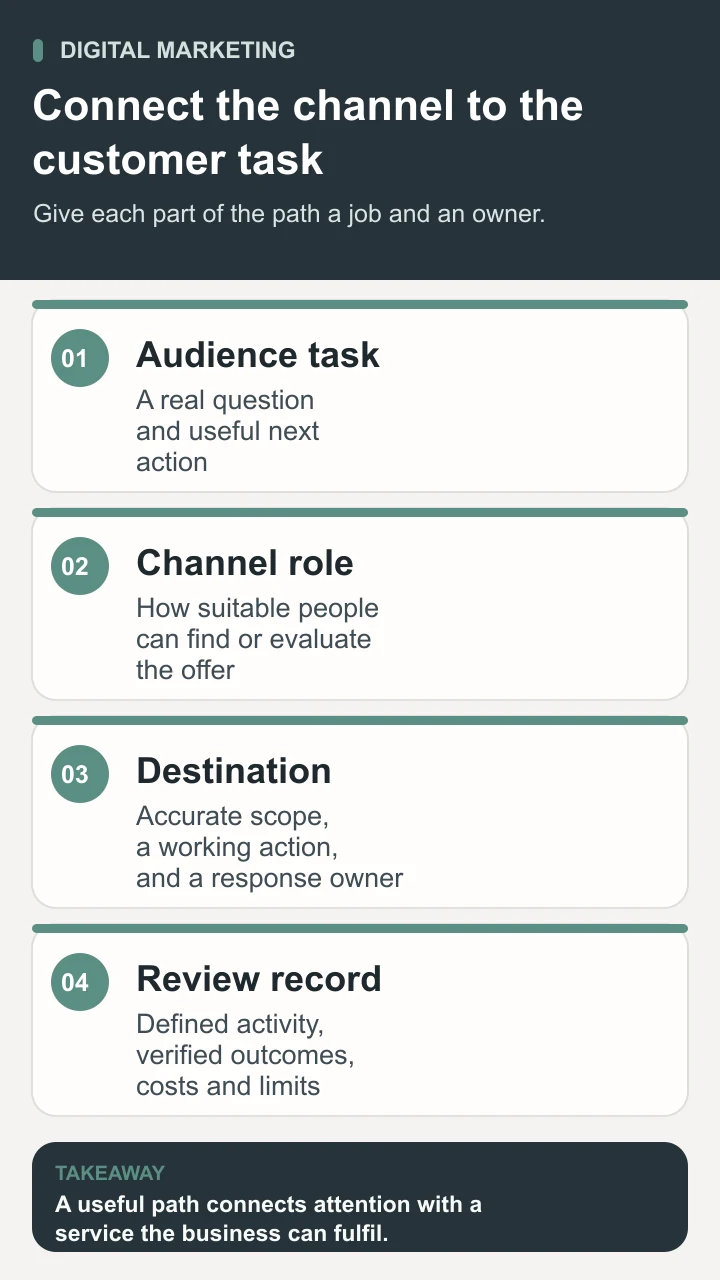
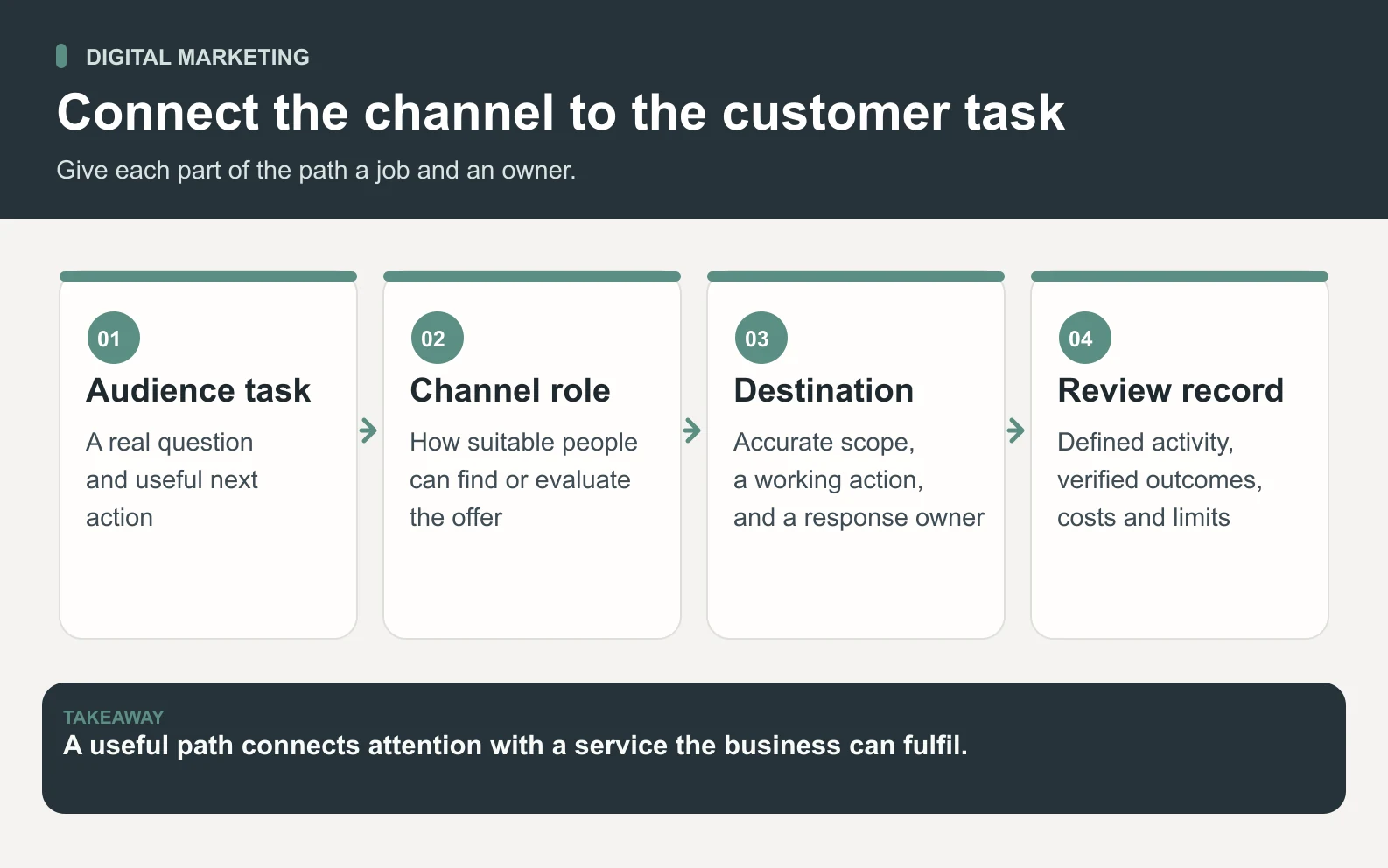
Choose the job before the format. Search can help someone investigate an existing question. A demonstration can make a service easier to evaluate. A permitted email can help an existing contact complete a relevant next step. These are planning hypotheses to verify with your own audience; they are not a universal sequence that every customer follows.
Scroll horizontally to view all columns.
| Channel or asset | Possible customer job | Check before using it |
|---|---|---|
| Service website | Explain repair scope, service area, and the assessment process | The offer is current, the form works, and someone owns the reply |
| Organic search | Help a person find an accurate answer to a relevant repair question | The page answers the question and is accessible to search systems |
| Paid placement | Present a suitable offer to a defined audience under a spending limit | Targeting, destination, claims, account access, and budget are approved |
| Helpful content | Show what a customer should check before requesting the service | The explanation uses real expertise and states its limits |
| Answer a relevant follow-up question for an appropriate existing contact | Audience permissions, message relevance, and the sending setup are reviewed | |
| Organic social | Demonstrate the work and answer questions in a native format | The example is truthful and the team can handle the response |
For organic discovery, Google's SEO Starter Guide explains the work of making content understandable to people and search engines. Build a useful, accessible page and an appropriate internal link path. Treat search visibility as something to measure, not a position you can buy or guarantee by adding a phrase to a heading.
Use the specialist guides when a channel needs deeper work: content marketing, email marketing, and social media marketing each cover their own operating process. A creator collaboration or referral arrangement also needs separate deliverables and commercial terms. The channel map should explain why that work belongs in this particular pilot.
Build a destination that can fulfil the promise
Read the campaign message and destination together. If the message offers collection for a specific area, the page should state that area and explain the next step. If an advertised price is conditional, explain the condition where it affects the decision. Use current, approved facts and show the limitation that could make the offer unsuitable. Attractive wording cannot repair a mismatch between the promise and the actual service.
Test the path on a phone as well as a desktop. Check whether the essential explanation appears before a visitor must commit, whether text and images remain readable, and whether the main action has an understandable label. Complete a permitted test submission and confirm where it arrives. Assign ownership of the reply, correction, or cancellation process rather than treating a submitted form as completed work.
Ask only for information needed to handle the request, and give customers an appropriate way to understand how it will be used. A repair enquiry may need a location and a description of the problem; it does not need an unrelated personal profile. Keep unnecessary customer information out of briefs and reporting documents. The business owner reviews the relevant privacy and communication requirements for the actual audience and systems.
Maintain one approved version of the offer across the page, messages, and response notes. Record who changes service availability or prices and how those changes reach the campaign owner. If the business cannot fulfil an active promise, pause or update the affected asset. A campaign is an operating commitment as well as a set of creative materials.
Run a bounded four-week pilot
Choose a manageable learning question, such as whether suitable local customers can understand the collection service and submit a request the owner can assess. Record the starting evidence or mark the baseline unknown. Set a cash limit, a production limit, and a human review owner. Those boundaries prevent the pilot from growing into several unrelated campaigns before the first one can be evaluated.
- 1Week one: check customer questions, define the service boundary, choose the channel roles, and agree what the owner will regard as a suitable request.
- 2Week two: prepare the destination and supporting assets, review the facts, test permitted links and forms, and verify the response handoff.
- 3Week three: activate only approved work within the spending and capacity limits. Keep a change log and inspect incoming questions for misunderstandings.
- 4Week four: reconcile the agreed reports with the service record, review costs and human effort, and choose one specific continuation or revision.
Define stop conditions before activation. Examples include an unavailable service, a broken form, a destination that differs from the approved offer, spending beyond the agreed limit, or more unanswered requests than the owner can handle. The owner decides the appropriate action. A deadline on a calendar is not a reason to keep distributing a claim that has become inaccurate.
Four weeks is a planning example, not a promise that every channel will mature in that time. A new search page, a seasonal offer, and a paid test have different observation windows. Record those limitations in the review. Use early evidence to fix a broken path without pretending it establishes the long-term economics of the channel.
Worked example: a bike-repair service reviews its pilot
Imagine a fictional mobile bike-repair service testing a collection offer. Every business detail, count, cost, and result in this example is invented for explanation; it is not a customer case, benchmark, or forecast. The owner reviews the service page, a permitted customer email, a helpful social demonstration, and a small paid placement. Existing search traffic also reaches the page during the same reporting window.
Scroll horizontally to view all columns.
| Record | Illustrative amount | What it establishes |
|---|---|---|
| Recorded sessions | 350 organic + 200 paid + 150 email + 100 social = 800 | Sessions in the stated report's assigned source groups, not 800 unique people |
| Distinct service requests | 40 | Requests after matching duplicate entries in the business log |
| Requests meeting the service criteria | 24 | The owner checked location, repair scope, and the required information |
| Status of those 24 requests | 12 completed, 6 scheduled, 4 cancelled, 2 pending | Completed work remains separate from future or unresolved work |
| Recorded revenue from completed jobs | 12 × $90 = $1,080 | Revenue recorded for the illustrative completed jobs before business costs |
| Stated campaign cash cost | $360 ads + $140 asset production + $50 tools = $550 | A limited cash budget that excludes unpriced owner time and service fulfilment |
The completed-job count divided by the recorded sessions is 12 divided by 800, or 1.5%, for this matched example. It is not a prediction or a count of newly acquired customers. Some jobs may involve existing customers, and the systems may miss part of the path. The $1,080 revenue record and $550 campaign cash cost do not establish profit: parts, travel, labour, other overhead, taxes, and later adjustments still need review.
The owner also finds that several unsuitable requests came from outside the collection area. That observation supports a concrete revision: make the location boundary clearer in the relevant asset and inspect the placement's setup. It does not show that every channel needs more spending. An uncontrolled pilot also cannot establish how many jobs would have happened without the campaign.
Use Space Office to prepare a reviewed campaign
Give the team one bounded preparation task: a channel-choice note, a customer-path brief, a destination-copy draft, and a reporting sheet. Supply approved audience research, service facts, examples of real questions, current page content, brand constraints, spending limits, and permission boundaries. Name the human who can resolve missing information and make the final business decision.
- 1Oxygen, the Strategy & GTM (CMO) Specialist, prepares channel options and explains their purpose, dependencies, assumptions, and capacity needs.
- 2Nitrogen, the Content & Copy Specialist, drafts the destination and supporting messages from approved facts. It keeps actual experience and unverified assumptions distinct.
- 3Hydrogen coordinates the handoffs and reviews whether the work follows the brief. Conflicting claims, missing evidence, or incomplete decisions return for clarification.
- 4The human owner checks the offer, sources, customer path, budget, permissions, and final assets. The owner approves account access, spending, publication, and the response process.

Add a specialist only when the scoped task requires that work. Neon can help with a defined search audit, Silicon with an approved paid-media task, or Cobalt with an agreed organic format. Check the live roster and coordination workflow before choosing roles. Naming a specialist does not connect an account, authorize an ad budget, or publish a page automatically.
Improve digital marketing from comparable evidence
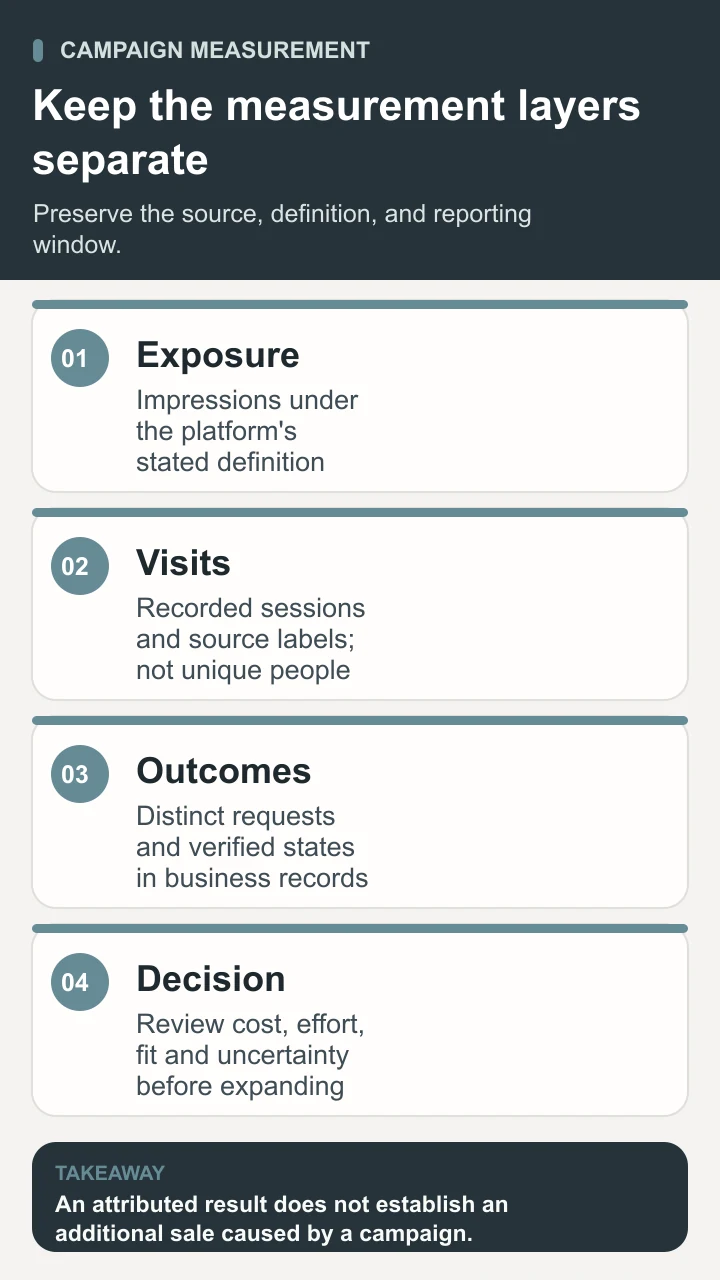
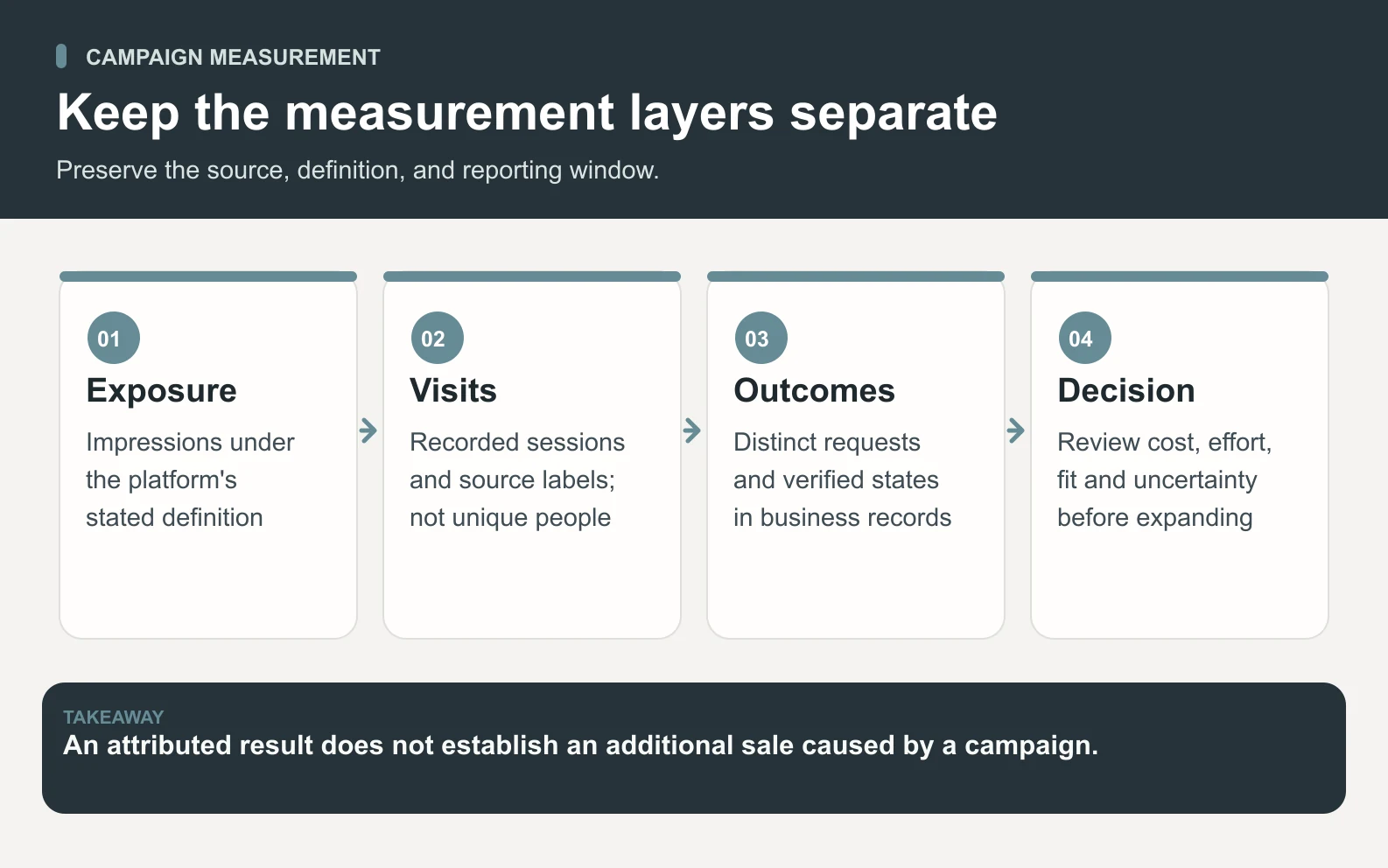
Keep the report's definitions beside its numbers. Search impressions, ad impressions, outbound clicks, website sessions, form submissions, and completed jobs describe different events. Preserve the reporting window and source system. Do not add visitors across channels as though every row represented a different person, or add requests across reports before checking the relevant identifiers.
Google Analytics documents campaign URL parameters for labelling referred traffic. Keep a consistent record of names such as utm_source, utm_medium, and utm_campaign, and test the destination you control. Those labels help interpret visits; they do not prove that a campaign caused a sale or resolve missing measurement on their own.
Combine the records with actual customer questions. If people understand the page but the owner cannot respond promptly, the next problem may be capacity. If suitable visitors abandon a confusing request, inspect that step before buying more attention. Keep uncertainty visible and change one meaningful part of the path when possible so the next review has a clearer question.
Start digital marketing with a useful customer task and a path the business can fulfil. Choose a few channel roles, check the destination, and reconcile the pilot with real operating records. Use the worksheet to decide what to maintain, what to revise, and what evidence is still missing before expanding.
Sources and review notes
Reviewed against the linked primary sources on the checked dates. Search features and citations are selected by their respective platforms; no placement is guaranteed.
Frequently asked questions
What is digital marketing in simple terms?
Digital marketing is the use of online channels and digital experiences to help people discover, understand, and act on an offer. It can include a website, search, useful content, email, social activity, and paid placements. A practical starting point is one customer question, a clear destination, and a way to compare activity with verified outcomes. The combination depends on the business and its audience.
Which channel should a small business start with?
Start with the customer task and the destination needed to support it. Then choose a channel that can reach suitable people and that the business can maintain. Existing customer questions, relevant search data, current relationships, and available expertise can inform the choice. Set a capacity and spending boundary rather than assuming the most popular platform is the best first channel.
How is this different from a marketing plan?
Digital marketing describes the online channels, assets, and customer experiences used in the work. A marketing plan records the wider audience, offer, goals, priorities, owners, budget, and review process. Use this guide to understand and connect channel roles; use the marketing-plan worksheet to document the overall business decisions and compare digital activity with other priorities.
Do more impressions or clicks mean more sales?
Impressions and clicks describe activity at particular stages. They do not establish that the audience was suitable, the destination worked, or a sale occurred. Compare them with requests, approved outcomes, completed work, revenue, costs, and human effort under stated definitions. Explain missing data and avoid treating an attributed result as proof of an additional sale caused by the campaign.
Can AI prepare the campaign?
AI can organize approved inputs, compare channel options, draft useful copy, and prepare a reporting template. In Space Office, Oxygen and Nitrogen prepare scoped work while Hydrogen coordinates and reviews it. Humans provide and verify the business facts and make the final decisions about claims, access, spending, publication, and customer responses. The team does not automatically receive access to advertising, analytics, or sending accounts.