Guide
B2B Marketing: Strategy, Channels, and a Worked Example
Build a B2B marketing approach that helps a business buying group understand the problem, check your evidence, and agree on a sensible next step.
By the Space Office team · Published · Updated · 16 min read
B2B marketing is the work of helping one business discover, evaluate, and choose another business’s products or services. Start by defining the kinds of organizations you can serve, the buying situation, the people involved, and the evidence they need. Then choose suitable channels, useful content, an owned sales handoff, and clear measurements. In Space Office, Oxygen can prepare the strategy and sales-enablement brief, while Nitrogen drafts the supporting copy. Hydrogen coordinates and reviews their output; a human verifies claims, approves access and spending, and makes the final publication and commercial decisions.

Key takeaways
- Define fit at the organization level, then understand the people who influence the purchase.
- Prepare evidence for different buying questions; one lead record rarely describes the whole decision.
- Choose channels for the actual buying situation and useful destination, not a universal platform ranking.
- Give marketing and sales a shared definition of a suitable enquiry and the next step’s owner.
- Report people, accounts, meetings, proposals, and revenue as distinct units with explicit observation windows.
Download the free B2B marketing worksheet to map account fit, buyer questions, proof, channels, and handoffs. The commercial lighting maintenance provider, retail-chain pilot, and counts below are fictional. They teach planning and measurement; they are not customer results. For the broader choices about whom to serve and how to compete, start with the marketing strategy guide.
What B2B marketing means in a real buying decision
The business customer is an organization, but people still make the decision. A store manager may notice a recurring lighting issue, an operations lead may compare service coverage, and a budget owner may approve an agreement. The marketing task is to help those people understand the offer and assess whether it fits. The exact roles depend on the company and purchase.
LinkedIn’s B2B marketing overview describes promotion to companies and organizations and highlights education, relationships, and agreement across buying groups. Use that as a starting point, not a reason to assume every purchase has a large committee or a long sales cycle. A small repeat order and a new multi-site service arrangement can require very different levels of evaluation.
Scroll horizontally to view all columns.
| Buying context | Who receives the offer | What the marketing must help explain |
|---|---|---|
| B2B | A business considering a product or service for its operations | Operational fit, evidence, stakeholders, purchasing steps, and continuing support. |
| B2C | A person buying for personal or household use | Personal fit, experience, price, convenience, and the purchase conditions. |
| Business with both | Different audiences buying from the same provider | Which offer and decision route apply to the current situation. |
The same company may serve both contexts. A lighting provider might sell individual items to household customers and maintenance services to retailers. The business offer should have its own scope and route to enquiry when those needs differ. Avoid sending every visitor to a general page that leaves a retailer guessing whether multi-site work is actually available.
Keep marketing and sales connected without collapsing them into one task. Marketing can help buyers discover the provider and understand its evidence. Sales can clarify the specific need and agree on a suitable next step. Delivery must then fulfil the approved scope. A persuasive page that creates expectations the service team cannot meet damages that entire chain.
Define account fit before collecting more contacts
An ideal customer profile is a working description of the kinds of organizations the business can usefully serve. Begin with operational facts: industry, service area, number or type of sites, relevant need, and delivery requirements. Include only criteria that affect fit. A long list of company attributes is less useful than a short set that changes whether the provider should accept the work.
For the fictional provider, a first focus might be independent retail chains with three to ten stores inside its current coverage area. The owner must verify that the team can support the relevant sites and service scope. The example does not establish that those chains have demand, budget, or a current project. It defines the group the team intends to investigate.
- 1Write the business problem and the situation that makes it relevant now.
- 2List the organization characteristics required for competent delivery.
- 3Name exclusions, such as locations or service requirements the team cannot support.
- 4Record the evidence for each criterion and identify what remains a hypothesis.
- 5Distinguish an observable trigger from an inferred purchase intention.
- 6Agree how sales will confirm fit and record a reason when an enquiry is unsuitable.
A trigger could be a buyer describing a change in store operations or asking how the provider handles multiple locations. A job title or a page visit alone is not proof that an organization is buying. Keep public company facts, directly stated needs, and inferred interest in separate fields. This helps prevent an attractive prospect list from becoming a collection of invented intentions.
Use the target audience guide to describe the buying situation and the market research guide to select evidence. If there are no customer interviews or approved sales records, make the first deliverable a research brief. Do not present an AI-generated profile as a validated market segment or assume a national company count equals reachable demand.
Map the buying group to questions and proof
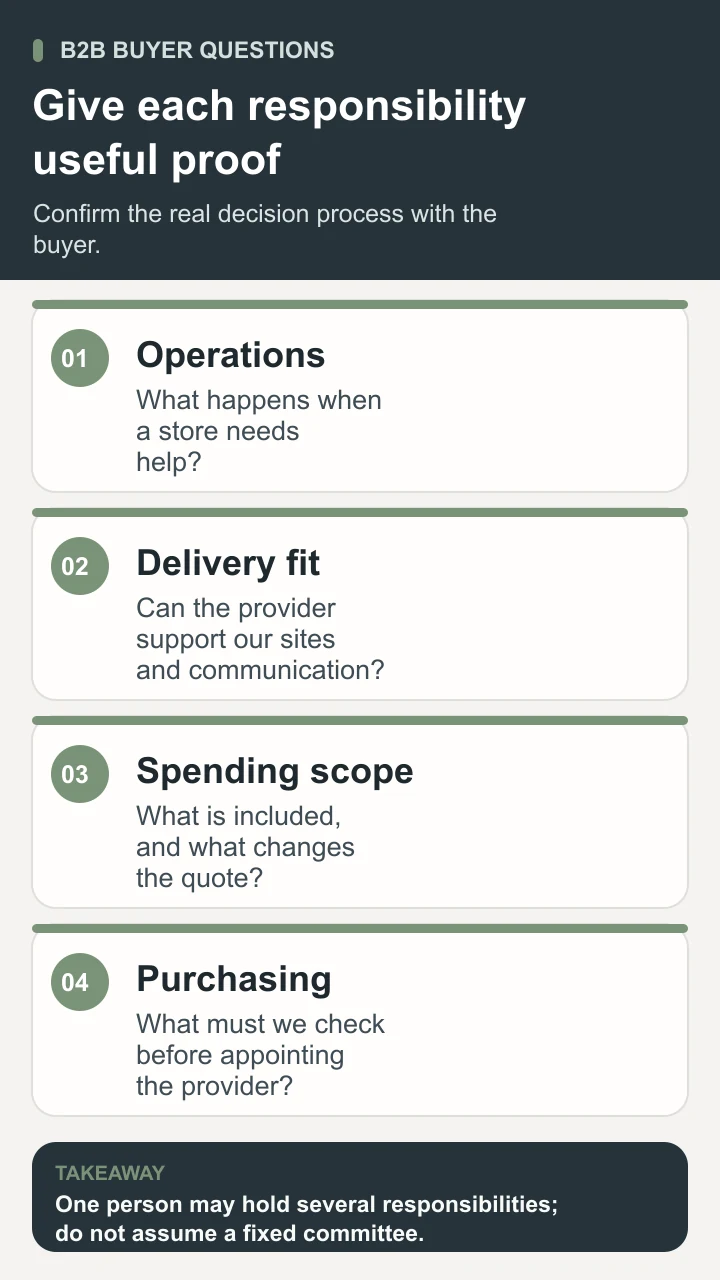
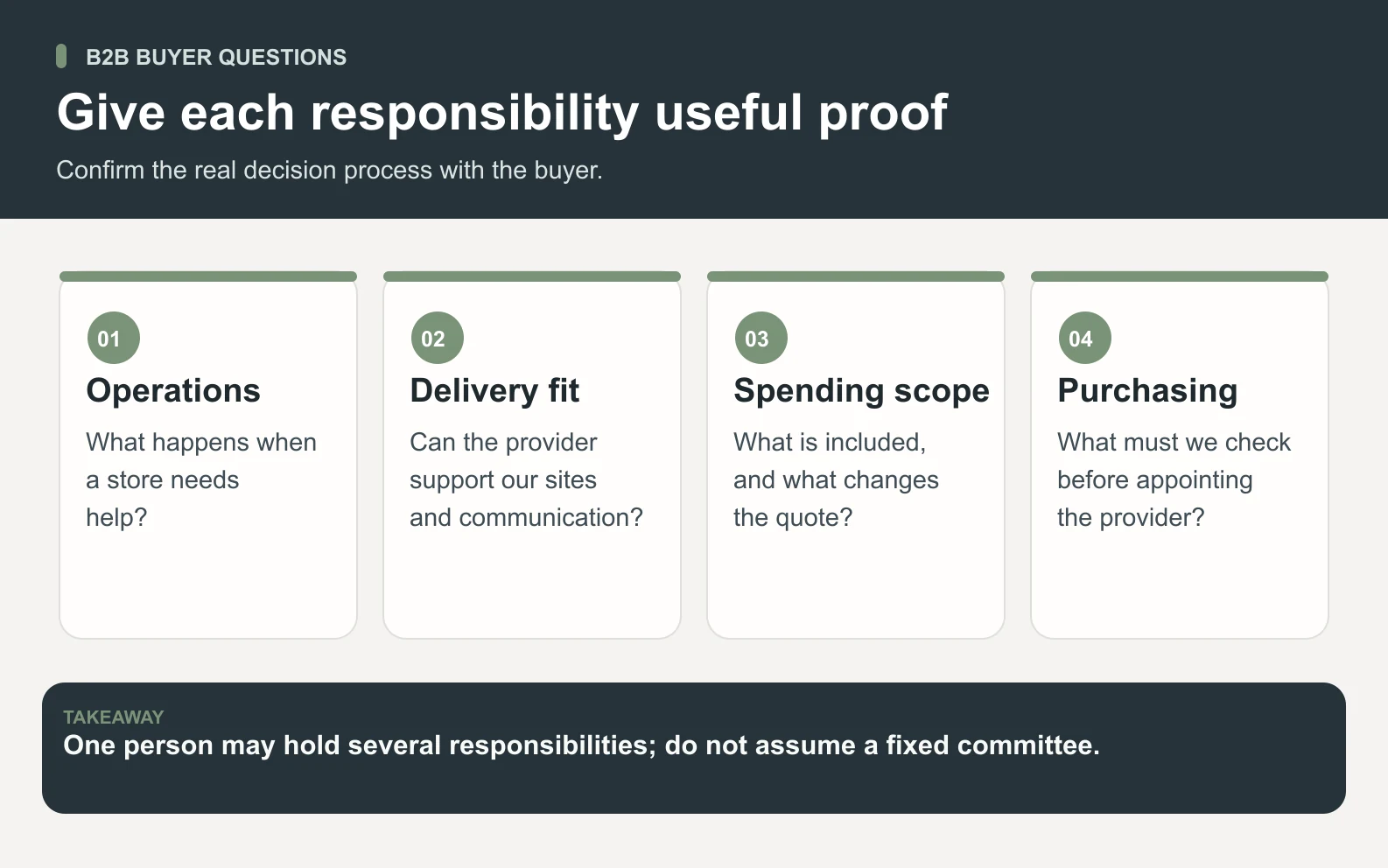
Identify responsibilities before job titles. Someone experiences the problem, someone evaluates delivery, someone checks spending, and someone may control purchasing requirements. One person can hold several responsibilities. Ask the buyer how the decision works rather than imposing a generic committee diagram. The goal is to prepare helpful information, not to collect every employee’s details.
Scroll horizontally to view all columns.
| Possible responsibility | Question to answer | Useful evidence or content |
|---|---|---|
| Store operations | What happens when a store needs help? | Owner-approved service process, coverage boundaries, and a clearly labeled sample report. |
| Multi-site coordination | Can information be organized across our locations? | A sample reporting structure and an explanation of who receives updates. |
| Budget approval | What is included, and what changes the quote? | Approved scope, exclusions, quote assumptions, and the route for clarifying costs. |
| Purchasing review | What do we need before appointing this provider? | Accurate company information and documents the provider can actually supply. |
Create a proof record for each material claim. If the page says the business serves a particular area, link that statement to the current operational boundary. If it shows a completed job, obtain the necessary permission and describe the actual work. If a report is invented to demonstrate its format, label it as a sample. Never turn an illustrative document into a customer case study.
Make the information easy to share internally. A concise service overview with a clear date, scope, exclusions, and contact owner can travel further inside a company than an unstructured sales conversation. Keep the essential explanation available without requiring an unnecessary form. Use an optional conversation for details that genuinely depend on the buyer’s sites or requirements.

For a small number of important organizations, account-based work may be appropriate. Salesforce Trailhead defines account-based marketing as a coordinated strategy across marketing, sales, and service around selected accounts and their buyers. It is a way to organize effort, rather than a software purchase by itself. Choose it when the potential relationship justifies the research and attention required.
Avoid confusing personalization with relevance. Repeating a prospect’s company name in generic copy adds little. Explaining which site requirements the provider can support, what remains to be checked, and how the buyer can assess the service is more useful. Public research cannot reveal every purchasing constraint. Keep a question open when only the buyer can answer it.
Choose channels that lead to useful evaluation
Channel selection starts with access to the audience and the buying task. Search can help someone already describing a problem. A relevant industry event can support conversations. A partner introduction may carry context and trust. Professional social content can make expertise visible. None of these is automatically the best channel for every business or a substitute for a clear offer.
Scroll horizontally to view all columns.
| Route | Useful first asset | Next action to own |
|---|---|---|
| Search and website | A page that answers the service question and states coverage and scope. | A fit-check request received by a named person. |
| Relevant partner | A concise description of suitable and unsuitable referrals. | An agreed introduction with the buyer’s context. |
| Professional social or event | A practical explanation or labeled sample that helps assess the problem. | An optional conversation or a useful ungated resource. |
| Approved email follow-up | An answer to a question the recipient actually raised. | A relevant next step with a clear response owner. |
Choose content by the question it resolves. A beginner explanation helps someone describe the problem; a sample service report helps someone assess communication; a scope sheet helps someone compare an offer. Publishing several similar awareness posts will not resolve a buyer’s uncertainty about coverage, appointment arrangements, or exclusions. Review the content set as an evaluation path.
For a first pilot, use a small set the team can maintain. The fictional provider prepares an accurate service page, a labeled sample report, and a fit-check outline. It discusses the offer with relevant existing referral partners and responds to suitable enquiries. Any advertising budget, account connection, or outbound campaign requires its own owner-approved scope; this article does not assume those actions are already authorized.
Follow the appropriate communication rules and the recipient’s preferences for the actual market and channel. Keep opt-outs and existing customer commitments visible in the operating process. This planning guide does not establish permission to contact a particular person. For preparing a useful permission-based campaign, use the email marketing guide; for the technical send path, use the separate deliverability guidance.
Build a focused pilot around one business problem
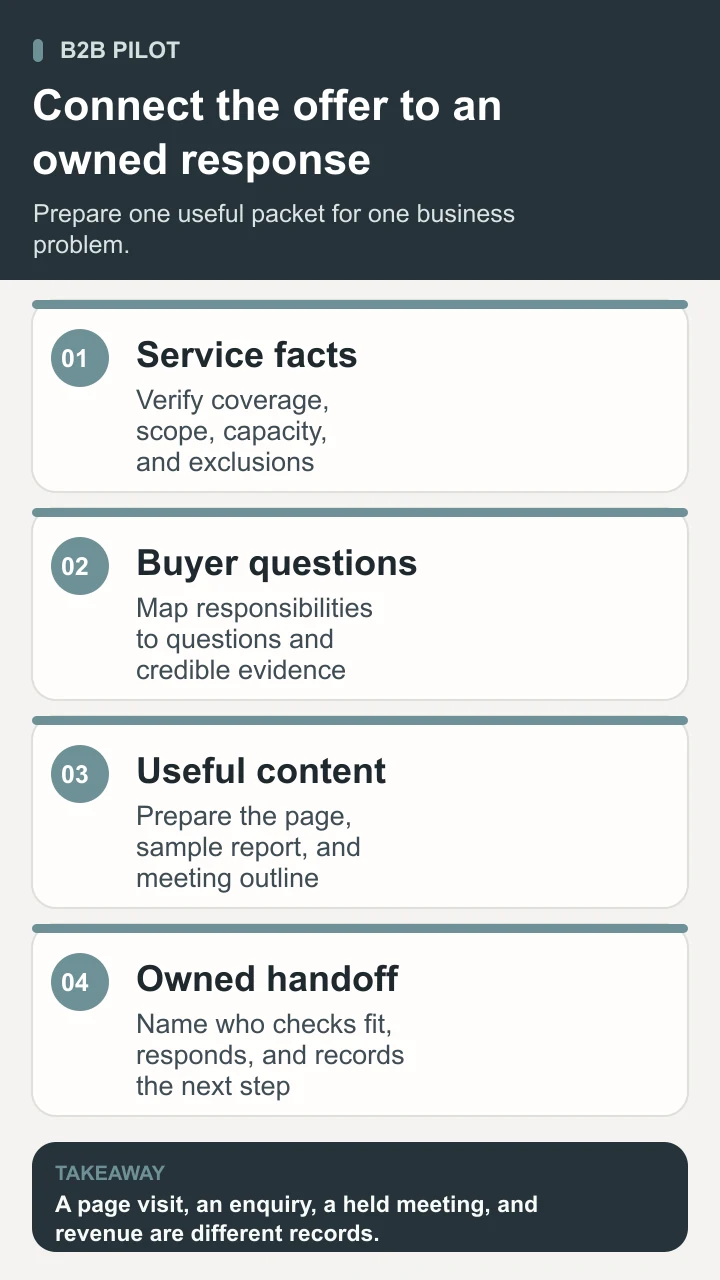
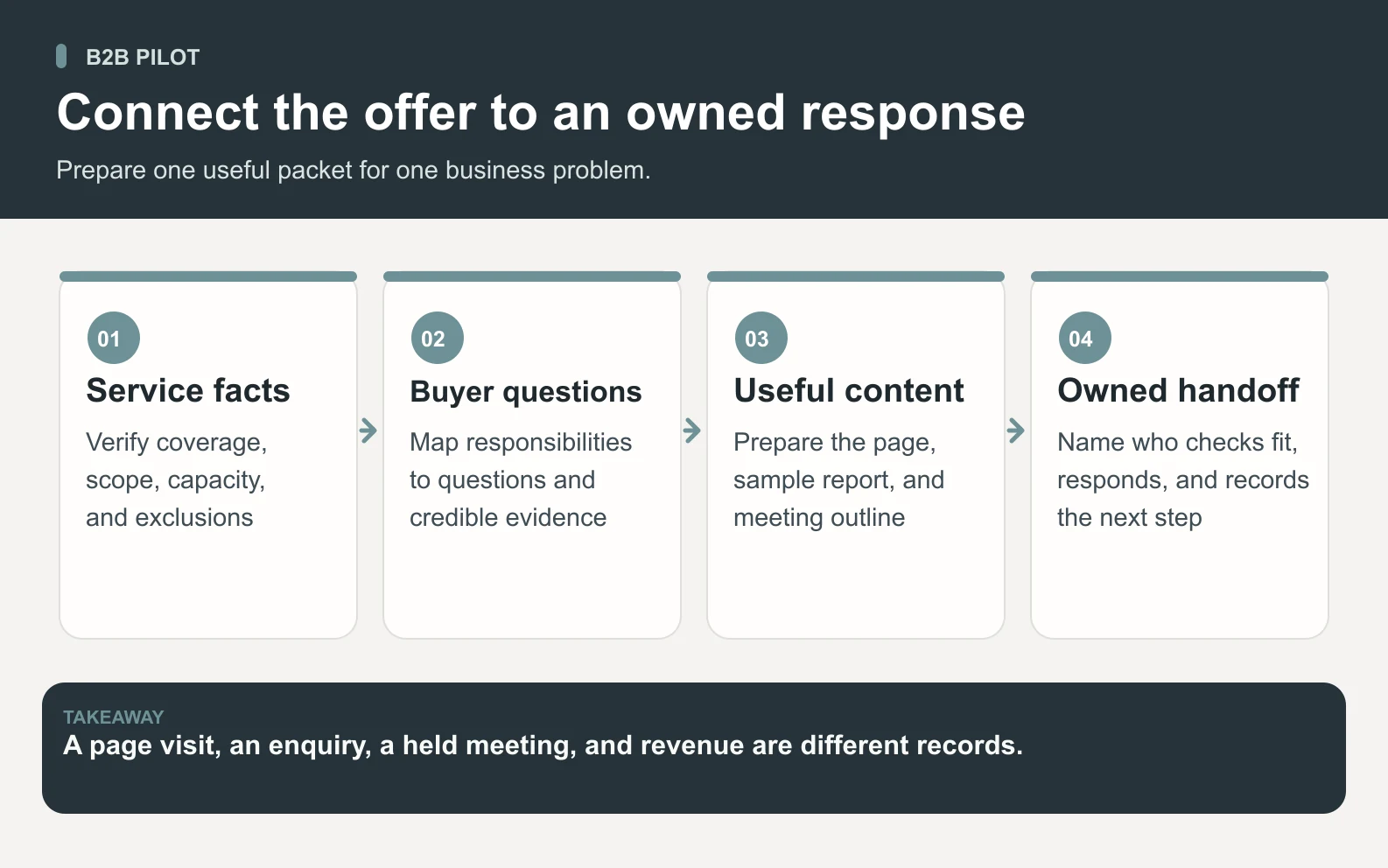
The fictional lighting provider chooses one planning question: can a clear multi-site service packet help suitable retail organizations assess the offer and request a useful discovery meeting? This is narrower than “generate more B2B leads.” It defines a customer task, a reviewable content set, and a next action. It also leaves room for buyers to conclude the service is unsuitable.
- 1Confirm the service owner’s coverage, capacity, scope, exclusions, and quote process.
- 2Describe the target account group and check the evidence behind its fit criteria.
- 3List buyer questions and create the service page, sample report, and meeting outline.
- 4Choose the initial routes to the material and assign an enquiry response owner.
- 5Test the page, form, confirmation, internal notification, and fallback contact route.
- 6Record enquiries, fit decisions, meeting outcomes, unresolved objections, and the review date.
Set acceptance criteria before writing. The page must accurately explain the offer; the sample must clearly say it is a sample; the form must request only what is needed for a first fit check; and the reply must state what happens next. The owner should be able to review each item without reconstructing the entire campaign from chat messages.
Use a four-week period for this illustrative preparation-and-enquiry pilot, with a later cutoff for meeting outcomes where needed. The period is a planning choice, not a claim about a typical sales cycle. A service agreement may take longer to evaluate. Record what is still open when the review ends, rather than declaring every unresolved account lost.
Budget for the work as well as any media. Research, writing, review, enquiry handling, sales calls, and maintaining the sample documents consume time. If a route brings more requests than the team can respond to, the operating limit matters more than the traffic total. Decide who can reduce activity or update availability before the pilot begins.
Give marketing and sales a shared handoff
Define a suitable enquiry using facts the receiving person can check. For this example, it could mean an organization in the approved service area, a stated need within scope, and enough information to arrange a fit conversation. That is different from a newsletter signup, an anonymous visit, or a guessed intent score. Use the lead generation guide for the broader enquiry process.
A handoff record should contain the organization, source if known, stated problem, relevant locations, fit evidence, unresolved questions, prior promises, and next-step owner. Include only information needed for the task. Sales should not need to ask the buyer to repeat facts already provided, and marketing should not turn an unanswered assumption into a promise of acceptance.
Agree what happens when the enquiry does not fit. The receiving person might explain the coverage limit, ask a clarifying question, or close the request with a clear reason. That feedback helps improve the page and targeting. Rejection is not automatically a marketing failure; an accurate boundary can save time for the buyer and the provider.
For a Space Office preparation workflow, give Oxygen the approved offer, fit criteria, buyer questions, constraints, and source evidence. Oxygen can prepare strategy and sales-enablement structure. Nitrogen can draft the service overview, sample explanations, and response copy from those approved facts. Hydrogen coordinates and reviews the packet. A person verifies claims and decides what can be published or sent.
Ask for a deliverable with explicit gaps: the buyer-question map, draft content, a handoff template, and a review checklist. The specialists do not automatically know the company’s contracts, connect its CRM, access private buyer information, or authorize outreach. Check the agent directory and workflow overview, then discuss the bounded setup through contact.

Measure accounts and outcomes without mixing units
Choose the counted unit before calculating a rate. Several people may work for one company, and one company may have several sites. A contact total, account total, store total, and enquiry total answer different questions. Deduplicate accounts using a documented rule and keep a correction log when records are merged. Do not divide meetings from one group by visits from another and call it an account conversion rate.
Consider a fictional entry cohort of 20 distinct organizations that submitted a fit-check enquiry during days 1–28. Review their outcomes through day 56. Twelve meet the agreed fit criteria; eight of those same twelve hold a discovery meeting by the cutoff. The four suitable accounts without a completed meeting remain separately labeled with their observed status, such as scheduled, deferred, or no response.
Scroll horizontally to view all columns.
| Measure | Fictional calculation | What it can establish |
|---|---|---|
| Suitable account share | 12 suitable / 20 enquiring organizations = 60% | Fit among this defined enquiry cohort, under the stated criteria. |
| Meeting rate among suitable accounts | 8 meetings held / 12 suitable accounts = 66.7% | Completed-meeting progression among the suitable accounts by day 56. |
| Overall enquiry-to-meeting rate | 8 meetings held / 20 enquiring organizations = 40% | Progression to a held meeting within this entire cohort and cutoff. |
| Sales or revenue result | Not available in this example | A meeting or proposal does not establish an accepted agreement or recognized revenue. |
Google’s campaign URL guidance explains how source, medium, and campaign parameters identify tagged traffic in Analytics. Use consistent names when those links fit the route. Keep web traffic reporting separate from the matched account cohort. Missing tags, shared materials, and offline conversations can leave source information incomplete; mark it unknown instead of assigning credit to the most convenient campaign.
Review both the counts and the reasons. If many unsuitable organizations enquire, check whether the scope or coverage is unclear. If suitable accounts cannot arrange a meeting, check scheduling and response ownership. If meetings reveal the wrong buyer problem, revisit the offer. These observations suggest the next investigation; a before-and-after change alone does not prove the marketing caused an outcome.
Make B2B marketing easier for the buying group
Good B2B marketing gives suitable organizations a clear way to understand the offer, inspect credible evidence, involve the right people, and decide on the next step. Start with one buyer problem, one realistic account group, and a content set your team can maintain. Keep delivery limits and unresolved questions visible so the decision remains useful even when the answer is no.
Use the worksheet to connect account fit, buyer responsibilities, proof, channels, and the sales handoff. Agree on the record definitions before the pilot and keep open outcomes open at the cutoff. If your next task is implementing the wider direction, the marketing plan guide can turn those choices into owned work, resources, and a review schedule.
Sources and review notes
Reviewed against the linked primary sources on the checked dates. Search features and citations are selected by their respective platforms; no placement is guaranteed.
Frequently asked questions
What is B2B marketing?
B2B marketing is the practice of helping businesses discover, evaluate, and choose products or services from other businesses. It includes defining suitable organizations, understanding the people involved in the purchase, preparing useful evidence and content, selecting channels, and coordinating the next step with sales and delivery. Its format should match the actual buying situation rather than assume every purchase follows the same process.
How is B2B marketing different from B2C marketing?
The main distinction is whether the customer is an organization or a person buying for personal use. A business purchase may involve operational requirements, several responsibilities, and a purchasing process, but the complexity varies. Avoid assuming that business buyers are purely rational or that all consumer purchases are simple. Prepare the information the actual people need to make their decision.
Which channels work best for B2B marketing?
There is no universal channel winner. Search, a useful website, professional social content, industry events, partners, and appropriate email can serve different buying tasks. Choose based on where the intended audience can be reached, what evidence it needs, and whether your team can handle the response. Evaluate a manageable pilot using consistent definitions and business outcomes alongside traffic.
What should a small B2B business prepare first?
Prepare a clear description of suitable accounts, an accurate offer page, evidence for material claims, a useful sample or explanation, and a named enquiry response owner. Confirm the handoff and test the contact route. When customer evidence is missing, start with research and label the assumptions. Buying more software or adding more channels will not resolve an unclear offer.
Can AI help with B2B marketing?
AI can organize approved inputs, draft a buyer-question map, and prepare content and handoff documents. In the Space Office example, Oxygen supplies strategy and sales-enablement structure, Nitrogen drafts copy, and Hydrogen coordinates and reviews. The human owner checks facts, fit, access, spending, publication, and commercial commitments. AI-generated interest scores or invented customer proof do not establish a real buying opportunity.