Guide
Public Relations: What It Is and How to Plan Useful PR
Build public relations around a real audience need, inspectable evidence, relevant relationships, and a clear plan for questions and corrections.
By the Space Office team · Published · Updated · 17 min read
Public relations is the planned work of listening, sharing reliable information, and building relationships between an organization and the people who affect or are affected by it. Begin with a communication need, check the evidence, prepare a useful explanation, and respond responsibly to questions. In Space Office, Silver can research media fit and prepare the communications packet while Nitrogen drafts supporting copy; Hydrogen coordinates and reviews their work. A human verifies the facts, approves contact and publication, and remains responsible for commitments and corrections.

Key takeaways
- Start with the people who need information and the decision or misunderstanding the communication should address.
- Make the story useful through verified facts, appropriate sources, and an honest explanation of its limits.
- Keep a prepared pitch, a published announcement, independent coverage, and business outcomes in separate records.
- Research relevant recipients and preserve their freedom to question, decline, or report independently.
- Assign an owner for factual approval, questions, changes, and corrections after publication.
Download the free public relations worksheet for an audience question, story-evidence record, media packet, recipient-fit log, and evaluation sheet. The fictional tool-library example below shows how to use those records. When the task specifically needs an announcement document, use the separate press release template.
What public relations does and does not control
A business has relationships with more people than potential buyers. Employees need accurate explanations of a change. Neighbours may need to understand a new event. Customers need a clear answer when a service changes. Journalists need evidence and access to appropriate sources. Public relations connects the organization's explanation with those people's information needs and gives the organization a way to listen and respond.
PRSA's description of the profession places communication and relationships at its centre. Media relations is one part of that work. Writing an announcement, preparing a spokesperson, answering a community question, and correcting an inaccurate claim can all serve a communication objective. The useful output depends on what people need to understand, not on how many press releases the team can produce.
Scroll horizontally to view all columns.
| Work | What the organization can prepare | What remains outside its control |
|---|---|---|
| Media relations | A relevant story, factual materials, a suitable source, and a clear response | Whether a journalist investigates, publishes, links, or agrees with the organization |
| Owned announcement | The wording and evidence on its own approved website or account | How every reader interprets it or whether anyone repeats it |
| Paid placement | An agreed advertisement or sponsored deliverable under its terms | Independent editorial endorsement or a guaranteed business result |
| Community communication | A useful explanation, a listening route, and a named response owner | Agreement from every participant or the absence of criticism |
Keep paid activity visibly distinct from independent reporting. Buying a placement does not make it an editorial recommendation. Likewise, sending a pitch does not create a relationship or an obligation to cover the story. The team should describe what it can prepare and verify without promising favourable coverage, a backlink, or a change in public opinion.
Start with the public and the communication need
Write down who needs information and why now. For a community tool library opening a repair clinic, nearby residents may need to understand what can be repaired, who can attend, and how capacity is managed. A local reporter may need to know what is new, how it affects residents, and which facts can be independently checked. Those audiences overlap, but they need different explanations.
Name a specific communication objective. For example, help eligible residents understand the clinic's scope and route suitable questions to the organizer. That is more useful than a vague ambition to get publicity. Choose an observable sign of understanding, such as whether enquiries ask about the correct service, while acknowledging that the available evidence may be incomplete.
Listen before drafting. Review relevant questions, permitted feedback, earlier misunderstandings, and the organization's actual operating decisions. A comment from one person is a question to investigate, not a representative survey. Keep disagreement visible and identify which concerns the organization can answer with evidence. If a concern exposes a real service problem, communication alone may not resolve it.
Define the response owner and the limits of the brief. Decide who can confirm operational facts, who can speak publicly, which information is confidential, and where a difficult question should go. A marketing writer should not invent a policy to complete a paragraph. The marketing plan guide can help connect this communication objective with the wider business priorities without turning every relationship into a sales target.
Build a story from evidence
Begin with the change that matters to the audience. A genuine opening, a documented finding, an independently checkable improvement, or a useful local event can provide a starting point. The organization still needs to explain the relevance. Calling an ordinary announcement revolutionary does not supply a reason for a reader or reporter to care.
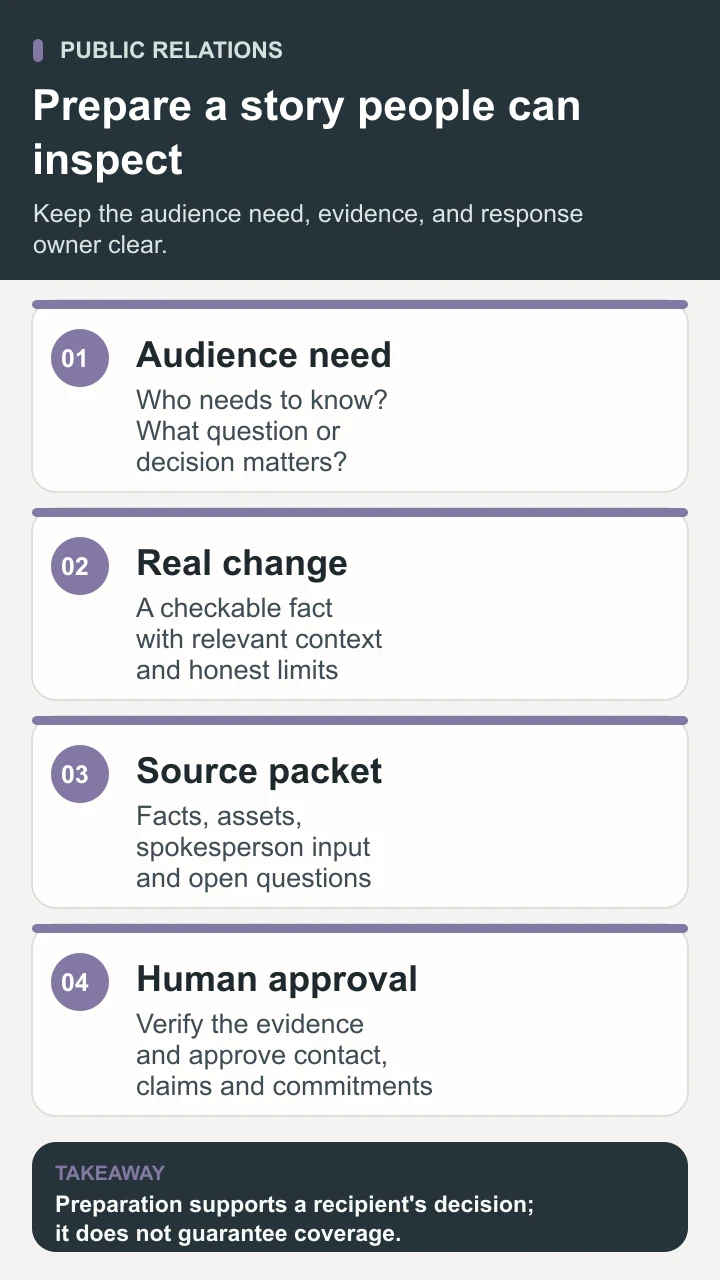
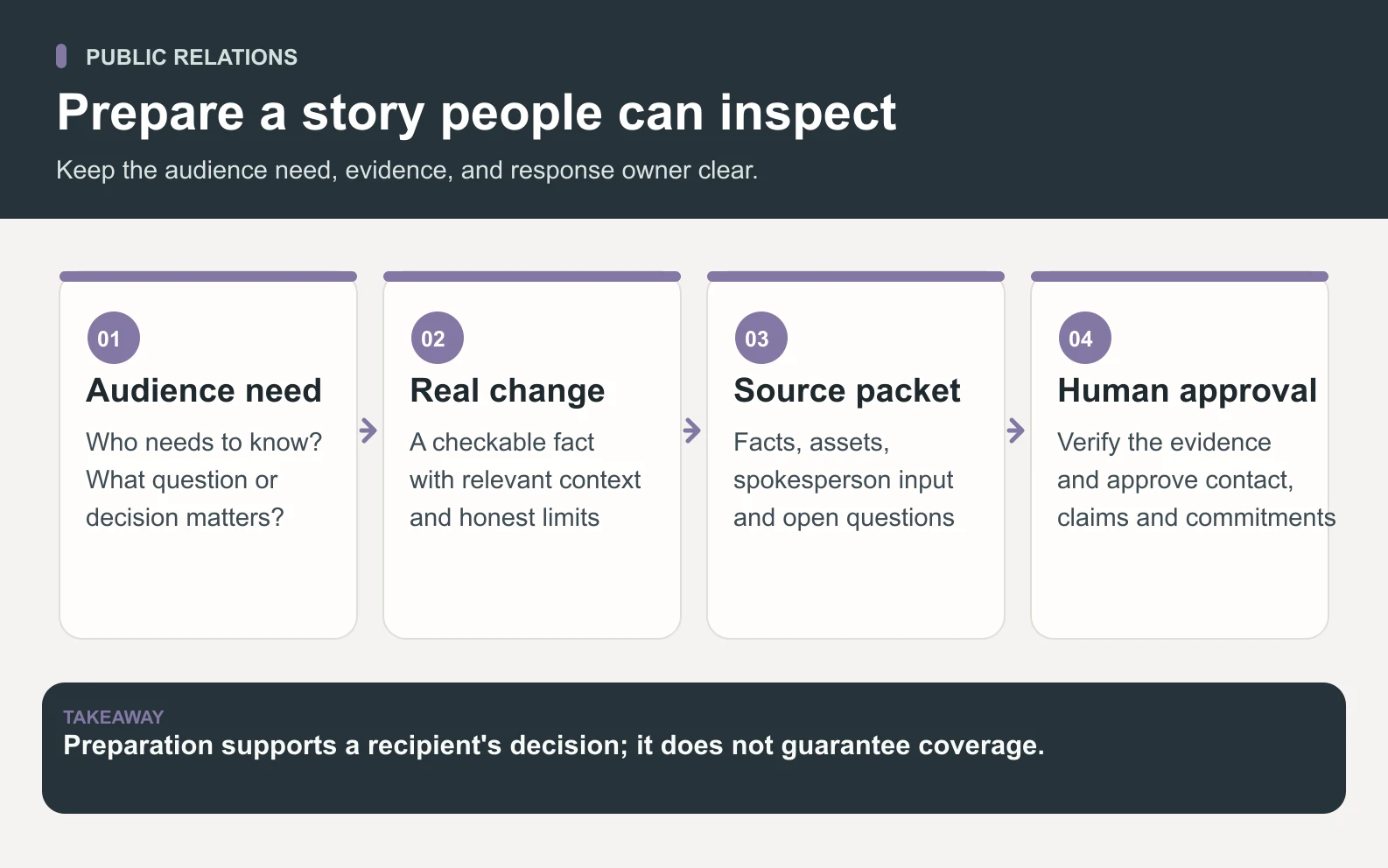
- 1State what happened or will happen. Separate a completed event from a proposal, target, or plan that still needs approval.
- 2Identify who is affected and what they need to understand. Keep the explanation tied to an actual task, consequence, or question.
- 3Attach a source to every important factual claim. Record the document, responsible person, checked date, and any relevant limitation.
- 4Test the proposed story against the evidence. Remove unsupported superlatives, unverified comparisons, invented experiences, and assumptions presented as facts.
- 5Assign unresolved questions. Hold the affected claim or asset until the human owner can provide an answer or approve an accurately limited explanation.
Use a claim record with three statuses: verified, proposed, and unresolved. For the clinic, the venue agreement might be verified while the number of repair stations remains proposed. A draft that quietly treats both as final creates avoidable confusion. Check photographs, captions, names, dates, capacity, and contact details against the same record so the packet does not contain several versions of the story.

Obtain real quotations from the person who is represented and have that person review the intended use. Do not manufacture a polished opinion and attribute it to someone because it sounds plausible. Use only photographs and materials the organization is permitted to share, with appropriate credits and restrictions. A source packet should make the evidence easier to inspect, not create an appearance of proof around an unsupported claim.
Prepare a media packet that answers practical questions
A small packet should let a recipient understand the story and find its evidence without navigating a large promotional archive. Start with a concise explanation of what changed, why it could matter to that recipient's audience, and whom to contact. Add supporting files because they answer a likely question, not because they make the attachment folder look impressive.
Scroll horizontally to view all columns.
| Packet item | Useful contents | Human check |
|---|---|---|
| Story note | A short explanation of the change, relevance, and current status | The proposed angle is accurate and does not promise independent interest |
| Fact sheet | Names, scope, timing, location, limitations, and source references | The operational owner confirms the current version |
| Supporting material | Relevant photographs, documents, captions, credits, and usage notes | The organization has permission to share the actual files |
| Spokesperson brief | Verified talking points, likely questions, and an escalation route | The speaker supplies their real experience and approves attributed words |
| Response details | A named contact, availability, and ownership of open questions | Someone can provide a reliable answer within the stated availability |
Link to the current packet and give each substantive revision an owner and date. If a venue or service detail changes, update the fact sheet, public page, response notes, and relevant recipients. Keep earlier versions where appropriate so the team can explain what was accurate at the time. Avoid asking a recipient to infer the authoritative version from several nearly identical attachments.
Use the press release worksheet for the announcement's format rather than forcing the whole packet into a long release. The release is a source document from the organization. It remains separate from a journalist's independent account, even when a news site republishes the wording. Record the actual type of placement before describing a result.
Approach relevant people and handle their questions
Build a short recipient list from current, relevant work. For each candidate, record the outlet, the subject they cover, a recent example, the audience connection, and an appropriate published contact route. An old directory entry or a large audience number is insufficient on its own. Keep unavailable information marked unknown instead of filling a contact record with guesses.
Draft a specific reason the story could help that recipient's audience. A local repair-clinic opening may fit a community reporter who covers neighbourhood services; it may be irrelevant to a national technology columnist. Personalization should explain the editorial fit, not imitate a relationship that does not exist. The human owner reviews the relevance and decides whether contact is appropriate.
Keep the first explanation concise and make the evidence easy to access. Offer the appropriate source and disclose whom you represent. Do not imply an embargo, exclusive, interview agreement, or publication commitment unless the relevant people have actually agreed to it. A proposed arrangement belongs in the owner's decision log until it becomes a real agreement.
When questions arrive, log the request, factual owner, deadline if one was stated, and status. Answer from verified information and say when an answer is not yet available. If the question exposes an error, correct the underlying record and the affected communication. Avoid repeatedly following up with someone who has declined or using an unrelated new detail to disguise the same unwanted pitch.
The PRSA Code of Ethics emphasizes accuracy, disclosure of represented interests, protection of confidences, and correction of erroneous communication. It is a professional code, and the owner must also consider the requirements relevant to the real activity. Use these principles as practical review questions: can the reader identify the source, inspect the important facts, and understand a material limitation?
Worked example: a community tool library explains a repair clinic
Imagine a fictional community tool library opening a small repair clinic. Every detail, count, cost, and result in this example is invented for a planning exercise. It is not a real organization, customer case, performance benchmark, or promise of coverage. The library wants residents to understand the clinic's repair scope and how to ask about a suitable item before attending.
The owner verifies the venue, available equipment, attendance process, and limitations with the operating team. The packet includes an approved fact sheet, a photograph of the workshop the library may share, a genuine spokesperson, and an enquiry route. Unsupported claims about waste prevented or money saved are left out because the library has no verified measurements for them.
Scroll horizontally to view all columns.
| Stage | Illustrative record | Interpretation |
|---|---|---|
| Recipient research | 12 candidate outlets; 7 fit the actual story and audience | Research output, with irrelevant candidates excluded |
| Approved contact | 5 individually reviewed pitches sent through appropriate routes | An activity record after the owner approved recipients and wording |
| Questions | 2 reporters request further information | A response to handle accurately, not a coverage commitment |
| Independent coverage | 1 independently reported story | A published output whose content the library does not control |
| Recorded follow-through | 36 referred visits and 4 distinct event enquiries | Separate observations with measurement limits, not proof of additional attendance |
| Preparation cash cost | $90 photographs + $60 fact-checking support = $150 | A stated partial cost; owner and spokesperson time remain unpriced |
The library also publishes three posts on its own account. Those are owned outputs and remain separate from the one independent story. It cannot add the outlets' potential audience estimates and describe the sum as people who read the story. It also cannot claim the four enquiries were caused entirely by that coverage: people may have encountered several sources, and some may have intended to attend already.
The review identifies a useful problem: two enquiries assume the clinic accepts a repair category outside its scope. The owner checks where that ambiguity appeared, clarifies the fact sheet and public page, and answers the people affected. That correction may be a more valuable next action than increasing pitch volume. The objective concerns accurate understanding and suitable participation, not the largest possible announcement count.
Prepare the work with Space Office
Scope a communications preparation packet: a story-evidence note, a relevant media shortlist, a fact sheet, an optional pitch draft, and a question-and-correction log. Supply approved operational facts, permitted research, actual spokesperson input, shareable assets, contact boundaries, and the name of the final reviewer. Identify confidential material and unresolved decisions before asking for a polished draft.
- 1Silver, the PR & Communications Specialist, researches media fit, prepares the story angle and briefing packet, and identifies source gaps and likely questions.
- 2Nitrogen, the Content & Copy Specialist, drafts supporting website or message copy from the approved evidence and agreed voice. It does not invent quotations or personal experience.
- 3Hydrogen coordinates the work and reviews the handoffs against the objective, evidence, and requested format. Missing facts and conflicting instructions return for clarification.
- 4The human owner verifies the facts, spokesperson words, recipient relevance, permissions, and final materials. The owner approves contact, commitments, publication, and any corrections.

Check the live specialist roster and how Space Office coordinates work before assigning the packet. Access to an inbox, media database, website, or social account requires the customer's authorized setup. A prepared list is not permission to send. The team cannot guarantee a journalist's response, editorial wording, publication, links, or public sentiment.
Measure public relations and maintain trust
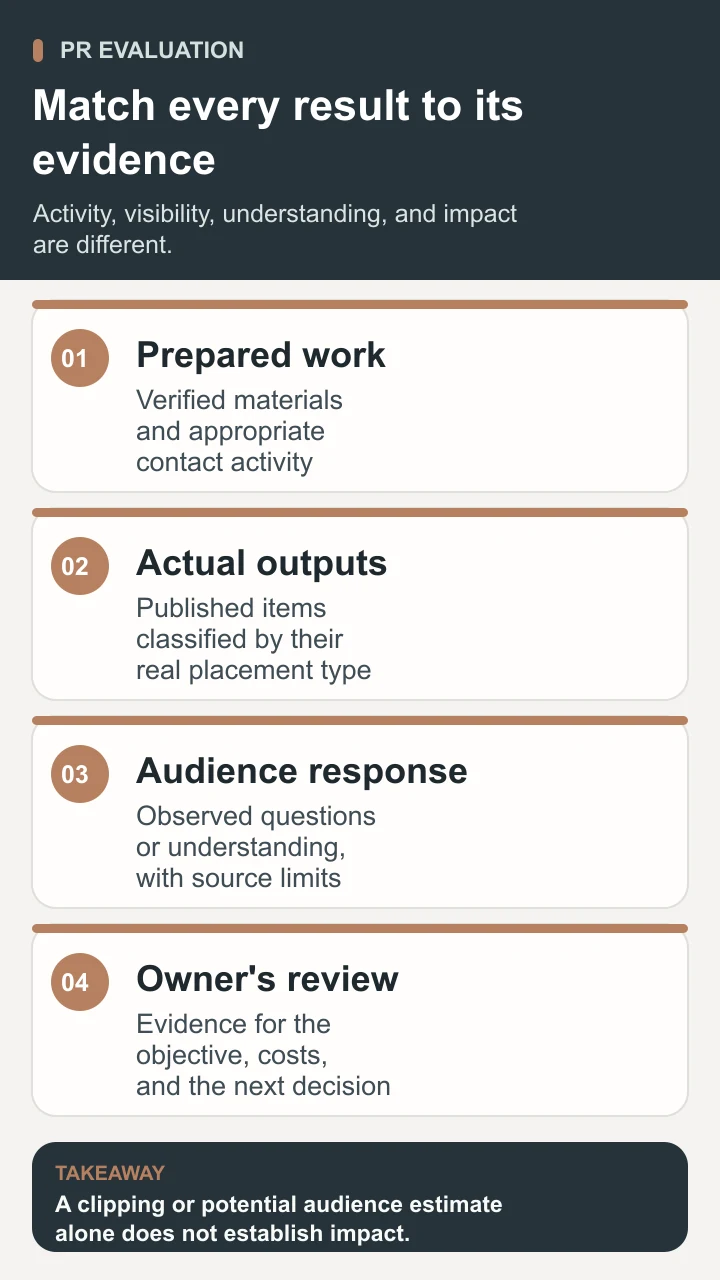
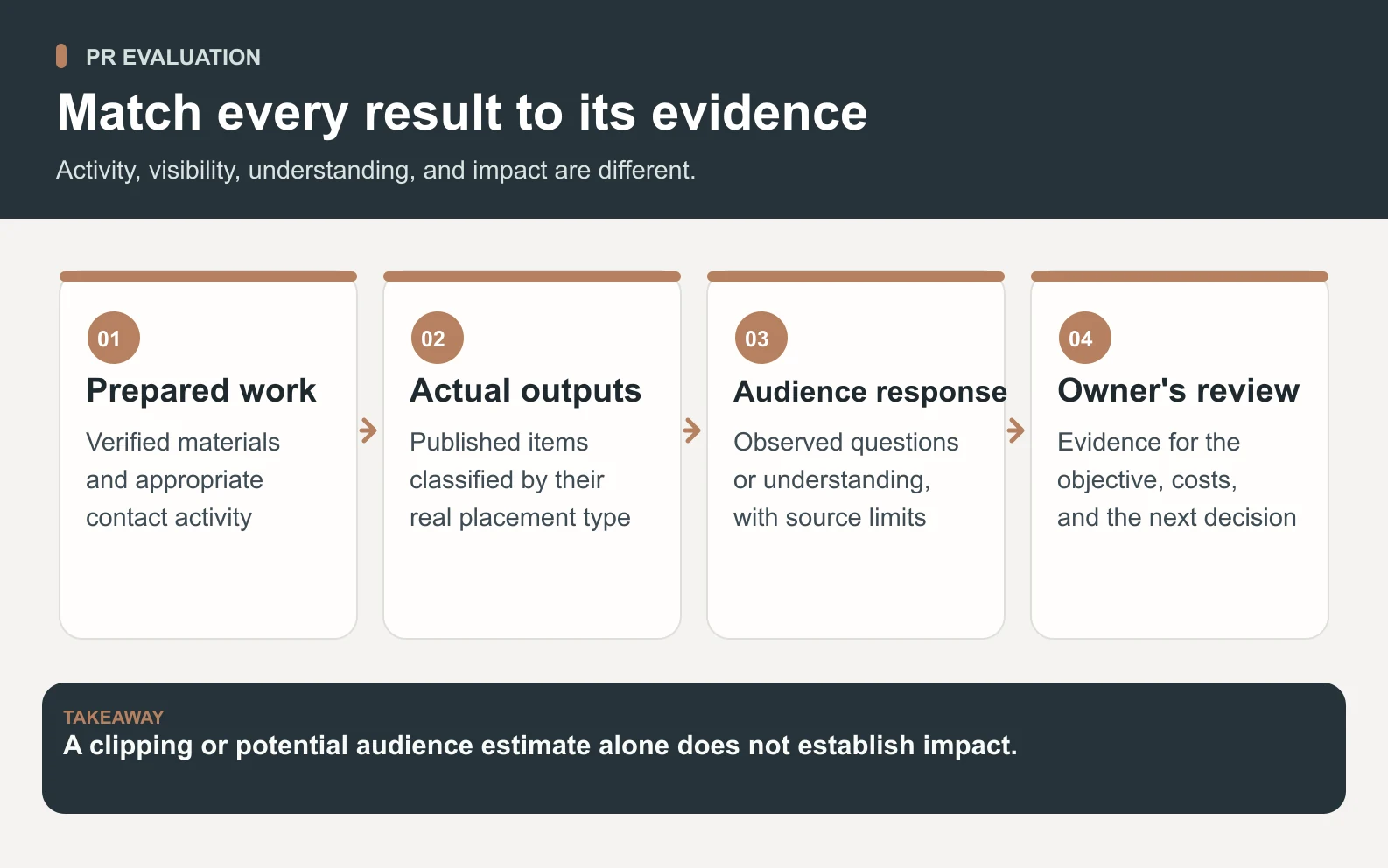
Plan the review before distribution. Record the objective, audience, starting evidence, work completed, actual responses, relevant questions, published outputs, costs, and limitations. Preserve source URLs and checked dates for coverage. Note whether an item is independently reported, republished material, owned content, or a paid placement instead of putting every appearance in a single success column.
AMEC's Integrated Evaluation Framework separates communication activity and outputs from audience response, outcomes, and wider impact. Apply that distinction to the actual question. A published article establishes a publication. Evidence that people understood a service boundary requires a different observation. A long-term change in trust or participation requires more evidence than a clipping or one referral report.
Read the coverage itself. Check whether the relevant facts and limitations are accurate, which questions remain unanswered, and whether a correction is needed. Use a documented, appropriate correction route when your information was wrong. An independent article can include criticism or context the organization did not request; that is different from a factual error.
Review the relationship work after the initial event. Keep current source materials, answer outstanding questions, and record what the team learned about audience needs. If the story lacks evidence or the organization cannot respond responsibly, narrow the scope or stop the proposed activity. Maintaining a useful, accurate public explanation can matter more than producing another announcement.
Start public relations with a real information need and facts you can defend. Prepare a useful story, approach relevant people respectfully, and keep an owner for questions and corrections. Use the worksheet to connect the objective, evidence, communication, and review before deciding what the next relationship or campaign needs.
Sources and review notes
Reviewed against the linked primary sources on the checked dates. Search features and citations are selected by their respective platforms; no placement is guaranteed.
Frequently asked questions
What is public relations in simple terms?
Public relations is the work of building understanding and relationships between an organization and its audiences through truthful communication, listening, and follow-through. It can include media relations, community explanations, spokesperson preparation, and responses to questions or errors. The useful task depends on what people need to understand and what the organization can support with reliable information.
Is PR the same as advertising?
Advertising involves a paid placement or agreed promotional deliverable. Public relations includes broader relationship and communication work, including preparing information for independent journalists and responding to audiences. A paid appearance should remain identifiable as paid activity. A journalist controls their own editorial decision; preparing a pitch does not purchase favourable coverage, a link, or a business result.
Does a small business need a press release for every story?
Choose the format that helps the recipient understand the information. A concise story note, fact sheet, source interview, community explanation, or announcement may fit different needs. A press release can organize a verified announcement, but it is only one source document. Keep the audience question, evidence, and response owner clear before choosing a format or deciding whether the story should be shared.
How should you evaluate a PR campaign?
Compare the work with a stated communication objective. Separate materials prepared, actual contact, published outputs, audience questions or understanding, and evidence of wider outcomes. Record costs, human effort, source definitions, and missing information. Do not treat potential audience estimates as confirmed readers or assume that a visit, enquiry, or change in sentiment was caused entirely by one piece of coverage.
Can AI prepare public relations work?
AI can organize approved research, propose relevant media candidates, draft factual materials, and prepare a review log. In Space Office, Silver and Nitrogen prepare scoped work while Hydrogen coordinates and reviews it. Humans supply real experience, verify facts and quotations, approve recipients and permissions, and control contact and publication. AI preparation cannot create an independent endorsement or replace responsibility for corrections.